
TRT
October 16, 2026
Better libido does not necessarily mean better erections on TRT
On this page
You feel interested in sex again. You initiate affection more often, and the sense that something has gone missing begins to lift. Yet getting or keeping an erection is still unreliable. Has testosterone treatment worked, failed, or simply addressed one part of the problem?
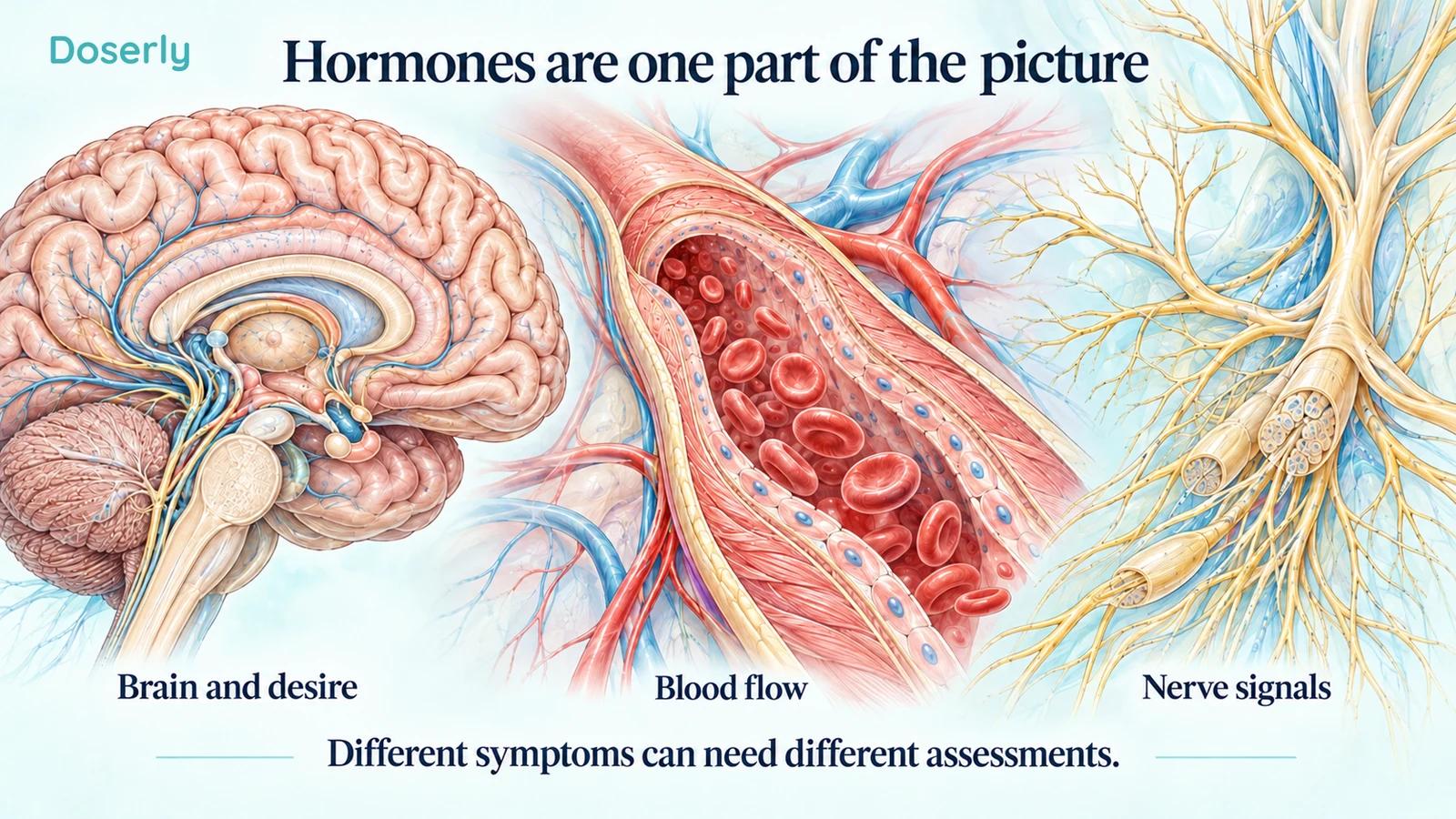
That is a more useful question than whether TRT “improves sexual function.” Sexual function covers several experiences, and a treatment can help one without resolving the others. The distinction matters both when reading research and when describing your own response. A conversation that begins with “my libido improved, but my erections did not” gives a clinician more to work with than either “TRT fixed me” or “nothing happened.”
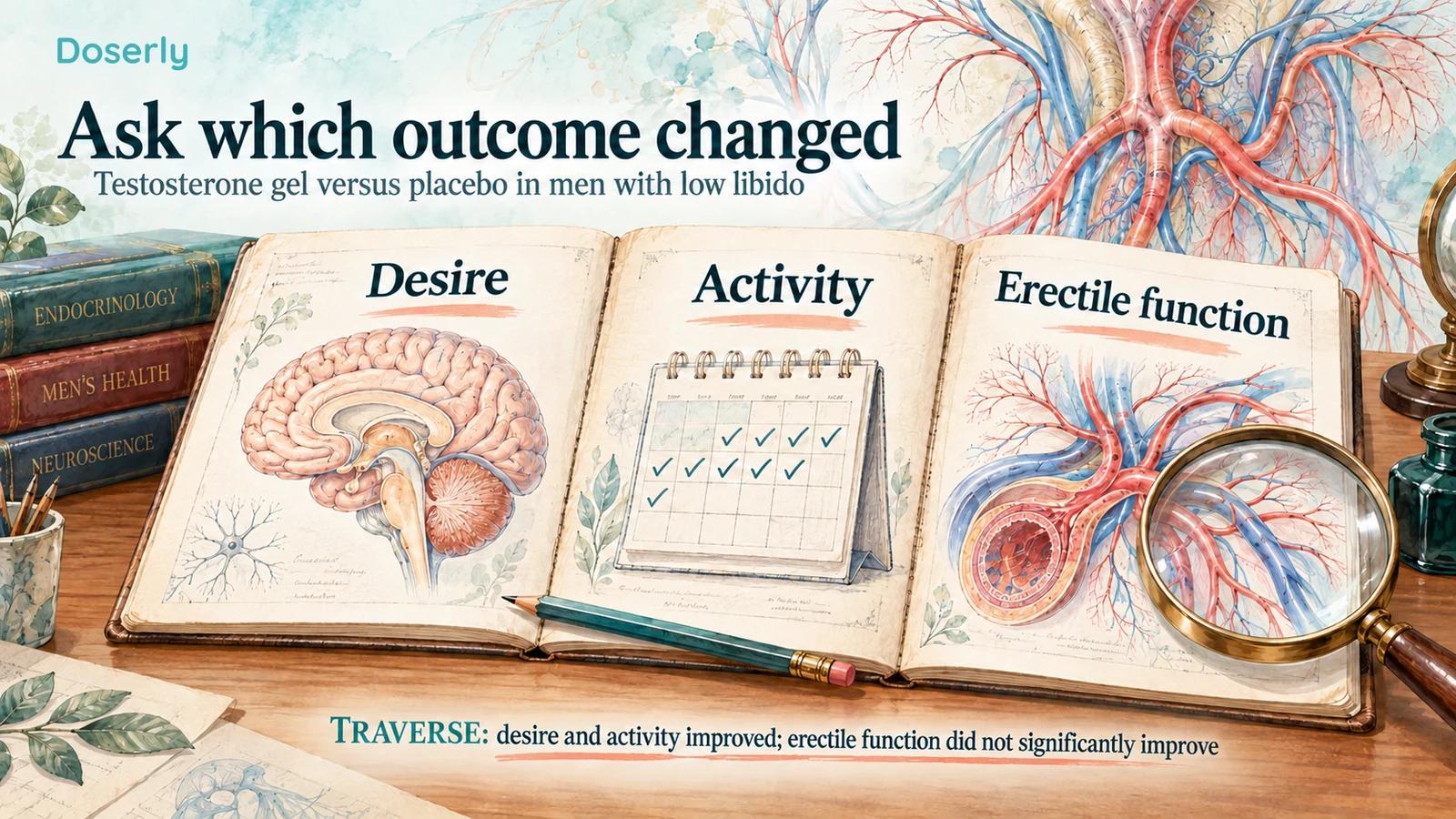
In the TRAVERSE sexual-function study, testosterone gel improved desire and activity compared with placebo, but it did not significantly improve erectile function. That finding supports a real, limited benefit; it does not establish testosterone as a general treatment for every sexual difficulty. TRAVERSE sexual-function trial
Name the outcome before judging the treatment
Libido means interest or desire. Erectile function concerns getting and maintaining sufficient firmness for the sexual activity a person wants. Activity describes what someone does, while satisfaction describes how they experience it. Orgasm and ejaculation are further questions. These terms overlap in everyday conversation, but they are not interchangeable measurements.
For example, someone might want sex more frequently while continuing to avoid intercourse because erections feel unpredictable. Another person might have dependable erections but little interest in sex. A third might enjoy more intimacy without a change in erection firmness. None of these descriptions cancels the others. They tell us that the word “better” needs an object: better desire, better confidence, better erections, or a more satisfying experience.
This is also why a trial's activity score should not be translated into a promise about intercourse frequency. A questionnaire measures the activities included in that instrument, within the circumstances of the people who completed it. Opportunity, willingness, relationship context, and what participants count as sexual activity all matter when applying a group result to a particular life.
A good starting point is to decide which change matters most to you before reviewing a hormone result. The laboratory value may help explain the clinical picture, but it does not replace that picture. Doserly's TRT beginner guide provides broader context for discussing treatment goals and follow-up.
What the large trial actually found
TRAVERSE's dedicated sexual-function study enrolled 1,161 men reporting low libido. They were 45–80 years old, had hypogonadal symptoms and two testosterone measurements below 300 ng/dL, and had cardiovascular disease or increased cardiovascular risk. Participants received either 1.62% testosterone gel or placebo gel. The primary outcome was change in a sexual-activity score; desire, erectile function, and other symptoms were assessed separately.
At six months, the estimated between-group difference in activity was 0.49 acts per day, with a 95% confidence interval of 0.19–0.79. At 12 months it was 0.47, with a confidence interval of 0.11–0.83. The activity benefit persisted at 24 months. Desire improved too, but erectile function did not show a significant treatment benefit. Those numbers describe average questionnaire findings, not a quota, an expected frequency of intercourse, or an individual guarantee. TRAVERSE sexual-function trial
The finding cannot tell you why one participant's erections remained difficult. In particular, it would be an overreach to declare that every unsuccessful erection response in this trial was caused by vascular disease. The participants' cardiovascular profile is important context, but a trial comparing treatments does not automatically diagnose the mechanism behind each person's symptoms.
“No significant benefit” also has a specific meaning. The study did not demonstrate a reliable average advantage on that outcome under its conditions. It is not a statement that testosterone has no role in erectile physiology, that no individual improved, or that a person with a different form of hypogonadism must have the same response.
Why another trial can sound more positive
The earlier Testosterone Trials studied 790 symptomatic men aged at least 65 with testosterone below 275 ng/dL. Over one year, testosterone gel produced a moderate benefit in sexual function, including improvements in desire and erectile function. These participants and the study duration were different from those in TRAVERSE. A positive finding in one trial and an absent significant benefit in another deserve comparison, rather than selecting whichever headline matches a preferred answer. Testosterone Trials main report
A more detailed sexual-function analysis included 470 men with low libido and a partner willing to have intercourse at least twice monthly. Testosterone improved 10 of 12 measures of sexual activity. Increases in testosterone and estradiol were associated with changes in desire and activity, but not with changes in erectile function; the investigators found no clear hormone threshold for these sexual outcomes. Detailed Testosterone Trials analysis
That result does not create a personalized hormone target. An association between hormone changes and symptom changes within a trial is different from proving that raising an individual's dose further will produce a desired result. It also does not justify manipulating estradiol independently. The practical interpretation is narrower: different outcomes may respond differently, and the number on a laboratory report cannot stand in for a complete sexual-health assessment.
The studies support an expectation of possible benefit in appropriately assessed men with low testosterone and symptoms. They do not support treating every sexual complaint as evidence of testosterone deficiency, or assuming more testosterone must be the next step whenever an erection problem remains.
A group benefit is not a personal response threshold
A statistically significant change can tell researchers that an average treatment difference is unlikely to be explained by chance under their model. It does not specify the smallest change that would matter to you. Someone may value a modest return of interest even if the remaining problem still needs treatment. Another person may notice a questionnaire change without feeling that their main concern has improved.
This is why the question at review should include both the symptom and its practical effect. “I think about sex more often” and “I feel less distressed about intimacy” describe related but different changes. Recording the distinction helps avoid accepting an improvement on one measure as the complete answer to a different concern.
An erection problem deserves its own assessment
Erectile dysfunction can involve blood vessels, nerves, hormones, medication effects, or psychological and emotional circumstances. Diabetes, vascular disease, neurological injury, and some medicines are among the possible contributors. Anxiety or relationship stress can coexist with a physical cause; this is not a choice between a “real” problem and one that is “just psychological.” NIDDK: symptoms and causes
Consider an illustrative situation: interest improves during treatment, but erections become unreliable after a new medicine is introduced. That sequence does not prove the medicine caused the problem. It does provide a useful question for the prescriber. Equally, if erection difficulties were present long before low desire, combining everything into a single low-testosterone story may obscure an important part of the history.
A clinical assessment can include medical, sexual, and mental-health history, a medication review, examination, and selected tests. Questions about onset, context, spontaneous erections, ejaculation, and orgasm help distinguish problems that might otherwise be described simply as “low libido.” Ultrasound or other specialized tests are used when appropriate; every person does not need every test. NIDDK: diagnosis
The purpose is to avoid making the remaining symptom disappear inside a hormone treatment plan. If desire has returned but erections remain unreliable, both facts deserve to be documented. One can be evidence of benefit, while the other remains a reason for further care. You do not have to describe the entire treatment as a success before bringing up an unresolved problem.
Adding another treatment is a separate decision
Treating erectile dysfunction may involve addressing contributing conditions, reviewing medicines, counseling, or a treatment directed at erections. PDE5 inhibitors are oral medicines that improve blood flow to the penis. They are not the same intervention as testosterone replacement, and choosing among treatments depends on the individual's health and preferences. Do not stop a prescribed medicine because it appears on a list of possible causes. NIDDK: treatment
Combination treatment should not be presented as automatically better. In a randomized trial of 140 men with erectile dysfunction and low testosterone, sildenafil treatment was optimized before participants received testosterone gel or placebo for 14 weeks. Adding testosterone did not significantly improve erectile function beyond sildenafil plus placebo. The study did not test whether testosterone without sildenafil would help. It answers a specific add-on question, not every possible treatment sequence. Spitzer and colleagues' randomized trial
Medication safety matters here. Oral ED medicines must not be combined with nitrates used for heart conditions, because of the risk of dangerous blood-pressure lowering. That is one reason a discussion of cardiovascular health and the full medication list belongs before choosing treatment, rather than after buying a product online. NIDDK erectile-dysfunction patient resource
The point is not to build a larger regimen whenever a symptom persists. It is to establish what problem is being treated, what evidence supports the proposed treatment, and how success and adverse effects will be reviewed. Those questions apply whether the next step is a medication, counseling, investigation, or a change in an existing plan.
Make the next conversation specific without turning sex into a test
A useful record can be brief. Describe what changed, when it changed, and whether the change matters to you. For example: “I feel interested again, but firmness is still inconsistent,” or “Erections are better, but I still have very little desire.” These are example descriptions, not diagnostic categories or promises about expected responses.
If you keep notes, use the same plain-language terms over time. Record major changes in medicines or treatment dates alongside the symptoms you want to discuss. Avoid interpreting each isolated encounter as evidence that a dose is right or wrong. A record should make it easier to explain your experience, not turn intimacy into continuous performance monitoring.
For a follow-up appointment, three questions are particularly useful:
- Which part of my original problem appears to have improved, and which remains?
- Does the remaining symptom need an assessment beyond the testosterone result?
- What would make us continue, reconsider, or change the current plan?
If a clinician uses a validated questionnaire, answer it as instructed. A personal note and a standardized measure serve different purposes; inventing a new score and comparing it with trial scores can create false precision. The TRT blood-work guide can help organize the laboratory side of follow-up, while the symptom account explains why those results matter in everyday life.
A partner's observations can be helpful if you want to include them, but your symptoms and preferences remain central. More activity is not automatically a better outcome if it creates discomfort or pressure. The most useful treatment goal is one you can recognize as beneficial in your own life and discuss honestly at review.
TRT can help some men with confirmed testosterone deficiency regain sexual interest. When that happens without dependable erections, the benefit is still worth acknowledging—and the unresolved symptom is still worth evaluating. Describing both accurately is a stronger basis for care than chasing a hormone number until every aspect of sexual health is expected to follow it.
Sources
- TRAVERSE sexual-function trial
- Testosterone Trials main report
- Detailed Testosterone Trials sexual-function analysis
- Sildenafil plus testosterone randomized trial
- NIDDK: symptoms and causes
- NIDDK: diagnosis
- NIDDK: treatment
- NIDDK: erectile-dysfunction patient resource