
Supplements
October 16, 2026
Beta-alanine tingles: what they mean and how performance is tested
On this page
Beta-alanine helps the body make carnosine, a compound found inside skeletal muscle. Carnosine helps buffer changes in acidity during demanding exercise, which is why researchers have investigated beta-alanine for activities in which people work hard enough to fatigue within minutes. The tingling that can follow a serving is a different effect, involving sensory nerves in the skin.
That distinction answers a common question about pre-workout supplements: feeling more tingling doesn't demonstrate a larger training benefit, and feeling none doesn't prove a product is ineffective. Skin sensation, muscle carnosine and exercise performance are separate measurements. They occur on different timescales and require different tests.
The human evidence is more interesting than the sensation suggests. Some studies find improved capacity for particular demanding tasks. Others show that muscle carnosine increased without a corresponding improvement in an actual sporting event. Understanding that difference can help you decide what result you are looking for, without treating discomfort as a reason to increase a serving.
Why muscle carnosine matters
Carnosine is made from beta-alanine and histidine, two amino acids. Beta-alanine availability helps determine how much carnosine muscle can make. Supplementation is therefore studied as a way to increase the muscle's carnosine stores over time, rather than as an instant source of energy.
During intense exercise, the chemical conditions inside a working muscle change. Carnosine contributes to buffering hydrogen ions, helping moderate changes in pH, a measure of acidity. This is one part of a much larger fatigue process. Fuel availability, nervous-system drive, temperature, oxygen delivery and the demands of the task also matter. A better buffer does not remove every reason a person slows down. ISSN position stand.
The popular phrase “clearing lactic acid” makes this sound more straightforward than it is. The studied aim is increased intracellular buffering, not simply flushing a waste product out of the muscle. It also doesn't mean that the burning sensation during exercise is a reliable reading of muscle carnosine. A person can feel an effort becoming difficult for several reasons, even when one physiological limitation has changed.
For more background on the compound and its formulations, the Doserly beta-alanine guide covers the wider biology and supplement context.
Where the tingling comes from
The pins-and-needles feeling is called paresthesia, meaning an unusual skin sensation. It can be noticeable on the face, arms or upper body. Its presence says that a sensory response has occurred; it is not a measurement of muscle growth, blood flow or readiness to train.
A mechanistic study investigated a sensory receptor called MrgprD. In mice, beta-alanine-related itch behavior depended on this receptor. The paper also included human skin experiments: beta-alanine injected into the skin produced itch without the typical wheal-and-flare response associated with histamine. The human experiment was not an oral supplement performance trial. Together, the findings support a sensory-nerve explanation while keeping the mouse receptor experiments distinct from the human observations. Liu and colleagues, mechanisms of itch.
This is why the sensation should not be described as the muscle “switching on.” The nerve signal is occurring in a different tissue and tells us nothing directly about whether a person will complete another repetition or run faster. It may be a tolerability issue even when no performance benefit occurs.
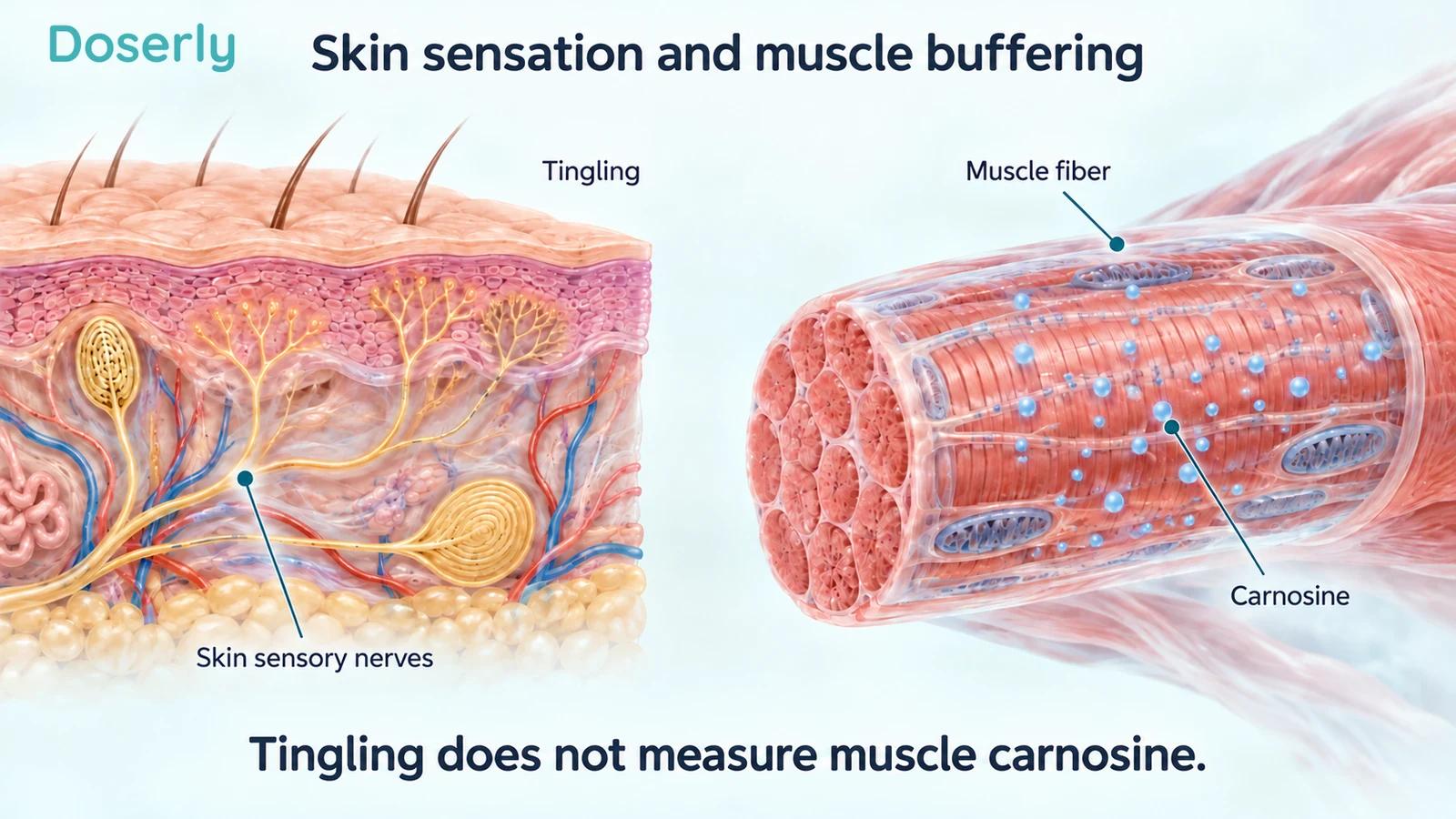
Less tingling can accompany similar overall exposure
A small randomized study in eleven healthy adults compared a 1.6-gram beta-alanine solution, the same amount in slow-release tablets and placebo. Researchers measured blood and urine beta-alanine over six hours and asked participants about unusual sensations. This was a study of absorption and tolerability, not a test of sporting performance.
The slow-release tablets produced a lower, later peak in blood concentration. Overall exposure, measured by the area under the concentration-time curve, did not differ between the two beta-alanine preparations. Sensory symptoms were weaker with the tablets and did not differ from placebo. Décombaz and colleagues, slow-release study.
That result directly challenges the idea that a stronger sensation is necessary for delivery. It does not establish that every slow-release product has identical properties or that the two preparations produce identical long-term performance. It shows that changing absorption can change the sensory experience without lowering the measured overall exposure in this experiment.
If someone changes brands and notices less tingling, several explanations are possible: a different formulation, serving size, meal context or other ingredients. The sensation alone cannot identify which explanation applies. Comparing the labels is more informative than increasing the amount until a familiar feeling returns.
Why a single pre-workout serving isn't the main research model
Much of the performance research gives beta-alanine repeatedly over weeks. Researchers then test whether muscle carnosine has increased and whether the exercise outcome has changed. This differs from taking a serving immediately before one session and judging its value by how stimulating it feels.
In an early cycling study, thirteen men received beta-alanine for four weeks, with a smaller subset continuing to ten weeks; twelve matched participants received placebo. Muscle biopsies were available from still smaller subsets. Carnosine increased by about 59% after four weeks and 80% after ten weeks in the supplemented participants. Total work in a high-intensity cycling-capacity test increased by 13% at four weeks, with a further increase at ten weeks. Hill and colleagues, cycling study.
These are changes in particular laboratory measurements. A 13% increase in work during a test to exhaustion does not mean a cyclist becomes 13% faster in a race. Nor does the percentage increase in carnosine translate directly into the same percentage increase in performance. The small samples and selected task matter when considering the scale of benefit.
More carnosine doesn't guarantee a faster race
A study of fifteen male competitive sprinters makes the distinction especially clear. Participants received beta-alanine or placebo for four weeks. The researchers measured calf-muscle carnosine using magnetic resonance spectroscopy, which estimates chemical content in tissue without a biopsy, and tested several exercise outcomes.
Carnosine increased in the supplemented group, by 47% in the soleus and 37% in the gastrocnemius, two calf muscles. Some late bouts of repeated knee-extension exercise improved. However, the treatment did not improve isometric endurance or indoor 400-metre race time. Derave and colleagues, sprinter trial.
This is not a contradiction. A controlled knee-extension test and a sprint involve different combinations of force, coordination, pacing and fatigue. The supplement can change a muscle measurement without changing the factor that determines the final race result. It also leaves open the possibility that a small study could miss a modest effect. What it cannot support is a promise that raising carnosine necessarily improves a specific event.
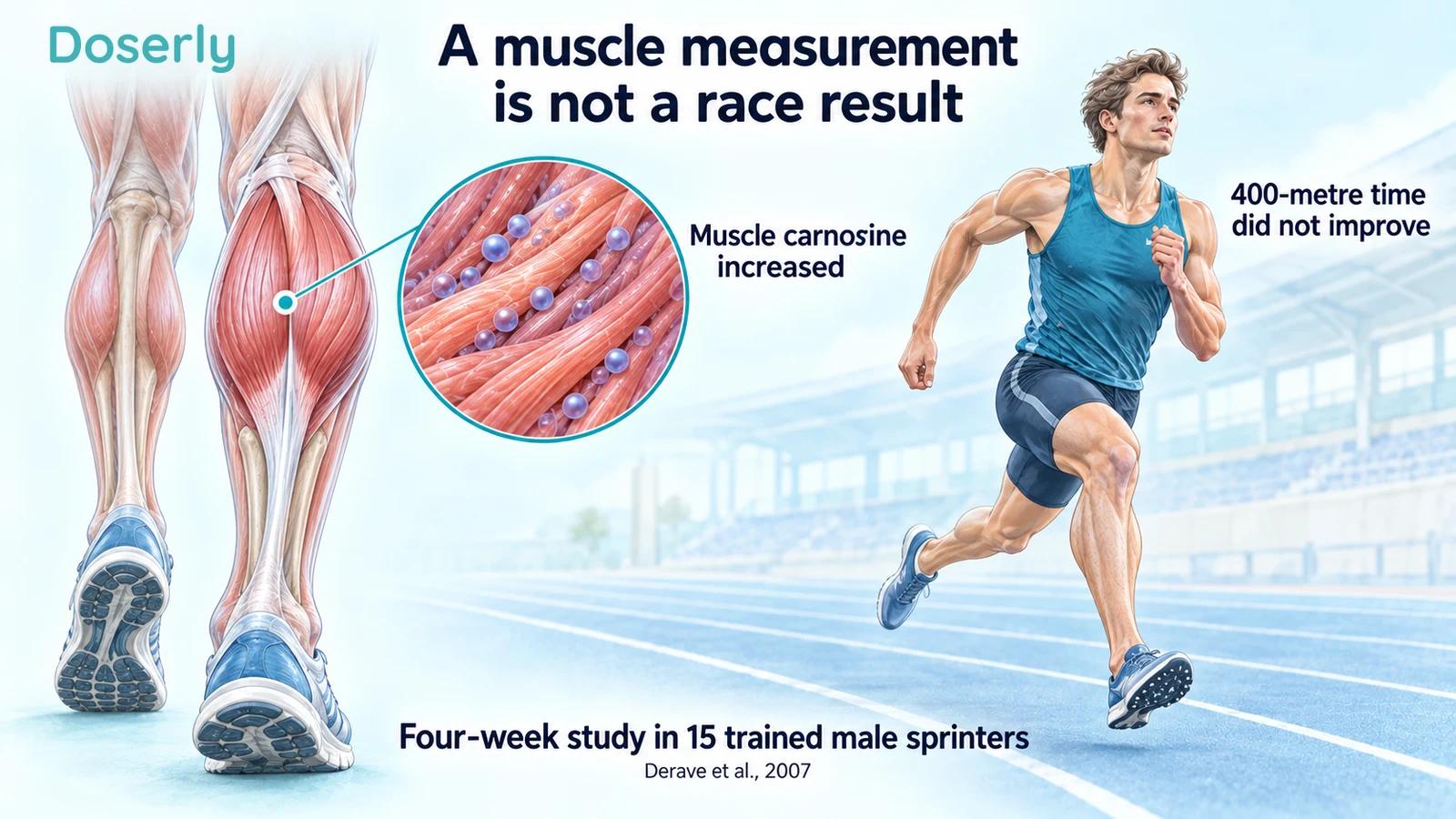
Image sources: Source: Derave and colleagues
Match the test to the activity you care about
A capacity test asks how long someone can keep going at a prescribed workload. A performance test asks how quickly someone completes a fixed task or how much they achieve within fixed rules. Both can be useful, but the results need to retain their original meaning.
For example, extending time to exhaustion at a demanding cycling workload may help explain physiology. A rider deciding whether a supplement improves a race wants a fixed-distance or race-specific result as well. Similarly, a lifter might care about repeated sets at a consistent load, whereas another person cares about a single maximal lift. Those are different demands even though both happen in a gym.
The 2015 ISSN statement identified the clearest potential in demanding efforts lasting roughly one to four minutes, while highlighting gaps for other activities. This is a description of the evidence pattern, not a precise boundary at which beta-alanine suddenly starts or stops working. The NIH's broader assessment also describes mixed results across exercise settings. ISSN statement and NIH exercise-supplement fact sheet.
For a reader whose main goal is general strength, muscle size or comfortable low-intensity exercise, the connection to this research is less direct. The question is whether buffering is relevant to the task that actually limits you, rather than whether the supplement produces a recognizable sensation.
What a personal training record can show
A useful record starts with a repeatable task: the same equipment, load, rest intervals and technique standards. Note the training session, sleep, illness and other supplements, especially caffeine. Record tingling separately from the exercise result so one doesn't become a substitute for the other.
If performance improves over several weeks, that is valuable personal information. It still doesn't isolate beta-alanine from training adaptation, familiarization or changes in motivation. You don't need to dismiss your progress; simply describe it accurately. “My repeated-set performance improved during this period” is a stronger observation than “the tingling proved the supplement was working.”
Avoid judging success from one unusually good or bad workout. It is also worth choosing the outcome before beginning a comparison. Otherwise, a person can search among many measurements until one appears positive while overlooking the original goal. A sports dietitian can help decide whether a formal supplement trial makes sense within the training plan.
Tolerability and product choice
The NIH fact sheet describes paresthesia as a recognized adverse effect and notes that smaller divided amounts or sustained-release formulations can reduce it. Published safety data are more informative for healthy adults over the studied periods than for years of use or people with complex medical conditions. Absence of a problem in a small trial doesn't establish safety for every person or product. NIH assessment.
A multi-ingredient pre-workout introduces another complication. Caffeine or other components may influence alertness, heart rate or symptoms, so the whole experience cannot be assigned to beta-alanine. Check the amount per serving and whether the label clearly identifies all ingredients. A stronger sensation is not a useful quality-control test.
Ordinary transient tingling should not become an excuse to ignore a different or severe reaction. Symptoms such as breathing difficulty, facial swelling or fainting need urgent assessment, rather than being assumed to be the expected supplement effect. Persistent unexplained numbness also deserves a medical discussion.
Beta-alanine is best understood through the task it may help and the exposure studied over time. Keep the sensory experience, biological measurement and performance outcome separate. That makes both positive findings and disappointing results easier to interpret, and gives you a clearer basis for deciding whether it belongs in your routine.
Explore the research
- ISSN position stand, 2015: professional assessment of mechanisms and exercise applications.
- Mechanisms of itch, 2012: mouse receptor experiments and human skin observations.
- Slow-release absorption and paresthesia, 2012: eleven-adult formulation comparison.
- Muscle carnosine and cycling capacity, 2007: small mechanistic exercise study.
- Carnosine and performance in sprinters, 2007: different outcomes within one controlled trial.
- NIH exercise-supplement assessment: safety and performance context.