
Supplements
October 16, 2026
Berberine is not a supplement version of a GLP-1 drug
On this page
Calling berberine “nature's Ozempic” turns several different questions into a misleading shortcut. Can a plant-derived compound influence glucose metabolism? Can a particular preparation improve blood sugar in people with diabetes? Does a supplement produce the weight loss, clinical benefits, and safety profile of a specific GLP-1 medicine? Evidence for one does not answer the others.
Berberine deserves a more serious discussion than either a miracle label or a blanket dismissal. There are human signals for glucose lowering, alongside important limitations in study quality, formulation, and generalizability. The 2025 trial that attracted attention adds another distinction: it tested berberine ursodeoxycholate, an investigational compound known as HTD1801, rather than an ordinary berberine supplement.
That study improved a blood-sugar endpoint over 12 weeks. Body weight remained stable. Understanding both findings is more useful than treating a positive diabetes trial as a weight-loss endorsement.
Start with the product, not the nickname
Berberine is an alkaloid found in several plants. Commercial supplements may use different salts, extracts, combinations, and delivery systems. A paper about one preparation is not automatically evidence for everything sold under the ingredient name.
HTD1801 is an ionic salt formed from berberine and ursodeoxycholic acid. The 2025 primary report describes it as a new molecular entity with properties that differ from its individual components. It is being developed as a metabolic treatment. The investigators did not simply buy an off-the-shelf berberine capsule and test a social-media claim.
This distinction matters even if a supplement label cites the study accurately. A citation can be real while the implication is wrong. To borrow its results, a product would need to match the intervention closely enough that the evidence transfers. Sharing one component or part of a chemical name does not establish that match.
The Doserly berberine guide provides broader ingredient context. For this article, keep three categories separate: conventional berberine supplements, the specific HTD1801 research formulation, and GLP-1 receptor agonist medicines.
What the 2025 trial actually found
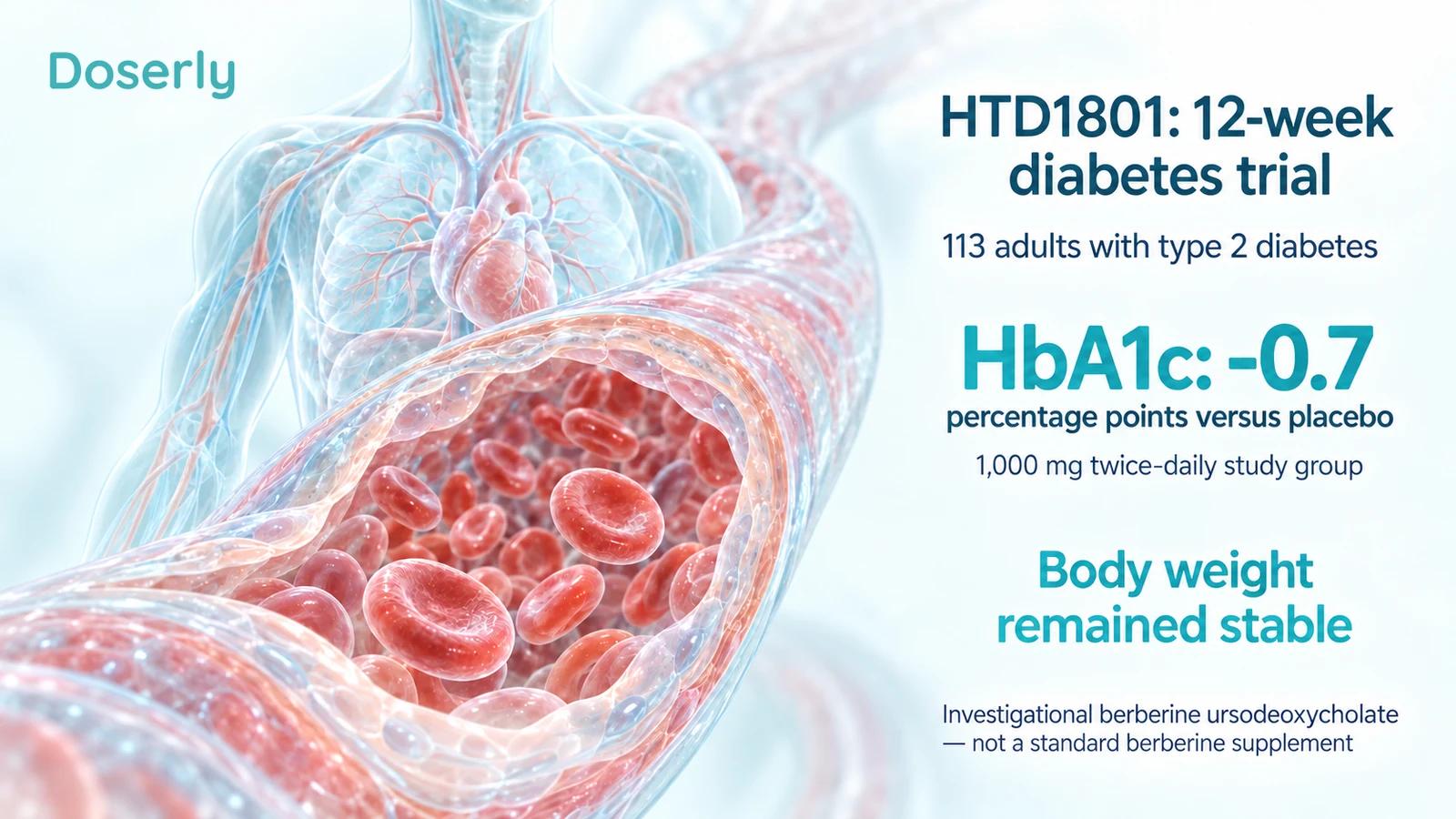
The phase 2, double-blind trial enrolled 113 adults with type 2 diabetes at 14 sites in China. Their diabetes remained inadequately controlled after a period of diet and exercise. Average baseline HbA1c was 8.2%, and average BMI was 25.5.
Participants were assigned to placebo, HTD1801 500 mg twice daily, or HTD1801 1,000 mg twice daily for 12 weeks. These are study regimens for the investigational compound, not suggested supplement doses.
The primary endpoint was the change in HbA1c. Compared with placebo, the estimated reduction was 0.4 percentage points in the lower-dose group and 0.7 percentage points in the higher-dose group. The higher-dose estimate had a 95% confidence interval from 0.35 to 1.10 percentage points lower than placebo. Both comparisons reached statistical significance.
A percentage-point change is not a relative percentage change. Moving from an HbA1c of 8% to 7.3%, for example, is a reduction of 0.7 percentage points. The trial's reported number was an adjusted comparison with placebo, so it should not be presented as the exact before-and-after result every participant experienced.
The findings support a glucose-lowering effect of HTD1801 in that population over that period. They do not establish prevention of heart attacks, kidney failure, or other long-term complications. The study was too short and was not designed around those outcomes.
The missing weight-loss result matters
Body weight remained stable across the trial groups. That is especially important when the paper appears in a discussion about replacing a weight-management medicine.
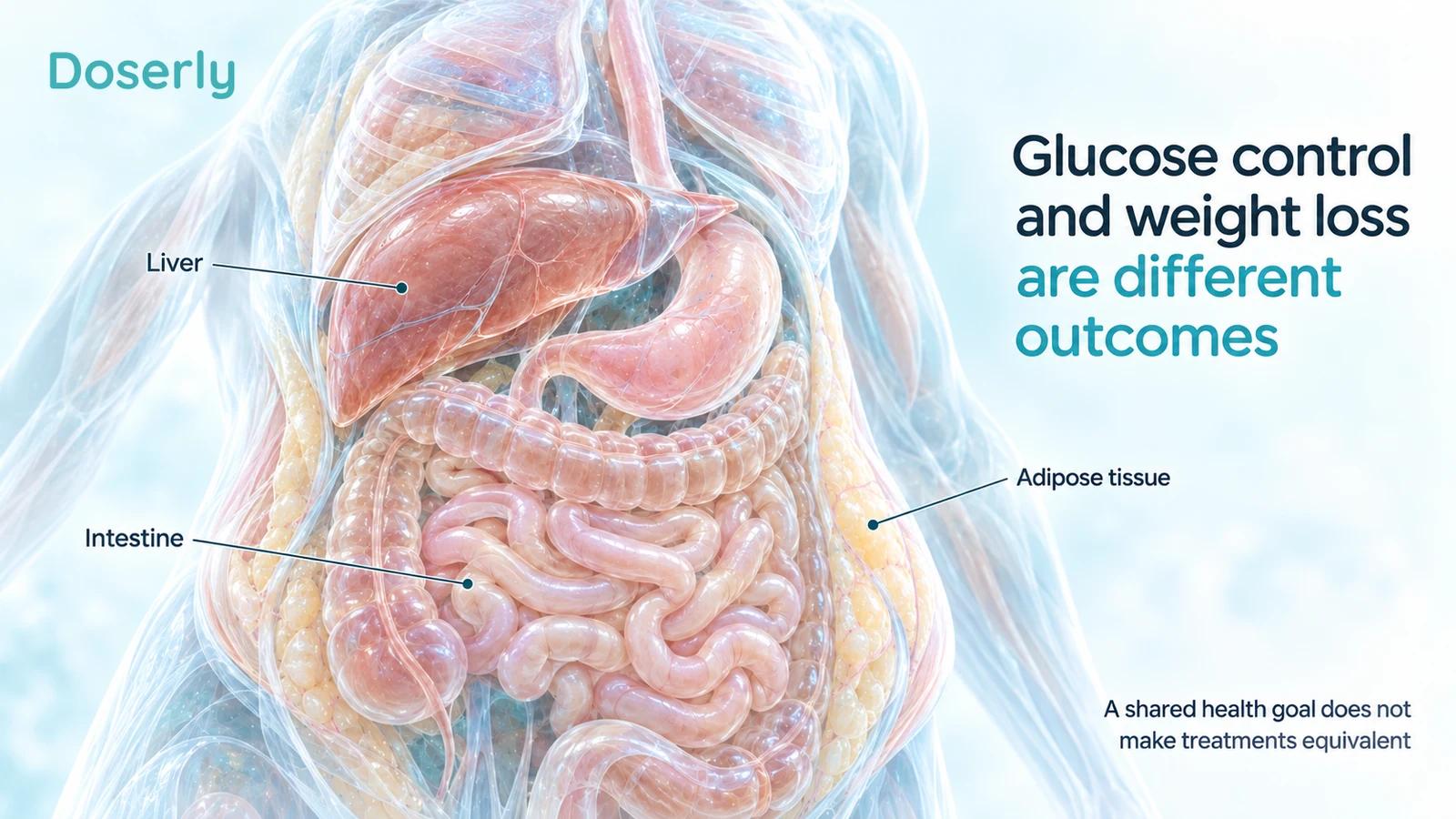
Glucose control and weight change are related clinical topics, but they are not interchangeable endpoints. A treatment can improve one without meaningfully changing the other. The fact that the researchers saw a blood-sugar benefit does not entitle a headline to add an unmeasured or absent weight-loss benefit.
Nor should results from other HTD1801 studies be casually spliced into this trial. Populations with different liver disease, diabetes treatments, starting weights, and treatment durations can respond differently. A result needs to stay attached to the people and intervention that produced it.
The sponsor funded the trial, and several authors reported company-related interests. That does not erase a randomized result. It does make transparent reporting and independent confirmation valuable. The short duration and predominantly Han Chinese population also limit how confidently the findings can be generalized to long-term use in other settings.
What ordinary berberine research contributes
An earlier pilot study published in 2008 included a randomized comparison of berberine and metformin in 36 adults with newly diagnosed type 2 diabetes. Over three months, the investigators reported glucose-lowering effects in both groups. A separate group of 48 adults with poorly controlled diabetes received berberine in addition to existing treatment.
These findings help explain scientific interest in berberine. They do not establish that it can replace metformin. The randomized component was small, and the add-on component was a different design. A study can report similar observed changes without being a sufficiently powered equivalence or noninferiority trial.
Starting glucose levels also matter. A substantial decline in people beginning with poorly controlled diabetes does not predict the same change in people with normal glucose. It certainly does not tell us how much weight someone without diabetes will lose.
The National Center for Complementary and Integrative Health considers the weight-loss evidence inconclusive. It notes inconsistent results, frequent risk of bias, varying formulations, and populations with health conditions that complicate interpretation. That is compatible with some studies showing benefit; it means the total evidence does not yet support a dependable promise.
Why the GLP-1 comparison fails
A GLP-1 receptor agonist is a drug class defined by its pharmacology. Berberine is not simply a botanical member of that class. Finding a pathway that overlaps somewhere in metabolism does not establish equivalent receptor activity, clinical effects, dosing, or safety.
Consider the STEP 1 semaglutide trial. It randomized 1,961 adults with overweight or obesity who did not have diabetes to semaglutide or placebo, alongside lifestyle intervention, for 68 weeks. Average body-weight change was −14.9% with semaglutide and −2.4% with placebo.
Those data concern a specific medicine, dose, population, and follow-up. They are not a head-to-head comparison with berberine or HTD1801. It would be inappropriate to calculate a precise relative effectiveness from these separate trials. What they do show is how different the evidence questions are: a large, longer weight-management trial versus a smaller, shorter diabetes trial whose participants' weight stayed stable.
Semaglutide also had adverse effects; gastrointestinal events led to more treatment discontinuations than placebo. Recognizing stronger evidence for a particular outcome does not mean the medicine is suitable for everyone or free of tradeoffs. The decision requires the person's diagnosis, goals, other conditions, and clinical supervision.
Mechanisms cannot supply the missing comparison
Berberine research often discusses AMPK, an enzyme system involved in cellular energy sensing, along with intestinal and liver pathways. HTD1801 research also concerns bile-acid and inflammatory biology. These mechanisms provide hypotheses for clinical investigation.
The tempting shortcut is to see an appealing pathway and assume a predictable whole-body result. But changing a signal in a cell experiment, altering a biomarker in humans, and improving a person's health are separate observations. Exposure, tissue distribution, compensatory responses, and treatment duration can all affect whether a mechanism becomes a useful therapy.
A mechanistic explanation is most helpful after the clinical question has been defined. Is the aim lower HbA1c in diagnosed diabetes, weight management, or a liver-disease endpoint? Each requires its own outcome data. “Metabolic health” is too broad to serve as a single result.
The 2025 trial's most defensible message therefore remains specific: HTD1801 improved HbA1c relative to placebo over 12 weeks in the studied adults. It did not make all berberine products equivalent to one another or to GLP-1 medicines.
A supplement can still have important interactions
The word “natural” does not tell us whether a compound changes drug exposure. In a human crossover study, repeated berberine administration altered the activity of several drug-metabolizing enzymes, including CYP2D6, CYP2C9, and CYP3A4. The study used probe medicines to measure these effects.
That experiment does not predict the exact consequence for every prescription. It does establish that interaction concerns are more than an abstract possibility. A pharmacist needs the actual medication list, supplement product, and intended use to judge relevance.
NCCIH also describes gastrointestinal effects such as nausea, abdominal pain, bloating, constipation, and diarrhea. It advises against berberine use during pregnancy or breastfeeding and against giving it to infants because of potential harm involving bilirubin. These considerations belong in the discussion before a product is added, not only after symptoms occur.
The HTD1801 trial cannot provide a lifetime safety guarantee for berberine supplements. Treatment-emergent adverse events occurred in all groups and were more frequent in the higher-dose group than placebo, although generally mild. No participant discontinued because of an adverse event. That is useful short-term information about that formulation in selected participants, with considerable uncertainty still remaining about uncommon or long-term effects.
Product quality and clinical efficacy are separate checks
A supplement should identify its ingredients and amounts clearly. Batch testing and quality documentation can help answer what is actually in a product. They cannot, by themselves, show that the product treats diabetes or matches the effect of a prescription medicine.
In the United States, FDA does not approve dietary supplements before marketing. Manufacturers have legal responsibilities, and FDA can act on unsafe or misbranded products, but a product's availability is not evidence of premarket efficacy review.
The practical question when a label says “clinically studied” is: studied as what? Check the ingredient form, amount, other ingredients, population, duration, and primary outcome. If the cited paper tested HTD1801, an ordinary berberine label needs more than a shared name to claim the same evidence.
A larger milligram number does not solve this mismatch. Nor does combining separate products recreate an investigational compound. Formulation differences are part of the science, not a technicality that can be bypassed at home.
A more useful conversation about metabolic goals
Someone interested in berberine usually has a concrete concern: glucose is rising, weight is difficult to manage, or a prescribed treatment is expensive or poorly tolerated. Those concerns deserve attention without needing a nickname to make them legitimate.
The next step is to define the target and review options with the clinician managing it. A person with diabetes should not stop or replace prescribed treatment because a supplement study looks promising. If an additional product is being considered, its interaction risks and the plan for evaluating benefit should be explicit.
A record of the exact formulation, start date, symptoms, and clinician-ordered measurements can help that discussion. It cannot turn an uncontrolled personal experiment into proof of equivalence. Changes in food intake, activity, illness, and other medicines may contribute to what happens.
Berberine research remains worth following. The clearest reading of the current trial is also the most useful one: an investigational berberine-containing compound produced a meaningful glucose signal, while leaving the supplement-as-GLP-1 claim unsupported.
Explore the research
- 2025 HTD1801 randomized trial — formulation, HbA1c, stable weight, and safety.
- 2008 berberine diabetes pilot — small randomized and add-on studies.
- STEP 1 semaglutide trial — separate weight-management evidence, not a berberine comparison.
- Human berberine enzyme-interaction study — measured effects on drug-metabolizing pathways.
- NCCIH berberine and weight-loss assessment — evidence limitations and safety.
- FDA dietary supplement questions and answers — U.S. regulatory and labeling context.