
Supplements
October 16, 2026
BCAAs and an adequate protein diet: what benefit remains?
On this page
A BCAA drink can change amino-acid availability and stimulate a measurable response in muscle. The more useful question for someone who already eats enough protein is whether adding that drink improves an outcome that matters: muscle growth, strength, useful recovery or the ability to train consistently.
Those questions are not interchangeable. A four-hour laboratory response does not establish an advantage after months of training. Feeling less sore does not necessarily mean force production has recovered. A favorable comparison with a drink containing no amino acids also does not tell you whether BCAAs outperform ordinary protein-containing food.
There is evidence that BCAAs can stimulate short-term muscle-protein synthesis and sometimes reduce soreness. Their additional value for muscle growth on top of an adequate protein diet remains unestablished by those findings. The distinction helps explain why a supplement can be biologically active without being an obvious priority.
Three amino acids, not the whole set
BCAA stands for branched-chain amino acids: leucine, isoleucine and valine. They are three of the nine essential amino acids that must be supplied by the diet. Protein-containing foods already provide BCAAs along with other amino acids; a separate BCAA powder is not the only way to consume them.
The NIH Office of Dietary Supplements describes the evidence for improved performance, muscle mass and recovery as inconsistent and emphasizes adequate protein intake. Its summary also distinguishes these three amino acids from a full essential-amino-acid supply. NIH exercise-supplement fact sheet
Leucine has an important signaling role, but muscle proteins are assembled from a range of amino acids. A signal to increase synthesis does not make the other materials unnecessary. At the same time, it would be wrong to say that BCAAs cannot produce any response because the other six essential amino acids are absent from the drink. The body has existing amino-acid pools and ongoing protein turnover; the actual response must be measured.
Our BCAA guide covers the supplement category. The distinction here is between providing part of the amino-acid supply and demonstrating a useful added outcome in someone whose diet already supplies that broader set.
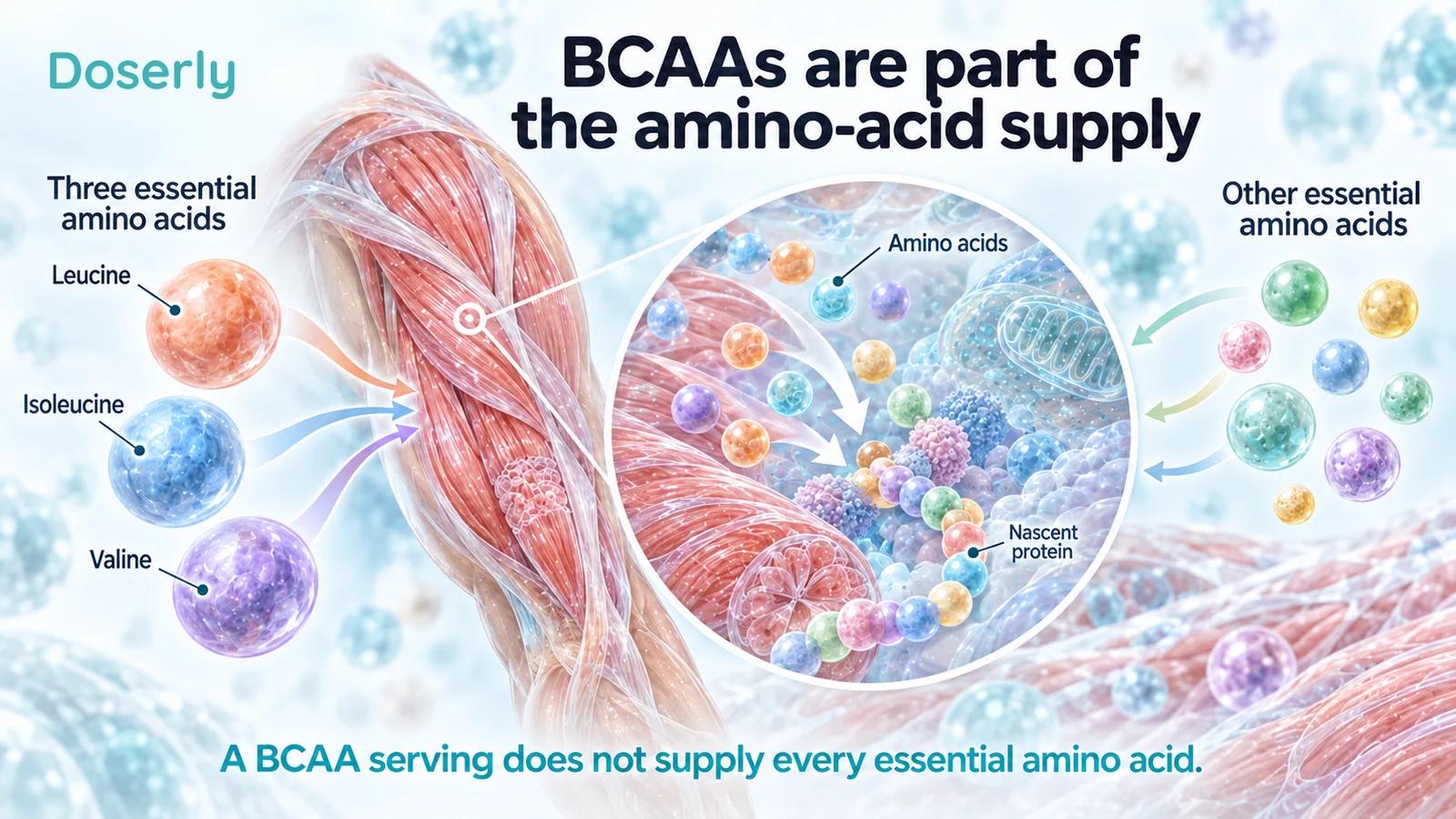
The spheres are schematic amino-acid symbols, not chemical structures or a literal count of molecules. BCAAs contribute to the supply but do not provide every essential amino acid.
The 2017 synthesis experiment found a real effect
Ten resistance-trained young men completed two exercise-recovery trials. After resistance exercise, they consumed either 5.6 g of BCAAs or a placebo drink. Researchers used a labeled amino acid and muscle biopsies to measure myofibrillar protein synthesis over four hours.
Synthesis was 22% higher after BCAAs than after placebo. Several signaling measures also changed. Jackman and colleagues
This is direct human evidence of a short-term muscle-protein response. It should not be dismissed as merely a marketing mechanism. It should also not be renamed “22% more muscle”: the study measured the rate at which labeled amino acid entered muscle proteins over hours, not an increase in muscle size over a training program.
There was no whey-protein group in this experiment. Comparisons with responses reported in other studies can generate hypotheses, but they do not create a randomized head-to-head comparison that was never performed. The clearest supported statement is that this BCAA serving increased the measured response relative to the tested placebo.
Adding carbohydrate does not resolve the practical question
A 2023 crossover experiment studied ten trained young men after resistance exercise. It compared an energy-matched carbohydrate drink with a drink containing carbohydrate plus 5.6 g of BCAAs.
The authors reported a roughly 15% greater four-hour myofibrillar synthesis response with the combined drink. This was another small acute experiment, with uncertainty around the estimated difference. BCAA and carbohydrate trial
The design helps separate the added amino acids from a simple difference in drink energy. It still does not compare BCAAs with a full protein serving, and it does not follow muscle growth over months. Two positive acute experiments do not become a long-term hypertrophy trial simply because their conclusions point in the same direction.
For a person who normally has a protein-containing meal after training, the real-life comparison is also different. Replacing that meal with BCAAs, adding BCAAs to it and taking BCAAs after an otherwise unfed workout are three separate strategies. A study of one should not be used to promise results from all three.
Recovery evidence is more mixed than a soreness headline suggests
One small 2017 study randomized 16 experienced resistance-trained participants to BCAAs or placebo around a demanding squat session. The investigators controlled diet and followed isometric strength, jump performance and perceived soreness for 48 hours.
The authors reported favorable recovery estimates with BCAAs for selected outcomes, including less soreness and smaller performance reductions at certain time points. These were small groups of eight, and the paper used magnitude-based descriptions such as “likely” effects. Waldron and colleagues
The result is a reason to investigate a recovery effect, not a guarantee that every lifter will notice one. Diet control improves interpretability, but it does not make a small single-session experiment equivalent to a large trial of sustained training progress.
A different randomized study in 30 trained men tested BCAAs with a small amount of carbohydrate against a carbohydrate drink during three consecutive days of intense lower-body training. Strength declined and soreness increased without a meaningful protective effect from the BCAA-containing product on the main recovery measures. The drinks also differed substantially in carbohydrate content, so this was not a perfectly isolated comparison of one ingredient. Three-day training trial
Together, these studies support a cautious interpretation: some protocols produce favorable findings, while others do not. “Recovery” should be unpacked into what was actually measured and when, rather than treated as one outcome that is either switched on or off.
Less soreness can occur without better jump performance
A 2025 study examined supplement timing in 24 untrained male college students. Participants received BCAAs or placebo and completed pre-exercise and post-exercise supplementation experiments. The researchers measured soreness, countermovement jump performance and blood markers over the following 48 hours.
Post-exercise BCAAs reduced soreness at 48 hours and improved selected inflammatory-marker comparisons. There was no significant between-group difference in jump performance. Timing and recovery trial
That separation is useful. A person may value feeling less sore, but it is a different claim from recovering neuromuscular performance. The study also involved untrained young men, whose response to unfamiliar exercise may not describe a trained athlete following a familiar routine.
Blood markers add another layer. A change in a marker associated with exercise stress is not itself proof of stronger muscles, faster tissue repair or fewer injuries. To make those claims, a study needs to measure the corresponding outcomes.

These are different ways to assess recovery. The illustration shows no measured treatment effects; red cells are an explanatory blood inset, not a depiction of a particular biomarker.
Endurance findings answer an endurance question
A crossover study in 12 long-distance runners tested BCAA-containing and energy-matched placebo drinks during intensive three-day training periods. Meals and the training program were standardized. Participants reported less soreness and fatigue with BCAAs, and several blood markers were lower after the BCAA period. Intensive running study
This is relevant evidence for a narrow recovery context. It does not directly demonstrate extra muscle growth in a strength trainee. The exercise load, drink volume, nutritional conditions and measured outcomes differ from a typical gym supplement routine.
It also illustrates why the word “athletes” can hide important differences. Long-distance runners completing a concentrated block of training and recreational lifters training a few times weekly are not interchangeable populations. A benefit under one unusually demanding protocol may not remain detectable when ordinary meals and recovery time already meet the person's needs.
What an adequate protein diet changes
If the diet already provides enough protein, adding BCAAs changes a particular subset of amino acids rather than filling a clear absence of protein. To establish extra value in that situation, a study should document baseline intake, keep the training and other nutrition comparable, and measure the desired outcome over an appropriate period.
For muscle growth, that means following muscle size or lean mass during sustained training. For useful recovery, it means looking beyond a single blood marker to performance or a clearly defined symptom. The studies discussed here do not establish a dependable added hypertrophy benefit in protein-replete lifters.
That is a statement about what the evidence demonstrates, not proof that no individual could ever experience a benefit. Small effects can be hard to detect, and results may depend on the population. But a purchase decision does not require proving a supplement is universally ineffective. It requires a plausible reason that its likely benefit is worth its cost and complexity for you.
The NIH assessment is consistent with giving the overall diet priority. Its summary should not be read as an instruction to replace ordinary food with a larger stack of isolated amino acids. NIH exercise-supplement fact sheet
A practical way to evaluate the claim
First, identify the outcome you want. “Better recovery” is too vague to evaluate. Less soreness the next morning, preserved performance at the next session and greater muscle size after several months are specific but different goals.
Next, look at the comparison behind the claim. Was the supplement tested against flavored water, carbohydrate, a complete protein serving or the same diet without an added powder? Ask whether the people studied resembled you and whether their ordinary protein intake was measured. A headline that omits the comparator has removed information needed to judge usefulness.
Check the full ingredient list as well. A product containing BCAAs, carbohydrate, caffeine and other ingredients cannot be evaluated as if it contained only three amino acids. If energy or alertness changes immediately, that does not identify BCAAs as the cause. Research on one formula cannot automatically establish the value of another with a similar name.
If you track your routine, record meals, exercise workload, sleep, soreness and the next session's performance. Change one optional supplement at a time. Ordinary variation and expectations can still influence an individual experiment, so a log is useful for describing your experience rather than proving a biological mechanism.
Finally, distinguish a training supplement from medical nutrition. Someone with unexplained weight loss, a prescribed protein restriction or a condition affecting nutrition needs individualized advice, not a dose copied from an exercise study. The amounts in the trials above describe research protocols and are not personalized recommendations.
BCAAs have measurable biology. What remains uncertain is the added practical payoff once the wider diet and training program are already doing their jobs. That is the appropriate standard for deciding whether another powder belongs in the routine.
Sources
- NIH Office of Dietary Supplements: exercise and athletic performance
- BCAAs and post-exercise myofibrillar protein synthesis
- BCAA and carbohydrate co-ingestion after exercise
- Acute BCAAs and recovery in trained athletes
- BCAAs versus carbohydrate across three days of intense training
- BCAA timing and recovery in untrained men
- BCAAs during intensive running training