
Supplements
October 16, 2026
Ashwagandha stress studies: why a cortisol number is not the whole story
On this page
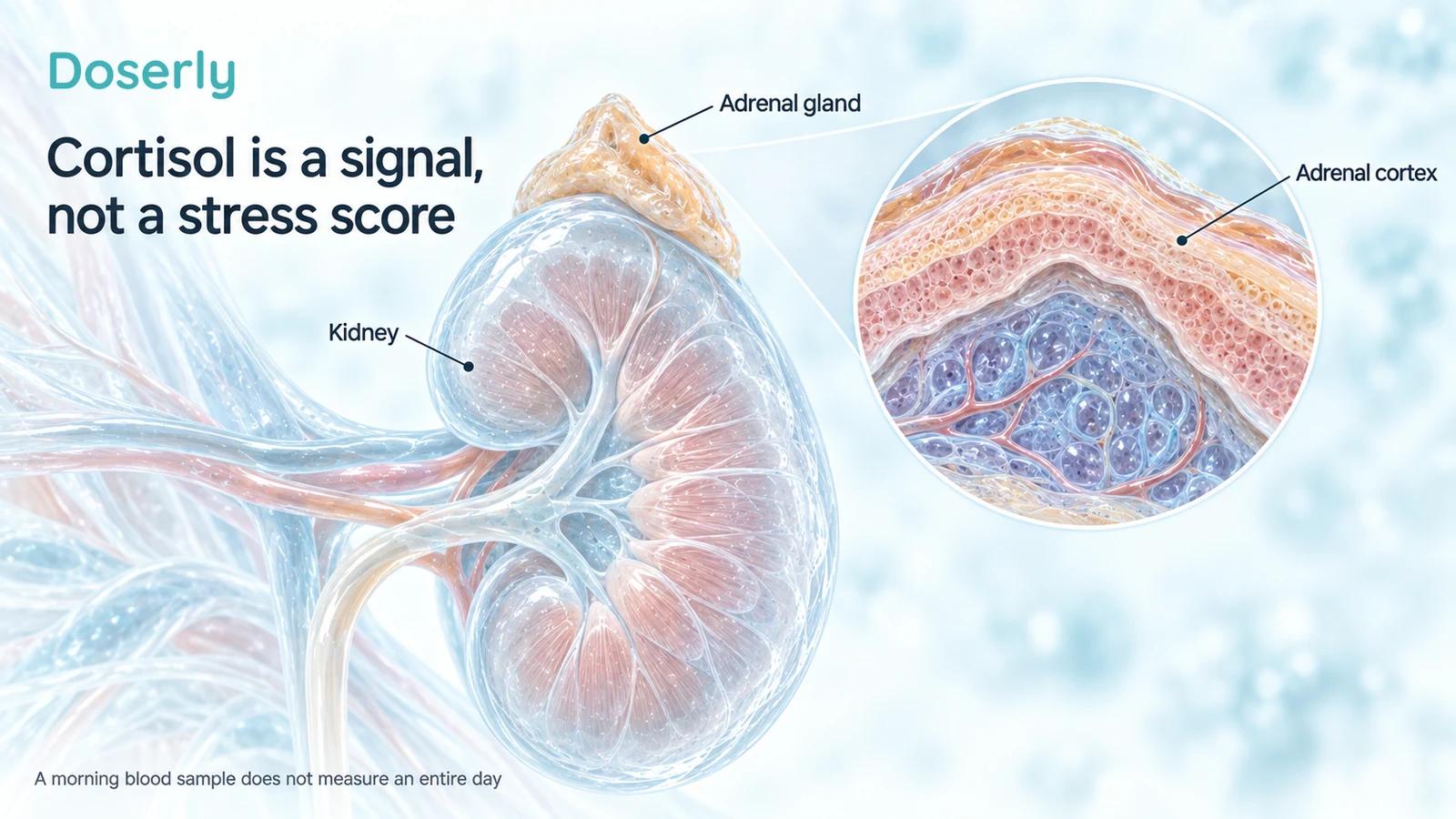
A lower cortisol result can make a stress supplement look unusually objective. Feelings fluctuate; a laboratory value appears precise. But precision is not the same as meaning. A blood sample measures a hormone at a particular time, while the question most people care about is whether they feel and function better.
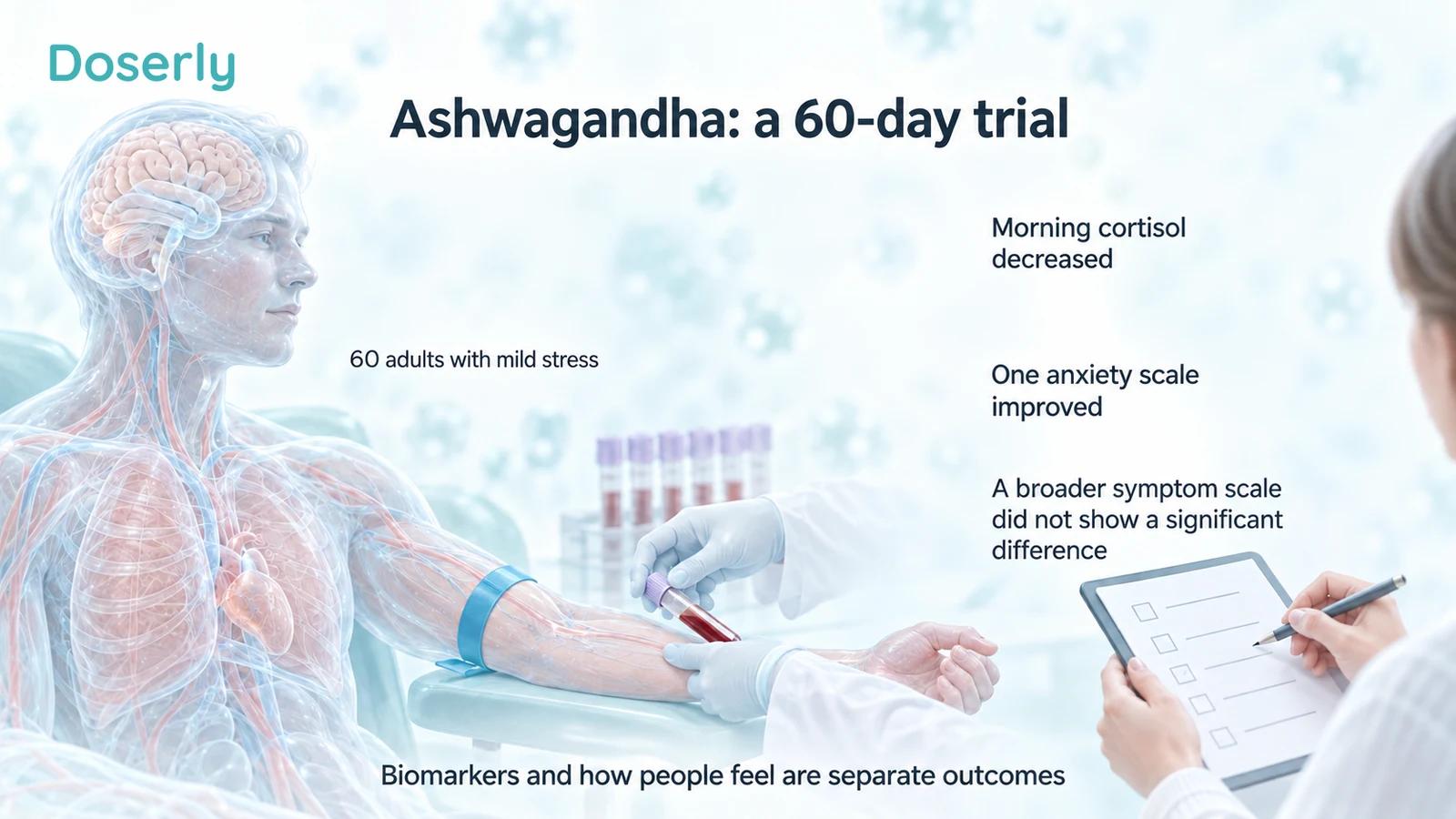
Ashwagandha trials offer some evidence for short-term improvements in stress-related symptoms. They also show why cortisol should not become the whole story. In one frequently cited 60-day trial, morning cortisol fell and one anxiety scale improved relative to placebo. A broader symptom scale did not show a statistically significant difference.
That is a more informative result than “ashwagandha lowers stress hormones.” It leaves room for a possible benefit while preserving uncertainty about which symptoms improve, which preparation matters, and whether repeated use remains safe.
Cortisol is part of normal physiology
Cortisol is produced in the adrenal cortex, the outer portion of the adrenal glands above the kidneys. It participates in the body's response to demands and follows a daily pattern. A morning value and a late-night value are therefore not interchangeable observations.
The stress response is not a contaminant that should always be suppressed. A hormone can be involved in distress without its lowest possible concentration becoming a health goal. What matters is the clinical context, the timing and method of measurement, and the relationship to symptoms and function.
This is also why ordinary stress and an endocrine disorder should not be conflated. The Endocrine Society's diagnostic guidance recommends specific tests when Cushing's syndrome is suspected and recommends against using a random serum cortisol result to diagnose it. It does not recommend broad testing of everyone who feels stressed.
A supplement trial that measures morning cortisol is not diagnosing Cushing's syndrome or proving that participants began with a hormone disorder. Its measurement is one research outcome. It should not be turned into a reason to order repeated cortisol panels without a clinical indication.
What the 2019 trial actually tested
The 2019 randomized study enrolled 60 otherwise healthy adults with mild stress. Participants received placebo or 240 mg daily of a standardized ashwagandha extract, Shoden, for 60 days.
Investigators assessed symptoms using the clinician-rated Hamilton Anxiety Rating Scale, or HAM-A, and the self-reported Depression, Anxiety and Stress Scale-21, or DASS-21. They also measured morning cortisol, DHEA-S, and testosterone. Blood was collected fasting at approximately 8 a.m., which helped standardize the sampling conditions.
The ashwagandha group showed a greater improvement on HAM-A than placebo, with P = 0.040. The DASS-21 comparison did not reach conventional statistical significance, with P = 0.096. Calling that second result “nearly significant” does not make it a confirmed benefit.
Morning cortisol declined by about 23% from baseline in the active group, while the placebo group had little change. The between-group analysis supported a difference over time. That 23% describes the hormone change within the treatment group; it is not a 23% reduction in all forms of stress, a 23% improvement in quality of life, or a prediction for an individual user.
All participants completed the trial, and no significant adverse events were reported. These are useful findings for the studied preparation over two months. They do not establish safety over years or in people excluded from a small trial.
Symptoms and biomarkers answer different questions
The HAM-A and DASS-21 are structured ways to assess symptoms, but they do not ask exactly the same questions or use the same assessment method. A trial can therefore show a difference on one measure without showing it on another.
The sensible interpretation is not to pick whichever measure looks most favorable. The trial provides a symptom signal with an inconsistent pattern across scales. Larger studies can help determine whether that pattern reflects a reproducible effect, differences between measures, or sampling variability.
Cortisol adds another kind of information. A lower morning value may be consistent with an effect on stress-related physiology, but the trial does not establish that the cortisol reduction caused the symptom improvement. Both could reflect a shared influence, and the measurements alone cannot resolve the causal pathway.
It also does not establish a healthier full-day cortisol rhythm. Sampling at approximately the same morning time improves comparability, but it is still a limited view. A claim that the supplement “resets the HPA axis” goes further than the outcomes directly demonstrate.
For a reader, the practical hierarchy is straightforward: improvements in distress, sleep, daily functioning, and tolerability should remain central. A favorable biomarker should support that picture, not replace it.
The testosterone finding illustrates another common mistake
The same 2019 paper reported an increase in testosterone over time among men taking ashwagandha. However, the difference compared with placebo was not statistically significant.
A significant change within one group and a nonsignificant change within another do not automatically establish a significant difference between the groups. The direct comparison matters. Without it, a headline can turn normal variability or baseline differences into an apparent treatment effect.
The result also does not establish treatment of testosterone deficiency. The study was designed around stressed, otherwise healthy adults, not a diagnosis requiring endocrine assessment. The clinical significance of a hormonal change needs its own evidence.
This point matters because supplement marketing often bundles stress relief, sleep, testosterone, and performance into a single claim. One small study does not provide equal support for every part of that bundle. Each outcome needs to retain its own result and level of uncertainty.
Other trials support interest, but products differ
An earlier 2012 randomized study enrolled 64 adults with a history of chronic stress. It tested 300 mg of a concentrated root extract twice daily for 60 days. The investigators reported reductions in stress-assessment scores and serum cortisol compared with placebo, with mild adverse effects in both groups and no serious adverse events.
This adds evidence beyond a single positive study. It still does not establish that every ashwagandha product has the same effect. The preparation and daily amount differed from those in the 2019 trial.
The NIH Office of Dietary Supplements review describes studies using root extracts, root-and-leaf extracts, and other preparations with different standardization processes. It concludes that there are promising findings for stress and sleep, while noting that heterogeneous products and short, often small trials make specific recommendations difficult.
The 2019 trial was funded by the ingredient supplier, which also supplied the extract. Funding does not invalidate randomization or erase the findings. It is relevant context when deciding how much confidence to place in a proprietary formulation before independent replication.
Sleep deserves its own outcome measures
Feeling less stressed and sleeping better can overlap, but one should not be assumed from the other. Ashwagandha sleep trials are useful because they measure sleep more directly.
A 2019 insomnia study randomized 60 participants and tested a root extract for ten weeks. It used actigraphy and questionnaires, reporting improvements in sleep-onset latency and selected sleep measures compared with placebo.
Actigraphy estimates sleep from movement patterns; it does not directly record sleep stages in the way laboratory polysomnography does. The study therefore supports a narrower discussion about the outcomes it measured, rather than a general claim that ashwagandha increases restorative deep sleep.
It was also another preparation and regimen. Combining the most favorable cortisol result from one trial, sleep result from another, and hormone result from a third does not create evidence for one universally effective product.
The Doserly ashwagandha guide provides broader background. When reviewing an individual study, keep the actual extract, population, duration, and measured endpoint attached to the result.
“Standardized” helps identify an extract, not guarantee a benefit
Withanolides are a group of compounds used in describing many ashwagandha extracts. A standardized percentage can make a preparation more reproducible. It does not mean two products with the same capsule weight are clinically interchangeable.
Plant part, extraction method, measured compound profile, and other ingredients can differ. A higher percentage is not automatically a better stress treatment, and a larger milligram amount is not necessarily equivalent to a smaller amount of another extract.
This is why the study doses above are descriptions, not a personal protocol. The relevant question is whether a product matches evidence appropriate to the person's situation and whether its risks are acceptable.
A label that cites a real randomized trial should make that match clear. If the cited intervention is a specific proprietary extract, evidence from that trial cannot be assumed to cover an unspecified powder or multi-ingredient blend.
Short trials cannot settle long-term safety
Common reported effects include stomach upset, diarrhea, nausea, and drowsiness. NIH sources describe short-term tolerability as generally reassuring for many studied participants, while emphasizing that evidence over many months or years is lacking.
There are also clinically important liver-injury reports. A 2020 case series described five people with liver injury attributed to ashwagandha-containing supplements. Symptoms included jaundice and itching, with onset after roughly two to twelve weeks. Investigators evaluated other causes, and available products were chemically examined.
A case series cannot calculate the risk among all users because it lacks a denominator. Some patients were taking other supplements, complicating attribution. It can still identify a credible safety signal that a 60-person trial would be poorly equipped to detect.
New jaundice, dark urine, or persistent significant abdominal symptoms during supplement use warrant prompt medical assessment. Continuing solely because a stress score improved would ignore a different and more consequential outcome.
Thyroid conditions and medication lists matter
NCCIH's safety guidance advises avoiding ashwagandha during pregnancy and breastfeeding and does not recommend it for people with thyroid or autoimmune disorders or those approaching surgery. It also identifies potential interactions with several medicine classes, including thyroid hormone, sedatives, immunosuppressants, and medicines for diabetes or blood pressure.
These cautions do not mean every combination inevitably causes harm. They mean the product should be reviewed in the context of the actual person's conditions and medicines. “Natural” and “adaptogen” are not interaction assessments.
The possibility of effects on thyroid function is especially relevant when symptoms such as fatigue, anxiety, palpitations, or sleep disturbance are already present. Treating all of them as ordinary stress can miss a different explanation.
A clinician or pharmacist can assess that context and whether a supplement trial is appropriate. The evidence does not support using an over-the-counter extract to self-treat a suspected hormone disorder.
Judge the experience by a meaningful goal
For someone considering ashwagandha, the useful question is not simply whether cortisol can be made lower. It is whether a defined problem improves enough to justify the cost, burden, and risk.
A practical record might include the exact preparation, start date, sleep quality, daytime drowsiness, gastrointestinal symptoms, and the specific stress-related difficulty being watched. Changes in workload, therapy, exercise, sleep habits, and other treatments should be noted too; they can influence the same outcomes.
Persistent distress or anxiety that interferes with life deserves assessment and access to established care. A supplement should not become a reason to postpone that conversation or to stop prescribed treatment.
Ashwagandha's evidence supports cautious interest in short-term symptom benefits for some preparations. The cortisol findings are part of that evidence. They are not a complete measure of health, proof of a hormonal reset, or a substitute for knowing whether someone is doing better.
Explore the research
- 2019 stress and hormone trial — symptom-scale differences, morning sampling, and testosterone comparison.
- 2012 stress trial — a separate extract and randomized symptom findings.
- 2019 insomnia trial — actigraphy and sleep outcomes.
- NIH ashwagandha evidence review — formulation differences and safety limits.
- NCCIH usefulness and safety guidance — contraindications and potential interactions.
- 2020 liver-injury case series — a safety signal without an incidence estimate.
- Endocrine Society diagnostic guidance — why random cortisol is not a diagnostic shortcut.