
Peptides
October 16, 2026
ARA-290 and small-fiber neuropathy: why nerve measures and symptoms differ
On this page
A treatment can produce a measurable change in nerve tissue without yet proving that it reliably reduces pain. That distinction is central to the research on ARA-290, also called cibinetide, in sarcoidosis-associated small-fiber neuropathy.
The strongest structural finding came from a small randomized trial published in 2017. One treatment group had a statistically significant increase in corneal nerve fiber area compared with placebo after 28 days. The corresponding placebo comparison for pain was not statistically significant. Conventional skin nerve fiber density also did not show a significant treatment-group difference. 2017 cibinetide trial
Those results can coexist. They describe different measurements, not competing versions of the same fact. Understanding them makes it possible to take the nerve signal seriously without turning it into a promise of pain relief or permanent repair.
What small nerve fibers do
Small nerve fibers contribute to pain and temperature sensation, as well as autonomic functions such as sweating. Damage can produce burning, altered sensation, or autonomic symptoms. The pattern varies, and the same symptom can have more than one cause.
These fibers are different from the larger fibers assessed by many routine nerve-conduction tests. A normal conventional study therefore does not settle every question about small-fiber disease. Depending on the clinical picture, specialists may use skin biopsy and other assessments alongside the history and examination. NINDS peripheral neuropathy guidance
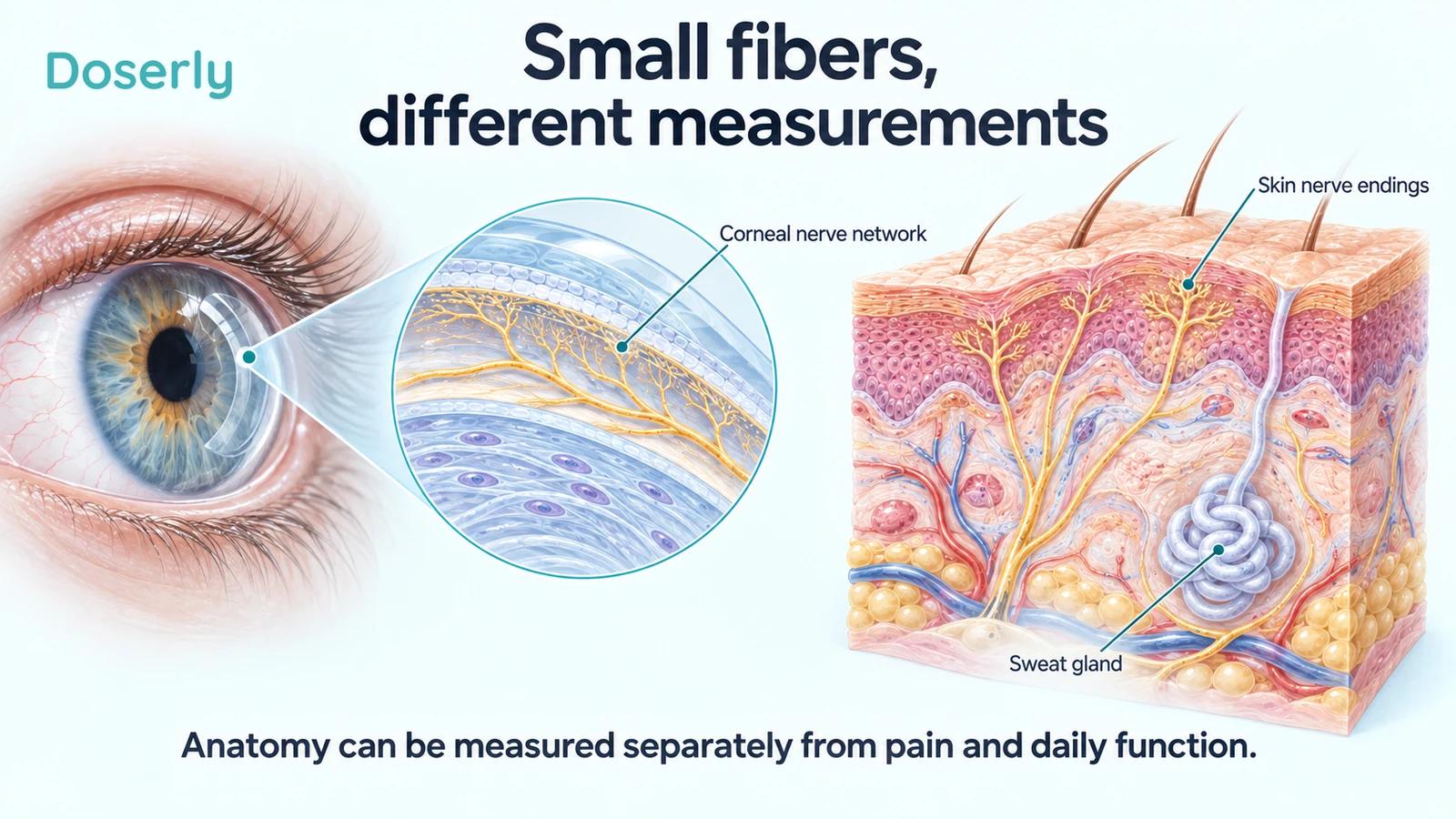
For a person living with persistent symptoms, an objective test can be valuable. It may document a problem that is otherwise difficult to explain. But a test result and the experience of illness still provide different information.
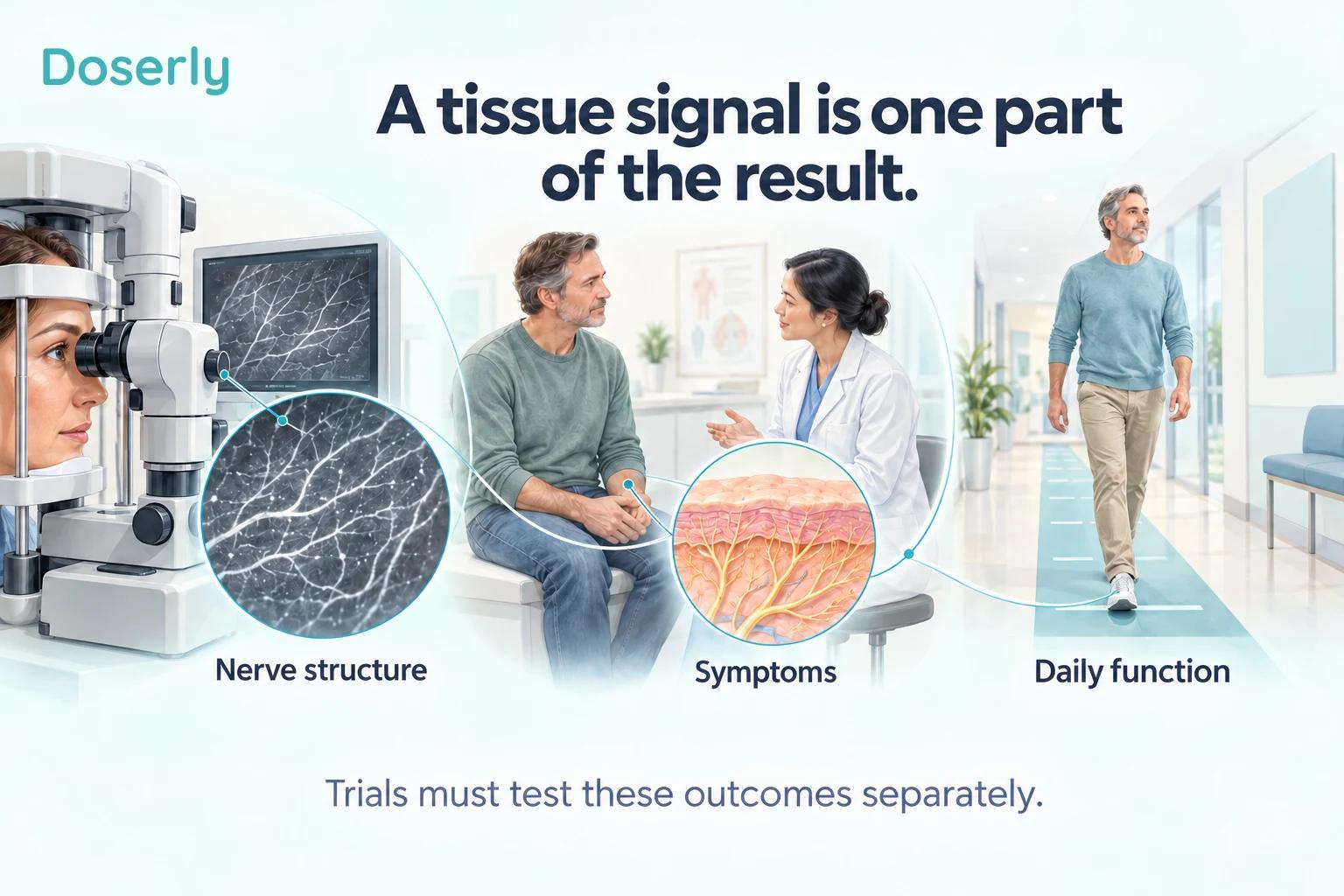
An increase in visible nerve area does not directly state how much pain a person feels, how well they sleep, or whether they can tolerate walking. Conversely, a symptom improvement does not automatically demonstrate that damaged nerves have regrown.
Why researchers examine the cornea
The cornea is the transparent front surface of the eye. Corneal confocal microscopy can visualize its small nerve network without removing a tissue sample.
Researchers can analyze several features of those images. Fiber density, fiber length, and fiber area are related measurements, but they are not interchangeable labels. Area describes how much of the image is occupied by the nerve network and can reflect features such as branching and thickness as well as length.
The 2017 trial selected change in corneal nerve fiber area at day 28 as its primary endpoint. Calling that simply “more nerves” can obscure what the instrument actually measured. Calling it a whole-body nerve repair rate goes further than the measurement supports.
The appeal is understandable: a repeatable tissue marker may reveal a biological response sooner than a long-term disability outcome. The harder question is whether a treatment-induced change in that marker reliably predicts benefits that patients experience. That relationship must be demonstrated rather than assumed. Trial methods and endpoint rationale
Doserly's ARA-290 guide provides background on the compound and its proposed mechanism. The question here is more specific: what do the human trial measurements actually establish?
The early pilot showed why symptom scales cannot be combined
The 2012 double-blind pilot enrolled 22 people with sarcoidosis and symptoms of small-fiber neuropathy. Twelve received ARA-290 and ten received placebo over four weeks.
The active-treatment group improved more on the Small Fiber Neuropathy Screening List, or SFNSL. That questionnaire covers a range of neuropathic symptoms; it is not simply a pain-intensity score.
Meanwhile, average Brief Pain Inventory scores and fatigue scores improved to a similar extent in both groups. Reporting only that pain improved after ARA-290 would omit the improvement among participants receiving placebo. 2012 pilot study
This is a practical example of the difference between a within-group change and a between-group treatment effect. The first asks whether a group changed from its own starting point. The second asks whether the active treatment changed the outcome more than the comparator did.
Both calculations can be useful, but the second is crucial when attributing a benefit to a drug. Symptoms can change during a trial for several reasons, including their natural fluctuation, expectations, and the attention associated with participation.
The pilot justified further investigation. Its mixed questionnaire findings did not establish uniform relief across every dimension of neuropathy.
The 2013 study added tissue measurements—and later a correction
A subsequent blinded, placebo-controlled study enrolled 38 people and examined corneal nerves, skin samples, sensory testing, symptoms, and walking performance after a 28-day treatment period.
It reported a corneal nerve-area signal and improvement in some symptom outcomes. Conventional intraepidermal nerve fiber density, measured in skin biopsies, did not show a significant improvement. Even at this early stage, the tissue assessments were not all telling the same story. 2013 study
In 2016, the authors published a correction: an arithmetic error had made the original absolute corneal nerve-area values too small. The correction specified how those values should be rescaled. An old chart copied from the original paper can therefore reproduce incorrect absolute numbers even when its general description sounds accurate. Publisher's erratum
That correction is not evidence that the entire research program was invalid. It is a reason to use the corrected record and avoid treating a striking image or unqualified percentage as a self-contained result.
It also illustrates why “nerve density increased” needs unpacking. Which tissue was sampled? Which measure was calculated? Was the change compared with baseline or placebo? Was the published analysis later corrected? Those details determine what a result means.
What the 2017 dose-ranging trial found
The later phase 2b trial randomized 64 participants with sarcoidosis-associated painful small-fiber loss to placebo or one of three cibinetide groups. Treatment lasted 28 days.
The groups were identified by study doses of 1, 4, and 8 mg per day. These are research-arm labels, not established treatment recommendations. The trial does not provide an approved regimen for self-treatment.
Two participants in the highest-dose group had a pharmacy assignment problem, and one participant in the middle group withdrew. The modified efficacy population therefore differed from the original randomized population. The registered study also included follow-up and safety assessments beyond the dosing period. Trial report, registered protocol and results
At day 28, the middle group had a placebo-corrected mean corneal nerve-area increase of about 697 square micrometers, with a 95% confidence interval from approximately 159 to 1,236. The reported P value was 0.012. The low and high groups did not achieve statistically significant differences for this endpoint.
This is evidence of a structural response under the trial's conditions. It is not a simple dose-response curve in which more drug produced more benefit. Nor does a positive middle group establish a universally optimal dose.
The skin result was more specific than “nerve density improved”
The investigators used two different approaches to skin nerve assessment. Standard intraepidermal nerve fiber density counted fibers according to the study's conventional method. A separate analysis measured fibers positive for GAP-43, a marker associated with nerve growth.
The middle treatment group showed a significant signal in GAP-43-positive fiber length. Standard intraepidermal fiber density did not show a significant difference between treatment groups.
That distinction is important because branching or elongation can change a nerve network without producing the same change in a conventional fiber count. The investigators interpreted the growth-marker result as supporting a regenerative effect. It remains more precise to describe the measured finding than to claim that all skin nerves were restored.
The corneal-area change also correlated with the skin growth-marker change. A correlation supports further investigation of a biological relationship. It does not establish that every participant gained a clinically important benefit or that the marker can already replace patient outcomes. Skin and corneal analyses
Pain and walking outcomes remained uncertain
Pain scores improved in the study groups, including placebo. In the subgroup with moderate-to-severe baseline pain, the middle cibinetide group had a placebo-corrected estimate favoring treatment, but the confidence interval crossed no difference and the P value was 0.157.
The authors described the estimated magnitude as clinically meaningful. That description should be read alongside the statistical uncertainty. A potentially worthwhile estimated effect and an inconclusive comparison can both be true.
Walking performance was assessed with a six-minute walk test. The middle-group comparison with placebo was also not statistically significant. Associations between corneal-area changes and walking changes did not turn that overall comparison into a positive trial result. Clinical outcomes
Outcome in the 2017 trial
Corneal nerve fiber area
- What the result supports
- A significant placebo comparison in the middle treatment group
Outcome in the 2017 trial
GAP-43-positive skin fiber length
- What the result supports
- A supportive growth-marker signal in that group
Outcome in the 2017 trial
Conventional skin fiber density
- What the result supports
- No significant treatment-group difference
Outcome in the 2017 trial
Pain and walking comparisons
- What the result supports
- Uncertainty about benefit beyond placebo
The table describes this trial, not every possible use of cibinetide. It also avoids collapsing several different endpoints into a single “success” or “failure” label.
Short-term findings do not establish durable recovery
The dosing period was four weeks. After treatment stopped, corneal nerve area trended back toward baseline. That observation limits claims that one short course permanently repairs neuropathy.
A longer trial would need to establish whether a tissue effect persists, whether patients experience meaningful improvement, and whether continued exposure changes the risk-benefit balance. It would also need enough participants to make estimates more stable.
Sarcoidosis itself further limits generalization. A trial in people with sarcoidosis-associated small-fiber loss is not direct evidence for chemotherapy-related neuropathy, an unexplained burning sensation, or a compressed nerve. Similar symptoms do not guarantee the same underlying process or treatment response.
These limitations are not reasons to dismiss an interesting finding. They identify the questions that remain unanswered before a structural signal becomes dependable clinical guidance.
Safety deserves the same precision as efficacy
The 2017 study did not support a blanket “no serious adverse events” description. Three participants in active-treatment groups had serious events. One participant in the highest group experienced suicidal ideation, which investigators considered possibly related to treatment.
That assessment does not establish causation, but it belongs in an honest account of the trial. The registry's safety results also document serious events and the smaller safety population. Full safety report, registry results
Several authors had relationships with the developer. Disclosure does not negate the data; it strengthens the case for independent replication and careful reading of endpoint choices.
As of the October 2026 research check, no approved cibinetide product was identified in the US FDA approval database under cibinetide or ARA-290. A research compound's availability from a seller does not establish that it matches the trial material or has an approved neuropathy indication. FDA approval databases
For someone considering these findings, the useful conversation starts with the diagnosis, the relevant trial population, and the outcome that matters most: pain, sleep, function, or a particular autonomic symptom. A nerve image may help researchers understand a treatment. The patient still needs evidence that the treatment improves life, with acceptable risks, over a meaningful period.
Sources
- 2012 randomized pilot
- 2013 corneal and skin study
- 2016 correction
- 2017 phase 2b trial, published full text
- NCT02039687 protocol and results
- NINDS peripheral neuropathy guidance
- FDA approval databases