
Peptides
October 16, 2026
ARA-290 and metabolic outcomes: what the diabetes study actually found
On this page
ARA-290 is usually discussed in connection with small nerve fibers and neuropathic pain. It has also been investigated for metabolic effects, including blood glucose and blood lipids. That overlap makes biological sense as a research question: diabetes affects nerves as well as the body's handling of glucose, and researchers wanted to know whether one investigational peptide might influence both.
There is an important detail in the human evidence. HbA1c was listed as a primary endpoint in the published diabetes trial, not merely an unexpected secondary discovery. The study's other findings still need to be separated into planned outcomes, additional analyses and possible explanations. Calling every metabolic observation “secondary” would understate the design; treating the whole package as established diabetes therapy would overstate the results. Primary trial methods
The useful question is what changed, by how much, in whom and for how long. Those details help explain why the findings deserve investigation without making ARA-290 a proven way to improve long-term metabolic health.
Why a nerve-focused peptide was studied in diabetes
ARA-290, also called cibinetide, is an 11-amino-acid peptide designed from part of erythropoietin. Its development aimed to separate tissue-protective activity from erythropoietin's stimulation of red blood cell production. Laboratory and animal research supplied the initial rationale for studying effects on injured or stressed tissues. That early work is distinct from demonstrating improved glucose control in people. Peptide-development study
Diabetes adds several connected but separate clinical questions. Can an intervention change average glucose? Does it affect blood lipids? Does it reduce nerve symptoms? Does it alter tissue structure? Does any of this reduce future complications? A single study can collect information about several questions, but a favorable result in one does not automatically answer the others.
Our ARA-290 guide explains the broader nerve-related research. Here the focus is the metabolic findings and how much they contribute to a treatment decision.
What HbA1c measures
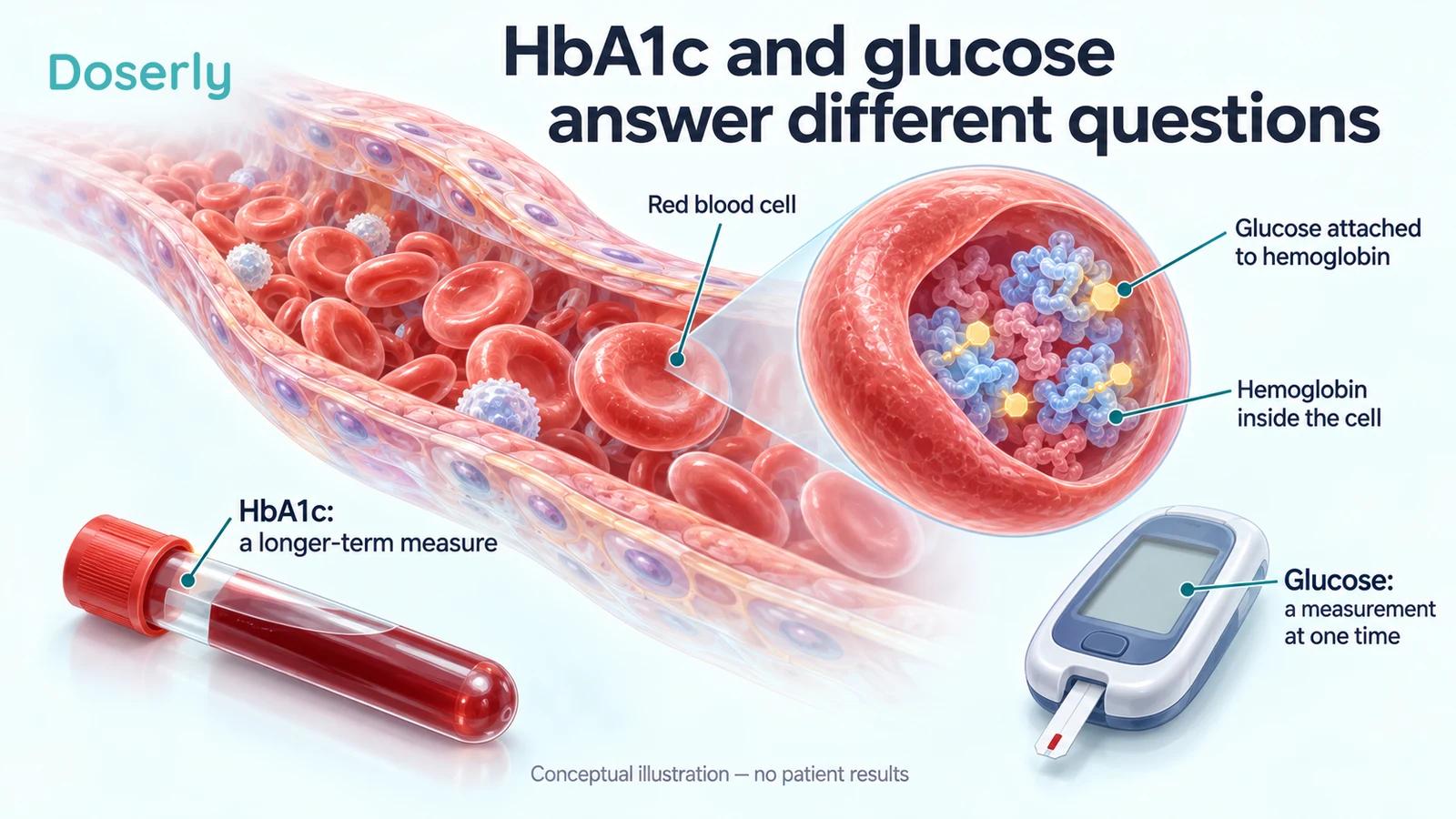
Hemoglobin is the oxygen-carrying protein inside red blood cells. Glucose becomes attached to some of that hemoglobin, and the HbA1c test measures the proportion with glucose attached. It provides information about average glucose exposure over roughly the preceding three months, with recent glucose levels contributing to the result. It is different from a glucose measurement taken at a single moment. NIDDK explanation of A1C
That timescale matters in a four-week treatment study. HbA1c can begin changing during a short intervention, but the result still reflects a period extending beyond the treatment days. A measurement a month after dosing stops does not, by itself, show that a drug remains active throughout that month or that a permanent biological change has occurred.
HbA1c is also not an infallible direct measurement of every aspect of glucose regulation. Conditions affecting red blood cells or hemoglobin can alter its interpretation. The ARA-290 study monitored hematology and did not report a clinically significant group-level blood-cell change, but complementary glucose measurements would still help characterize a metabolic effect. NIDDK; trial safety methods and results
Who was in the diabetes trial?
The study enrolled people with type 2 diabetes and painful neuropathic symptoms, rather than people seeking general metabolic enhancement. Forty-nine enrolled, and 48 entered the main analysis after one participant discontinued because kidney function worsened. Participants received daily subcutaneous ARA-290 or placebo for 28 days, followed by another 28 days without study dosing. Their existing diabetes and pain treatments generally continued. Trial design
The HbA1c analysis used 42 participants with complete serial measurements: 21 in each group. Mean starting HbA1c was 7.3% in the ARA-290 group and 6.9% in the placebo group. These were generally reasonably controlled participants, not a sample selected for very high glucose despite intensive treatment.
Both the missing measurements and the starting difference matter. They do not invalidate the study, but they limit how confidently its estimate can be transferred to another population. A small complete-case analysis is less secure than a large study with nearly complete follow-up and well-balanced baseline characteristics.
How large was the HbA1c change?
At day 28, mean HbA1c change was −0.16 percentage points with ARA-290 and −0.01 with placebo. At day 56, the changes were −0.21 and +0.21 percentage points, respectively. The paper reported a significant repeated-measures comparison across time, P=0.002. Metabolic results
Subtracting the reported mean changes gives an approximately 0.15-percentage-point advantage at day 28 and a 0.42-percentage-point advantage at day 56. These are simple differences calculated from group means, not separately reported adjusted treatment estimates with confidence intervals. They should not be presented as an exact expected effect for an individual.
The units are important. A fall of 0.21 percentage points from an HbA1c of 7.3% would produce about 7.09%, using those rounded group values. It is not a 21% reduction in blood glucose. Percentages and percentage-point changes are frequently confused, making small laboratory changes sound much larger than they were.
The later difference also partly reflects the placebo group's increase. Saying only that ARA-290 “lowered HbA1c by 0.42” would misdescribe the active group's observed change. Both trajectories belong in the explanation.
A planned primary outcome can still be preliminary
The trial listed adverse events and laboratory parameters, HbA1c, and several symptom questionnaires among its primary endpoints. Its sample-size calculation, however, was based on an expected difference in a small-fiber symptom score drawn from earlier sarcoidosis research. The study was not a large, dedicated confirmatory diabetes-outcome trial. Methods and statistical planning
These details answer different questions. Prespecification tells us that HbA1c was part of the planned investigation. Sample size and follow-up tell us how precisely and durably the effect was evaluated. Having a primary endpoint does not automatically make a study definitive, particularly when there are several primary measures and many additional comparisons.
The correct description is therefore a planned metabolic signal from a small phase 2 study. It should neither be dismissed as an accidental observation nor promoted as proof of a durable diabetes treatment benefit.
What happened to cholesterol and triglycerides?
The paper reported favorable changes in the total-cholesterol-to-HDL ratio and triglycerides, with P values of 0.039 and 0.043. HDL itself increased numerically, but the comparison had P=0.066 and did not cross the conventional 0.05 threshold. The authors also noted that the triglyceride samples were not fasting samples. Lipid results and discussion
These findings should remain individual findings, rather than becoming a broad claim that the peptide “normalizes cholesterol.” A ratio can change because its numerator, denominator or both change. Nonfasting sampling adds context to triglyceride interpretation. Several comparisons near a statistical threshold require replication, especially when the study was not sized around a lipid endpoint.
There is also a wording inconsistency in the paper: a figure caption describes a favorable increase in the cholesterol-to-HDL ratio, while the results text describes a reduced ratio. The article's clinical interpretation here follows the results narrative and does not reproduce the contradictory caption as a new claim.
Most importantly, blood-lipid measurements are not cardiovascular events. This study did not establish fewer heart attacks, strokes or deaths. A plausible metabolic effect is a reason to design that next stage of research, not a substitute for its results.
Did better glucose explain the nerve findings?
The same trial reported an improvement on PainDetect, one neuropathic symptom questionnaire, but not a consistent advantage across every pain measure. Overall corneal nerve density did not change significantly; a post hoc subgroup with low starting density showed a more favorable signal. Neuropathy results
Those observations do not establish whether glucose changes caused symptom changes, whether both arose through another mechanism, or whether the relationships would persist in a larger trial. The investigators discussed possible mechanisms from preclinical work, including effects on insulin resistance and insulin secretion, but did not directly establish those explanations in these participants.
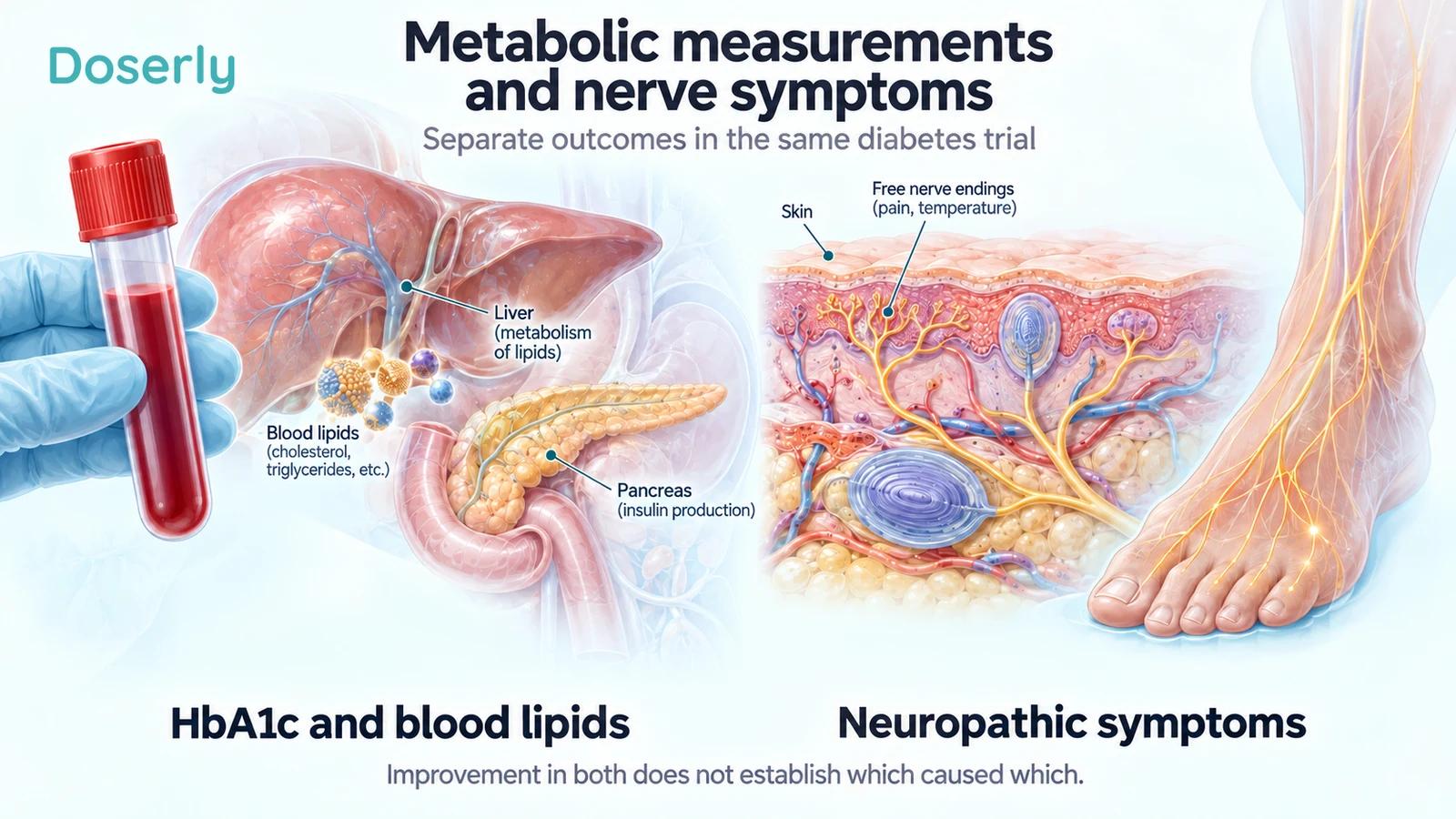
This matters when claims combine several steps into a single promise: better metabolism, then regenerated nerves, then lasting relief. The human study did not test and confirm that whole sequence. A careful account can acknowledge the findings without supplying an unmeasured causal pathway.
Does the eye study confirm a metabolic benefit?
A later report examined cibinetide in diabetic macular edema, swelling in the central retina. Nine participants were recruited, eight completed a 12-week course, and there was no placebo group. The main visual-acuity and retinal-thickness outcomes did not improve on average. The report described improvements in some exploratory metabolic or other measurements in some participants. Diabetic macular edema study
An uncontrolled observation in a few people is not an independent confirmation of the randomized HbA1c result. Existing treatment, behavior, measurement variability and the passage of time can contribute to changes. The eye study helps identify possible questions, but it cannot determine how much of a metabolic change was caused by cibinetide.
It also concerns a different clinical problem. Corneal nerve imaging, retinal swelling and a blood-glucose marker should not be blended into one generic “eye and metabolic repair” outcome. They examine different structures and functions.
What about the dedicated prediabetes study registration?
ClinicalTrials.gov lists a separate phase 2 study designed to examine oral glucose tolerance, insulin secretion and related measures in prediabetes or drug-naive type 2 diabetes. Its estimated enrollment was 24. When checked on October 15, 2026, the record's overall status was unknown, its last update was in September 2015, and no results were posted. NCT01933529
That registration shows that researchers planned a more directly metabolic investigation. It does not tell us whether the intervention succeeded, failed or produced inconclusive results. The historical planned dates cannot be treated as evidence that a completed positive trial exists.
The absence of posted results also should not be converted into proof of failure. It is an information gap. For someone assessing treatment claims, the practical consequence is that the registration cannot fill the missing evidence about insulin secretion, sensitivity or durable glucose control.
What research would change the clinical picture?
A more informative study would recruit a clearly defined diabetes population, specify one principal metabolic question, keep background care documented and follow participants long enough to assess a stable glucose effect. It would report all randomized participants, explain missing results and provide treatment differences with uncertainty estimates.
If the goal is glucose management, relevant measurements include HbA1c together with glucose profiles and adverse effects such as hypoglycemia. If the goal is reducing complications, the trial needs longer follow-up and outcomes that directly address those complications. If the proposed advantage is helping neuropathy as well, that benefit must be measured independently rather than inferred from HbA1c.
Safety remains part of this assessment. The diabetes study's detailed report includes serious adverse events and the kidney-related withdrawal. A small biochemical benefit cannot be weighed sensibly without the treatment's burdens and uncertainties. Full trial report
What the findings mean for a patient
The available result is interesting, but it does not provide a reason to replace established diabetes care with ARA-290 or to infer a personal dosing schedule. If you are discussing it with a clinician, ask which outcome is expected to improve and whether the evidence concerns people with your glucose control, complications and current medicines.
Ask for the actual change and comparison, rather than a general statement that a study “improved metabolism.” A modest HbA1c shift, an uncertain lipid result and a reduction in serious complications are different claims. Our ARA-290 human evidence section can help connect those questions with the broader clinical research.
The strongest conclusion is specific: a small randomized trial reported a planned HbA1c signal and additional metabolic findings over a short period. It established a worthwhile research question, not a complete answer about long-term metabolic treatment.
Explore the research
- Brines et al., diabetes trial: primary endpoint definitions, HbA1c, lipids and safety.
- NIDDK: the A1C test: measurement and interpretation.
- Original peptide-development experiments: preclinical rationale.
- Diabetic macular edema study: uncontrolled clinical and exploratory findings.
- NCT01933529: dedicated metabolic study plan, with no posted results at this review.