
Supplements
October 16, 2026
Apple cider vinegar: a meal glucose effect is not a weight-loss treatment
On this page
Apple cider vinegar enters the glucose conversation because some small human experiments found a lower blood-glucose response after a carbohydrate-containing meal. That is an interesting nutritional observation. It is also a much narrower result than a promise to reverse insulin resistance, treat diabetes or produce lasting weight loss.
The distinction matters because these claims often travel together. A person sees a lower post-meal reading, assumes less of the meal was absorbed, then expects that effect to accumulate into fat loss. None of those steps automatically follows from the previous one. A meal test measures a response over a particular observation window. Long-term glucose management and body-weight change require different measurements and longer studies.
There is also an update that changes the weight-loss discussion: BMJ retracted the widely publicized 2024 apple cider vinegar trial in 2025 because its results were unreliable. Those findings should no longer be used as evidence of benefit. BMJ’s retraction announcement.
The useful question is what remains when that unreliable result is removed and the meal studies are read on their own terms. The Doserly apple cider vinegar guide offers additional background on the ingredient; this article separates the short-term glucose findings, longer studies and practical tolerability issues.
What the meal experiments actually tested
A 2010 publication reported four randomized crossover experiments, each involving only nine or ten adults. Three involved people without diabetes and one involved people with type 2 diabetes. Participants received different vinegar amounts, timing conditions or preparations, with glucose measured for two hours after a test meal. Most experiments used a bagel-and-juice meal; one used a dextrose solution. Johnston and colleagues, 2010.
Vinegar reduced the post-meal glucose response under some conditions, particularly when consumed with a meal containing complex carbohydrate. The effect was not found with the monosaccharide condition, and sodium acetate did not reproduce it. Timing also mattered: taking vinegar with the meal had a more pronounced effect than taking it five hours earlier. The primary report therefore describes a meal-specific response, not an all-day glucose shield.
A crossover design lets the same person experience different conditions, which is useful for a small feeding experiment. It does not create a large population study. Nine people observed under several conditions are still nine people, not hundreds of independent participants. The controlled meal also makes the comparison cleaner than an ordinary day, while narrowing how confidently the result transfers to other meals.
For a reader, the key detail is that vinegar did not have a uniform effect on every carbohydrate challenge. That makes it inappropriate to promise that an arbitrary supplement taken at an arbitrary time will reproduce the result. It also means the food itself remains part of the intervention: the researchers did not test vinegar in isolation from the meal.
A smaller rise does not explain the whole mechanism
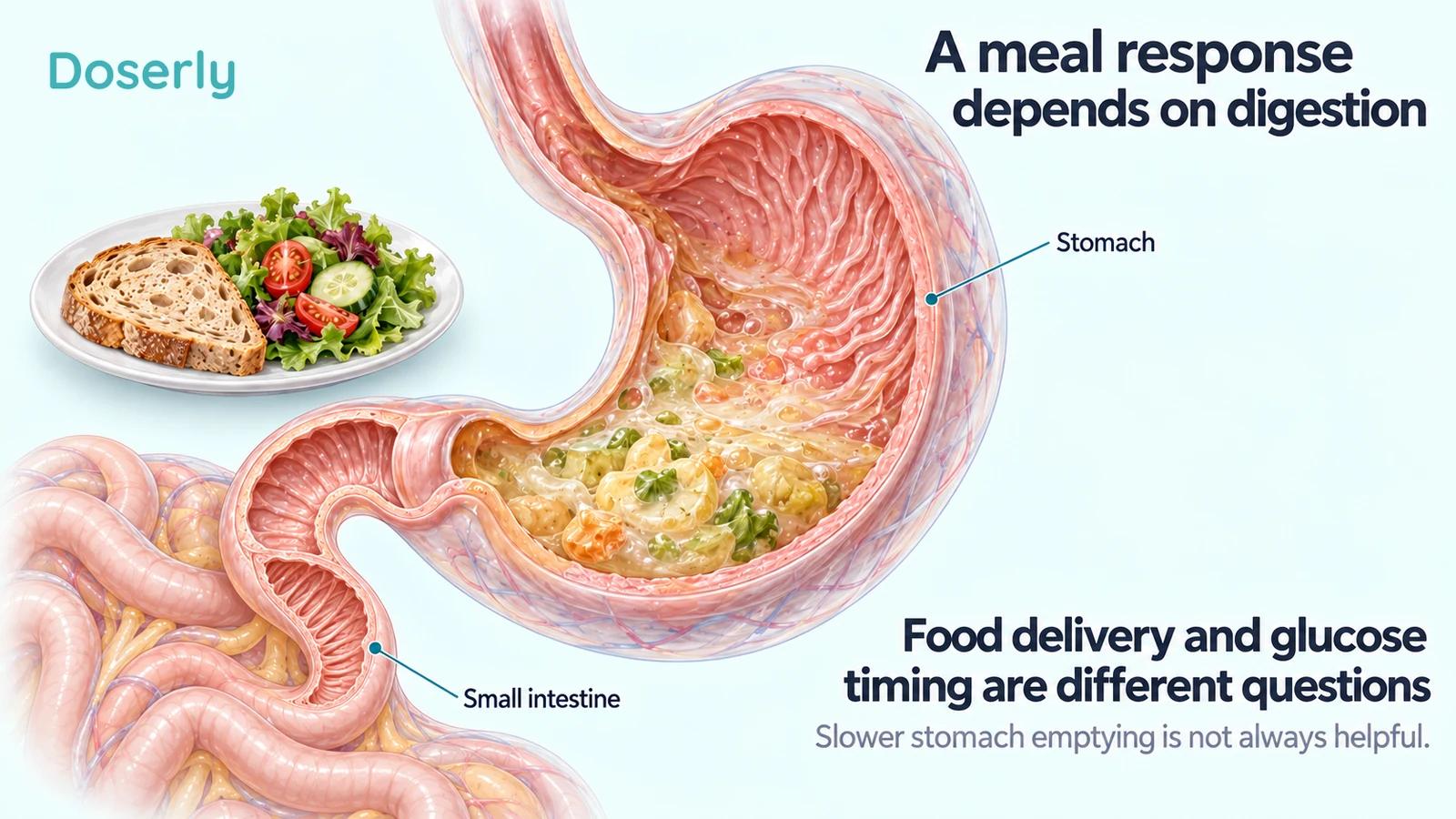
A lower glucose value after eating can arise from changes in the timing of digestion and nutrient delivery, as well as changes in glucose handling. A graph over two hours cannot by itself establish how much energy was absorbed, whether later glucose values differed, or whether the effect would persist with daily use. These are separate questions that need appropriate measurements.
One reason gastric emptying deserves attention is a small study in people who already had delayed stomach emptying. Ten adults with type 1 diabetes and diabetic gastroparesis completed a crossover pilot study comparing a rice-pudding meal with water against a condition including apple cider vinegar. Ultrasound measurements showed a further reduction in the gastric-emptying rate: median values were 27% without vinegar and 17% with it. Hlebowicz and colleagues, 2007.
The authors warned that this could be a disadvantage for glucose control in that population. The same general idea that sounds attractive in an advertisement—food leaving the stomach more slowly—may be unhelpful when stomach emptying is already abnormal. This pilot does not establish a universal mechanism in everyone, but it does establish a reason not to transfer advice from healthy meal studies to gastroparesis.
Someone with diagnosed gastroparesis or a diabetes regimen tied to meals should discuss vinegar use with the treating team rather than trying to engineer a lower peak independently. A change in the timing of food delivery is not the same as correction of the underlying condition. The measured curve must be interpreted within the person’s treatment and symptoms.
Longer glucose studies offer a signal, with important instability
A 2021 systematic review combined nine studies with 686 participants. It reported pooled reductions in fasting glucose of about 8 mg/dL and HbA1c of about 0.5 percentage points. However, results varied substantially between studies. The HbA1c result was especially fragile: it became nonsignificant when one influential study was removed, and also when studies judged at high risk of bias were excluded. Hadi and colleagues, 2021.
The included interventions lasted roughly one to three months. Participants, comparators and study quality differed, and the review did not find a significant overall effect on fasting insulin or HOMA-IR, a calculated measure used in insulin-resistance research. The review predates the retracted 2024 weight-loss paper, so that later retraction is not the explanation for its limitations. The 2021 review has its own reasons for caution.
This distinction is useful when reading a pooled result. A meta-analysis can summarize a collection of trials, but it cannot make their design problems disappear. If the answer changes markedly when a single study is removed, the average is less dependable than its decimal places suggest. The appropriate takeaway is a possible adjunctive effect that needs stronger confirmation, rather than a reliable amount to subtract from a person’s next HbA1c.
Nor does a fasting-glucose result prove improved long-term clinical outcomes. None of these short trials establishes prevention of kidney disease, retinopathy or cardiovascular events. A person receiving diabetes care should not reduce treatment because a supplement review reports an average laboratory improvement. The review does not supply an individualized replacement strategy.
What happened to the prominent weight-loss study
The 2024 Lebanese trial attracted attention for apparently substantial weight loss with small daily quantities of apple cider vinegar. BMJ’s subsequent investigation identified problems involving statistical analysis, implausible values, raw-data reliability, methods reporting and lack of prospective registration. Independent statisticians could not replicate the results, and the authors agreed to retraction. BMJ Group’s account.
That is more consequential than adding a routine “small study” caveat. The findings are unreliable and should be removed from the evidence supporting a weight-loss claim. Repeating the original dramatic figures with a brief warning still gives them a role they no longer deserve.
The retraction does not prove that vinegar can never influence body weight. It changes which data can support the argument. Older, independent studies can still be evaluated, but a summary that includes the retracted trial needs to be checked before its pooled estimate is repeated. A later publication date alone does not tell the reader whether that correction has been incorporated.
The older Japanese trial was more modest
A 2009 randomized trial enrolled 175 Japanese adults with BMI between 25 and 30; 155 were included in the final reported study population. Participants received a daily beverage containing 15 mL of apple vinegar, 30 mL, or no vinegar for 12 weeks. Both vinegar groups had lower body weight than the placebo group, with the authors describing reductions on the order of 1–2 kg. Kondo and colleagues, 2009.
The report also states that body weight returned to initial values during the four-week post-treatment period. The investigators were affiliated with a vinegar manufacturer, and the participants were a defined population without medication use. These details limit how confidently the findings can be generalized. The trial is a short-term signal, not evidence of durable weight maintenance. The full primary report.
The studied beverage also does not validate every product sold under the apple cider vinegar name. A tablet, gummy, concentrated shot or differently formulated drink may not deliver the same acetic-acid exposure. A recognizable ingredient name does not make all those interventions equivalent.
For someone seeking a sustainable weight-management approach, duration matters as much as whether a result reaches statistical significance. A few months of change followed by loss of the effect is a different proposition from a treatment with demonstrated maintenance and a well-characterized long-term benefit–risk balance. The older trial is worth knowing about, but it does not justify the sweeping promise usually attached to vinegar.
Reduced appetite may reflect poor tolerability
Two acute feeding studies examined whether vinegar’s effect on appetite was related to how well it was tolerated. In the ingestion study, involving 16 healthy young adults, reduced appetite was accompanied by higher nausea ratings. A separate taste-only experiment in 14 adults did not reproduce the appetite effect. The investigators concluded that poor tolerability was an important explanation for the apparent appetite suppression. Darzi and colleagues, 2014.
That is a clinically relevant distinction. Feeling comfortably satisfied after a meal is not the same experience as avoiding food because a drink makes you nauseated. A product does not become a good weight-management choice merely because it makes eating less appealing.
If vinegar causes nausea, burning or other discomfort, there is no reason to interpret those symptoms as proof that it is working. The tolerability result argues against celebrating an unpleasant effect as a metabolic advantage. It also helps explain why an appetite questionnaire and a long-term weight outcome are not interchangeable measures.
Acidity creates risks before any metabolic effect
Repeated contact with dietary acids can damage tooth surfaces. The American Dental Association emphasizes that frequency and patterns of exposure matter, not just the acidity of a single serving. Its advice includes avoiding swishing or holding acidic drinks in the mouth, rinsing with water afterward, and avoiding immediate brushing after an acidic exposure. ADA dental erosion guidance.
That is relevant to routines involving repeated vinegar sipping or concentrated shots. Dilution does not turn an acidic product into a proven metabolic treatment, and tolerating it does not establish that the teeth are unaffected. A dentist can assess existing erosion or sensitivity and the wider pattern of acidic exposures.
Tablets are not automatically a solution. A 2005 report followed an esophageal injury associated with an apple cider vinegar tablet and tested eight tablet products. The investigators found considerable differences in acidity, composition and label claims. It was a case-linked product investigation, not an estimate of how frequently tablets cause injury. Hill and colleagues, 2005.

Keep a food choice separate from a treatment decision
Enjoying vinegar in food does not require believing that it treats diabetes. If the purpose is flavor, choose it for flavor and tolerability. If the purpose is glucose management or weight loss, the evidence needs to meet that larger claim. The available meal experiments do not establish a universal dose or a substitute for care.
When discussing an existing vinegar routine with a clinician, describe the actual preparation, amount, timing, symptoms and medications. If glucose readings changed, bring the meal context and broader pattern rather than one favorable screenshot. A meal was not necessarily identical simply because it had the same name: portion size, accompanying foods and timing may have changed as well.
The research leaves room for a modest food-related effect on selected measurements. It does not support treating a lower meal reading as proof of fat loss, a retracted trial as continuing evidence, or nausea as a desirable appetite mechanism. Those distinctions let vinegar remain an ordinary culinary choice without asking it to carry a treatment promise it has not earned.
Sources
- Johnston et al. Examination of the antiglycemic properties of vinegar, 2010.
- Hlebowicz et al. Apple cider vinegar and delayed gastric emptying in type 1 diabetes, 2007.
- Hadi et al. Apple cider vinegar, lipid profiles and glycemic parameters: systematic review, 2021.
- BMJ Group. Retraction of the apple cider vinegar weight-loss trial, 2025.
- Kondo et al. Vinegar intake and body weight in Japanese adults, 2009.
- Darzi et al. Vinegar tolerability, appetite and food intake, 2014.
- American Dental Association. Dental Erosion.
- Hill et al. Esophageal injury and apple cider vinegar tablet evaluation, 2005.