
TRT
October 16, 2026
Anastrozole as a routine TRT add-on: what does the evidence show?
On this page
Anastrozole reduces the conversion of testosterone into estradiol. That makes it capable of changing a hormone result, but it does not establish that everyone starting testosterone replacement therapy needs it. The important question is whether adding the drug improves a particular problem enough to justify its risks and monitoring.
If anastrozole appears in a treatment package beside testosterone, it is reasonable to ask what each prescription is intended to accomplish. Testosterone treats an established deficiency in an appropriate patient. Anastrozole is a separate intervention with a separate purpose. Combining them on a prescription does not make the evidence for both equally strong.
The studies most relevant to men include a small retrospective TRT cohort, experiments on hormone physiology and trials examining bone or metabolic measurements. They answer useful questions, but they do not amount to a large randomized trial showing that routine preventive anastrozole makes TRT safer or more effective. Our anastrozole guide explains the medicine’s broader clinical context.
What does anastrozole actually change?
Aromatase is an enzyme that helps the body produce estrogens from androgens, including estradiol from testosterone. Anastrozole inhibits that enzyme. A decrease in estradiol therefore indicates that the drug is doing something pharmacologically predictable; it is not, by itself, evidence that the person needed treatment.
The drug’s FDA-approved uses concern breast cancer in postmenopausal women. Prescribing it for a man on TRT is an off-label use. Off-label prescribing can be appropriate in medicine, but the approval for a different population and condition cannot establish the benefit of this particular combination. National Cancer Institute drug summary.
Anastrozole also needs to be distinguished from medicines that act at estrogen receptors. Reducing hormone synthesis and changing receptor signaling are different interventions. A treatment discussed for breast tissue cannot be assumed to have the same effects throughout the body as another drug described informally as an “estrogen blocker.”

What did the TRT cohort find?
A 2021 report reviewed a clinical population of 1,708 men receiving testosterone therapy. After exclusions, the analysis included 44 men treated with anastrozole for elevated estradiol under that clinic’s criteria. Median estradiol decreased from 65 to 22 pg/mL, while total testosterone did not change significantly. Punjani and colleagues.
This was a retrospective study: researchers examined clinical records rather than randomly assigning otherwise comparable patients to routine anastrozole or no anastrozole. The treated men were selected because of their results and, in some cases, symptoms. The paper supports the conclusion that the medication lowered estradiol in this selected group.
It does not establish that all 1,708 patients would have benefited from taking it. Nor does it validate the clinic’s treatment thresholds as universal cutoffs. The design does not provide a reliable estimate of how often preventive treatment would improve symptoms, prevent breast changes or cause harm compared with a strategy of evaluating problems as they arise.
The distinction matters when a clinic says it “uses anastrozole successfully.” That may accurately describe laboratory changes or individual experiences. To evaluate routine use, however, we need to know what happens to comparable people who do not receive it.
Routine prevention and treatment of a problem are different questions
Imagine a man who has just started TRT, feels well and has no breast symptoms. A preventive add-on asks whether taking anastrozole now will avert a problem later. That requires evidence about future outcomes in similar people, including how many would never have developed the problem without it.
Now imagine someone with persistent breast tenderness that has been examined and investigated. Treatment in that setting asks whether an intervention improves an existing complaint. The benefit might be more immediately assessable, but the diagnosis and the reason for choosing that drug still matter.
These situations should not be pooled into one claim that “anastrozole works on TRT.” A drug can change estradiol in both while having very different practical value. A person without the target symptom cannot experience relief of that symptom, so preventive prescribing requires its own justification.
The American Urological Association discusses measuring estradiol in the context of breast symptoms and recognizes that symptoms can sometimes settle during monitoring. It does not make automatic anastrozole part of every testosterone prescription. AUA guideline.
Does a better testosterone-to-estradiol ratio mean better health?
A ratio can summarize two measurements, but it cannot create a clinical outcome that was not measured. Increasing a ratio might reflect higher testosterone, lower estradiol or both. Those changes need not have identical effects.
The 2013 hormone-suppression experiment in healthy men illustrates the problem. Testosterone and estradiol contributed differently to body composition and sexual function. In that experimental setting, estrogen deficiency was primarily responsible for fat accumulation, while both hormones contributed to sexual function. A higher androgen-to-estrogen relationship was therefore not a general guarantee of a better result. Finkelstein and colleagues.
A ratio also depends on units. Dividing testosterone reported in ng/dL by estradiol reported in pg/mL gives a different-looking number from expressing both in the same units. Before discussing an “optimal ratio,” ask how it was calculated and which patient outcome validates that target.
For someone making a treatment decision, the useful questions remain concrete: did tenderness improve, did sexual function improve, did an unwanted effect develop, and what happened to relevant safety measurements? A mathematically attractive ratio cannot answer those questions on its own.
What do the bone findings mean for men?
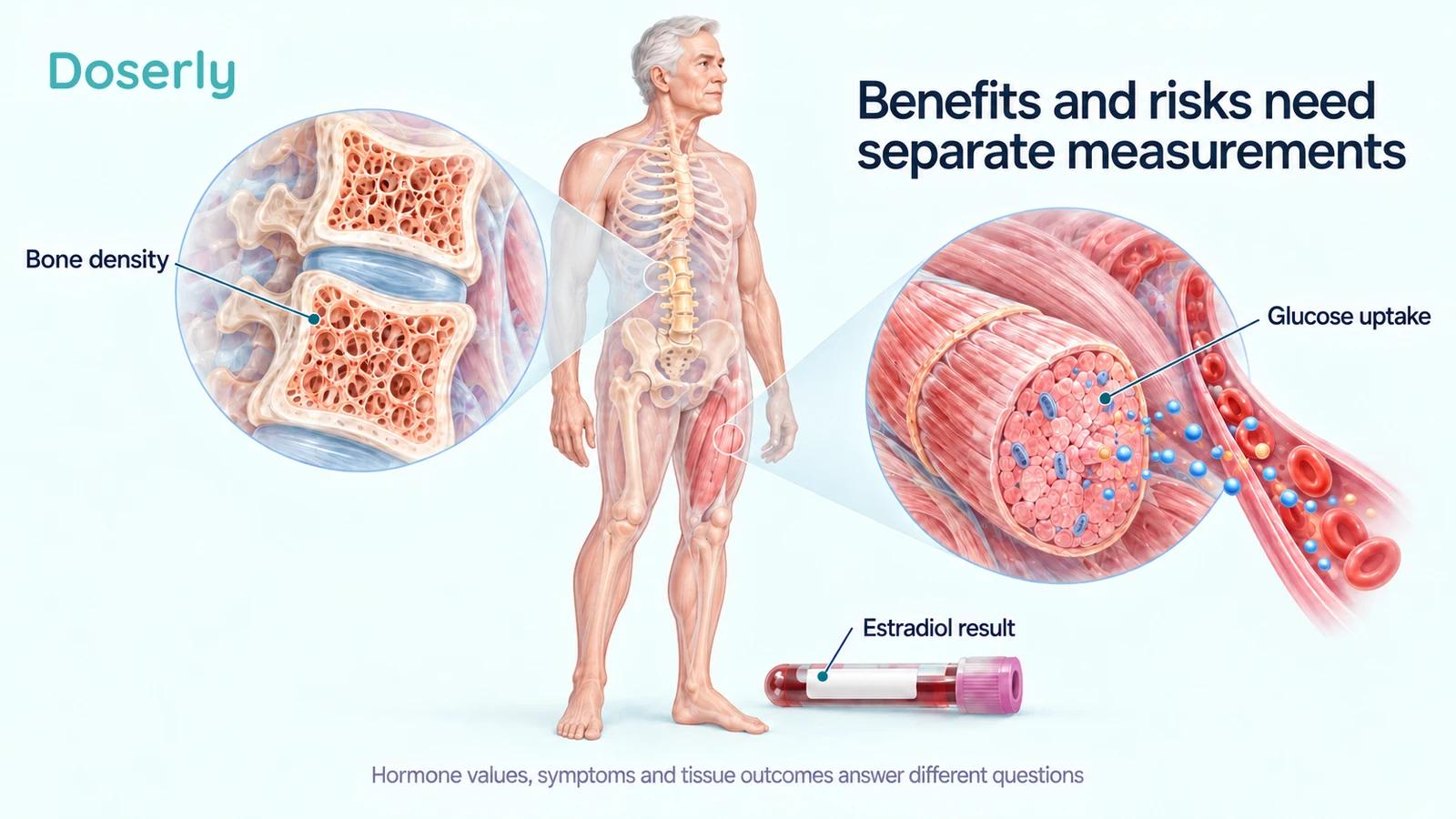
A randomized one-year trial in 69 men aged 60 or older found that anastrozole increased testosterone while spine bone mineral density decreased relative to placebo. These participants had low or borderline testosterone and symptoms; the study was not a comparison of low-dose add-on schedules in men already receiving TRT. Bone-density trial.
The result is a safety signal about sustained aromatase inhibition. It does not establish the fracture risk of every proposed regimen, and bone density is not the same endpoint as a fracture. It nevertheless challenges the assumption that raising testosterone while lowering estradiol must improve all hormone-sensitive tissues.
Someone considering prolonged use should ask how personal bone-health history affects the plan. The prescriber may consider age, prior fractures and other clinical factors when deciding whether additional assessment is appropriate. The decision cannot be reduced to whether joints feel comfortable during the first few weeks.
That perspective is especially relevant to a drug offered indefinitely “just in case.” An intervention intended to prevent an uncertain future problem can still introduce a measurable physiological trade-off.
Are there metabolic effects beyond the hormone numbers?
A small randomized crossover study examined 17 healthy men aged 18–50. Each participant received anastrozole and placebo for six weeks each, separated by a two-week washout. Researchers measured insulin sensitivity using a controlled infusion procedure that examines how the body handles glucose under standardized conditions.
Peripheral glucose disposal was reduced during aromatase inhibition. That suggests a metabolic effect worth taking seriously, but it is not proof that anastrozole causes diabetes in routine TRT care. The experiment was short, small and conducted in healthy volunteers. Gibb and colleagues.
The useful lesson is that estradiol suppression has effects beyond breast tissue and a blood-test flag. A treatment package should be judged by its overall benefit and burden, not by the apparent simplicity of adding one tablet.
These data also do not justify claiming that every person will experience metabolic harm. A careful discussion can acknowledge a signal without converting it into a precise personal risk that the study did not estimate.
What about gynecomastia specifically?
Gynecomastia means growth of glandular breast tissue. It is different from fat accumulation in the chest and from breast tenderness without demonstrable gland enlargement. Determining which problem is present changes the treatment discussion.
European Academy of Andrology guidance emphasizes evaluating causes and does not recommend aromatase inhibitors for gynecomastia in general. That broad recommendation reflects limitations of the evidence and the need to address the underlying condition. It does not prevent a specialist from discussing selected off-label options, but it makes a blanket prevention claim difficult to defend. EAA guideline.
If a new lump appears during TRT, the important first step is an appropriate assessment. Starting an estrogen-lowering drug cannot establish what the lump is. Similarly, persistence despite a lower estradiol result should prompt reconsideration of the explanation rather than automatic escalation.
A clinical response should be defined before treatment. Reducing pain, changing gland size and preventing future enlargement are separate goals; one should not quietly be substituted for another at follow-up.
How can a prescriber make an individualized trial informative?
A useful plan begins with the indication. Ask the clinician to describe the problem being treated and why anastrozole is preferred for it. If the only explanation is that estradiol commonly rises alongside testosterone, the next question is whether that expected biochemical change is causing a clinically important problem here.
Agree on what will be reassessed and when. A follow-up that records only estradiol cannot answer whether mood, tenderness or sexual function improved. Conversely, a report of feeling better does not remove the need to consider safety or whether several changes happened together.
Keep a record of medication names and changes, laboratory dates and the main symptom. It is particularly helpful to identify additions made by different prescribers. A testosterone adjustment, a new aromatase inhibitor and a change in another medicine at the same time can make later interpretation difficult.
These are principles for discussing prescribed treatment, not instructions to start, stop or adjust medication yourself. A person already taking anastrozole may have a specific reason that is not apparent from a general article.
Questions to ask before accepting routine use
A brief conversation can clarify whether the prescription has a defined purpose:
- What finding or symptom makes anastrozole appropriate for me?
- What evidence supports using it now rather than evaluating a problem if one develops?
- Which outcome will show that it is helping?
- How will you assess excessive suppression and longer-term concerns?
- What would make us reconsider continued treatment?
The answers need not promise certainty. They should make the reasoning understandable. An individualized decision can be reasonable even when evidence is incomplete, provided the uncertainty is acknowledged and the plan is reviewable.
Anastrozole clearly can reduce estradiol. The stronger claim—that routine use improves TRT for everyone—requires evidence about symptoms, prevention and long-term outcomes that a laboratory response alone cannot supply. For more detail about the medicine and the monitoring issues behind these questions, see the Doserly anastrozole guide.
Sources
- Anastrozole — National Cancer Institute
- The Utilization and Impact of Aromatase Inhibitor Therapy in Men With Elevated Estradiol Levels on Testosterone Therapy
- Evaluation and Management of Testosterone Deficiency: AUA Guideline
- Gonadal Steroids and Body Composition, Strength, and Sexual Function in Men
- Effects of Aromatase Inhibition on Bone Mineral Density and Bone Turnover in Older Men with Low Testosterone Levels
- Aromatase Inhibition Reduces Insulin Sensitivity in Healthy Men
- EAA Clinical Practice Guidelines—Gynecomastia Evaluation and Management