
HRT
October 16, 2026
An IUD in an HRT plan: one device, different clinical jobs
On this page
“It lasts eight years” can be correct advice about contraception and incomplete advice about an HRT plan.
A levonorgestrel intrauterine device may prevent pregnancy, reduce heavy menstrual bleeding, and provide the progestogen component of some estrogen-containing menopause regimens. Those are separate clinical jobs. Evidence supporting a longer duration for one job does not automatically extend the others.
That distinction matters most when someone already has an IUD and later starts estrogen. The device may be familiar, comfortable, and still effective for contraception. Its insertion date nevertheless needs to be checked again against its proposed role in protecting the uterine lining. Starting estrogen does not reset the device's age.
The useful question is not simply “Do I have a coil?” It is “Which device is this, when was it inserted, and what are we relying on it to do?”
Why estrogen treatment raises a uterine-lining question
The endometrium is the tissue lining the inside of the uterus. Systemic estrogen can stimulate it. When a person with a uterus uses systemic estrogen for menopause symptoms, the regimen usually needs adequate progestogen protection against excessive endometrial growth.
A suitable levonorgestrel IUD can supply that progestogen locally. It releases levonorgestrel within the uterine cavity, producing a strong effect on the lining. It does not contain estrogen, and it does not independently replace estrogen treatment for hot flushes. UK Mirena product information
This is why an IUD and an estrogen patch may appear together in one plan without doing the same thing. The patch may address systemic menopause symptoms; the IUD may supply endometrial protection and, when still needed, contraception. Whether that combination is appropriate depends on the person and the specific product.
“Local” also needs careful interpretation. It describes where the device delivers its hormone and where important effects occur. It does not mean that no levonorgestrel reaches the bloodstream or that hormone-related adverse effects are impossible. Nor does it make the device identical to oral micronized progesterone.
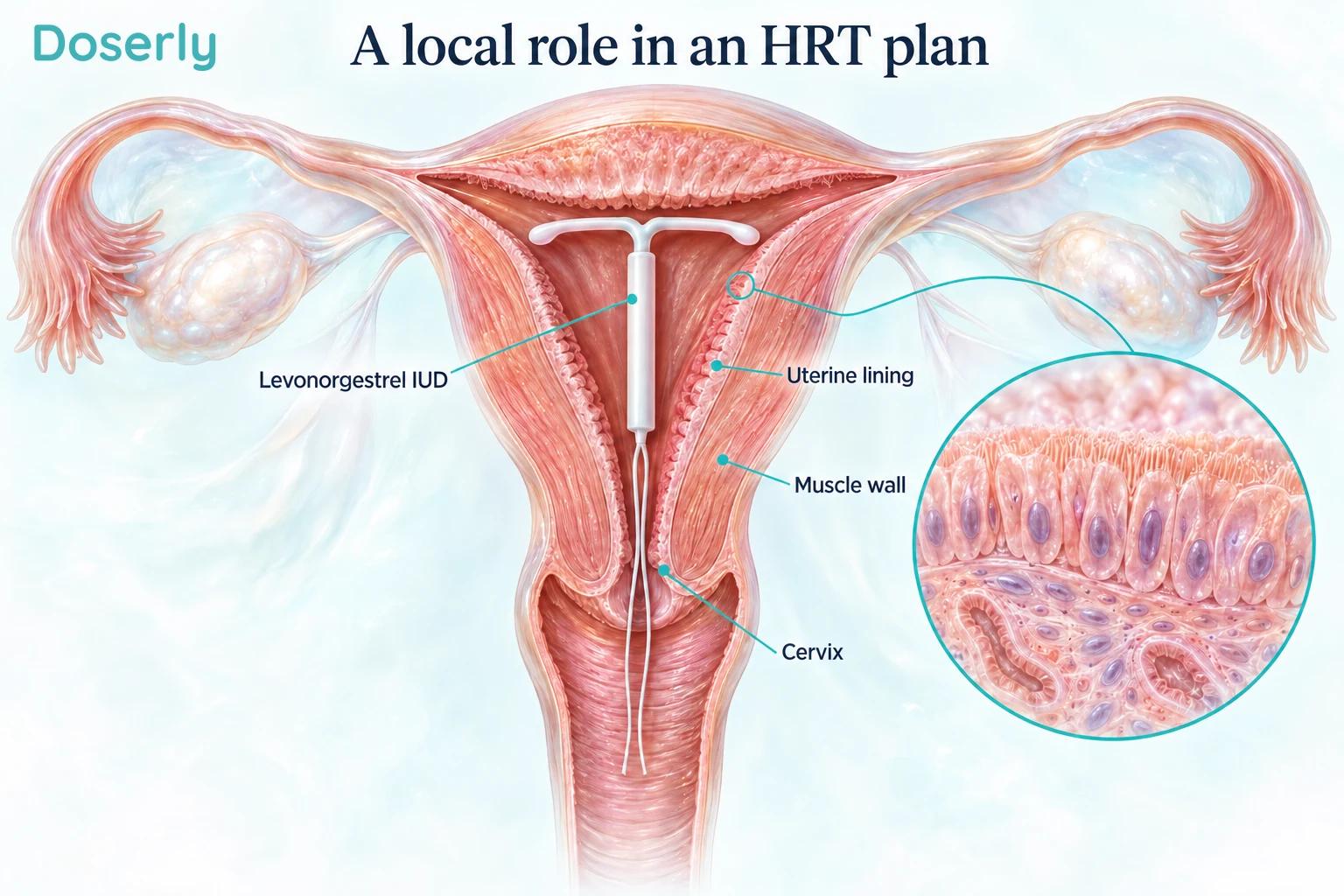
The Doserly levonorgestrel IUD guide explains the broader treatment context. For a prescription decision, the crucial details are the actual device and its agreed role.
What the eight-year study established
The Mirena Extension Trial studied existing users who were aged 18–35 when entering the extension phase. Of 362 participants starting year six, 223 completed year eight. Two pregnancies occurred with the device in place during the extension period. The estimated cumulative contraceptive failure rate across years six through eight was 0.68%, with a 95% confidence interval of 0.17%–2.71%. Jensen and colleagues
Those findings supported extended contraceptive use. They did not test protection of the endometrium in postmenopausal people receiving systemic estrogen. The investigators also noted that too few participants were using the device for heavy menstrual bleeding to assess extended use for that indication.
The study was a prospective, single-arm extension involving people who had already continued their device for years. It was not a randomized comparison of replacement at five years versus continuing during HRT. Its population and outcome therefore matter as much as the headline duration.
A pregnancy-prevention endpoint asks whether pregnancies occur while the device is used. An endometrial-protection study asks what happens to uterine tissue during estrogen exposure. Both are clinically important, but success on one cannot answer the other by analogy.
This does not undermine the contraceptive evidence. It keeps that evidence attached to the question the investigators actually studied. The same discipline applies whenever a familiar medicine or device gains an extended indication: check whether the new authorization covers your own reason for using it.
The HRT evidence comes from a different setting
A small prospective study published in 2001 followed postmenopausal women using a levonorgestrel intrauterine system together with estradiol. Forty began treatment, and 29 used the combination for five years. Endometrial sampling at removal showed suppressed endometria and a strong progestin effect. Varila and colleagues
That is directly relevant to an HRT plan because the participants were receiving estrogen and the investigators examined the lining. It is also a much smaller evidence base than a large contraceptive program. There was no randomized comparator, and the findings do not establish eight-year protection or eliminate every future possibility of endometrial disease.
The study's five-year observation is not interchangeable with a guarantee for every estrogen dose, every device, or every person's medical history. It contributes to the evidence considered by specialist guidance. Clinical recommendations also draw on other studies and professional assessment.
This is a useful example of why counting publications is less informative than identifying their endpoints. A pharmacokinetic paper, a contraception trial, and an endometrial biopsy study may all concern the same device while answering different questions. A claim about an HRT replacement date needs evidence relevant to HRT.
The absence of abnormal tissue in a small study should also not be rewritten as proof that an IUD prevents all endometrial cancers. Protection against estrogen-related overgrowth is an important treatment goal; lifelong cancer prevention is a broader claim that this cohort cannot establish.
Why UK and US advice can sound different
Current UK product information lists Mirena for contraception for eight years and for protection against endometrial hyperplasia during estrogen replacement therapy for four years. UK FSRH guidance supports use of a 52 mg levonorgestrel IUD for up to five years for endometrial protection as part of HRT. That includes a period beyond Mirena's licensed four-year duration for this indication. UK product information, FSRH guideline
In the United States, the current Mirena label lists prevention of pregnancy for up to eight years and treatment of heavy menstrual bleeding for up to five years in people choosing intrauterine contraception. It does not list endometrial protection during menopausal estrogen therapy as an approved indication. US prescribing information
These differences explain how two reliable clinicians can refer to different durations or licensing status without necessarily contradicting one another. Product authorization, professional guidance, and individualized off-label prescribing are related but distinct.
An online duration should therefore come with a country, a product, and an indication. A recommendation from another jurisdiction may be useful background, but it does not replace the local prescribing discussion.
The exact insertion date remains the starting point. If estrogen is added several years after insertion, the clinician needs to assess the remaining period of appropriate endometrial protection. The HRT clock does not begin anew because the estrogen prescription is new.
Not every hormonal IUD can fill this role
The “52 mg” description refers to the device's initial levonorgestrel content, not a daily dose. Smaller hormonal devices contain different amounts and have their own evidence and authorizations.
FSRH's HRT endometrial-protection recommendation concerns 52 mg levonorgestrel devices. It should not be extended to 19.5 mg or 13.5 mg devices merely because they are also hormonal IUDs. A copper IUD supplies no progestogen and does not take over this job. FSRH intrauterine contraception guidance
This makes product identification a clinical task rather than administrative trivia. A person may remember the insertion appointment and still be uncertain about the brand or strength. The insertion record or clinic can help resolve that uncertainty before another medicine is changed.
Similarly, an IUD that was inserted for heavy bleeding should not simply disappear from the medication review because it is not a daily pill. Its current purpose may change as pregnancy prevention becomes less relevant and systemic estrogen is considered.
A useful record names each role explicitly. For example: contraception while still needed, bleeding treatment, and endometrial protection during systemic estrogen. The review or replacement plan should state which role determines the date.
Hormone release declines, but an illustration cannot set a deadline
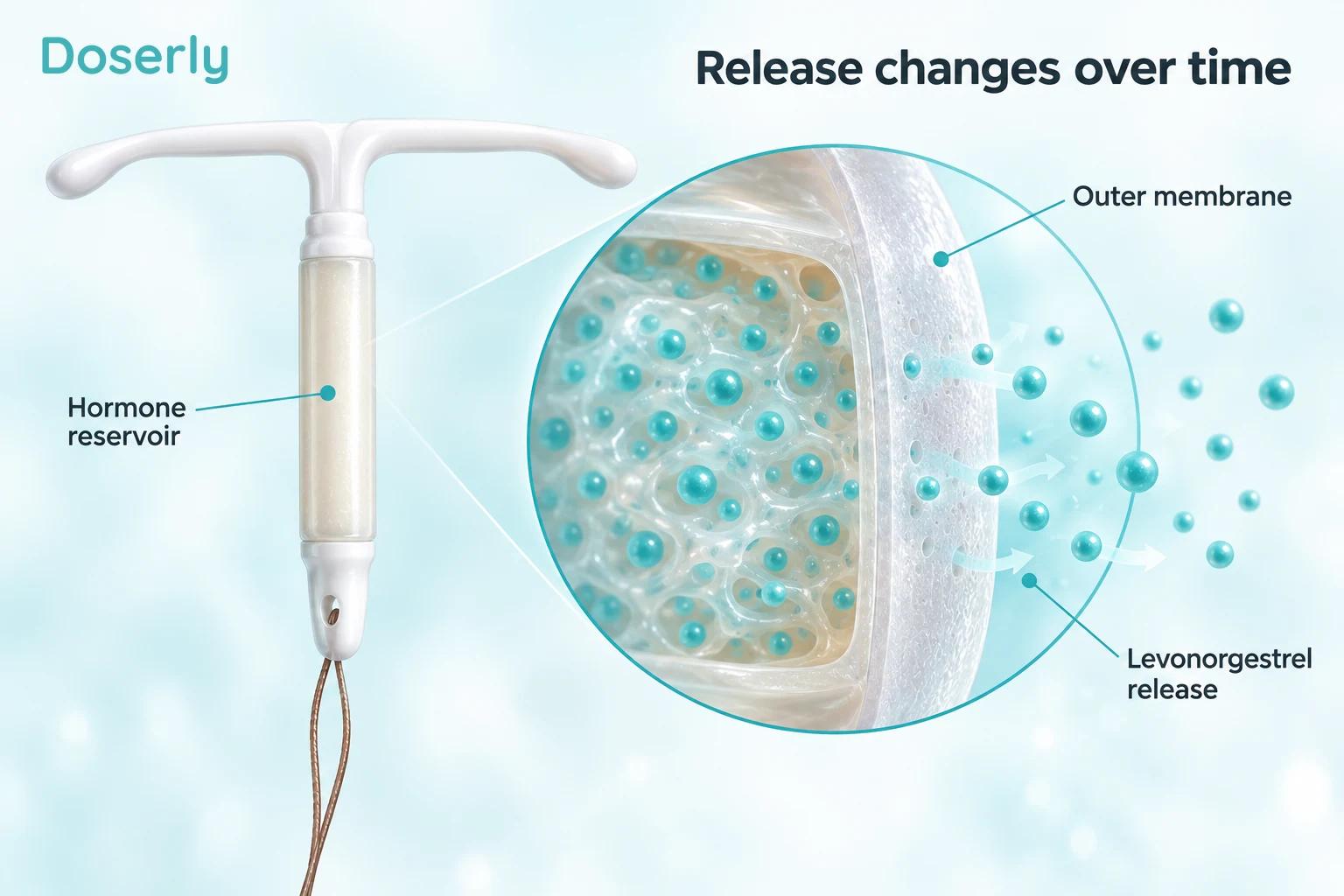
A 2023 pharmacokinetic analysis combined measured blood concentrations and residual hormone content from removed devices with mathematical modeling. Estimated levonorgestrel release from the 52 mg system declined from approximately 21 micrograms per day after insertion to approximately 7 micrograms per day at eight years. Blood exposure remained measurable. Jensen and colleagues
That finding helps explain why duration is not a simple full-versus-empty switch. A device may still release hormone after several years, while the evidence supporting particular clinical uses differs.
It would be a mistake to infer an HRT protection threshold from those release figures. Similar estimated release rates between different products at different ages do not automatically establish interchangeable clinical effectiveness. A model describing exposure is not a trial showing adequate protection during a specific estrogen regimen.
For the same reason, a symptom change cannot reliably measure how much hormone remains. Returning bleeding may need assessment; absence of bleeding is not a laboratory assay of the reservoir. Neither gives a dependable new replacement date.
The reservoir illustration is therefore explanatory rather than predictive. It shows gradual delivery through a membrane, with symbolic particles. It does not show a measured concentration in an individual uterus or prove that a particular older device remains appropriate for HRT.
Bleeding changes need context, not automatic reassurance
Hormonal IUDs commonly change bleeding patterns. Spotting and irregular bleeding can occur after placement, and bleeding often becomes lighter with continued use. Some users have no periods. The US label advises evaluation when a significant bleeding change develops during prolonged use. Mirena prescribing information
A new pattern deserves more than “the coil does that,” particularly when it appears after a settled period or after an HRT change. The clinician may need to consider the treatment schedule, device position, pregnancy possibility, or an unrelated cause. The appropriate assessment depends on the circumstances.
Conversely, no bleeding does not prove menopause. The device's effect on the endometrium can obscure the menstrual pattern even while ovarian activity continues. That is one reason contraception decisions cannot be based simply on the absence of periods.
Pain, fever, suspected expulsion, or possible pregnancy also requires appropriate medical advice. A hormonal IUD is highly effective contraception, but pregnancy can occur, and pregnancy with an IUD needs prompt evaluation. These are assessment questions, not reasons to remove or manipulate the device yourself.
Side effects should receive the same attention as with other medicines. A local delivery route does not justify dismissing a person's report of mood changes, headache, breast symptoms, or other concerns. Timing is useful information; it does not by itself establish causation.
Make replacement and removal part of the plan
Consider someone who was told that an existing device could remain for contraception, then later starts an estrogen patch. The additional prescription creates a new question: is this device currently appropriate for endometrial protection, and for how long? The earlier contraception advice may still be correct while being insufficient for the new regimen. FSRH intrauterine contraception guideline.
The reverse situation matters too. Removing an IUD may remove both contraception and the progestogen component of HRT. A replacement plan should be settled before assuming that the estrogen prescription can simply continue unchanged. The required approach depends on the person's current needs and medical history.
Bring the product name, insertion date, estrogen prescription, bleeding history, and any side effects to the review. Ask which indication determines the next appointment and who will arrange it. If different services manage contraception and menopause care, make sure each knows what the other is prescribing.
Clear records do not need to be elaborate. They need to preserve the distinction between “still effective for pregnancy prevention” and “appropriate protection for this estrogen regimen.” That small piece of precision can prevent an otherwise sensible plan from developing an unnoticed gap.
Sources
- FSRH intrauterine contraception guideline, amended January 2025 (2025).
- Mirena UK Summary of Product Characteristics (2026).
- Mirena US prescribing information (2025).
- Jensen et al. Mirena Extension Trial (2022).
- Varila et al. Five-year LNG-IUS follow-up during hormone replacement therapy (2001).
- Jensen et al. Population pharmacokinetic study of extended LNG-IUS use (2023).