
Peptides
October 16, 2026
Amycretin became zenagamtide: why the name matters
On this page
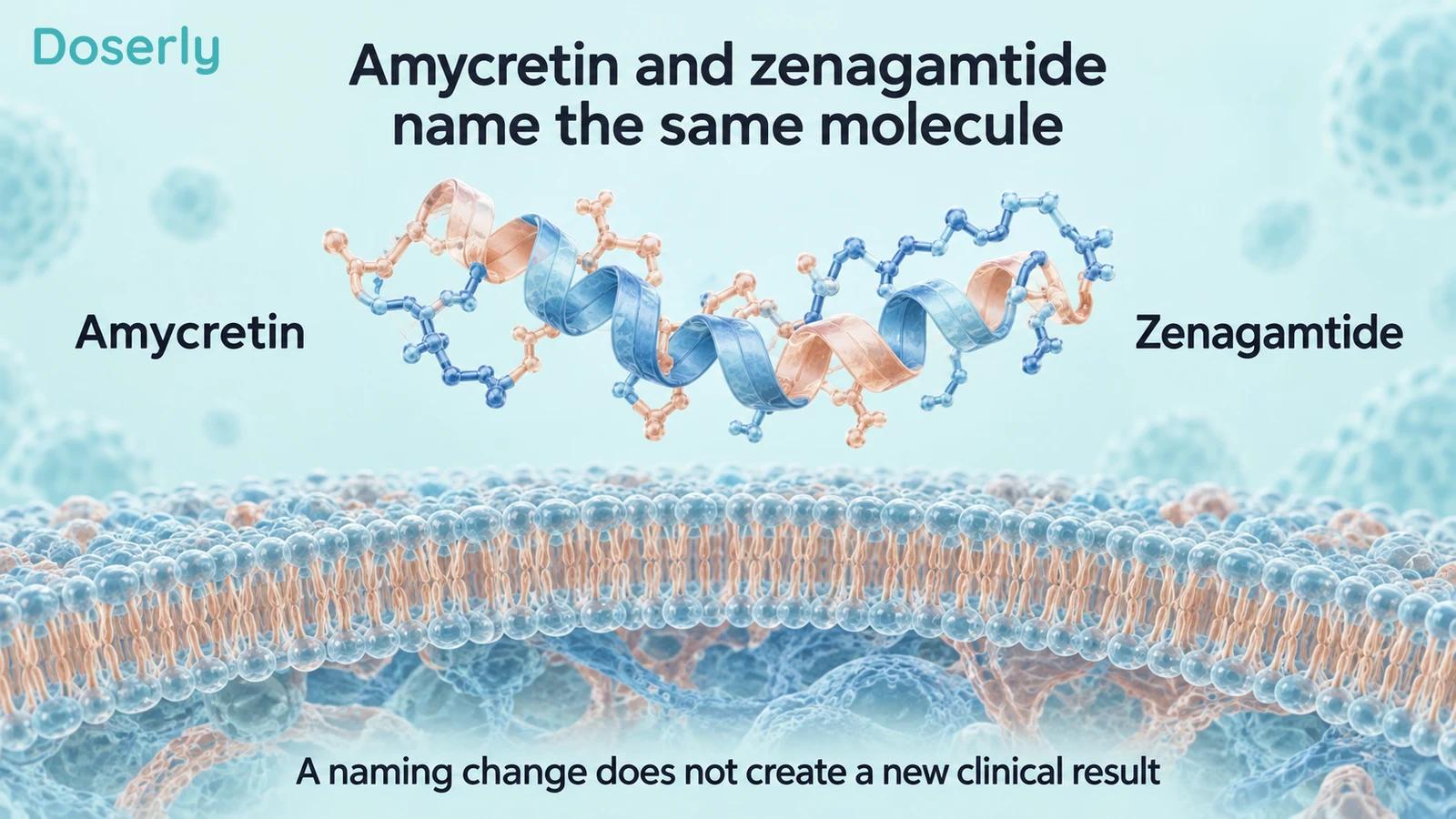
If you followed amycretin's early obesity studies and later encountered zenagamtide, you did not miss the arrival of a second molecule. Zenagamtide is the name now used for the investigational medicine previously called amycretin.
That connection is stated directly in the 2026 primary clinical publications. It is more than a useful search trick: without it, the same development program can appear to be two competitors, an older study can look unrelated to a newer one, or a repeated announcement can be mistaken for independent confirmation. Subcutaneous phase 2 publication
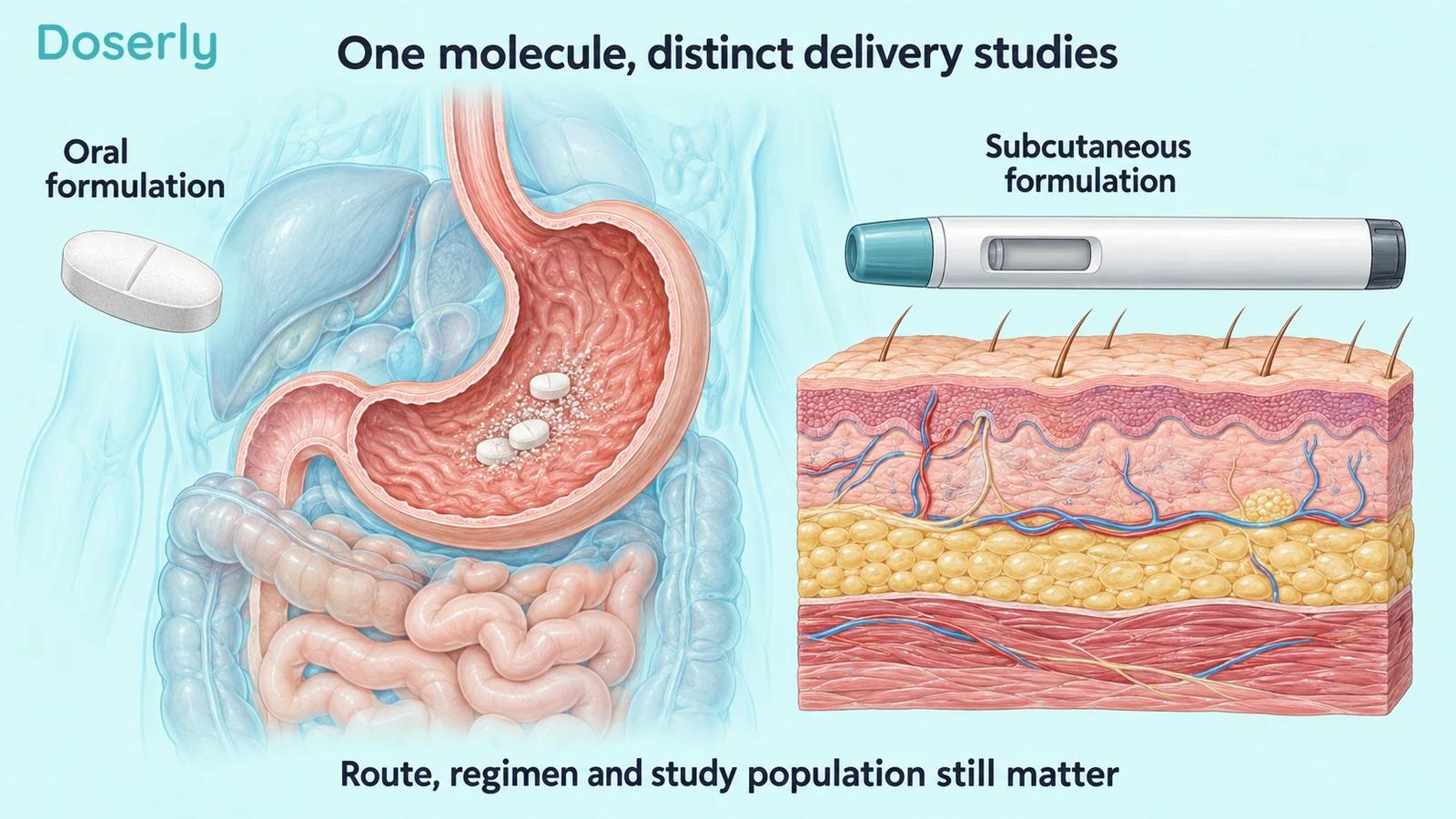
The name connection does not mean all the evidence can be merged. Oral and subcutaneous formulations have different study regimens. Early obesity studies and later diabetes studies enrolled different populations and asked different primary questions.
The zenagamtide guide provides a broader overview. This article explains how to follow the evidence across the naming change without losing those distinctions.
What stayed the same
The underlying candidate is a single peptide molecule developed to activate GLP-1 and amylin receptor pathways. Its preclinical publication uses the name amycretin and identifies the compound as NNC0487-0111.
That development code appears in trial registrations for both oral and injected formulations. It provides a link across publications, registry records and later use of the name zenagamtide. Primary preclinical paper
The 2026 papers describe zenagamtide as formerly amycretin. They also describe activity at calcitonin receptors, a detail that makes the full receptor profile more nuanced than the common shorthand “GLP-1 plus amylin.”
A new name does not itself establish a new formulation, a new dose, a regulatory approval or a new result. Those changes require their own documentation. Conversely, keeping the same molecular identity does not mean the development program stands still: formulations, trial populations and dosing strategies can evolve.
Names identify medicines; trial numbers identify experiments
The molecule's name answers “what was studied?” A trial registration number helps answer “which experiment was this?”
The early oral study is registered as NCT05369390. The early subcutaneous study is NCT06064006. The later oral and subcutaneous diabetes program is recorded under NCT06542874.
Those identifiers are useful because paper titles, conference abstracts and press releases can use different wording. A conference presentation and a journal article sharing the same trial identifier may be different reports from the same participants, rather than two independent replications.
The reverse also matters. Two papers using the same molecule name can report different studies with different populations. Searching only the drug name is therefore insufficient for deciding whether results should be compared or combined.
The registry is a starting point, not an infallible replacement for the publication. It describes the study plan and its updates. The final paper explains what was actually analyzed and reported. Where details differ, the discrepancy should be investigated rather than silently choosing whichever version makes a cleaner story.
The 2025 oral study was an early development experiment
The first-in-human oral amycretin publication included 144 participants across several parts. Some received a single dose, others received repeated doses for a short period, and the longest treatment portion lasted 12 weeks.
The primary endpoint concerned treatment-emergent adverse events. Pharmacokinetic measurements assessed drug exposure, while weight change was exploratory in the longer portion. Oral phase 1 primary report
That design is appropriate for an early question: can the candidate be administered orally with measurable exposure and a tolerability profile that supports further investigation? It is not the same question as whether a final regimen provides durable benefit in a large population.
The publication reported 364 adverse events in 89 participants. Events and people are different denominators: one person can report several events. Quoting an event total as if it were the number of affected participants would exaggerate the count.
The registry retains the development-code wording and describes oral formulations within the study. That helps connect the trial to the newer name without implying that every formulation tested was identical. Oral study registration
The 2025 injected study was a separate trial
The subcutaneous amycretin study published in 2025 randomized 125 participants across five parts. It included single-dose work and repeated weekly treatment, with different parts lasting up to 36 weeks.
The widely discussed estimated 24.3% weight reduction came from the part that escalated to 60 mg over a 36-week treatment period. It was not a result from the oral tablet study, and it did not describe all 125 participants receiving the same regimen. Subcutaneous phase 1b/2a report
The paper also reported substantial withdrawal, with many discontinuations for reasons other than treatment-emergent adverse events. That limitation remains part of the evidence after the name changes. Renaming the molecule does not strengthen a small trial, eliminate missing data or turn an estimated result into an observed result for every participant.
The subcutaneous trial registration connects the paper to NNC0487-0111. It also confirms that this was a distinct experiment from the first oral study.
For readers, the practical distinction is simple: the same active molecule can generate multiple evidence streams. Each result must remain attached to its route, regimen, participants and follow-up period.
The 2026 injected diabetes paper asks a new question
By 2026, the published name had changed to zenagamtide, and the program had expanded into people with type 2 diabetes.
The subcutaneous phase 2 paper randomized 262 participants, with 261 exposed to treatment. Participants received one of six weekly dose regimens or placebo for 36 weeks. They had type 2 diabetes treated with metformin, with or without an SGLT2 inhibitor.
The primary endpoint was change in HbA1c, a measure used to assess glycemic control. Estimated reductions across active groups ranged from approximately 0.9 to 1.7 percentage points. The largest-dose group's estimated difference from placebo was 1.56 percentage points. These are HbA1c changes, not percentages of body weight lost. 2026 subcutaneous phase 2 paper
This represents new evidence in a new clinical setting. It does not directly repeat the early obesity trial, because the population, dose schedules and primary outcome differ.
The safety report also deserves its own reading. The abstract reports serious adverse events in 21 of 261 exposed participants across all groups, including three participants receiving placebo. That is a count of reported serious events by participant, not proof that the medicine caused every event.
The 2026 oral diabetes paper remains a distinct analysis
A companion phase 2 publication reports once-daily oral zenagamtide in 186 randomized participants with type 2 diabetes. It studied three dose levels over 36 weeks, with HbA1c change as the primary outcome.
The estimated HbA1c reductions were approximately 0.9, 1.3 and 1.4 percentage points across the three active groups. Gastrointestinal adverse events were more frequent in the higher-dose groups than in the lowest-dose group, and the paper reported serious events separately. 2026 oral phase 2 paper
The oral and injected reports share the registration NCT06542874. The current registry lists 448 participants overall, which corresponds to 262 in the injected report plus 186 in the oral report.
That is a useful example of why identifiers must be interpreted carefully. Treating 448 as the sample size of the injected analysis would overstate it. Treating the two papers as unrelated programs would miss their shared study framework. Combined program registration
Neither publication alone establishes that one route is superior to the other. Each route was evaluated against its relevant placebo regimen. A fair route comparison needs the appropriate design and analysis rather than a casual comparison of the largest reported numbers.
The dose numbers cannot be converted by name
A tablet dose and an injected dose are not equivalent simply because both contain zenagamtide. Administration route and formulation affect how a peptide reaches the circulation.
The clinical program studies those differences through pharmacokinetic measurements and dose finding. A higher milligram amount in an oral study does not automatically mean a stronger clinical effect, and a lower injected amount does not automatically mean a safer regimen.
The frequency also matters. Once-daily and once-weekly schedules describe different patterns of administration. Multiplying or dividing the listed doses does not produce a validated conversion.
These distinctions are particularly important when older headlines use amycretin and newer material uses zenagamtide. The name change can make a route change less obvious, encouraging readers to compare numbers that answer different questions.
Publication dates can create another illusion of novelty
A trial may finish enrollment long before a journal article appears. It may also be announced in a sponsor release, presented at a conference and published later.
The 2025 oral paper, for example, describes a study conducted over an earlier period. The 2026 diabetes publications likewise report participants recruited before the publication date. “Published this year” does not mean “participants started treatment this year.”
The relevant dates depend on the question. Publication date helps identify what evidence was available when a claim was made. Recruitment and follow-up dates help establish which study is being discussed. Registry update dates show when the record was last revised.
Keeping those dates separate prevents the same result from being counted as several successive breakthroughs. A later publication can add methods and detail without representing a new group of participants.
Why mechanism labels also need checking
The shorthand “dual GLP-1/amylin agonist” is useful, but it should not erase the full receptor findings. The preclinical paper tested GLP-1, amylin and calcitonin receptor activity in cell systems.
Amylin receptors themselves are complexes involving a calcitonin receptor and a receptor activity-modifying protein. That biology makes simple receptor-count slogans less informative than they first appear.
None of this means zenagamtide is the same as a two-drug combination such as cagrilintide plus semaglutide. A single molecule with activity at multiple targets has its own exposure and pharmacology. It is not created by simply putting the names of two established drugs together.
The relevant claim should therefore be traced to the actual compound and experiment. A cell assay demonstrates receptor activity under its conditions; it does not establish the size of a human benefit or the contribution of each receptor pathway to that benefit.
How to follow the program accurately
When a new zenagamtide report appears, connect it to amycretin, then check the route, trial number, population, duration and primary endpoint. Keep the reported analysis attached to those details.
For a personal research note, one precise sentence is often enough: the molecule, oral or injected formulation, study population and time point. Adding the registry identifier makes it easier to recognize later reports from the same experiment.
The naming change is useful because it gives the program a consistent contemporary name. It does not reset the evidence. Earlier limitations, newer findings and separate formulations all remain part of the same developing story—and each result still needs to be read on its own terms.
Sources
- Subcutaneous zenagamtide phase 2 publication.
- Oral zenagamtide phase 2 publication.
- 2025 subcutaneous amycretin publication.
- 2025 first-in-human oral amycretin publication.
- Amycretin primary preclinical paper.
- Combined oral and injected diabetes registration.
- Early injected study registration.
- Early oral study registration.