
Supplements
October 16, 2026
Alpha-GPC and focus: separate cognitive testing from marketing confidence
On this page
Alpha-GPC has an appealing explanation: it supplies a choline-containing compound, choline helps make acetylcholine, and acetylcholine is involved in memory and muscle control. From there, it is easy to imagine that more precursor must produce a sharper mind.
The missing step is whether additional alpha-GPC improves a meaningful outcome in the person taking it. A healthy adult looking for focus, a patient with mild cognitive impairment and someone with established dementia are not interchangeable research populations. Neither are a short cognitive test, a prescription-record diagnosis and a gym performance measure.
The evidence contains promising findings. It also contains negative task results and conflicting vascular safety associations. A useful assessment needs all of those pieces without treating any one as a complete answer.
Choline matters; that does not diagnose a shortage
Choline is an essential nutrient used in cell membranes and in the production of acetylcholine. The NIH Office of Dietary Supplements describes food sources including eggs, meat, fish, beans and some vegetables. It also notes that although many people consume less than the adequate intake, frank deficiency in healthy men and nonpregnant women is rare. NIH choline fact sheet
That distinction prevents a common leap: trouble concentrating does not identify a choline deficiency, and being below a population intake reference does not prove that a specific person's attention will improve with alpha-GPC.
Alpha-GPC is also not interchangeable with every other choline source. A study of a particular alpha-GPC preparation cannot automatically support a different compound or an entire nootropic blend. The amount of the ingredient on a label is not necessarily the same as the amount of choline it supplies.
Our alpha-GPC guide gives broader ingredient context. This article focuses on how to read the evidence behind a claim of better focus, including what the longer-term studies can and cannot add.
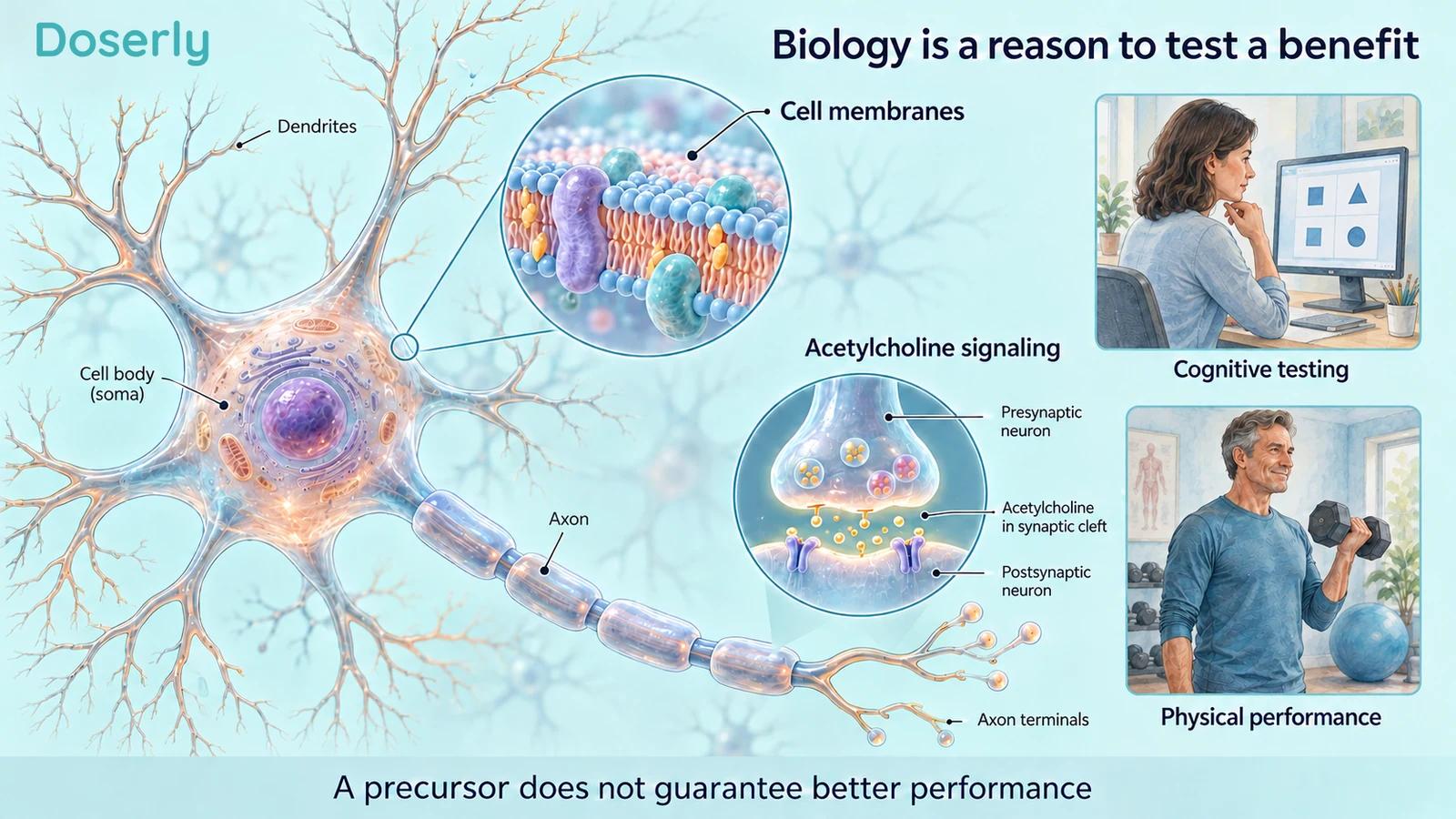
There is a small acute trial in healthy men
A 2024 randomized, double-blind crossover trial tested 20 resistance-trained men. They received placebo, 315 mg alpha-GPC or 630 mg alpha-GPC, with cognitive assessments before and after an exercise protocol. The tests included Stroop, N-Back and Flanker tasks. Acute cognition trial, 2024
Both alpha-GPC conditions improved the change in total Stroop score relative to placebo, and the higher dose improved Stroop completion time. The N-Back and Flanker assessments did not show significant between-group benefits. Mood, alertness-related ratings and growth hormone did not show significant group differences either.
The Stroop result is a legitimate signal. It should not be stretched into an across-the-board improvement in cognition. The paper also acknowledges that its approach to multiple pairwise comparisons was less stringent than stronger correction methods, which could have affected the final findings.
This was an acute study in selected men, not months of ordinary work or study. The specific doses describe the experiment; they are not a recommendation to select the larger one.
“Focus” hides several different abilities
The Stroop task asks a participant to manage interference between competing information, such as a word and its ink color. Working-memory and attention tasks ask different questions. A product can produce a favorable change on one while leaving the others unchanged.
That is why a broad phrase such as “enhances cognitive performance” needs unpacking. The result may be real but narrower than the phrase suggests. A person whose main difficulty is remembering instructions, for example, should not assume that a better interference-control score solves that problem.
There is also a difference between testing performance and perceived benefit. Someone may feel more alert without making fewer errors. Conversely, a modest task change may occur without a noticeable improvement in daily experience. If both are measured, report both; if only one is measured, do not imply the other.
The healthy-men trial is useful precisely because it includes these distinctions. Treating its negative outcomes as irrelevant would remove information a prospective user needs.
Physical performance is a separate claim
Alpha-GPC appears in pre-workout products as well as cognitive supplements. The 2024 study included jumping, bench-press throws and a demanding lower-body exercise protocol. Its physical results were not a clean, consistent demonstration of improved performance across measures; the full report describes selected pairwise signals alongside nonsignificant overall comparisons. Acute cognition trial
A claim about muscle power should therefore be supported by the relevant physical test, not borrowed from the Stroop result. Likewise, measuring growth hormone after exercise does not by itself establish muscle growth, and the study did not show a significant alpha-GPC-related growth-hormone difference.
For a multi-ingredient pre-workout, attribution becomes harder still. If the product also contains caffeine or other active ingredients, feeling a stronger workout effect does not identify alpha-GPC as the cause. An experiment with isolated alpha-GPC and a finished commercial blend are different interventions.
Mild cognitive impairment is not ordinary distraction
A separate 2024 randomized trial enrolled 100 people with mild cognitive impairment. Participants received a preparation containing 600 mg alpha-GPC or placebo for 12 weeks. The primary outcome was change on the Alzheimer's Disease Assessment Scale cognitive subscale, commonly abbreviated ADAS-cog. Mild cognitive impairment trial, 2024
The active group improved more than placebo on that scale. The reported 2.34-point decrease was the active group's change from baseline, not the placebo-adjusted treatment difference. No serious adverse events or adverse-event-related discontinuations were reported during the study.
This supports further evaluation in the studied clinical population. It does not demonstrate prevention of dementia, and it is not evidence that a healthy person will achieve the same improvement. A cognitive symptom requiring clinical assessment should not be relabeled as a supplement-selection problem.
The study's 12-week tolerability findings are reassuring within that interval and sample. They do not resolve uncommon events or years of use, particularly when long-term observational studies raise a different question.
What the large 2025 cohort adds
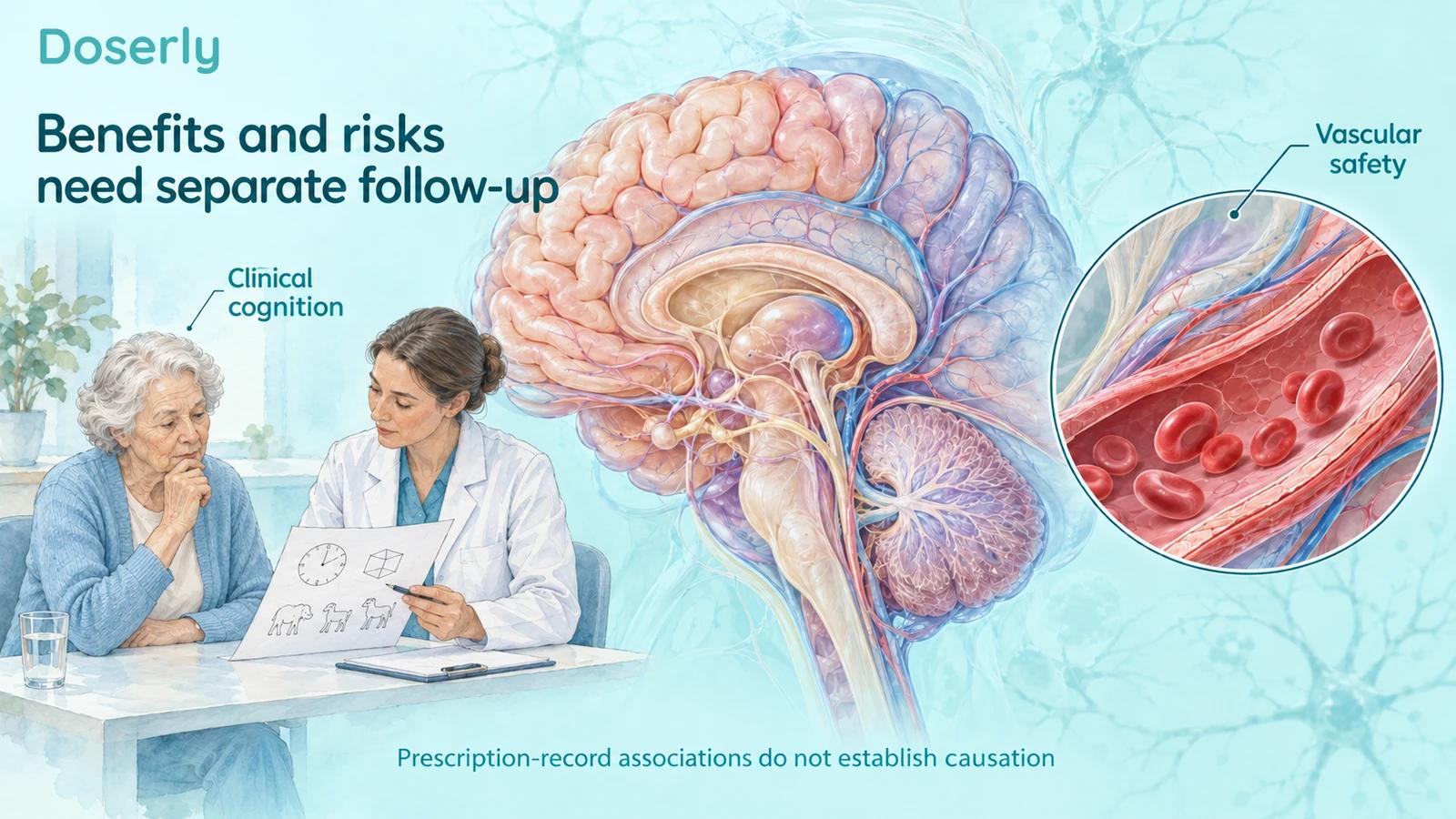
A South Korean nationwide study followed prescription records for 508,107 people newly diagnosed with mild cognitive impairment. Alpha-GPC use was associated with lower subsequent conversion to Alzheimer's disease dementia and vascular dementia. The adjusted hazard ratios were 0.899 and 0.832, respectively. These are relative hazard estimates, not absolute percentage-point reductions in a person's risk. Nationwide cohort, 2025
The study is informative because it examines clinical diagnoses over longer follow-up in a large population. But treatment was not randomly assigned. Prescription decisions, other care and differences between users and nonusers can influence the association even after statistical adjustment.
The authors also lacked detailed cognitive-test and biomarker information and did not examine effects by dose. Prescription records do not demonstrate an immediate improvement in a healthy user's focus. The cohort supports a research question about progression in people already diagnosed with impairment; it cannot supply the missing healthy-user trial.
The stroke evidence deserves an honest explanation
An earlier South Korean cohort study examined more than 12 million adults aged 50 or older without underlying stroke or Alzheimer's disease. Alpha-GPC prescriptions were associated with higher subsequent stroke risk. In the covariate-matched analysis, the adjusted hazard ratio for total stroke was 1.43, with a 95% confidence interval of 1.41–1.46. Stroke cohort, 2021
That is an important safety signal. It is not proof that alpha-GPC caused the strokes, nor a statement that 43% of users experienced one. A hazard ratio describes relative occurrence over follow-up under the analysis; it is not an absolute event probability.
The newer mild-cognitive-impairment cohort did not reproduce the same direction in its primary stroke analysis. However, its propensity-matched analysis found no significant stroke differences. Differences in populations, exposure definitions and analytic methods make a simple “new study disproved old study” interpretation inappropriate. Nationwide cohort, 2025
The responsible conclusion is uncertainty that matters for risk-benefit decisions. Neither a marketing claim of protection nor a definitive statement that the supplement causes stroke is justified by these observational comparisons alone.
What the animal mechanism does—and does not—resolve
A laboratory study found that alpha-GPC promoted atherosclerosis in genetically susceptible mice with abnormal lipid handling. The researchers also examined microbial metabolism, trimethylamine N-oxide, or TMAO, and inflammatory signaling in cultured human coronary artery endothelial cells. Preclinical vascular study
These findings offer biological reasons to investigate the human safety signal. They do not turn the mouse result into a measured stroke risk for a healthy adult taking a commercial supplement. A cultured human cell is not a clinical participant, and the specialized mouse model is not an average supplement user.
Equally, dismissing the mechanism because it is preclinical would lose useful evidence. Its role is to help explain what might be happening and guide human research. The clinical question still requires appropriately designed human studies, including exposure duration and underlying vascular risk.
This is a case where both overconfidence and over-reassurance are avoidable. The uncertainty should remain visible, especially when the proposed benefit is a modest, short-term change in a task score.
What would count as a convincing healthy-user benefit?
A stronger study would recruit the population making the decision, specify the main cognitive outcome in advance and follow participants for a useful period. It would report accuracy as well as speed, adverse effects as well as benefits, and outcomes that transfer beyond repeatedly completing the same test.
Replication also matters. One small positive trial can justify more research without establishing the size or reliability of the benefit in ordinary use. Repeated testing can introduce familiarity, and small studies can produce unstable estimates. A well-designed placebo comparison helps, but it cannot create long-term evidence from a single-dose experiment.
For alpha-GPC, the benefit question should remain distinct from the safety question. A cognition trial with a few dozen participants is not capable of excluding a rare vascular outcome. A large prescription cohort, in turn, may have little information about the precise attention problem a healthy buyer hopes to improve.
Put the decision in the context of the actual problem
If the problem is occasional distraction during a sleep-deprived week, begin by describing that pattern rather than assuming a neurotransmitter shortage. If memory or attention is persistently worsening or affecting daily function, seek assessment rather than relying on a supplement response to explain it.
For someone already prescribed alpha-GPC in a clinical setting, these studies are a reason for a conversation with the treating clinician, not an instruction to stop prescribed treatment. The benefit-risk context of diagnosed impairment can differ from elective use for a possible edge in concentration.
Bring the exact product, ingredient amount, other supplements and medicines to that discussion. A routine containing several choline products or stimulants is harder to evaluate than a single labeled ingredient. A record of perceived benefits, unwanted effects and timing can help describe experience, but cannot establish dementia prevention or vascular safety.
Alpha-GPC has human evidence worth discussing. The clearest reading preserves its boundaries: selected acute cognitive findings, a positive short clinical trial in impairment, observational progression associations and unresolved vascular signals. Confidence in the mechanism should not exceed confidence in those outcomes.
Sources
- NIH choline fact sheet
- Acute alpha-GPC cognition trial in healthy men (2024)
- Alpha-GPC trial in mild cognitive impairment (2024)
- Nationwide dementia-conversion cohort (2025)
- Alpha-GPC and subsequent stroke cohort (2021)
- Preclinical alpha-GPC and atherosclerosis study (2021)