
Peptides
October 16, 2026
Afamelanotide for EPP: a treatment for painful light sensitivity
On this page
For someone with erythropoietic protoporphyria, or EPP, daylight can make ordinary activities painful. Walking to an appointment, spending time with family outside or standing beside a sunny window may require planning that other people never notice. Afamelanotide research addresses this medical problem: whether treatment can help people with EPP tolerate more light without pain.
Afamelanotide is also known as Melanotan I, which can create confusion when its clinical results appear alongside advertisements for tanning products. The approved medicine, Scenesse, is a defined implant used for adults with EPP. Its evidence is not an endorsement of cosmetic injections or nasal sprays sold under a related name. US prescribing information.
The treatment has meaningful clinical evidence, but the findings need their disease context. More pain-free light exposure is different from a darker skin tone, unrestricted sun exposure or protection against skin cancer. Understanding that difference allows the medical benefit to be taken seriously without turning it into a much broader claim.
What makes EPP different from ordinary sunburn?
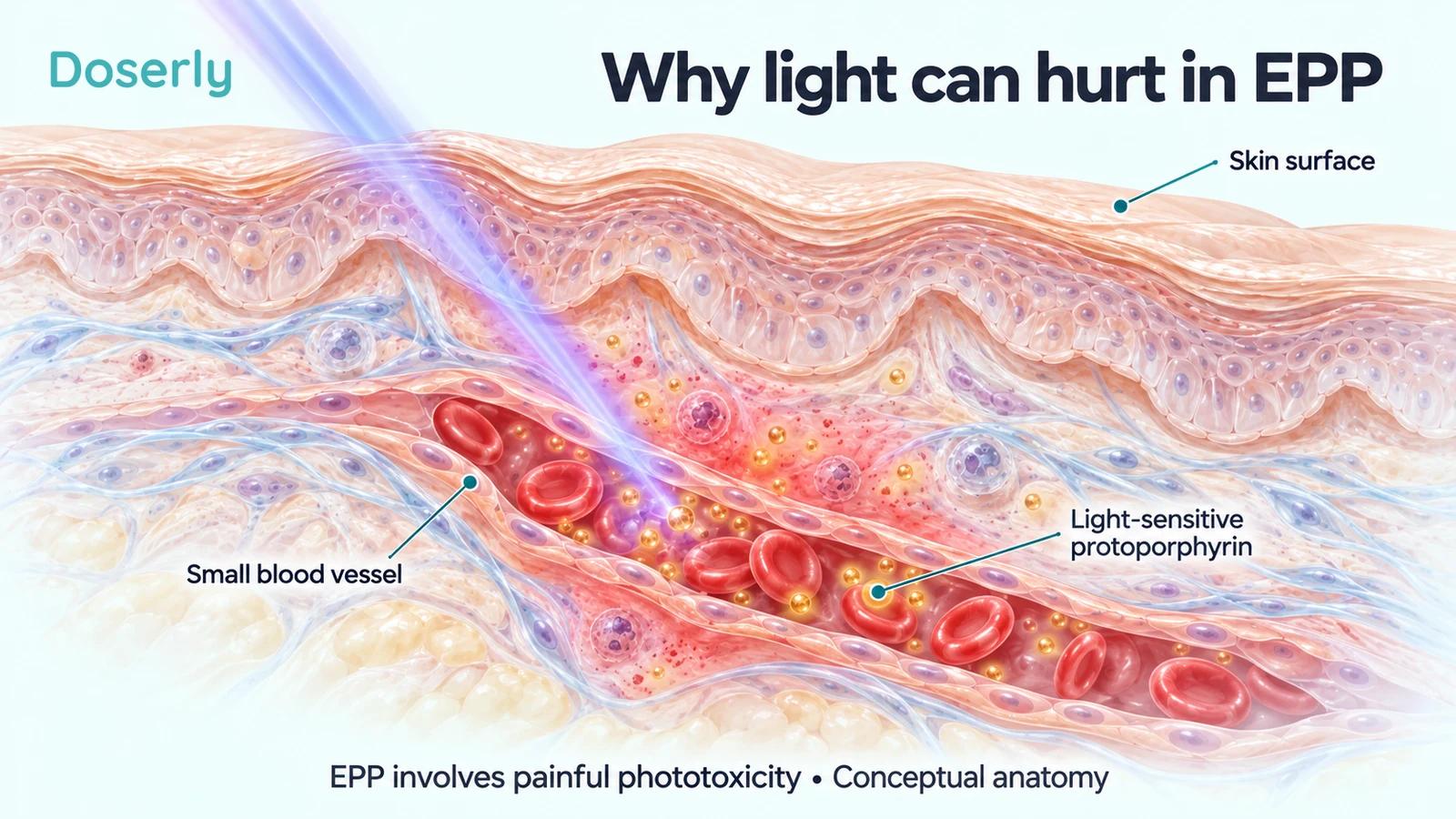
EPP is an inherited disorder involving production of heme, an essential component of several proteins, including hemoglobin. A problem in that pathway leads to accumulation of protoporphyrin, a light-sensitive substance. When light activates it, tissue can be injured and painful symptoms can follow.
Visible light, particularly blue wavelengths, is important in this process. That differs from thinking only about ultraviolet radiation and ordinary sunburn. The appearance of the skin may also fail to convey how much pain someone is experiencing. Expert guidance therefore addresses light avoidance, protection and the broader consequences of the disease rather than treating it as a cosmetic sensitivity. EPP and X-linked protoporphyria consensus guideline.
This distinction changes the treatment goal. Someone with EPP may want enough tolerance to complete necessary daily activities with fewer symptoms. A person without EPP who wants a tan has a different goal and a different starting risk. Evidence in the first group cannot answer every safety or benefit question in the second.
The diagnosis matters too. “Sun sensitivity” can describe several conditions. EPP treatment evidence applies to a specific disorder, not to everyone who burns easily or develops a rash outdoors. A specialist assessment connects the symptoms with the relevant biochemical and clinical findings.
How does afamelanotide help?
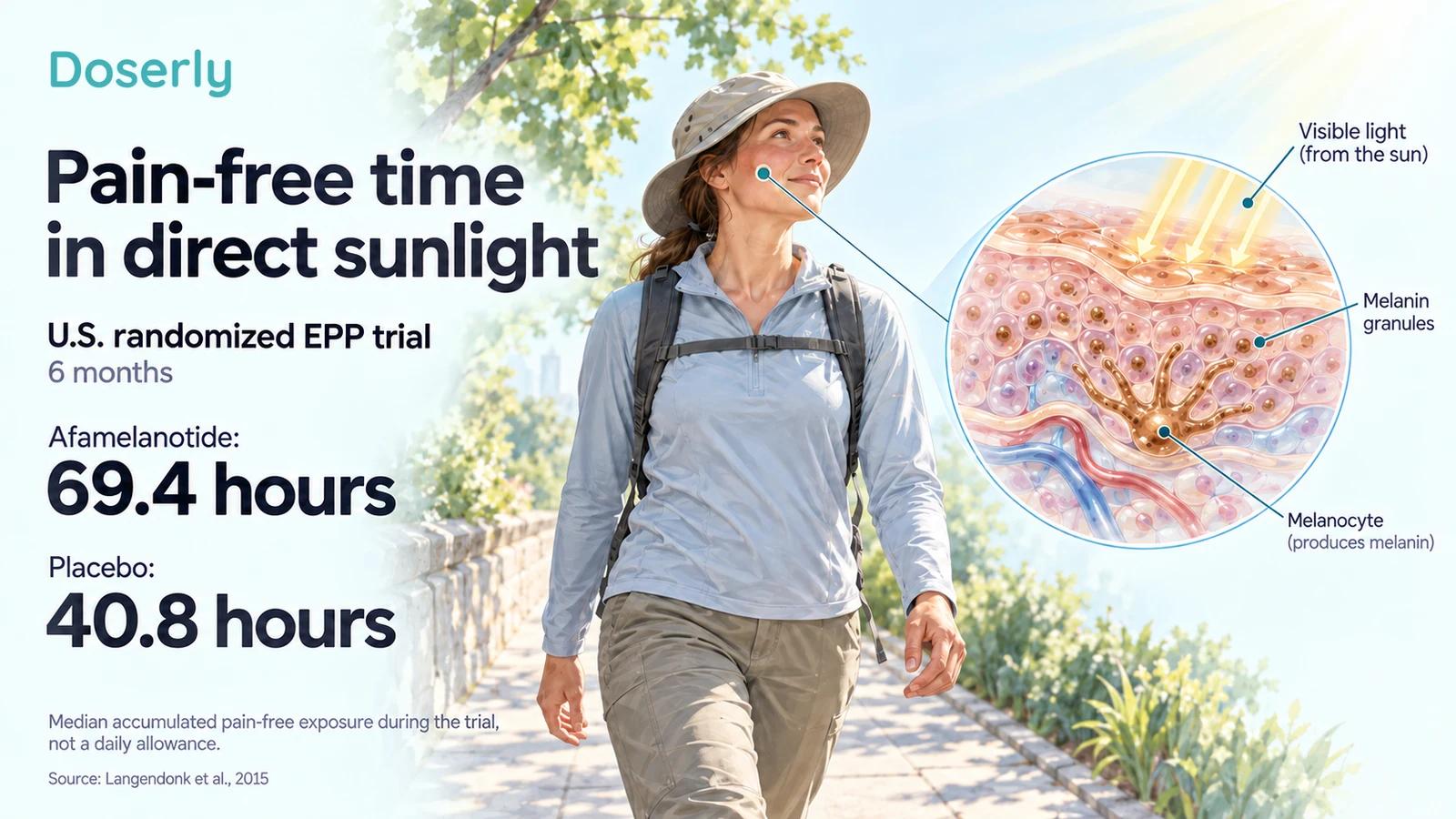
Afamelanotide acts at the melanocortin-1 receptor, or MC1R, involved in signaling pigment-producing cells called melanocytes. The resulting increase in eumelanin, a form of skin pigment, is part of the proposed protection against EPP-related phototoxicity. The medicine does not correct the inherited enzyme problem that defines the disease. Scenesse prescribing information.
The distinction between reducing symptoms and correcting the underlying disorder is useful. A treatment can help someone function better even when the cause of the disease remains. That benefit still matters. It simply should not be described as a cure or assumed to remove the need for ongoing care.
A visible change in pigmentation is also not a complete measure of benefit. The relevant clinical question is whether the person can spend more time in light without the painful reaction, and whether that translates into activities that matter to them. Our Melanotan I and afamelanotide guide gives a broader comparison of pigmentation research and clinical EPP studies.
What did the randomized trials measure?
A 2015 publication reported two randomized, placebo-controlled trials enrolling 74 participants in Europe and 94 in the United States. Participants received afamelanotide or placebo implants, and recorded exposure and symptoms over nine and six months, respectively. In the US trial, median accumulated pain-free direct-sunlight exposure was 69.4 hours with afamelanotide and 40.8 hours with placebo, with p=0.04. Langendonk and colleagues.
These are totals accumulated during the study, not hours per day or the length of a single safe exposure. “Median” identifies the middle value in each group. The difference between the medians was 28.6 hours, but that is not a promise that every treated person gained precisely that amount.
The European study reported 6.0 versus 0.8 hours. Its diary definitions and exposure conditions differed from those in the US study, so those values should not be read as a direct comparison of how well treatment works on different continents. Both the measurement rules and the regulatory assessment need attention before combining the results.
An important qualification from the European regulator
The European Medicines Agency's original assessment identified serious data-quality problems in two earlier studies, CUV029 and CUV030, including the European study reported in the publication. Their main efficacy data were not considered sufficiently reliable for the pivotal assessment. The later US trial, CUV039, became the pivotal study supporting the application. EMA assessment report.
The report also discussed difficulties with blinding, diary measurements and interpretation of effect size. Pigmentation can reveal which treatment a participant probably received. That knowledge may affect behavior or reporting, especially when exposure is something the participant chooses rather than something investigators can ethically force.
This does not mean the approved medicine has no benefit. It means the evidence is more qualified than “two equally definitive trials proved protection.” The assessment considered the broader findings, the rare disease context and patient and expert input. A careful account should include those qualifications alongside the positive result.
Why was approval granted under exceptional circumstances?
EMA describes authorization under exceptional circumstances, reflecting the difficulty of obtaining comprehensive information for this rare condition. The agency considered improvements in pain-free exposure, possible quality-of-life benefits and substantial unmet need, while requiring additional longer-term information through a patient registry. EMA Scenesse overview.
That is a specific regulatory judgment about this medicine for EPP. It should not be translated into either “nothing is known” or “all uncertainties are resolved.” Treatment can be available while additional evidence is still required.
For patients, the distinction helps set expectations. An approval supports a defined use, with monitoring and continued assessment of benefits and harms. It does not remove the need to ask whether the treatment is helping a particular person or whether circumstances have changed.
What do later patient studies add?
Observational follow-up can show how treatment fits into ordinary care, where weather, work, family activities and previous habits influence exposure. It complements randomized evidence, but it cannot provide the same protection against differences between treated and untreated people.
A three-year observational study reported that patients' median maximum tolerated exposure increased from 10 minutes before treatment to 180 minutes during treatment. The respective observations came from 39 and 37 people, with two missing treatment measurements. This was a reported tolerance measure, not the accumulated six-month diary endpoint used in the US randomized trial. 2020 observational study.
The scale of that change may help explain why some patients describe treatment as transformative. It should not be presented as a guaranteed three-hour exposure window. Recall, changes in behavior, environmental conditions and the absence of a concurrent placebo comparison affect interpretation.
A US cohort published in 2024 followed 29 adults with protoporphyria and found improvements in reported light tolerance and several quality-of-life measures. It did not find corresponding improvements in liver biochemistry or protoporphyrin levels. US cohort. This is a useful reminder that feeling and functioning better can be real while laboratory indicators of the underlying disorder remain unchanged.
Does better light tolerance mean the liver is protected?
Not necessarily. EPP can involve the liver, and that raises a separate treatment question. A Swiss observational analysis of 38 patients reported favorable changes in some laboratory measures during afamelanotide treatment and proposed possible liver protection. It was a retrospective analysis of clinical data, not a randomized trial of liver outcomes. Swiss study.
The smaller US cohort did not reproduce a reduction in liver laboratory measurements. Differences in populations, follow-up and testing may matter, but the available reports do not establish that afamelanotide prevents liver failure. A liver-enzyme result is also not the same endpoint as preventing severe liver disease.
For someone receiving treatment, improved time outdoors is therefore not a reason to assume all EPP-related monitoring is no longer needed. The clinical team should continue to address the disease as a whole. The observed benefit and the unresolved organ-specific questions can coexist.
What safety and follow-up remain relevant?
The US label advises continuing sun and light protection during treatment. It also recommends twice-yearly full-body skin examinations because existing moles and freckles may darken and new pigmented lesions need assessment. Serious hypersensitivity reactions, including anaphylaxis, have been reported. The approved implant is administered by a trained healthcare professional. Current Scenesse label.
These precautions belong alongside the intended benefit. They are not evidence that every pigment change is malignant or that treatment is unsuitable for every person with a mole. They explain why the medication is part of supervised care rather than simply a way to change skin color.
Keeping a record of symptoms, activities, treatment dates and unwanted effects can help the specialist understand the balance for you. A patient should not have to deliberately provoke a painful reaction to demonstrate that a treatment matters. Describing what has become possible in daily life may be more informative than chasing a maximum exposure time.
Why the EPP findings don't endorse cosmetic tanning
The clinical trials involved a specific disease, a manufactured implant and defined outcomes. A research vial or spray sold as Melanotan I changes important parts of that evidence. Even if the claimed ingredient is afamelanotide, the product's identity, delivery, exposure and quality cannot simply be assumed equivalent to the medicine studied.
Australia's Therapeutic Goods Administration explicitly warns that unapproved melanotan tanning products have not been assessed for quality or safety and that artificial pigmentation should not be treated as sunscreen-like protection. TGA warning.
The difference in purpose matters as well. A patient trying to reduce severe phototoxic pain may accept particular treatment burdens because of a substantial medical need. That benefit-risk judgment cannot be transferred to a healthy person seeking a darker complexion. Neither the EPP endpoint nor the approval establishes prevention of skin cancer in cosmetic users.
Questions for an EPP treatment discussion
Start with the activity or symptom that limits your life: the journey to work, an outdoor family routine, or the duration and severity of painful episodes. Ask how the team will assess improvement and how it will account for seasonal changes or avoidance habits.
Agreeing on one or two ordinary activities to discuss at follow-up can make a group-level trial result more relevant to your situation. The goal is to describe change in daily life, without turning an activity into a deliberate test of painful exposure.
It is also reasonable to ask about skin examinations, light protection, unwanted effects and the monitoring needed for other aspects of EPP. If a different formulation is proposed, ask what evidence specifically supports that product and route.
Afamelanotide can represent important progress for people living with EPP. Keeping the diagnosis, preparation and outcome connected makes that progress understandable without expanding it into unsupported claims about cosmetic tanning. The afamelanotide guide provides additional background on the medicine and the distinctions between products.
Sources
- EPP/XLP consensus guideline.
- Langendonk et al., 2015: randomized afamelanotide trials.
- EMA: original assessment report.
- EMA: Scenesse overview and exceptional circumstances.
- Scenesse US prescribing information.
- 2020: three-year observational light-tolerance study.
- 2024: US clinical cohort.
- 2023: Swiss liver laboratory study.
- TGA: unapproved melanotan tanning products.