
Supplements
October 16, 2026
A response to Physionic’s NMN investigations: ask which human outcome survived the hype
On this page
Physionic's public NMN research page frames its investigation around a sensible question: whether supplementation delivers the health effects attributed to it. The page describes an examination of thirteen studies. That is a useful invitation to inspect evidence rather than stop at a compelling explanation of cellular biology. Original Physionic research page.
This response follows that published question into human research. It is not a claim-by-claim audit of a full video or members-only analysis that was not available for review.
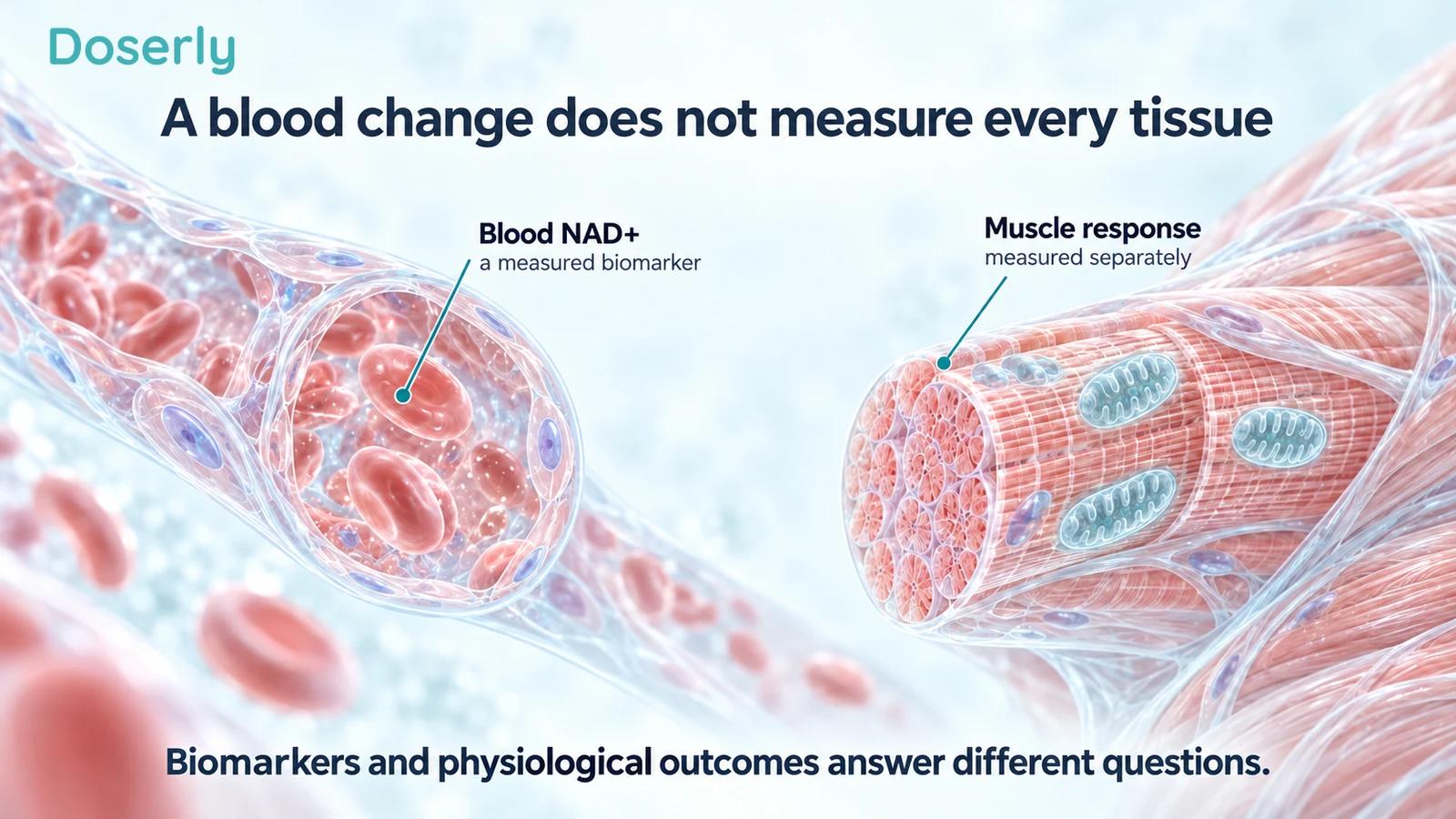
The central distinction is straightforward. Raising a blood biomarker, improving a physiological measurement and helping someone live longer are different achievements. NMN research contains findings worth discussing, but the outcome has to remain attached to the claim. Otherwise, a real biochemical effect can be promoted into a benefit the experiment never tested.
The first question is what “works” means
NMN, or nicotinamide mononucleotide, is a precursor in the biology of NAD+, a molecule involved in cellular metabolism. That makes it plausible to investigate whether NMN supplementation changes NAD-related measures and whether those changes affect human function.
But “works” can refer to several different endpoints. A trial may measure NAD in blood, glucose handling during a laboratory procedure, a walking test, a sleep questionnaire or a disease outcome. Each can be useful, but they are not interchangeable.
A person considering NMN for fatigue may care very little about an assay unless the change predicts a meaningful improvement in daily life. A researcher studying metabolism may consider the same assay an important step in understanding exposure. Neither perspective is wrong; they are answering different questions.
The strongest consumer explanation makes that difference explicit. It tells the reader what changed, how it was measured, who was studied and what remains uncertain. A diagram of the pathway cannot answer those questions by itself.
What the metabolic evidence review found
A systematic review published online in 2024 and in a 2025 journal issue included twelve studies involving 513 participants. It found an overall increase in blood NAD with NMN supplementation, but most clinically relevant glucose and lipid outcomes did not significantly differ from control. The authors rated seven studies as having some risk-of-bias concerns and five as high risk. Read the review.
That does not mean every trial was neutral or that every possible metabolic effect has been ruled out. It means the broader evidence did not justify treating the blood-NAD response as established, general metabolic benefit.
Pooling studies can improve perspective, but it cannot remove limitations in the underlying research. Differences in participants, exposure, duration and measurements still matter. Nor can a review include studies published after its search period.
This is why a review and an individual trial play different roles. The review helps resist selecting only the most exciting result. The primary study shows exactly what happened and whether its circumstances resemble the reader's question.
The muscle-insulin-sensitivity finding deserves its precise meaning
A 2021 double-blind randomized trial studied 25 postmenopausal women with overweight or obesity and prediabetes. After ten weeks, NMN improved muscle insulin sensitivity measured with a controlled insulin-and-glucose procedure, alongside related muscle-signaling findings.
The effect was selective. The study did not show corresponding improvements in body composition, fasting glucose or liver and adipose-tissue insulin sensitivity. Muscle NAD content itself did not increase, even though NAD in peripheral blood mononuclear cells did. Read the primary Science paper.
This is a meaningful physiological signal in a defined population. It is not evidence that NMN prevents diabetes, causes weight loss or produces the same response in everyone.
The distinction between a controlled procedure and an ordinary clinical outcome is especially important here. Researchers can use a sensitive laboratory method to detect an effect that does not yet translate into a demonstrated change in disease risk or day-to-day health.
The result should neither be inflated nor dismissed. It supports further investigation of a specific response. It does not supply the missing long-term outcomes.
Walking results require reading beyond the title
A 2024 trial randomized 60 older adults to NMN or placebo for twelve weeks. Its primary stepping-test outcome did not significantly differ between groups. Secondary findings were more favorable: the NMN group had a shorter four-meter walking time, higher blood NAD-related measures and better scores on selected sleep-questionnaire outcomes. Read the primary trial.
Those positive secondary findings are worth preserving. So is the neutral primary result. A title emphasizing walking and sleep can be accurate about selected findings while still requiring the reader to inspect the full hierarchy of outcomes.
A short walking test measures a particular aspect of function under specified conditions. It does not directly establish fewer falls, less disability or longer healthy life. Those are reasonable future research questions, not alternate names for the result already obtained.
When several outcomes are measured, it is also important to know which were planned as primary and how multiple comparisons were handled. A favorable result among many tests can be informative without being definitive.
Improvement over time is not automatically a supplement effect
A 2022 study of 108 older Japanese adults compared morning and afternoon NMN with corresponding placebo groups over twelve weeks. Sit-to-stand performance improved across all four groups. Drowsiness improved in both the afternoon NMN and afternoon placebo groups, although the afternoon NMN group showed the largest within-group effect sizes for selected measures. Read the trial.
This is a useful reminder to distinguish “better than before” from “better because of the supplement.” Participants can improve with repeated testing, changing routines or other influences. A control group helps reveal how much of the improvement might occur without the active intervention.
The study does not need to be dismissed to make that point. Its design asks interesting questions about timing and function. But a within-group effect size should not be presented as though it were the size of the benefit over placebo.
For a reader, the most useful follow-up to “participants improved” is “compared with what?” That question often changes the practical meaning of an impressive percentage or a favorable headline.
A September 2026 trial makes the biomarker gap especially clear
A new peer-reviewed trial published on September 25, 2026 tested daily NMN for 24 weeks in adults aged 65 and older. Its experimental exposure was 1,250 mg per day. The publisher initially released an accepted version, subject to final editing.
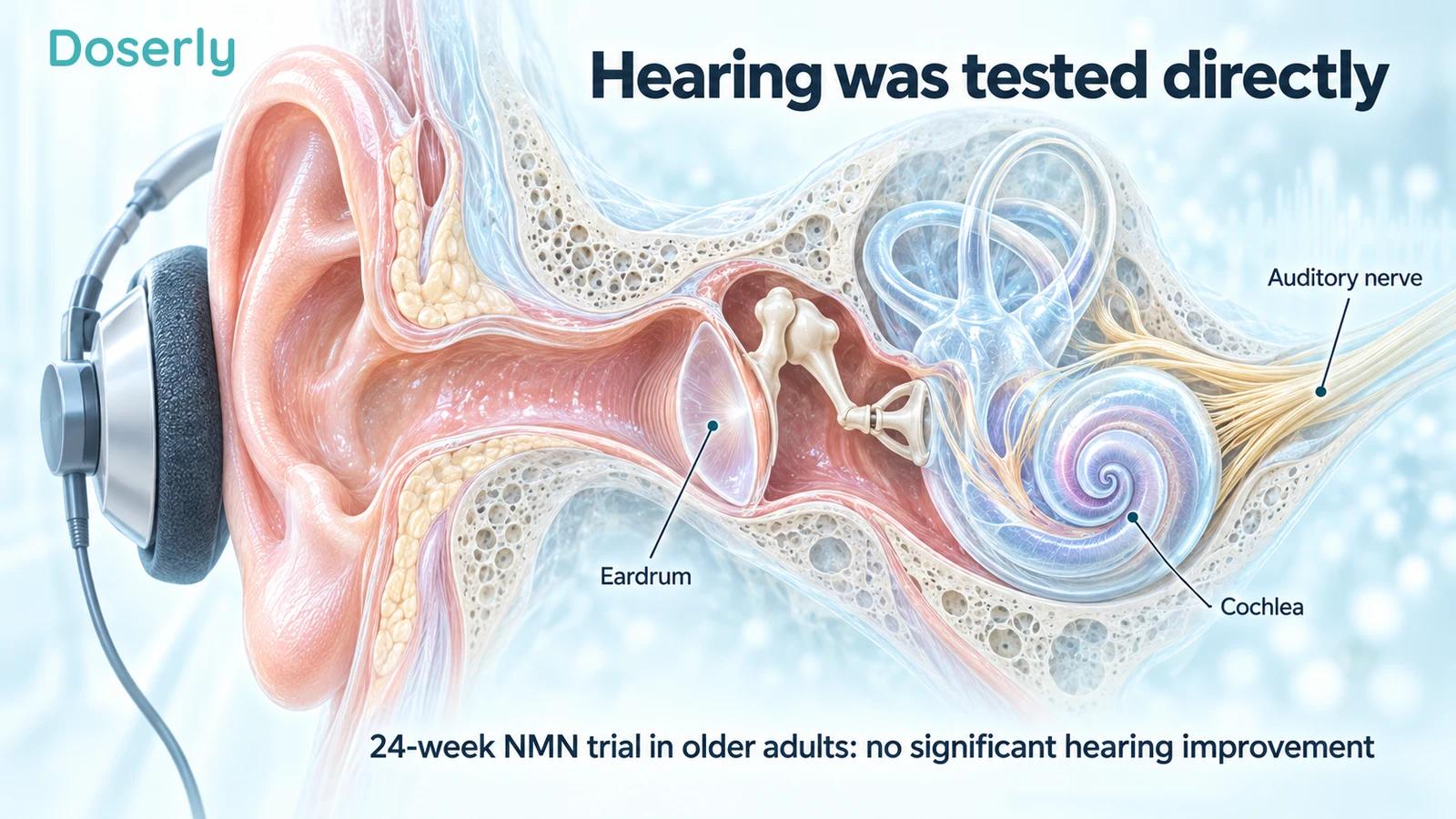
Blood NAD and related metabolites increased. The primary hearing outcome and physical-performance measures did not significantly improve. Some nominal changes in other measures did not remain significant after correction for multiple testing and were considered exploratory. The study was funded by the NMN supplier, and several authors reported employment by that company. Read the publisher's trial report.
This is a direct example of biochemical activity without a demonstrated benefit on the main functional question. The research dose is a description of the experiment, not a recommendation to escalate a personal routine.
The findings also prevent an easy explanation that every neutral trial simply used too little or lasted only a few days. More exposure and longer follow-up still need to produce the outcome being claimed; they do not guarantee it.
A blood-NAD result is not a biological-age score
Another 2026 human investigation examined whole-blood NAD across seven independent cohorts. It found levels remained relatively stable with age and across the lifestyle interventions studied, while changing in response to nicotinamide riboside supplementation. The authors questioned the usefulness of blood NAD as a marker of aging or lifestyle factors. Read the primary cohort investigation.
That study is about whole blood. It does not establish that NAD remains unchanged in every tissue, and its supplementation component involved NR rather than proving an NMN health benefit.
Its relevance is the measurement problem. A blood test can be responsive to an intervention without being a validated score of how young or healthy the person has become.
Before interpreting a commercial result, ask what sample was measured, which assay was used and what evidence connects a change to a patient-relevant outcome. A reference range or a higher value does not automatically provide that connection. Without it, chasing the biomarker can become a substitute for defining the benefit.
Short-term tolerability cannot settle lifelong use
Human trials can report whether participants tolerated the tested preparation over their follow-up period. That information matters. It is also limited by the number of participants, who was eligible, what was monitored and how long observation continued.
For example, an experiment lasting several months cannot reliably exclude uncommon events or establish the safety of taking a different product for decades. An absence of observed harm is narrower than proof of indefinite safety.
This limitation should not be converted into a claim that NMN is known to cause a particular long-term disease. Uncertainty works both ways. The honest conclusion is that the available experiments do not answer every safety question raised by lifelong, broadly marketed use.
The same caution applies to combining products. A trial of one preparation does not automatically assess a routine containing multiple NAD-related supplements, medicines and other ingredients. The actual combination is a separate exposure.
What would make a stronger human-benefit claim?
For a mobility claim, a useful next study might prespecify a clinically relevant functional endpoint, recruit people whose function could plausibly improve and follow them long enough to assess a durable difference. Replication would help establish whether a favorable result is dependable.
For diabetes prevention, the relevant question extends beyond one measure of insulin action. It requires evidence about progression, diagnosis or other meaningful clinical outcomes in an appropriate population.
For longevity, the gap is larger still. A change in a metabolite, a questionnaire or an aging-related laboratory estimate is not a count of additional years lived. None of the trials discussed here establishes that NMN extends human lifespan.
These distinctions are not a demand that every early study answer every future question. They are a way to keep each study useful. A small mechanistic trial can succeed at detecting a physiological effect without becoming a complete consumer health recommendation.
A practical response to the creator's question
Physionic's published research question is a good starting point because it leaves room for both positive findings and skepticism. A fair answer should do the same: acknowledge selective human signals, show neutral primary outcomes and identify where a biomarker has been promoted into a broader promise.
The Doserly NMN guide provides broader ingredient context. For an actual routine, document the exact preparation, reason for use, start date and other products or medicines. Record meaningful changes without assuming they were caused by NMN, particularly when sleep, exercise or treatment changed at the same time.
Persistent fatigue, declining function or an abnormal clinical test deserves assessment on its own terms. A supplement experiment should not displace investigation of the problem it is intended to solve.
The most useful answer to “does NMN work?” therefore names an outcome. It can raise blood NAD-related measures, and some small trials report specific physiological or secondary functional benefits. The evidence remains much less convincing for broad metabolic improvement, prevention of disability or longer human life. Keeping those claims separate is how an engaging research discussion becomes a sounder decision.
Sources
- NMN Supplementation — does it actually work?
- Efficacy of oral nicotinamide mononucleotide supplementation on glucose and lipid metabolism for adults: a systematic review with meta-analysis on randomized controlled trials (2025)
- Nicotinamide mononucleotide increases muscle insulin sensitivity in prediabetic women (2021)
- Ingestion of β-nicotinamide mononucleotide increased blood NAD levels, maintained walking speed, and improved sleep quality in older adults in a double-blind randomized, placebo-controlled study (2024)
- Effect of 12-Week Intake of Nicotinamide Mononucleotide on Sleep Quality, Fatigue, and Physical Performance in Older Japanese Adults (2022)
- Sustained NAD⁺ augmentation by high-dose nicotinamide mononucleotide supplementation in older adults: a 24-week randomized, double-blind, placebo-controlled trial (2026)
- Human whole-blood NAD+ levels do not vary with age or lifestyle interventions (2026)