
Supplements
October 16, 2026
Saccharomyces boulardii: what being a probiotic yeast changes
On this page
Saccharomyces boulardii is a yeast, not a bacterium. That difference helps explain why it is studied during antibacterial treatment, but it does not establish that it prevents every episode of antibiotic-associated diarrhea. It also introduces a safety question that deserves more attention than a generic “friendly microbe” description usually provides.
The human evidence is mixed. Some trials report fewer diarrhea episodes, while other hospital trials found no preventive benefit. A small 2026 study reported a particularly large effect, but its unusually high placebo event rate and single-center design make it a result to examine carefully rather than a reason to discard the rest of the literature.
The decision therefore has two parts: whether a particular preparation has useful evidence for the intended situation, and whether a live yeast is appropriate for the person taking it. Our Saccharomyces boulardii guide provides broader ingredient context. This article focuses on antibiotic-associated diarrhea, the distinction from C. difficile infection, and the people for whom the safety balance changes.

A yeast is not a stronger version of a bacterium
Yeasts are fungi with cells that contain a nucleus. Bacteria have a different cellular organization. S. boulardii is also described in scientific and regulatory material as S. cerevisiae var. boulardii, reflecting its close taxonomic relationship to S. cerevisiae. That naming relationship does not make a baking yeast or an unidentified yeast product equivalent to a studied probiotic preparation. EMA assessment
The distinction matters when discussing medicines. Antibacterial and antifungal treatment are different categories; compatibility should be checked for the actual medicine and product. The EMA assessment discusses concomitant antifungal use and product-specific precautions. A pharmacist can help interpret those details without assuming that a generic instruction for a bacterial probiotic applies to a yeast. EMA assessment
But surviving in a particular treatment environment is not the same as producing a clinical benefit. A preparation still needs trials showing an outcome such as fewer diarrhea episodes. Biology can explain why an intervention is plausible. It cannot tell you how much it helps, who benefits, or whether the safety tradeoff is acceptable.
Positive trials exist, including a striking recent result
An older placebo-controlled trial in 193 hospitalized patients receiving beta-lactam antibiotics reported antibiotic-associated diarrhea in seven of 97 people receiving S. boulardii and 14 of 96 receiving placebo. This supports a preventive signal in that study population. It does not establish the same effect for all antibiotics, all hospital patients, or all yeast products. Beta-lactam trial
A 2026 trial in Bosnia and Herzegovina randomized 100 hospitalized adults to a named S. boulardii product or placebo for 28 days. Diarrhea occurred in four of 51 participants receiving the yeast and 35 of 49 receiving placebo—7.8% versus 71.4%. No toxin-positive C. difficile infections were identified. 2026 trial
That very large difference needs context. The trial used a definition of at least two loose or liquid stools within 24 hours, had an unusually high placebo event rate, and was conducted at one center. The full paper also states that it was not prospectively registered. The authors call for confirmation in larger multicenter studies with standardized definitions. The result is evidence for the tested intervention under those conditions, not a reliable forecast that a typical user will obtain the same absolute benefit. 2026 trial
A large percentage reduction can be persuasive because it sounds definitive. Yet its practical meaning depends on the starting risk and what counted as an event. A study counting one pattern of loose stools cannot be assumed to measure the same clinical burden as a study requiring more frequent or sustained diarrhea. Comparing results requires reading those definitions, not just lining up percentages.
Other hospital trials found no preventive benefit
A multicenter German trial enrolled 477 adults receiving systemic antibiotics and stopped early for futility. There were 21 antibiotic-associated diarrhea events in the S. boulardii group and 19 in the placebo group. The estimated hazard ratio was 1.02, with a wide confidence interval spanning benefit and harm. Investigators found no evidence of prevention in that population. Multicenter trial
A separate trial in predominantly elderly hospital patients also did not show a benefit. Of 275 randomized participants, 204 completed follow-up. Diarrhea occurred in 15.1% of probiotic recipients and 13.3% of placebo recipients among those completing follow-up. The substantial loss between randomization and completed follow-up is an important limitation, but the observed result was not a positive prevention finding. Older inpatient trial
These studies do not prove that S. boulardii can never help. They do prevent a simple claim that its effect is consistent across hospital settings. The type of patient, underlying risk, antibiotic exposure, timing, formulation, event definition, and follow-up can all differ between trials.
A balanced interpretation keeps the positive and negative results in view. It is not enough to select the newest trial because it is favorable, or the largest negative trial because it is convenient. The question is how the full set of relevant studies applies to the person and purpose being considered. That is a clinical judgment, not something a broad product slogan can settle.
Antibiotic-associated diarrhea and C. difficile are not the same outcome
Antibiotic-associated diarrhea is a clinical category that includes diarrhea occurring in relation to antibiotic treatment. C. difficile infection is a specific diagnosis within a different, more precise clinical question. Preventing any loose-stool episode does not automatically establish prevention of that infection, and a prevention study does not establish treatment of an infection that is already present.
The distinction is visible in the trials. C. difficile-associated diarrhea occurred in only four of 477 participants in the German study. Such sparse events leave substantial uncertainty about that particular outcome. The absence of toxin-positive cases in the recent 100-person trial also does not demonstrate prevention; there were no such cases in either group to establish a comparative effect. Multicenter trial, 2026 trial
The AGA's 2020 probiotic guideline suggested certain preparations, including S. boulardii, for prevention of C. difficile infection during antibiotics, while restricting probiotic use for established infection to clinical trials. Its newer 2026 guidance for people with inflammatory bowel disease advises against probiotics for primary or secondary prevention of C. difficile infection. The population and purpose matter; the older suggestion is not a blanket recommendation for every patient. AGA probiotic guideline, AGA guidance for IBD
If diarrhea develops during or after antibiotics, a probiotic should not become a reason to delay assessment. The clinician needs to determine whether the problem is mild and self-limited, related to another medicine or illness, or requires testing and specific treatment. A preventive supplement cannot answer that diagnostic question.
The bloodstream safety issue changes the decision
A Finnish retrospective study identified 46 patients with Saccharomyces fungemia across five university hospitals. At least 20 had been using an S. boulardii probiotic. Fungemia means yeast in the bloodstream, a very different situation from a microbe being present inside the intestinal lumen. The study found an association with probiotic use; it cannot calculate the chance of infection for an otherwise healthy person buying a supplement. Finnish safety study
The investigators advise against use in people who are critically ill, immunocompromised, or have indwelling catheters, and urge caution when gastrointestinal integrity may be compromised. This is a meaningful safety boundary, not a claim that everyone who takes the product is likely to develop an infection. A treating hospital team should make the decision in these settings; families should not add a live yeast product independently. Finnish safety study
The EMA assessment likewise identifies critical illness, impaired immunity, and central venous catheters as contraindication contexts for the assessed medicinal preparation. It also discusses contamination risks when live products are handled around vulnerable patients. “Natural” and “probiotic” do not remove those precautions. EMA assessment
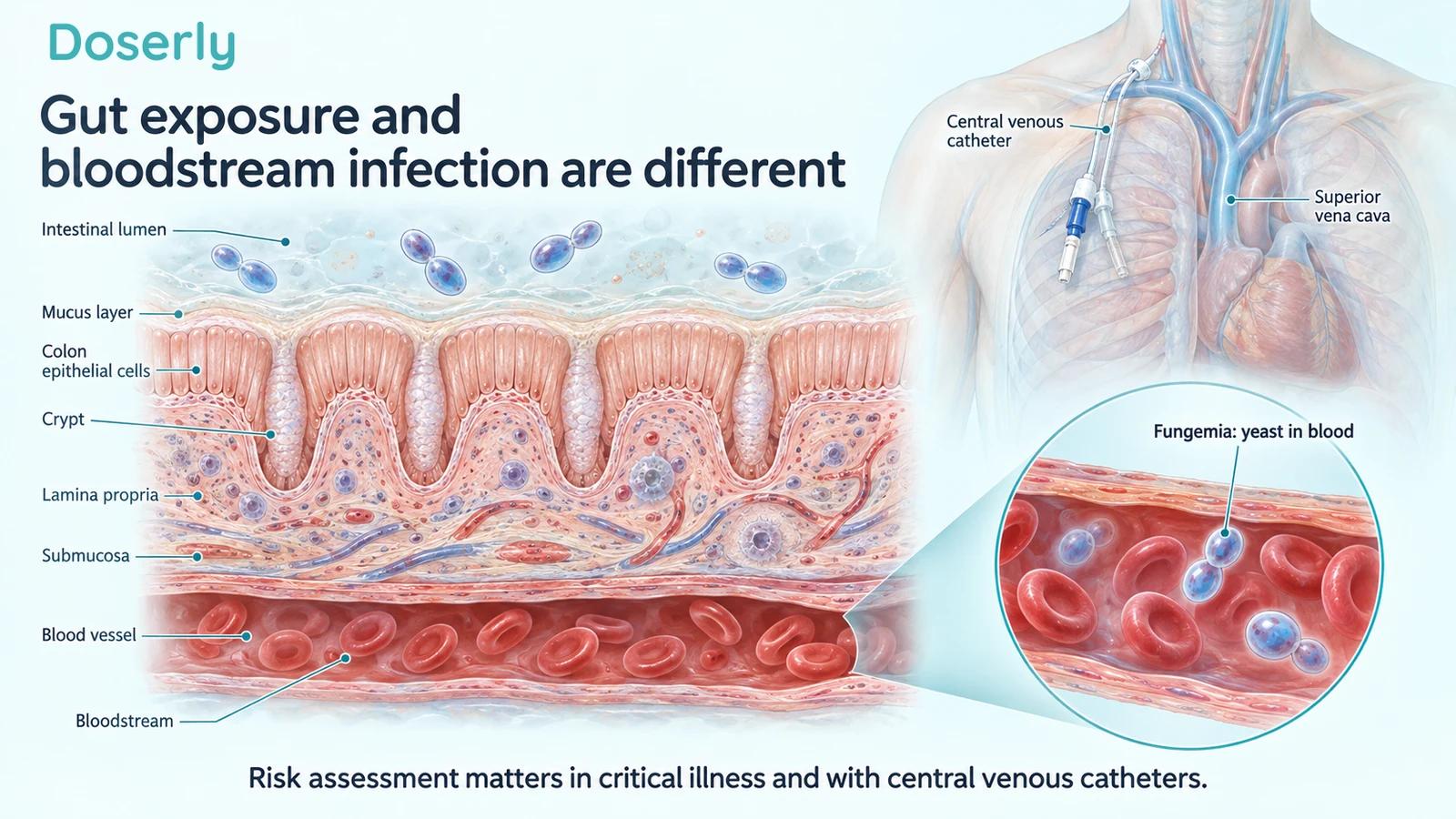
What a product label needs to clarify
A useful comparison starts with a named preparation and, where specified, its strain identity. A study of one medicinal product should not be assumed to validate every supplement using the organism's name. The amount also needs careful reading: milligrams describe mass, while colony-forming units describe viable organisms measured under test conditions. Those quantities are not automatically interchangeable across preparations.
The recent trial, for example, identified its commercial preparation and reported the manufacturer's viable count per capsule in the methods. That detail makes the intervention more identifiable. It does not prove that another product with the same capsule weight has the same properties. 2026 trial
Check the actual package rather than relying only on a retailer's shortened description. Note the complete organism name, preparation, amount per serving, storage directions, and intended use. If a manufacturer cites a trial, look for whether the trial used that product and asked the same question. Missing information should remain visible as uncertainty rather than being replaced with confidence borrowed from another preparation.
This is especially relevant when someone wants to substitute a food yeast or combine several microbial products. The studies discussed here tested particular interventions. They do not establish that adding more species, changing preparations, or improvising a mixture improves the outcome.
A clinician conversation that gets to the useful question
Start with the purpose. Are you trying to prevent ordinary antibiotic-associated diarrhea, reduce the chance of a diagnosed infection, or treat symptoms that have already started? Those questions need different evidence and sometimes different care. Also identify the antibiotic, expected treatment course, other medicines, and important health conditions.
Then ask about the likely benefit in your setting. A large effect in a small trial with a high event rate may not translate into a large benefit where the underlying risk is lower. A clinician can also consider whether any safety factor makes a live yeast inappropriate before debating how promising the efficacy evidence looks.
If a product is used, record the exact preparation and start date alongside symptoms and the antibiotic course. That record can help describe what happened, but it cannot determine the cause of diarrhea or establish that a supplement prevented an event that never occurred. Do not change or stop an antibiotic on the basis of a probiotic claim without discussing it with the prescriber.
The EMA assessment emphasizes rehydration as central to diarrhea care, particularly for children and older adults. A supplement is not a substitute for managing fluid loss or obtaining assessment when symptoms are concerning. EMA assessment
S. boulardii deserves to be understood as a specific live yeast intervention with mixed prevention evidence and important safety exclusions. Its unusual biology is a reason to ask better questions about the product—not a reason to assume it is the best probiotic for everyone taking antibiotics.
Sources
- EMA: assessment of Saccharomyces cerevisiae CBS 5926
- S. boulardii during beta-lactam treatment, 1995
- Single-center prevention trial in hospitalized adults, 2026
- Multicenter prevention trial, 2016
- Older hospitalized adults prevention trial, 2012
- AGA: probiotics in gastrointestinal disorders, 2020
- AGA: C. difficile infection in IBD, 2026
- Rannikko and colleagues: Saccharomyces fungemia and probiotic use, 2021