
Supplements
October 16, 2026
Zinc lozenges for colds: why the formulation changes the answer
On this page
Zinc is essential for normal immune function. A zinc lozenge, however, is more than a way to meet a nutritional requirement: it dissolves in the mouth and exposes oral tissues to a particular formulation over time. That is one reason cold studies using lozenges cannot automatically be applied to a swallowed zinc tablet.
Some trials have found meaningfully shorter colds. Others have found no clear benefit, including a study of a commercial zinc acetate lozenge. The useful question is therefore more detailed than “does zinc work?” It includes the salt, elemental amount, other ingredients, dissolution, timing and outcome being measured.
Our zinc guide covers the nutrient more broadly. Here we'll examine why those product details matter, what the conflicting human studies actually found and which safety distinctions should remain visible when considering a cold remedy.
A nutrient role and a cold treatment are different uses
Zinc contributes to many cellular processes, including immune activity and normal growth. Correcting inadequate intake is a nutritional goal. Trying to shorten a cold with repeated lozenges is a treatment question that may involve exposures unlike ordinary dietary intake. NIH zinc fact sheet
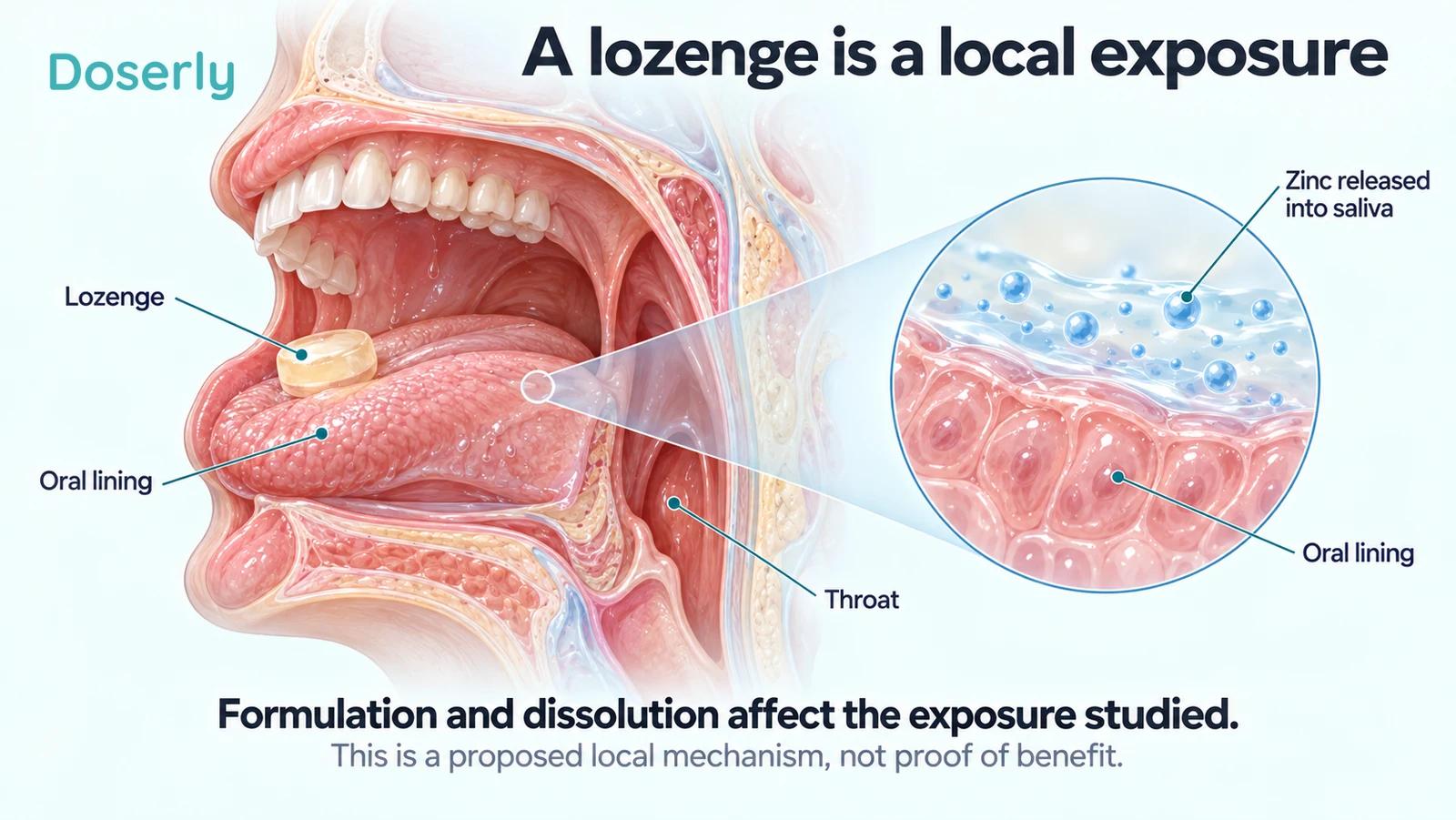
A lozenge's proposed local effects have attracted attention because zinc is released into saliva. The form and other ingredients can influence that exposure, and researchers have discussed dissolution time as one possible explanation for differing trial results. These remain explanations to investigate; the presence of zinc in saliva alone does not prove a clinical benefit. Commercial zinc acetate trial
That distinction helps when comparing a lozenge with a multivitamin. Both can contain zinc, but they don't deliver it in the same way. It also prevents a treatment claim from becoming a reason for indefinite high intake after the cold has ended.
A positive trial: zinc gluconate in adults with early symptoms
A 1996 randomized, double-blind study enrolled 100 Cleveland Clinic employees whose cold symptoms had begun within the previous 24 hours. Fifty received zinc gluconate lozenges and fifty received placebo. The research product contained 13.3 mg of zinc per lozenge and was used every two hours while awake during symptoms.
Median time to complete symptom resolution was 4.4 days with zinc versus 7.6 days with placebo. Side effects were also more common: 90% versus 62% reported adverse effects, with bad taste and nausea among the concerns. Mossad and colleagues
Those results describe the tested formulation and schedule; they are not instructions to copy it. The median is the middle observed duration, not the duration everyone experienced. Subtracting the medians gives 3.2 days, but that difference cannot be promised to a person buying a different product.
The side effects belong in the same conversation as the benefit. A cold ending sooner may be worthwhile to someone, but unpleasant taste or nausea can change that judgment. A striking duration result without its tolerability context gives an incomplete picture.
A negative trial: zinc acetate did not reliably speed recovery
In a 2020 randomized trial, researchers supplied zinc acetate or placebo lozenges to 253 participants so treatment could begin promptly if a cold developed. Eighty-eight developed a cold, and 87 were included in the primary analysis. The planned zinc exposure was 78 mg per day for five days.
The study did not find a statistically significant improvement in recovery over ten days. The recovery rate ratio was 0.68, with a 95% confidence interval of 0.42–1.08. The estimate favored slower recovery with zinc, but its uncertainty included no difference. Zinc acetate trial
This result should not be described as proof that zinc causes longer colds. It does show that the name “zinc acetate” is not enough to guarantee a positive result. The authors discussed features such as lozenge dissolution and treatment duration, but hypotheses about why a trial was negative do not turn it into a positive trial.
The enrollment distinction matters too. Saying “253 people with colds were treated” would be inaccurate. Participants were supplied products in advance; the clinical analysis concerned the smaller group who developed illness.
Experimental colds and naturally acquired colds can disagree
A 2000 report included two randomized studies: 273 participants with experimentally induced rhinovirus colds and 281 with naturally acquired colds. Researchers compared zinc gluconate, two zinc acetate lozenge amounts and placebo.
In the experimental-infection study, zinc gluconate reduced median illness duration from 3.5 to 2.5 days without improving symptom severity. Zinc acetate did not improve either measure. In the naturally acquired cold study, neither formulation improved duration or severity. Turner and Cetnarowski
An experimental infection offers control over exposure, but it doesn't reproduce every feature of naturally acquired illness. People arrive at treatment at different points, and illnesses described as colds can involve different viruses. The two results should stay distinct rather than being compressed into a single positive or negative headline.
This is also a reminder that duration and severity are separate. Recovering earlier is useful, but it doesn't necessarily mean feeling less ill during the days before recovery. A reader deciding about a product may care about both.
What the 2024 review adds
The 2024 Cochrane review found that zinc treatment may shorten average cold duration by about 2.37 days, with a confidence interval from 0.53 to 4.21 days shorter. That analysis included eight studies with 972 participants and was judged low-certainty evidence. Differences between studies were very large, with an I-squared statistic of 97%. Cochrane zinc review
The pooled estimate is a summary of varied interventions, not a product guarantee. Low certainty means further research could materially change confidence in the result. The review also found increased nonserious adverse events during treatment and uncertainty around several symptom outcomes.
The fair interpretation is that zinc may help shorten some colds, while the size and reliability of benefit remain uncertain. That is more informative than treating every negative trial as a defective formulation or every positive trial as proof for the entire product category.
What to look for beyond “contains zinc”
Start with elemental zinc, the amount of zinc itself, rather than the total weight of the zinc-containing salt. The ingredient list identifies the form, such as acetate or gluconate, while the nutrition or drug label identifies the amount supplied. Compare the amount per lozenge with the number used; a per-piece figure isn't a daily total. NIH zinc fact sheet
Next, distinguish a lozenge designed to dissolve slowly from a tablet swallowed immediately. If the rationale involves local exposure, product behavior matters. That doesn't mean readers can calculate a proven treatment effect from dissolution time at home. It means a study of one delivery method should not be advertised as though it tested another.
Other ingredients can matter to formulation chemistry, taste and tolerability. But an ingredient list alone doesn't settle how much freely available zinc reaches a particular tissue, or whether that exposure shortens a cold. Claims about a perfect salt or a single “blocking” additive need stronger support than a favorable interpretation of one trial.
A practical product discussion can therefore be quite specific: Is there a trial of this formulation? Did participants start at a comparable point in illness? Was the outcome time to recovery, severity, or merely a laboratory measurement? These questions avoid making the label do more evidentiary work than it can.
Oral zinc and nasal zinc are not interchangeable
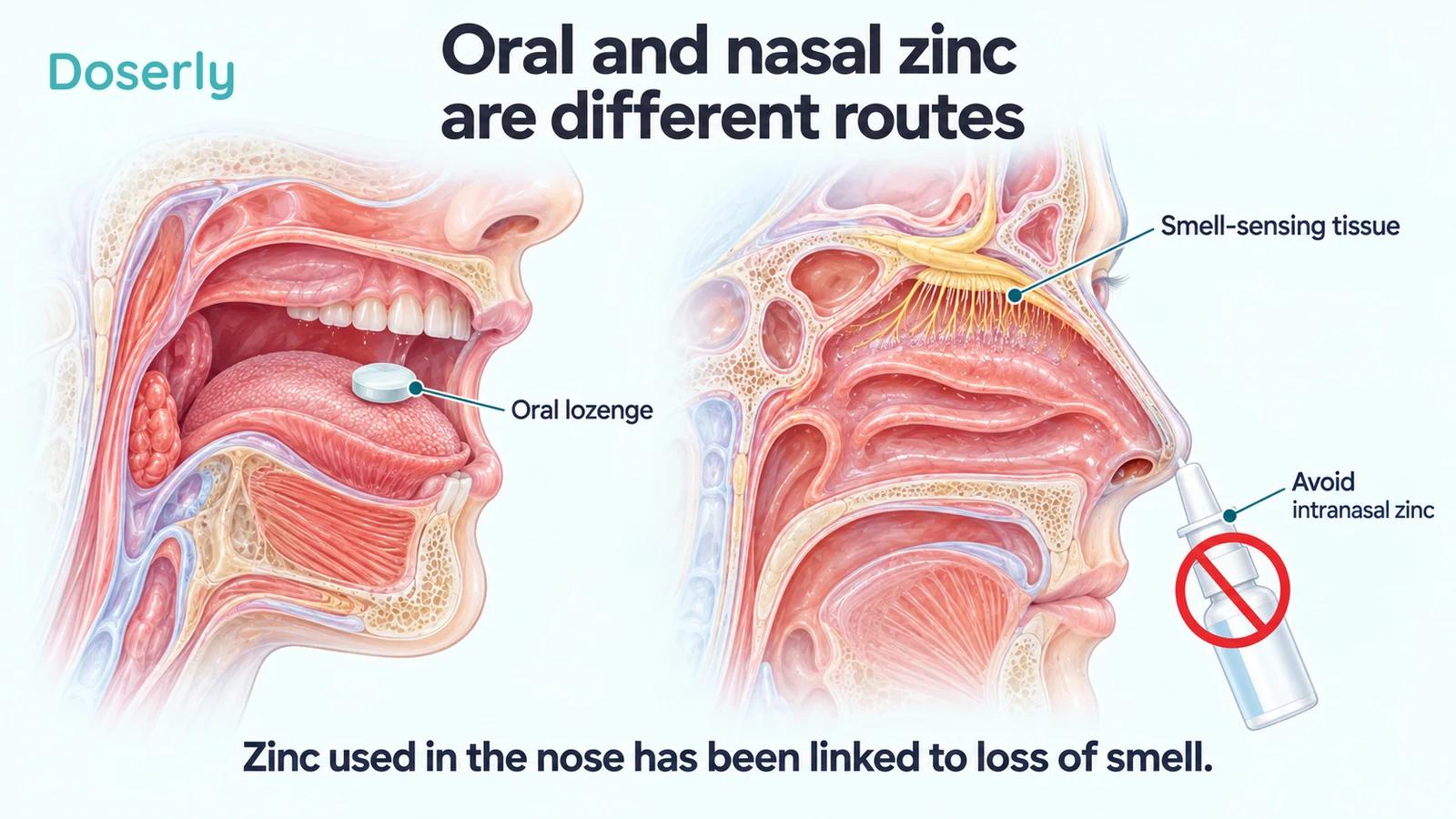
Zinc-containing products placed in the nose have been associated with loss of smell, including potentially persistent loss. FDA's 2009 warning addressed three intranasal zinc products and advised consumers to stop using them. The archived FDA document is a safety warning about that route, not a conclusion about the benefit of oral lozenges. FDA intranasal zinc warning
Do not move an oral product into the nose or assume that local exposure means nasal delivery must work better. Nasal anatomy includes specialized smell-sensing tissue, and changing the route changes both exposure and risk. A brand name is not sufficient to identify what a current product contains, because formulations can change.
If smell changes occur, seek assessment and report the exact product and route used. The important detail is not simply “I used zinc,” but whether it was an oral lozenge, swallowed supplement or nasal preparation.
Short-term research doses should not become a daily habit
Zinc can cause nausea and other gastrointestinal symptoms. Prolonged high intake can interfere with copper status, and zinc can interact with medicines including certain antibiotics and penicillamine. NIH lists an adult upper intake level of 40 mg per day, which is not a cold-treatment target. Some research regimens exceeded it for a short period; that does not establish the safety of continuing them indefinitely. NIH zinc fact sheet
Bring the complete medication and supplement list to a pharmacist. A multivitamin, separate zinc capsule and cold lozenge can overlap even if they were purchased for different reasons. Medication timing may need review, but the appropriate spacing depends on the actual medicine; a generic online schedule isn't a substitute.
For children, pregnancy or a significant medical condition, ask about the specific product before using adult cold-study regimens as a model. The evidence discussed here does not establish a universally suitable lozenge schedule.
Keep cold care broader than the supplement decision
Most uncomplicated colds improve with time. Rest, fluids and appropriate symptom relief can help, while trouble breathing, dehydration, persistent fever or worsening after initial improvement deserve medical attention. People at increased risk from influenza or COVID-19 should seek timely advice about testing and treatment rather than assuming every respiratory illness is a common cold. CDC cold guidance
If you and a clinician or pharmacist decide a product is reasonable, make the plan concrete: which formulation, what the label permits, how it fits other medicines, when use ends and what adverse effects would prompt stopping. Keeping the label and the start date is more useful than remembering only the brand.
The potential benefit is a shorter illness under some studied conditions. It isn't assured prevention, a replacement for clinical assessment or evidence that more zinc is always better. The zinc guide can help you separate the nutrient's everyday role from the more specific question of a cold lozenge.
Sources
- NIH: Zinc, health professional fact sheet.
- Mossad et al., 1996: positive gluconate lozenge trial with adverse-effect data.
- Zinc acetate trial, 2020: commercial formulation without a clear recovery benefit.
- Turner and Cetnarowski, 2000: experimental and natural cold comparisons.
- Cochrane review, 2024: pooled benefits, uncertainty and adverse events.
- FDA warning, archived 2009 document: intranasal zinc and smell loss.
- CDC: Manage Common Cold.