
Supplements
October 16, 2026
Your pre-workout may be borrowing tomorrow's energy
On this page
A good workout is easy to notice. The bar moves faster, the last interval feels manageable, and getting through the session seems to justify the scoop you took beforehand. The harder question arrives later: did that same product make the night less restorative?
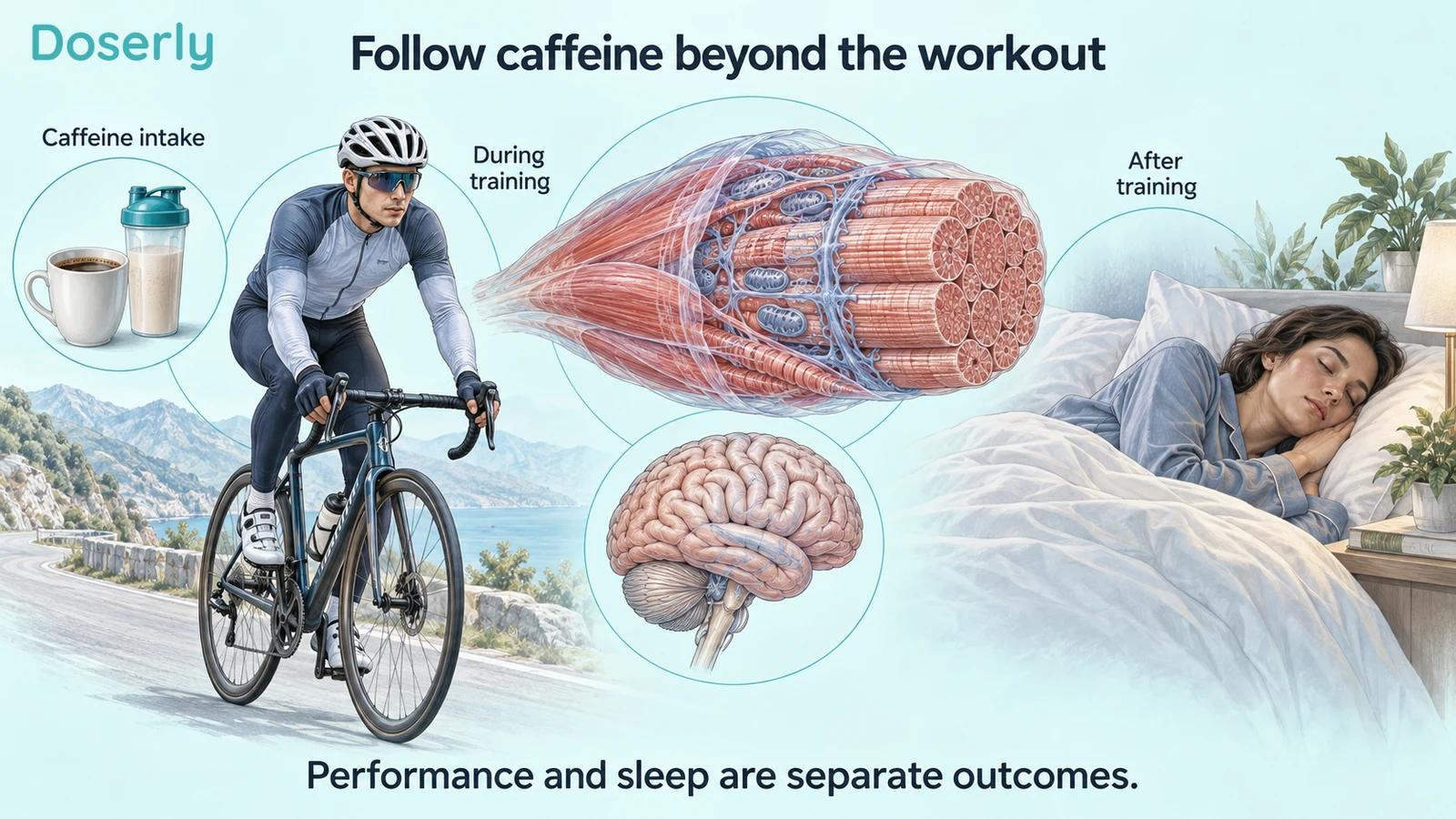
Caffeine can improve exercise performance and disrupt sleep. Those effects can coexist in the same person on the same day. “Borrowing tomorrow's energy” is a useful description of the possible trade, but it is not a measured biological debt or proof that every caffeinated workout harms recovery.
The most useful assessment follows the whole sequence: total caffeine, timing, training, sleep and the following day. It also distinguishes evidence about caffeine alone from claims about a multi-ingredient pre-workout.
Why feeling ready to train is only one outcome
Caffeine blocks adenosine receptors and can increase arousal while reducing perceived fatigue and exertion. The NIH Office of Dietary Supplements describes performance benefits across several exercise settings, particularly endurance activities. This is a real reason athletes use it; a harder session need not be imagined. But reducing the feeling of effort does not establish that the body needs less sleep afterward. NIH exercise-performance fact sheet
Think of two separate questions. Did you complete the planned work more effectively? And did you retain the sleep opportunity needed for the rest of your routine? A product can score well on the first while creating a problem on the second. Conversely, someone who uses a smaller amount early in the day may not experience the same trade as someone taking a large evening serving.
The Doserly caffeine guide provides broader ingredient context. Here, the focus is the interval between the gym and the next morning, where an apparently successful supplement can be harder to evaluate.
The six-hour study tested a substantial dose
The often-cited 2013 experiment by Drake and colleagues compared 400 mg of caffeine taken at bedtime, three hours before bedtime or six hours before bedtime with placebo. Participants slept at home, using a portable sleep monitor and reporting their sleep. Each caffeine timing produced significant sleep disruption relative to placebo. Drake and colleagues, 2013
That finding challenges the idea that caffeine stops mattering once the immediate buzz fades. It does not establish a universal rule that every person can use any amount until exactly six hours before bed. The experiment tested one substantial dose at three particular times; it did not locate each participant's personal threshold.
It also should not be turned into “caffeine six hours before bed always ruins sleep.” An experiment estimates effects under its conditions. Individual responses, other doses and different schedules still need consideration. The practical lesson is to include afternoon intake in a sleep review, even when the person does not describe feeling stimulated at bedtime.
There is another distinction hidden in the phrase “400 mg.” A dose administered in one experimental condition is not interchangeable with a daily total distributed across many hours. Both the total and the pattern of exposure belong in the conversation.
A newer trial makes the dose question clearer
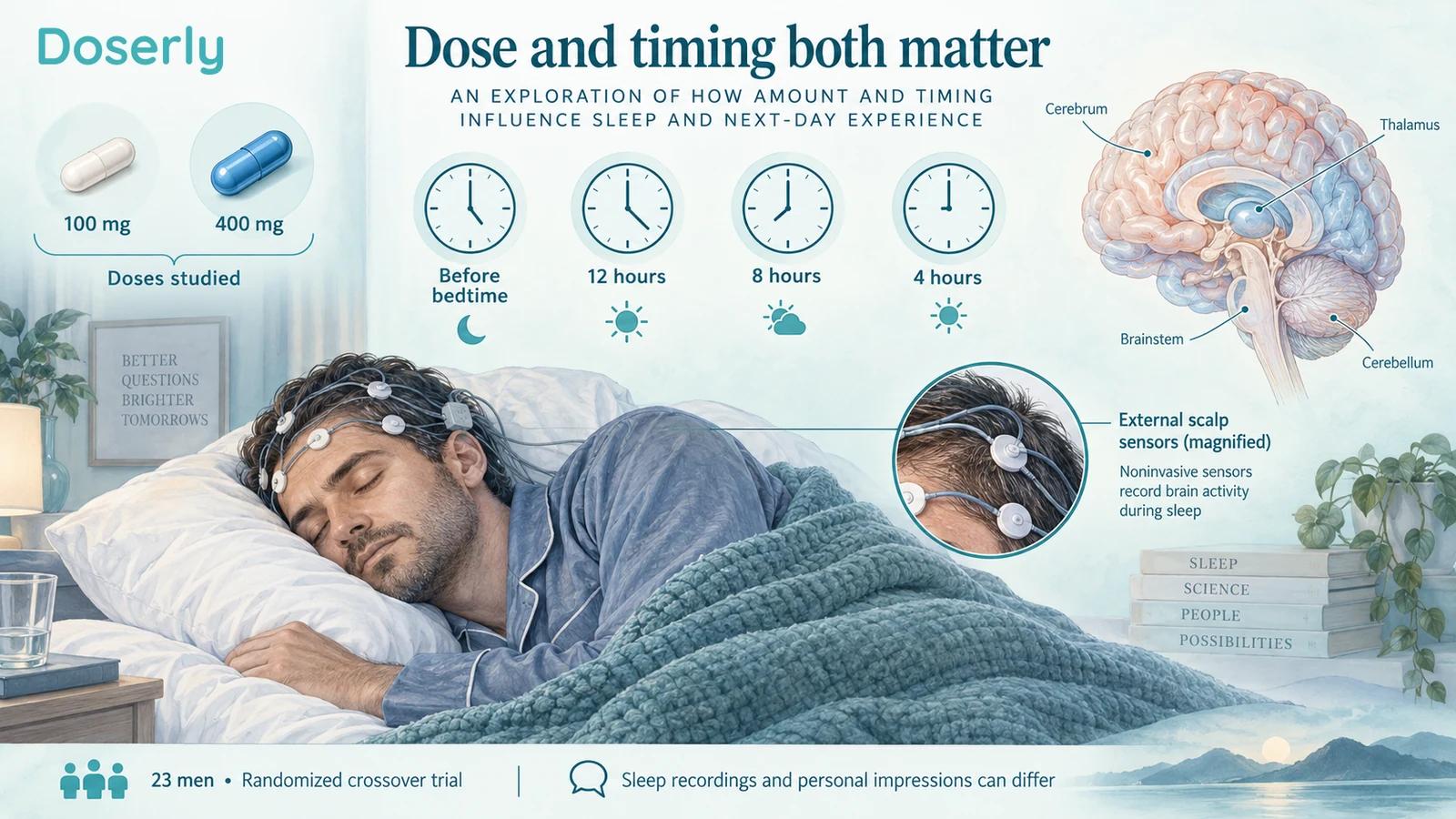
A randomized crossover trial published in Sleep in 2025 examined 23 men with moderate habitual caffeine consumption. It compared placebo with 100 mg or 400 mg taken 12, eight or four hours before bedtime. Researchers used in-home partial polysomnography alongside sleep diaries. Dose and timing trial
The 100 mg conditions did not produce statistically significant objective or subjective sleep differences from placebo. The 400 mg conditions affected sleep, including initiation and architecture when taken within 12 hours, with more fragmentation when taken within eight hours. Perceived sleep quality was worse at four hours, but did not show the same significant signal at eight or 12 hours.
This is a useful contrast, not a permission slip for 100 mg near bedtime. The sample was small, young and male, and the absence of a significant difference cannot guarantee no effect for every user. Nor can these results define an untested 200 mg cutoff by splitting the difference.
Sleep initiation describes getting to sleep, whereas fragmentation concerns interruptions after sleep has begun. Those can change independently, which is why falling asleep without difficulty is not a complete assessment of the night.
The mismatch between recordings and perceptions matters. Saying “I slept fine” may be accurate as a report of experience while missing a measurable change. A diary remains useful, but confidence in one's impression should not erase the possibility of an effect.
Athletes have been studied across both halves of the night
A small 2014 crossover experiment connected the performance and sleep questions directly. Six male cyclists or triathletes completed late-afternoon cycling followed by a time trial, with carbohydrate-electrolyte drinks during exercise. Caffeine was split into two doses of 3 mg/kg, before and during the training session; comparison sessions used placebo. Miller and colleagues, 2014
Time-trial performance improved with caffeine. Sleep measured afterward also deteriorated: average total sleep time was 391 minutes with caffeine versus 464 minutes with placebo, and sleep onset took longer. The very small sample and fairly high combined dose limit how widely those numbers should travel.
Still, this study illustrates the central issue better than either a performance-only or sleep-only study. The workout benefit did not cancel the sleep finding. The sleep finding also did not make the workout benefit unreal. Both belonged to the outcome.
What it did not establish was an exact reduction in muscle growth, a lost amount of recovery, or worse performance the next morning. Those require their own measurements. It would be misleading to convert minutes of sleep difference into a percentage of training adaptation.
Sleep timing is more than sedation
Caffeine's influence is not limited to whether someone feels awake. In a controlled human experiment reported in 2015, evening caffeine given three hours before habitual bedtime delayed the timing of the melatonin rhythm by roughly 40 minutes. The paper also included separate cell experiments investigating clock mechanisms. The human timing observation and the laboratory mechanism should not be treated as the same type of evidence. Burke and colleagues, 2015
That result offers one reason to consider the body's schedule as well as immediate alertness. It does not mean every coffee shifts everyone's clock by 40 minutes, nor that adding a sleep supplement reverses the effect. The finding came from specific experimental conditions.
For a person with a fixed morning alarm, a later night can have practical consequences even when falling asleep eventually feels easy. The available sleep window may shrink. For someone with a flexible schedule, later waking can obscure the change if only total hours are recorded. Bedtime and wake time therefore help interpret a sleep diary together.
Do not blame evening exercise automatically
Late training and late caffeine often occur together, making it easy to blame the whole evening routine. They are not the same exposure. A randomized crossover study in ten recreationally trained men compared several evening cycling intensities with a non-exercise condition. Evening cycling did not impair sleep in this selected group with an intermediate chronotype; some sleep measures improved after sprint intervals. Evening cycling trial
That small study cannot promise that every late workout is sleep-neutral. It does show why removing a convenient training session may be the wrong first inference when caffeine also changed. Exercise timing, intensity, travel home, late meals and stimulant intake can all move together.
A practical review should name what actually differs between good and bad nights. “Gym day” is less informative than “late gym day with a double serving after afternoon coffee.” The second description creates a specific question without assuming the answer.
Count the day, not just the scoop
The label on a pre-workout describes that product, not the rest of the day. Coffee, tea, energy drinks, gels and some medicines may contribute caffeine. Container size and serving size can differ, and botanical ingredients such as guarana can complicate a quick reading of the label.
The FDA cites 400 mg a day as an amount not generally associated with negative effects for most adults, while emphasizing substantial variation in sensitivity and elimination. That population-level statement is not a target, a single-serving recommendation or a guarantee of undisturbed sleep. Pregnancy, medications and medical conditions can change the discussion. FDA caffeine guidance
A useful first step is an inventory rather than a calculation of an imagined perfect dose. Write down the product, the amount actually consumed and the time. Include the second coffee and the portion left in a bottle. If the caffeine amount is unclear, record that uncertainty rather than filling in a number from another brand.
A multi-ingredient blend adds another problem: even a change in symptoms cannot reliably identify which ingredient caused it. Caffeine studies should not be presented as validation of the entire mixture.
What a useful training-and-sleep record looks like
Choose a question before collecting observations. “Does my late pre-workout coincide with worse sleep?” is manageable. “Does this improve everything?” invites selective memory.
A short record can include:
- Exposure: all caffeine sources, amounts when known and consumption times.
- Training: session start and end, planned work, completed work and perceived effort.
- Night: bedtime, estimated time to fall asleep, awakenings and final waking time.
- Following day: sleepiness, ability to work or train, and any extra caffeine used.
Keep expectations modest. A wearable sleep score can be a consistent personal observation, but it is not interchangeable with laboratory polysomnography. A single unusually good or bad night is also vulnerable to stress, illness, alcohol, travel or changes in training load.
If comparing routines, changing several supplements and the bedtime simultaneously makes interpretation difficult. When it is appropriate to review caffeine use, a simpler comparison creates a more useful conversation with a clinician, pharmacist or sports dietitian. Do not deliberately recreate palpitations, severe anxiety or marked insomnia to obtain a cleaner experiment.
There is value in defining success beyond a personal best. Completing the intended session, sleeping adequately and functioning the next day may be a better outcome than one exceptional evening followed by a difficult morning. The relevant balance depends on whether the occasion is a rare competition or an ordinary training week.
When the pattern needs more than a supplement adjustment
Repeatedly needing stronger stimulation to get through normal activity deserves attention. A diary can reveal the pattern, but cannot diagnose its cause. Persistent sleep difficulty or substantial daytime impairment should not automatically be assigned to caffeine, especially if symptoms remain after the routine changes.
The FDA lists insomnia, anxiety, jitters, palpitations and gastrointestinal symptoms among signs of excessive caffeine exposure and advises discussing symptoms with a healthcare professional. People taking medicines or managing health conditions should review the combined routine, not assume a sports label makes it appropriate. FDA caffeine guidance
The central decision is whether the benefit remains worthwhile over the full day. Caffeine can help a session. The evidence also gives a concrete reason to assess what happens after that session, particularly with larger or later intake. Tomorrow's experience belongs in today's evaluation.
Sources
- Drake and colleagues: caffeine at bedtime, three and six hours beforehand (2013)
- Dose and timing effects on subsequent sleep (2025)
- Combined caffeine and carbohydrate in athletes (2014)
- Caffeine and the human circadian clock (2015)
- Evening cycling and sleep (2021)
- NIH exercise and athletic performance fact sheet
- FDA caffeine guidance