
Peptides
October 16, 2026
Why survodutide targets glucagon as well as GLP-1
On this page
Glucagon is best known for helping raise blood sugar when the body needs fuel. That makes it an initially surprising target for a drug being studied in obesity and type 2 diabetes. Why activate a glucose-raising signal in people who may already have high glucose?
Survodutide combines glucagon-receptor activity with activity at the receptor for glucagon-like peptide-1, or GLP-1. The idea is to influence several aspects of metabolism together: appetite, glucose regulation and the liver's handling of nutrients. Human trials show that the combined molecule can reduce weight and lower HbA1c in selected populations. They do not establish that every proposed mechanism contributes equally, or that adding glucagon activity is automatically better for every patient. Diabetes trial, obesity trial
Understanding the design helps explain the interest in survodutide. It also helps separate what researchers intended the molecule to do from what they have directly measured. The survodutide guide covers the wider clinical program; this article concentrates on the two-receptor rationale.
What does activating a receptor actually mean?
A receptor is a protein that responds to a particular signal. When a molecule activates it, the cell changes its activity through internal signaling pathways. A drug that activates a receptor is called an agonist. A dual agonist can activate two receptor types.
Survodutide is one engineered peptide, not a mixture of GLP-1 and glucagon injections. Researchers developed it to act at both receptors and remain active long enough for practical clinical testing. Its earlier research name was BI 456906, which appears in the discovery literature. Original discovery and pharmacology paper
“Dual” describes its targets, not a guaranteed doubling of benefit. Receptors occur in different tissues, their signaling effects interact, and the amount of drug reaching a tissue changes over time. A laboratory potency comparison cannot simply be converted into a percentage of an individual's weight loss.
Nor does a receptor's presence prove that it is responsible for every effect seen after treatment. Researchers use cell assays, animal experiments and human biomarker studies to investigate that connection. Clinical trials then test whether the overall intervention produces a useful result.
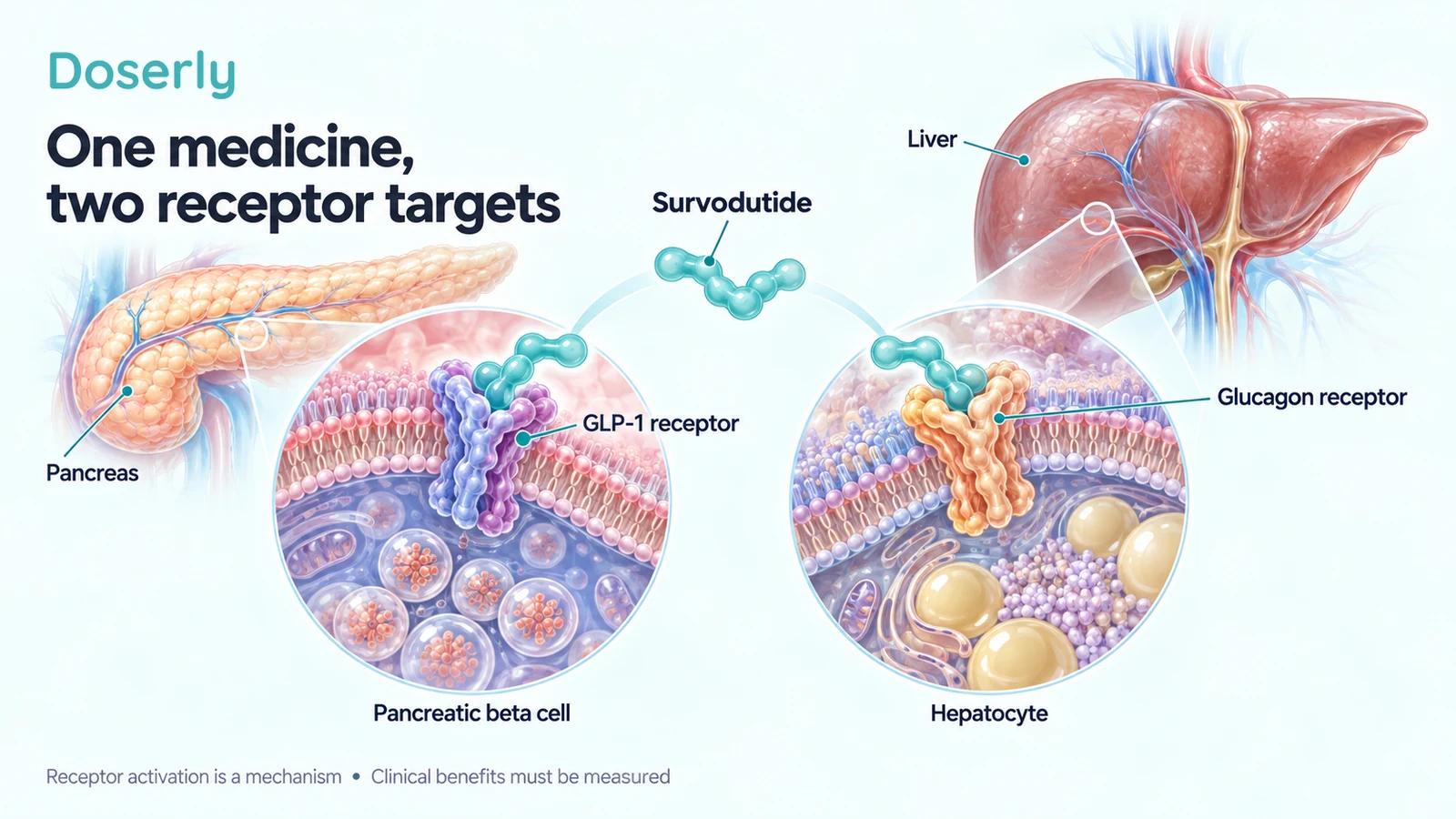
What does GLP-1 activity contribute?
GLP-1 receptor activation is associated with glucose-dependent insulin secretion and effects on appetite and food intake. Glucose-dependent means the insulin response is influenced by the glucose level; it is not an instruction to release the same amount of insulin in every metabolic situation.
For obesity research, appetite-related signaling is important because sustained changes in food intake can affect weight. For diabetes research, the glucose response is also a central outcome. These goals overlap, but a drug can have different dose-response patterns for appetite, body weight and blood sugar. Biological rationale and diabetes results
The GLP-1 part of survodutide's design therefore provides an established biological reason to expect effects on both eating and glucose regulation. It doesn't tell us how large those effects will be in a particular person or whether they will be sufficient to balance the glucose-related effects of glucagon signaling.
That balance is a property of the full treatment under the conditions tested. It shouldn't be assumed from the names of the receptors alone.
Why add glucagon activity?
Glucagon receptors are important in liver metabolism. Glucagon can stimulate glucose production and release, but glucose is not the only nutrient pathway it influences. Researchers are also interested in its effects on fat and amino-acid handling and on energy expenditure.
In the preclinical development work, BI 456906 reduced food intake and increased energy expenditure in mice with diet-induced obesity. The investigators used several approaches to demonstrate activity at both receptors and changes in liver metabolic pathways. These experiments support the rationale for a dual-target drug. Discovery study
The attraction is that glucagon activity might add useful metabolic effects to those obtained through GLP-1 alone. The challenge is achieving an acceptable overall profile: weight and liver effects, glucose control, tolerability and safety must all be considered.
This is more specific than saying the drug “boosts metabolism.” Metabolism includes many processes, some using energy and some storing or releasing fuel. A change in one pathway isn't necessarily a sustained increase in the number of calories a person expends each day.
Does the glucagon component raise blood sugar?
The phase 2 diabetes trial gives a direct clinical test of the net effect. It studied people with type 2 diabetes taking metformin and measured HbA1c, a marker of average glucose exposure, over 16 weeks. Adjusted HbA1c changes ranged from −0.91 to −1.71 percentage points across survodutide groups, compared with −0.15 points with placebo. Original trial
Those results show that activating the glucagon receptor within this dual molecule did not prevent average glucose improvement in that population. They do not establish that glucose can never rise at a particular time, that hypoglycemia is impossible, or that results will be identical with other background medicines.
They also do not prove exactly how much GLP-1 activity “canceled out” glucagon activity. The trial tested the whole drug, not separately adjustable receptor components. Translating a clinical response into a precise division between receptors requires additional evidence.
For someone with diabetes, the useful conclusion is that the net glucose effect was measured and favorable under the trial conditions. It is a stronger statement than a mechanism-based prediction, while remaining specific to the participants and treatment studied.
What have human obesity trials demonstrated?
In a phase 2 obesity trial, 386 participants received treatment for up to 46 weeks. They had overweight or obesity and did not have diabetes. In the planned-treatment analysis, the highest assigned survodutide group had an average weight change of −14.9%, compared with −2.8% with placebo. Phase 2 obesity report
That is evidence of weight reduction with the complete dual agonist. It doesn't isolate the glucagon contribution, because the trial's comparator was placebo. It also doesn't directly measure how much of the weight change came from reduced eating, increased energy expenditure or other changes in energy balance.
Only 233 of the 386 treated participants completed the treatment period. Adverse events were common, especially gastrointestinal symptoms. These facts belong in the interpretation because a mechanism that looks attractive in a laboratory still has to translate into a treatment people can continue using.
A receptor-count comparison cannot replace an actual clinical comparison. Demonstrating that a drug activates two receptors does not show it is superior to every GLP-1 medicine, every dose of those medicines, or another dual agonist.
What do brain studies tell us about appetite?
A 2026 study examined receptor expression and the sites reached by fluorescently labeled survodutide in mice. The molecule reached circumventricular organs, regions with specialized access to circulating signals, and nearby brain areas associated with appetite regulation. The investigators did not find evidence of uniform passage across the blood–brain barrier. Original brain-distribution study
The work included receptor-expression observations in human tissue as well as mouse tissue. That human component is informative about biology, but it is not a human treatment experiment demonstrating brain distribution or appetite benefit after survodutide administration.
The findings support a role for GLP-1 receptor activity in appetite-related effects. They don't justify describing survodutide as freely entering the entire human brain or acting through every brain region where a hormone receptor might be found.
For readers, the distinction is useful because “acts on the brain” is often used as a broad phrase. The relevant questions are which sites, in which species, after which exposure, and with what measured response.
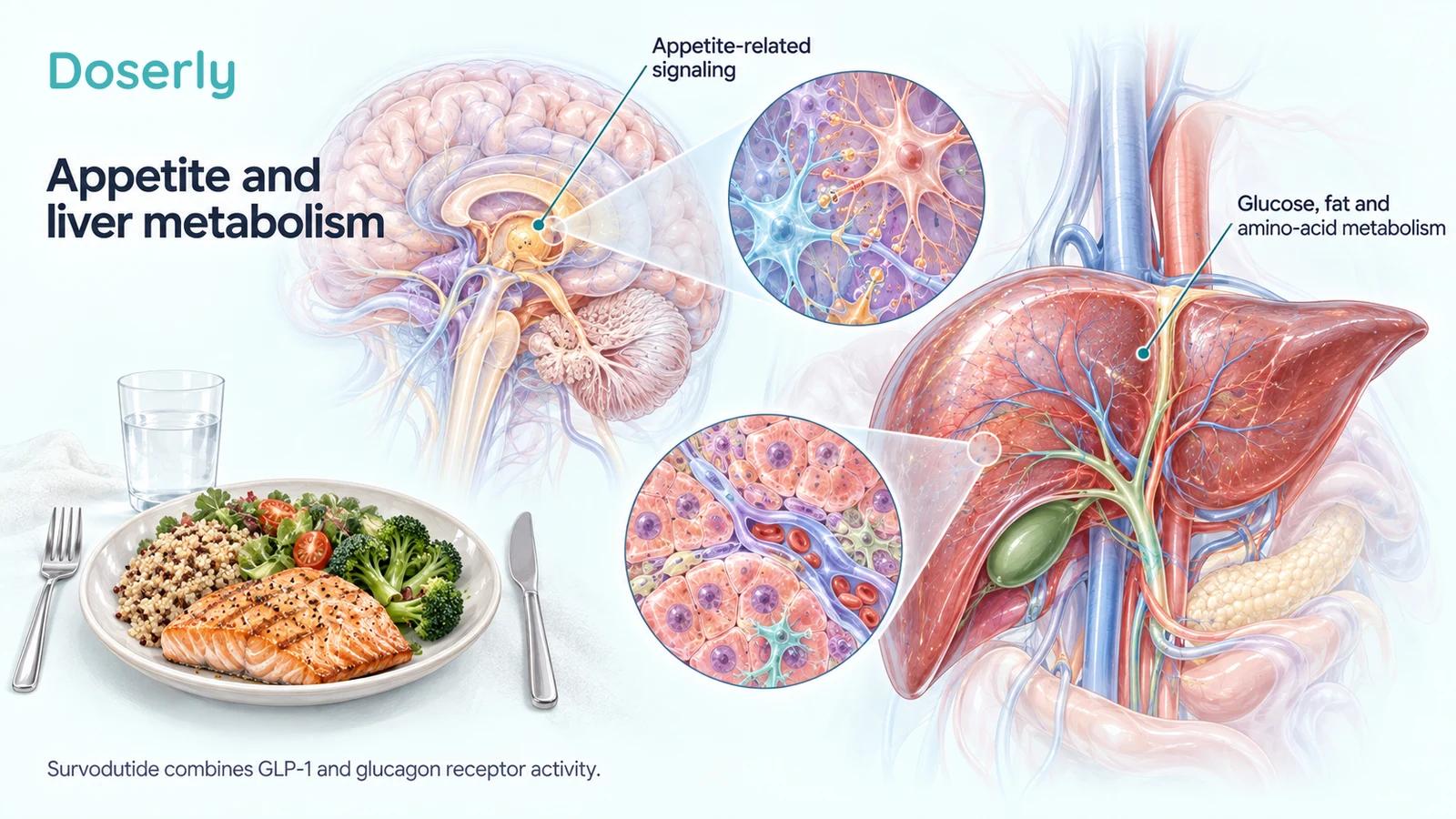
Has increased energy expenditure been shown in people?
There is human evidence that glucagon itself can acutely increase energy expenditure. In a mechanistic study of 11 healthy men, researchers used indirect calorimetry during glucagon infusion, cold exposure and a control condition. Energy expenditure rose by about 15% during the glucagon experiment. Original glucagon study
That experiment involved native glucagon infused for an acute laboratory assessment. It did not involve repeated survodutide treatment in adults with obesity. A different molecule, delivery pattern and time frame can produce a different response.
The mouse survodutide experiments and acute human glucagon study therefore provide mechanistic support, but neither supplies a validated figure for extra calories burned during long-term human survodutide treatment. It would be inaccurate to promise that users burn 15% more energy or can add a fixed number of calories to their diet.
Direct human energy-expenditure studies of the actual treatment would be needed to answer that quantitatively. Weight loss alone cannot identify the mechanism because lower intake can also produce it.
Why are researchers interested in the liver?
The glucagon receptor's role in liver metabolism makes liver disease a logical research area. In a 48-week phase 2 trial in adults with biopsy-confirmed MASH and F1–F3 fibrosis, survodutide improved the primary histologic endpoint more often than placebo. MASH is liver inflammation and injury associated with metabolic liver fat. MASH trial
The primary endpoint was MASH improvement without worsening of fibrosis. That finding is more specific than simply observing weight loss, because it involves tissue examination. However, it still doesn't isolate a direct glucagon-receptor effect from changes associated with weight loss or other actions of the drug.
This is where mechanism and outcome evidence complement one another. Biology explains why a liver trial was reasonable; the trial establishes a result on a defined endpoint. Neither alone proves that all liver disease stages will respond or that cirrhosis complications will be prevented.
Does more receptor activity mean more risk?
Additional biological activity can introduce additional questions, but risk can't be inferred from the number of receptors alone. It depends on the molecule's effects, exposure, patient population and other medicines. Common adverse effects and uncommon serious harms need actual observation.
Gastrointestinal symptoms were prominent in the diabetes, obesity and MASH studies. Trial duration and size also limit what can be said about uncommon or delayed problems. The relevant comparison is the balance of benefits and harms for a particular use, not whether a label says “single,” “dual” or “triple.”
This also explains why combining separately obtained peptides is not equivalent to using a studied dual agonist. A combination would have different exposure patterns and proportions, and its safety and efficacy would need to be tested as a separate intervention. Survodutide's development does not establish a self-designed stacking protocol.
What should you take from the two-target design?
The glucagon component is there because researchers are trying to influence more than appetite alone. The strongest support for the approach comes from measured human glucose, weight and liver outcomes, interpreted alongside tolerability. The proposed mechanisms help explain the research direction; they do not provide an individual forecast.
When a claim says survodutide is better “because it has two targets,” ask what actual clinical comparison supports that statement. When it says the drug burns more calories, ask whether energy expenditure was directly measured in people receiving survodutide. Those questions keep the discussion focused on the benefit you want to understand.
For broader context, the survodutide guide connects the mechanism with trial findings and safety considerations. The two-receptor design is scientifically interesting because it offers a testable approach to metabolic disease, with clinical results determining how useful that approach becomes.
Sources
- Zimmermann and colleagues, discovery and preclinical pharmacology, 2022.
- Blüher and colleagues, randomized diabetes trial, 2024.
- Le Roux and colleagues, randomized obesity trial, 2024.
- Survodutide brain-distribution and receptor-expression study, 2026.
- Salem and colleagues, acute human glucagon and energy expenditure, 2016.
- Sanyal and colleagues, MASH and fibrosis trial, 2024.