
Peptides
October 16, 2026
Research PT-141 and prescription bremelanotide: what differs?
On this page
Two products can use the same molecule's name without carrying the same evidence. That is the central problem when an online vial labeled “PT-141” is compared with Vyleesi, the prescription bremelanotide product studied for a specific form of low sexual desire. The shared name tells you what the seller says the active ingredient is. It does not establish what is inside a particular container, how that product performs, or whether its use has the same balance of benefits and harms.
The distinction is more useful than a blanket claim that every alternative product is counterfeit. Some questions concern chemical identity. Others concern manufacturing, formulation, delivery, clinical outcomes, and regulatory review. Each requires its own evidence. A convincing answer to one does not automatically answer the rest.
For background on the molecule and its clinical research, see the Doserly PT-141 guide. This article focuses on the gap between a named substance and a finished medicine.
What the approved evidence actually belongs to
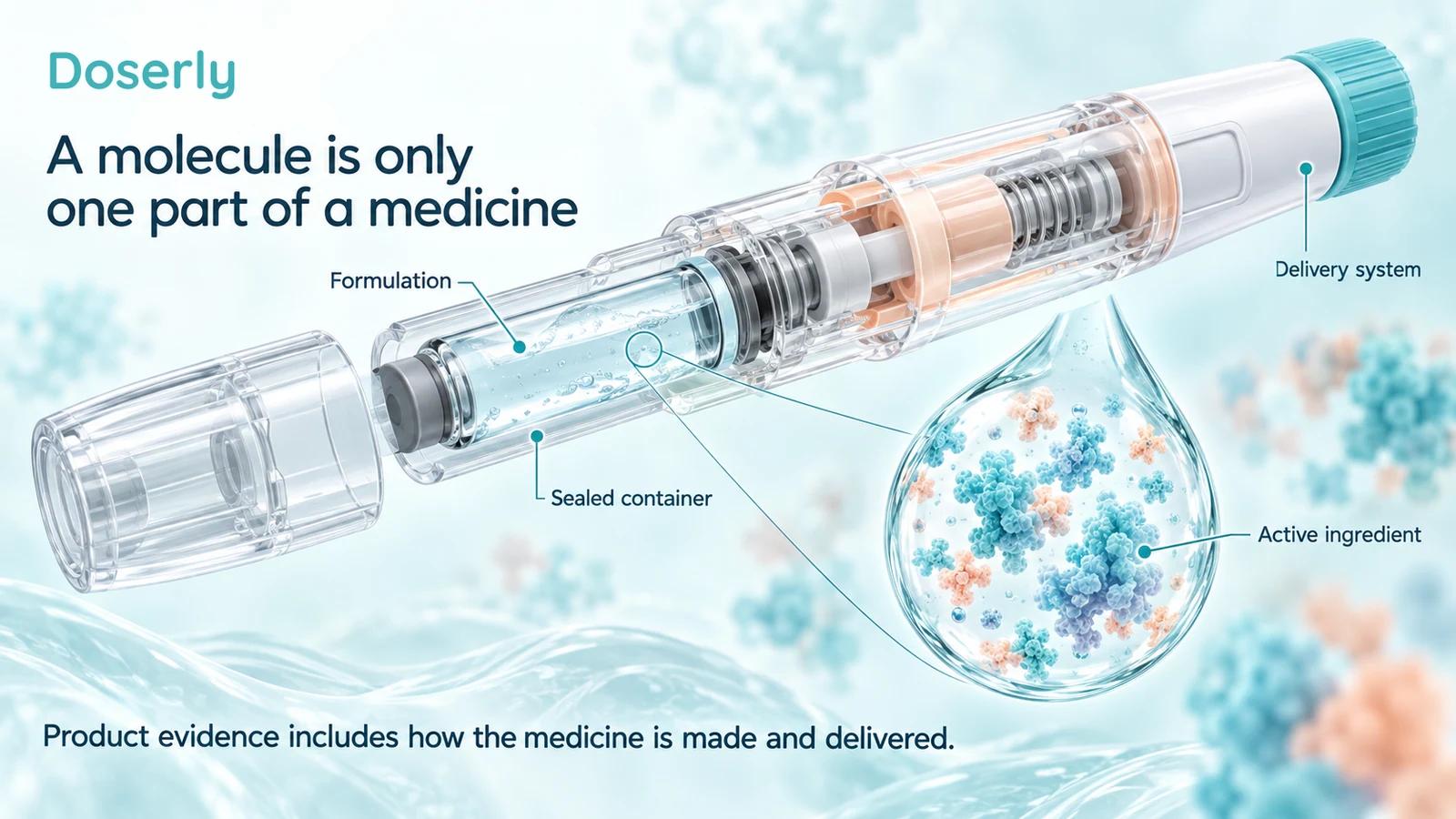
The US approval letter identifies a particular drug application for Vyleesi. It is not a declaration that every product bearing the terms PT-141 or bremelanotide has been reviewed. The current prescribing information describes a sterile solution supplied in a single-dose autoinjector, with a defined strength, route, ingredients, storage conditions, and instructions. Those features describe the product to which its labeling applies. FDA approval letter, Vyleesi prescribing information
The clinical question was also specific. The pivotal RECONNECT trials studied premenopausal women with acquired, generalized hypoactive sexual desire disorder. They measured desire and distress related to low desire, alongside other outcomes and adverse events. A trial result in that setting cannot independently establish a benefit for men seeking stronger erections, people seeking general sexual enhancement, or users of an untested nasal formulation. RECONNECT trial report
There are therefore two separate transfer questions. Does the clinical evidence apply to the person and treatment goal? And does the evidence apply to the actual product being supplied? A person might fit the studied population while receiving a formulation that has not demonstrated comparable performance. Conversely, a genuine approved product does not make every proposed use an approved or well-supported one.
Identity, amount, purity, and sterility are different questions
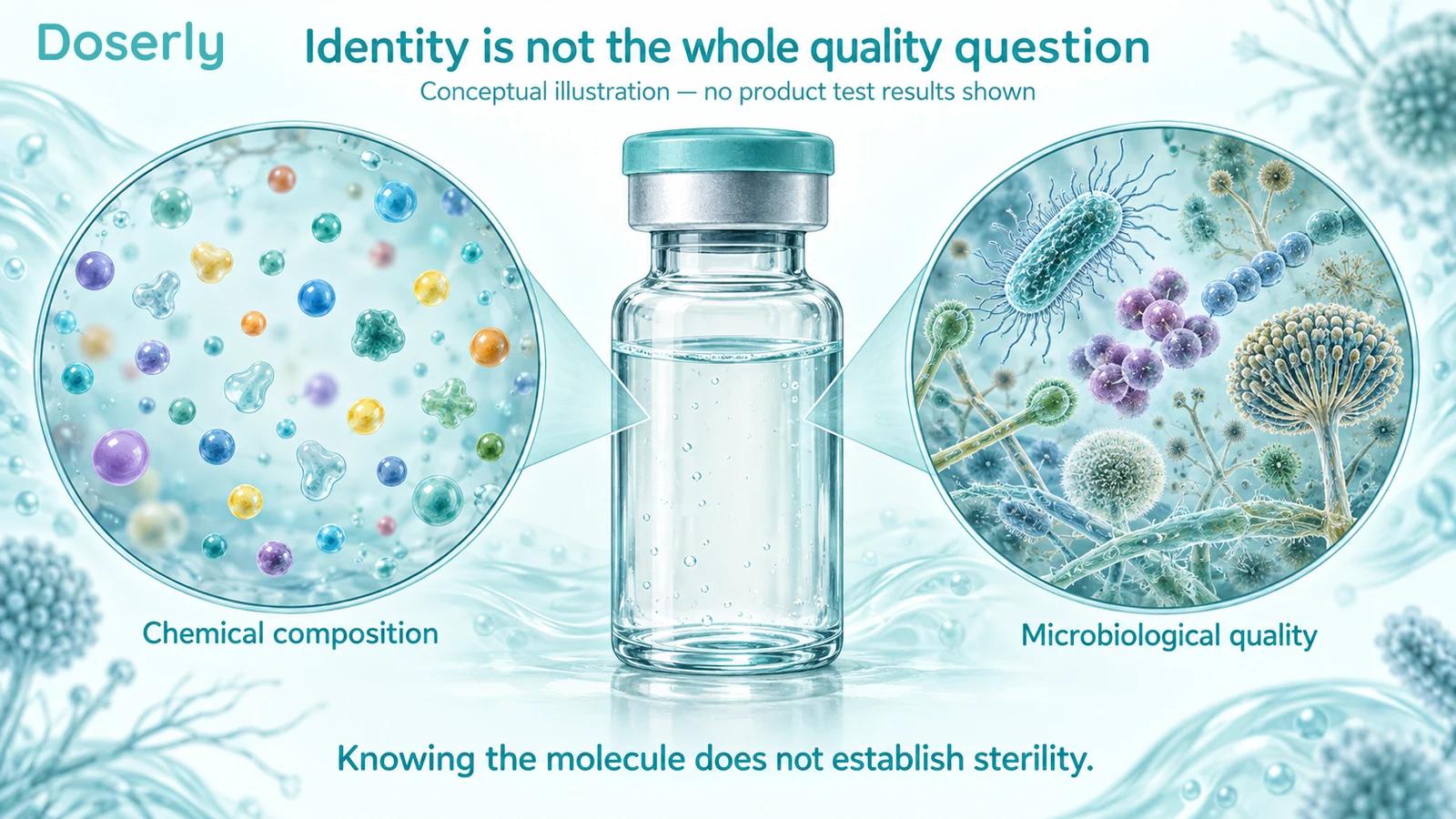
“Contains bremelanotide” is an identity claim. “Contains the labeled amount” is a quantity claim. “Has few unwanted chemical substances” is a purity claim. “Meets the required microbiological standards for an injectable medicine” is another claim again. These statements are related, but none can stand in for all the others.
A useful example comes from a forensic study of confiscated performance and image enhancing drugs. Researchers used high-resolution mass spectrometry to characterize melanotan II and bremelanotide among eight unknown samples. The work demonstrates how analytical methods can identify compounds in seized material. Its abstract does not establish that all online PT-141 products contain a particular amount, are sterile, or produce the outcomes observed in clinical trials. Nor does it provide a representative survey of the current marketplace. Original analytical study
That boundary matters when a seller posts a certificate of analysis. The first question is what the reported test actually measured. A chemical identity result cannot, by itself, demonstrate freedom from microorganisms. A purity percentage does not automatically tell a reader how much active ingredient is present in the finished container. Evidence concerning a raw ingredient may not describe a later finished product after formulation, filling, transport, and storage.
These are questions to take to a pharmacist or prescriber, not a checklist that makes home product evaluation reliable. A customer usually cannot independently verify the chain connecting a posted certificate, a tested sample, a manufacturing batch, and the container delivered to them. The absence of obvious discoloration or particles does not resolve the missing information.
What the FDA's quality review adds
The publicly available chemistry review for Vyleesi shows that product review was broader than identifying a peptide. It addressed the drug substance and finished product, formulation, labeling, stability, and manufacturing facilities. The final recommendation followed resolution of labeling issues, including clear statements of strength and route. The review also discussed degradation products and the evidence supporting storage conditions. Some commercial details are redacted. FDA chemistry review
This document is useful because it makes the missing bridge concrete. A seller cannot recreate that body of evidence merely by citing the chemical name or linking to the pivotal clinical trial. The trial answers a clinical question under its study conditions; the quality assessment addresses whether the submitted medicine has appropriate product controls. Both contribute to the basis for approval.
Approval does not mean that an individual will benefit, that adverse effects cannot occur, or that a manufactured medicine can never have a quality problem. It means that there is an identifiable reviewed product with specified labeling and regulatory responsibilities. That is a different evidentiary position from an unidentified online vial whose composition and handling cannot be confirmed.
A reader need not become a manufacturing specialist to use this distinction. Ask what product is actually being prescribed or supplied, who is responsible for making it, and which evidence supports the proposed formulation and use. If the answer repeatedly changes from the product in front of you to studies of a different product, the central question has not been answered.
A documented example of why finished-product quality matters
A 2019 FDA warning letter to Promise Pharmacy described an injectable bremelanotide sample containing 114.3% of its labeled amount. That means 14.3% above the label claim, not “114.3% more.” The same letter described deficiencies concerning sterile production. These are distinct findings: the measured strength result is not proof that that sample contained microorganisms. FDA warning letter
The letter is a historical regulatory record concerning one inspected operation. It should not be presented as a current assessment of that pharmacy, a prevalence estimate for all compounded products, or proof that every research vial is contaminated. Its value here is narrower: a product bearing the correct ingredient name can still raise finished-product quality concerns.
That example also explains why “the same milligrams” can be an incomplete comparison. A printed amount is a label claim. Whether the contents match it is an empirical question. And even a verified amount does not settle the clinical consequences of a different route, formulation, schedule, or patient population.
Compounded medicine is a separate category
Compounding can serve legitimate patient needs when an approved product does not meet an individual medical requirement. It should not be treated as synonymous with an online product sold for laboratory research. At the same time, the FDA explains that compounded drugs are not FDA approved and do not undergo the agency's premarket review for safety, effectiveness, and quality. FDA explanation of compounded-drug risks
That distinction permits a precise conversation without declaring all compounded care illegitimate. The relevant questions include why a compounded formulation is needed, what pharmacy supplies it, how its quality is controlled, and what evidence supports the intended use. A prescription does not transform a compounded product into the approved commercial product, and a discussion of compounding does not validate a research-only seller.
Legal requirements also depend on the product, activity, and jurisdiction. This article does not establish whether a particular supplier or prescription complies with current law. Broad claims such as “the molecule is approved, so every version is legal” or “all bremelanotide outside one brand is illegal everywhere” go beyond the sources discussed here.
For a practical decision, a licensed pharmacist can identify what category of product is being supplied and explain the relevant standards. That conversation is more informative than relying on a seller's use of terms such as pharmaceutical grade, laboratory tested, or research quality without understanding the evidence behind them.
A different route needs its own bridge
A nasal spray, a prepared injection, and an oral product do not become interchangeable simply because the label lists bremelanotide. The route changes the delivery problem. The amount placed in a container is not necessarily the amount reaching circulation, the timing of exposure, or the exposure at relevant tissues.
Early bremelanotide development included intranasal research. The existence of that work does not establish that an arbitrary current nasal product reproduces the study formulation, delivery device, exposure, or results. Nor can findings from an early male erectile-response experiment substitute for the later female HSDD trial program. Early intranasal study
A valid comparison would need evidence appropriate to the question being asked. If the claim is comparable systemic exposure, pharmacokinetic data would be relevant. If the claim is comparable clinical benefit and tolerability in a different population, clinical evidence may be necessary. A chemical assay alone cannot demonstrate either outcome.
The same logic applies to anecdotes. Feeling nausea after a product does not establish its identity, concentration, sterility, or effectiveness. Experiencing a perceived benefit does not reveal whether another container will behave the same way. Symptoms and personal observations matter for care, but they cannot authenticate a product.
What to bring to a prescribing conversation
Bring the exact product name, formulation, supplier information, and proposed treatment goal. If you have already used a product, provide its packaging and a record of when it was used and what happened afterward. The aim is to help a clinician assess the actual exposure and symptoms, not to reconstruct a research protocol from an online label.
Ask which part of the evidence supports your situation. Is the discussion about an approved indication, an off-label use of an approved product, a compounded preparation, or a research-only product? What is known about the specific formulation? What remains uncertain? These categories can coexist in a conversation, but they should stay identifiable.
Also discuss the drug's own risks. A quality-controlled product can still cause adverse effects. Bremelanotide labeling includes cardiovascular restrictions and warnings, nausea, and focal hyperpigmentation, among other concerns. Product authenticity does not erase those considerations. The PT-141 safety section provides context for that discussion. Vyleesi prescribing information
The most defensible conclusion is specific: the evidence for a licensed bremelanotide product cannot be assigned wholesale to any vial, spray, or preparation called PT-141. The molecule's identity is a starting point. A treatment decision needs the rest of the product and clinical story.
Sources
- Vyleesi prescribing information
- FDA approval letter
- RECONNECT trials
- FDA chemistry review
- LC-HRMS analytical study
- Promise Pharmacy warning letter, 2019
- FDA compounded-drug explanation
- Early intranasal bremelanotide study