
Peptides
October 16, 2026
PT-141 nausea: weighing benefit against tolerability
On this page
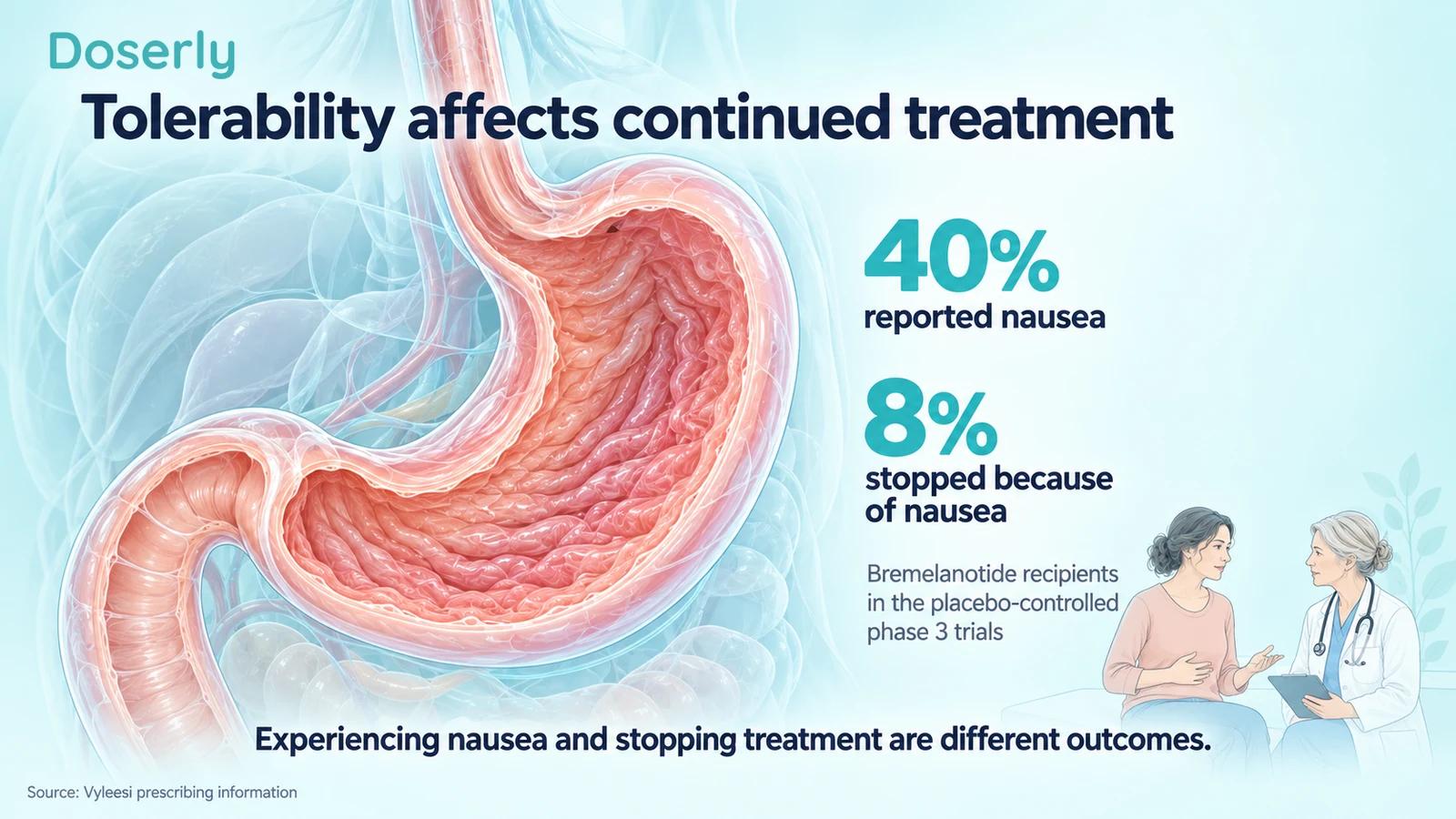
Nausea is one of the most common unwanted effects of bremelanotide, the peptide also called PT-141. In the placebo-controlled studies supporting Vyleesi, 40% of treated participants reported nausea, compared with 1.3% receiving placebo. About 8% of treated participants left the studies because of nausea. Those are not minor details to consider only after discussing benefit: they are part of what treatment is like. Vyleesi prescribing information
For someone seeking help with distressing low desire, the practical question is whether an improvement is worth the burden of using the medicine. A treatment can improve an average score while being difficult for some people to continue. Understanding the timing, frequency, and limits of the nausea evidence makes that tradeoff easier to discuss without assuming that everyone will tolerate it or that nausea means the drug is working.
What the 40% figure actually measures
The controlled safety population included 627 bremelanotide recipients and 620 placebo recipients. The 40% figure describes participants reporting nausea during the study period. It does not mean that 40% of injections caused nausea, that each affected person felt sick every time, or that nausea occupied 40% of the treatment period. Those would require different denominators. Label adverse-reaction table
Similarly, the 8% discontinuation figure concerns the treated group overall, not 8% of the people who had nausea. It identifies a different outcome: deciding or needing to stop because of that symptom. The gap between experiencing an adverse effect and leaving treatment is clinically useful. Some people continued despite nausea, while others found it unacceptable or unsuitable to continue.
The original RECONNECT publication describes two 24-week randomized, blinded trials in premenopausal women with acquired, generalized hypoactive sexual desire disorder, or HSDD. That population and formulation matter when interpreting the rates. These are not established predictions for men, postmenopausal women, nasal preparations, or research vials. RECONNECT primary report
When did nausea begin, and how long did it last?
The label reports a median onset within about one hour after administration and a duration of approximately two hours. A median describes the middle of a distribution, not a deadline by which everyone recovers. Some people can experience a longer episode, and persistent or severe symptoms deserve assessment. Label nausea section
Timing matters because Vyleesi is used in anticipation of sexual activity. Even an episode that resolves later can overlap with the period when someone hoped to feel comfortable and interested. Calling an adverse effect transient describes duration; it does not tell us whether it was acceptable to the person experiencing it.
The label says nausea was most frequent after the first dose, reported in 21% of participants, and declined to approximately 3% after subsequent doses. That is encouraging for some people, but it cannot guarantee that an individual will adapt. People who stop early also no longer contribute later exposures. A decline across later doses should therefore not be interpreted as proof that persistence will solve every person's symptoms.
Nausea is not a measure of effectiveness
Bremelanotide activates melanocortin receptors, but the mechanism through which it improves HSDD remains incompletely understood. Feeling an effect in the body does not establish that the desired clinical outcome has improved. Nausea, flushing, or headache is not a validated marker of a successful response. Clinical pharmacology and adverse reactions
This distinction matters when a person worries that an absence of nausea means the medicine is inactive. It does not. Nor does more severe nausea establish a stronger benefit. The trials assessed desire and distress separately from adverse events, and a meaningful treatment discussion should do the same.
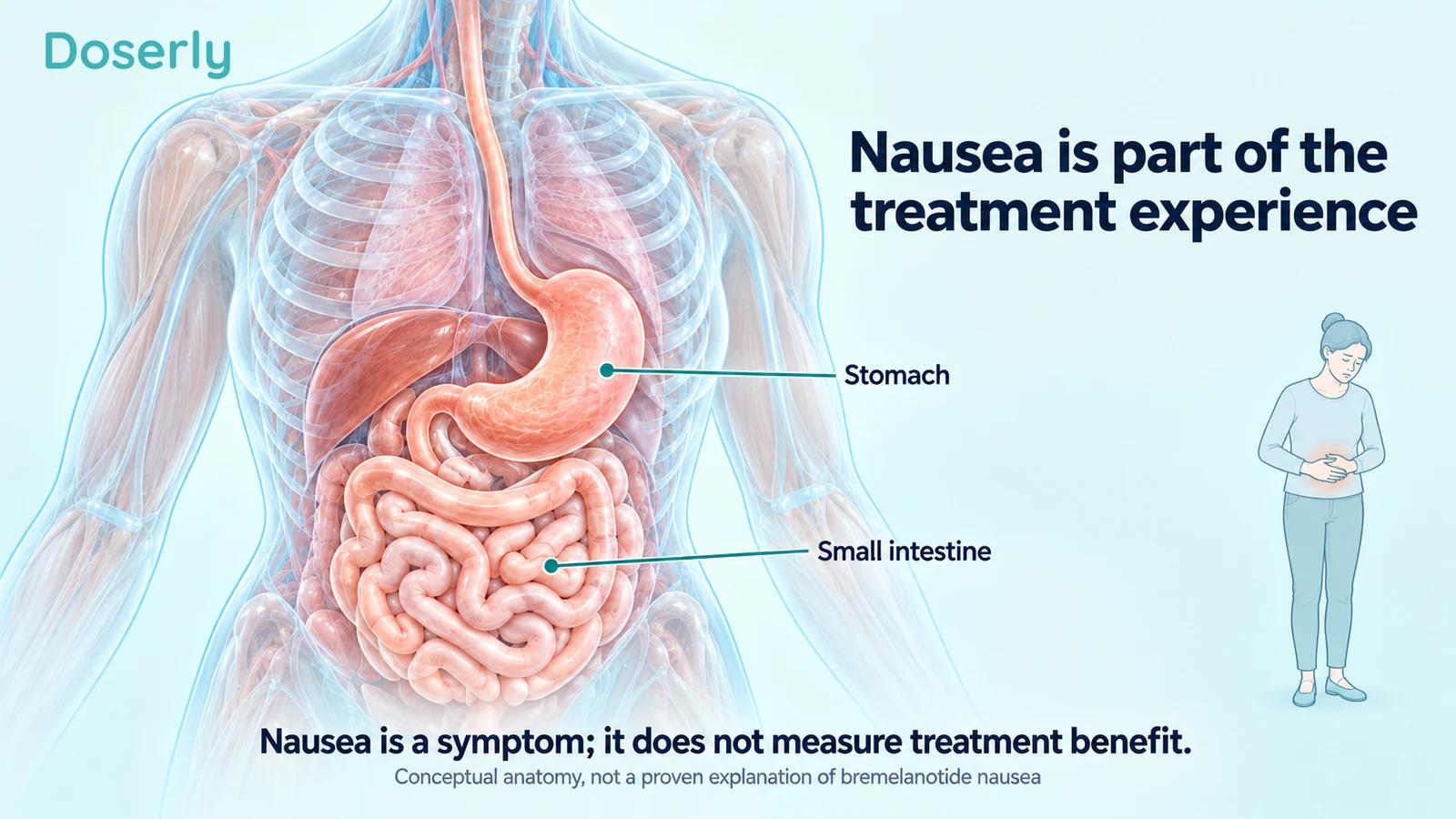
Bremelanotide can also slow gastric emptying, meaning movement of stomach contents onward into the intestine. The label discusses this in relation to oral-drug absorption. That does not prove that delayed emptying is the entire explanation for nausea. A symptom can involve several physiological processes, and the interaction warning should not be converted into a complete mechanism without supporting evidence.
Put the benefit beside the burden
The pivotal trials found improved patient-reported desire and reduced distress compared with placebo, but no significant increase in satisfying sexual-event counts. These are specific outcomes rather than a promise that every aspect of sexual life improves. The PT-141 research guide explains those distinctions in more detail. Label clinical-study results
Suppose someone feels a modest return of interest but loses much of the anticipated evening to nausea. Another person might have brief discomfort and feel a worthwhile improvement. These are hypothetical examples, not claims about how frequently either pattern occurs. They illustrate why an average efficacy result does not settle an individual's decision.
The relevant balance is not simply benefit minus nausea on an invented numerical scale. It includes whether the improvement addresses the person's goal, how often the symptom occurs, its severity, its timing, and the willingness to repeat the experience. A patient can reasonably decline further treatment despite a measurable benefit. Continuing is not evidence of greater commitment to recovery.
What stopping treatment tells us
Across the controlled trials, 18% of bremelanotide recipients discontinued because of adverse reactions, compared with 2% of placebo recipients. Nausea was the leading specific reason. The broader development-program safety publication also identified nausea as the most common reason for stopping bremelanotide. Prescribing information, development-program safety report
Discontinuation is not identical to a serious adverse event. A symptom can be medically nonserious yet sufficiently unpleasant to make an elective treatment unacceptable. Likewise, an event described as mild or moderate in a trial classification can matter greatly to daily life. The patient's experience and the study's severity category answer different questions.
Dropout also shapes the population seen later in research. People who remain are increasingly those willing and able to continue. Their later experiences can be informative, but they should not be used to erase the early difficulty of people who left. A long-term extension is therefore most useful when read alongside the controlled trial's starting population and reasons for discontinuation.
Did preventive ondansetron help?
The current label describes a randomized, placebo-controlled, single-dose study in 228 healthy women. Participants received either oral ondansetron, an anti-nausea medicine, or placebo before a single bremelanotide administration. The tested regimen used 8 mg ondansetron 30 minutes beforehand. It did not significantly reduce the incidence of bremelanotide-associated nausea. These amounts describe the experiment, not a recommendation for self-treatment. Label phase 4 results
The label consequently does not recommend that preventive regimen. It also says ondansetron given after bremelanotide or after nausea begins has not been formally studied. Prevention and treatment of an established symptom are different questions, so the result should not be stretched to claim that every possible anti-nausea intervention has been disproven.
At the same time, the lack of a study is not evidence that a rescue strategy is effective. The prescribing information allows clinicians to consider antiemetic treatment for patients bothered by nausea who wish to continue, or discontinuation for persistent or severe nausea. That is an individualized prescribing decision, not a reason to add another medicine without reviewing its own risks and interactions.
Why simply adding more medicines can complicate the situation
In the phase 3 program, 13% of bremelanotide-treated participants received an antiemetic. That number shows additional treatment was used; it does not establish how effective every antiemetic was, because it is not a randomized comparison of each strategy. Label safety results
There is also a medication-absorption issue. Bremelanotide may delay or reduce absorption of some oral drugs. The label particularly warns against use with oral naltrexone intended for alcohol or opioid addiction because reduced exposure could compromise that treatment. A medicine list should therefore include the drugs someone takes for symptoms as well as regular prescriptions.
Trying a lower amount, changing the delivery route, or mixing a research powder is not an evidence-based substitute for discussing tolerability. Those changes alter exposure and may alter benefit, while unapproved preparations add product-quality questions. FDA notes that compounded drugs are not reviewed for safety, effectiveness, or quality before marketing. FDA compounded-drug information
What to record and discuss
A useful symptom record is brief: when administration occurred, when nausea began, approximately how long it lasted, whether vomiting occurred, and how the episode affected normal activity. Record perceived benefit separately, such as a change in interest or distress, so discomfort is not mistaken for evidence of effectiveness.
Bring persistent or severe nausea to the prescriber rather than assuming it must be tolerated. Repeated vomiting or an inability to keep fluids down can require prompt medical assessment. A symptom record supports that conversation; it does not diagnose the cause or justify repeating an exposure to test a theory.
The label also recommends stopping Vyleesi after eight weeks if symptoms of HSDD have not improved. That reassessment should include tolerability even when some improvement is present. The aim is a worthwhile change in the patient's life, not completing a course at any cost. Discontinuation and counseling information
For a broader discussion of adverse effects and contraindications, see the PT-141 safety guide. Nausea deserves its place in that discussion because whether a treatment helps includes whether someone can comfortably and safely continue it.
Sources
- Vyleesi prescribing information: nausea rates, time course, discontinuation, ondansetron study and interactions.
- RECONNECT randomized trials, 2019: study population and clinical outcomes.
- Safety Profile of Bremelanotide Across the Clinical Development Program, 2022: accessible abstract; broader safety experience, not independent replication of the phase 3 data.
- FDA: Understanding the Risks of Compounded Drugs: product-quality distinction.