
Peptides
October 16, 2026
Why oxytocin's social effects depend on the people and the setting
On this page
Oxytocin is often introduced as a hormone involved in bonding. That description is incomplete, especially when it becomes a promise that a nasal spray will make someone more trusting or socially comfortable. Human experiments ask much narrower questions: whether a person entrusts money to a stranger, how they react when someone else wins, or how they respond after cooperation breaks down.
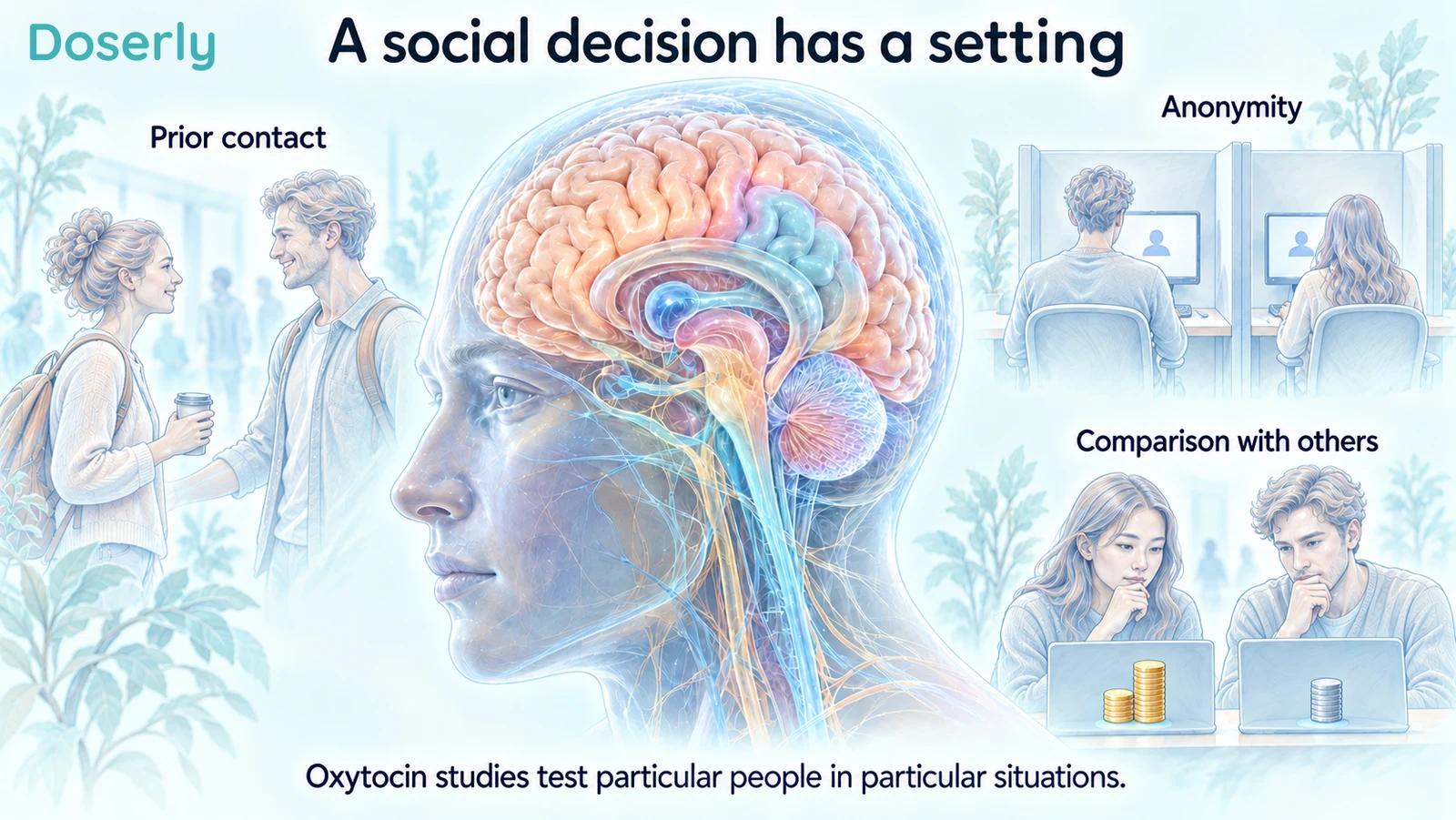
The setting matters because these are different social decisions. So do the people taking part. A result in men selected for low trust is not automatically a result in everyone who feels anxious around others.
Recent research makes this more interesting than a simple success-or-failure story. A 2020 registered replication did not reproduce a trust effect in its main social-contact condition. A 2026 preregistered study in 359 low-trusting men reported increased trusting behavior in an anonymous game. Both findings deserve attention, with the population and task kept attached. Replication, 2026 study.
Our oxytocin guide explains the broader biology and formulation questions. Here, we'll examine what “context” means in actual experiments and why it changes the interpretation.
What a trust game measures
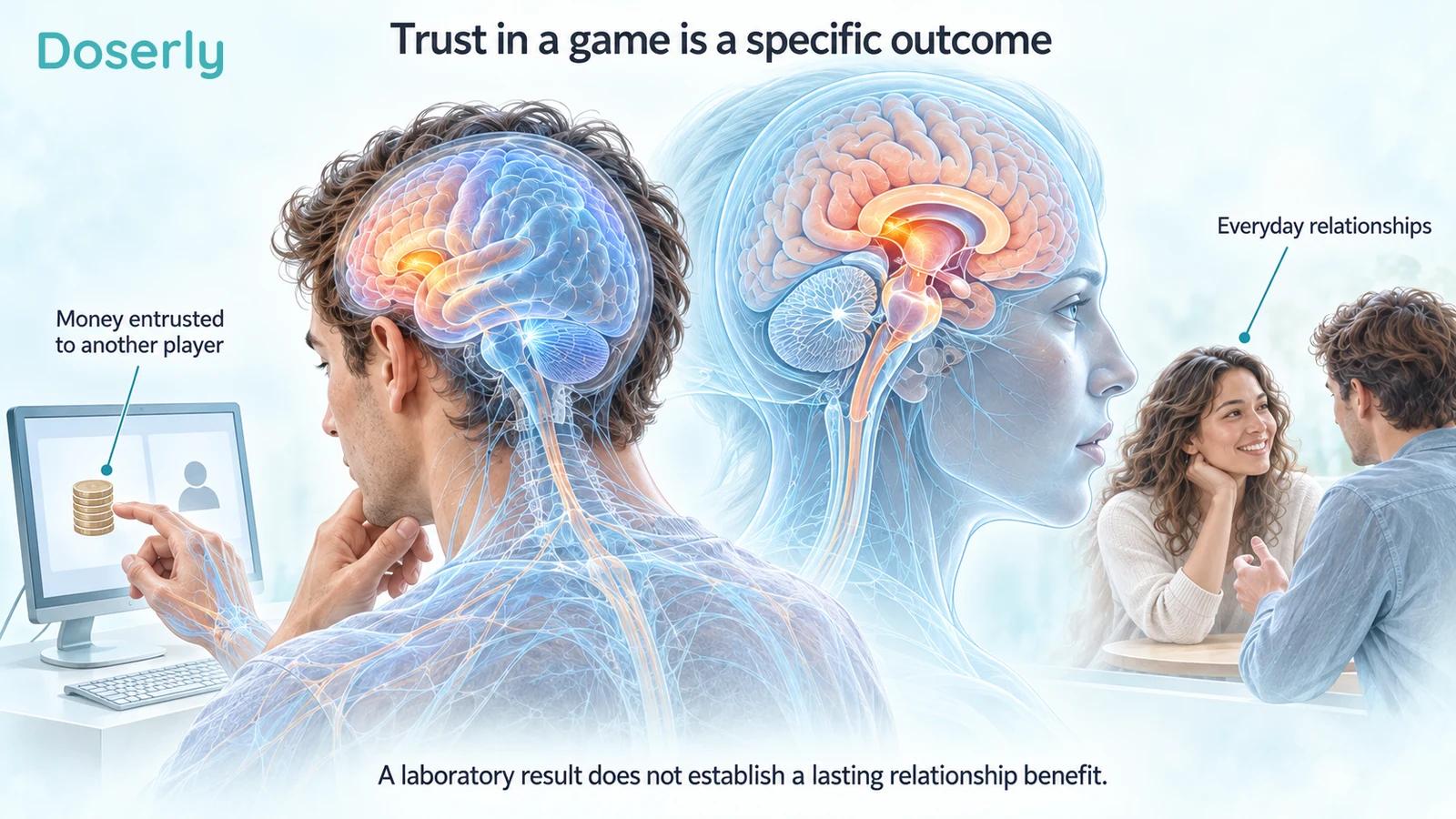
In a typical trust game, one participant can transfer money to another. The recipient then has an opportunity to return some money. The first person faces uncertainty about another person's behavior: cooperation could benefit them, but the other player might keep the proceeds.
Researchers treat the amount entrusted as a measure of trusting behavior. This is useful because the decision is concrete. It is also narrower than the word “trust” in everyday conversation, where trust can mean relying on a partner, believing a colleague or feeling safe with a friend.
The influential 2005 oxytocin experiment reported increased transfers in this kind of interaction. A separate risk comparison was intended to distinguish accepting uncertainty about another person from a general willingness to take chances. The authors did not find the same effect on general risk taking. Kosfeld and colleagues.
That design helped identify a social question, but it didn't measure long-term closeness, relationship satisfaction or whether participants became better at recognizing trustworthy people. Entrusting more money is a behavior; whether that decision is beneficial depends partly on what the recipient does.
Why even brief contact was worth testing
Imagine making the same decision after briefly meeting the other person, compared with knowing that the interaction is completely anonymous. The financial rules could be identical while the social experience differs. Researchers considered minimal prior contact a possible explanation for inconsistent attempts to reproduce the original oxytocin finding.
The 2020 registered replication included both a minimal-social-contact condition and a no-contact condition. It was designed with high statistical power for the target effect and used a placebo-controlled, double-blind comparison. The main social-contact condition did not show an oxytocin effect on trusting behavior. Declerck and colleagues.
This is particularly informative because a proposed explanation was tested directly. It would be misleading to say that the replication failed merely because participants never met: the study deliberately included contact.
Its exploratory analyses suggested a possible effect in people with a low disposition to trust under no-contact conditions. “Exploratory” means that the finding emerged from additional examination of the data. At that point, it was a hypothesis needing a fresh test rather than an established rule about who should receive oxytocin.
What the 2026 study adds
The newer study addressed that more focused question. Researchers recruited 359 men with a low disposition to trust and used a preregistered design in a completely anonymous trust game. The report describes roughly 15% higher trusting behavior with oxytocin. An analysis pooling these participants with an earlier sample also supported an effect. Vogt and colleagues, 2026.
Preregistration matters here because it distinguishes a planned test from an explanation developed after seeing the results. The earlier exploratory result helped generate a question; the later study selected a population and tested it prospectively. That is a meaningful advance.
The reported percentage concerns the study's behavioral measure. It does not mean that relationships improved by 15%, that 15% of participants recovered from anxiety, or that someone became 15% more socially capable. The pooled analysis also includes earlier participants; it is not another independent trial.
The study supplies evidence for an effect in a defined group and setting. It doesn't establish a treatment for distrust, identify low oxytocin as the cause of someone's interpersonal difficulties, or show a lasting benefit after repeated use. Full methods and long-term clinical outcomes answer different questions from the abstract's laboratory result.
Context does not always mean a more pleasant experience
Oxytocin research also includes social comparison, where someone judges their own outcome relative to another person's. A 2009 double-blind, within-person experiment enrolled 56 participants in a game involving unequal or equal monetary outcomes.
Compared with placebo, oxytocin increased ratings of envy when another player did better and gloating when the participant did better. It did not change ratings after equal gains or general mood. Shamay-Tsoory and colleagues.
This does not establish that oxytocin makes people jealous in everyday life. It shows that a social effect need not have a uniformly positive emotional direction. The experimental situation supplied something to compare, and the measured response depended on that comparison.
It's tempting to explain every result by saying oxytocin makes social information more important. That is a possible organizing idea, but an explanation needs predictions that can be tested. It shouldn't become a phrase that makes any positive, negative or absent result seem automatically expected.
For a reader considering a social benefit, the distinction is practical: a substance that changes a social response does not necessarily make the interaction kinder, safer or more satisfying.
The player's role can change the question
Sending money and returning money are different behaviors. The first asks how much someone is willing to entrust. The second asks how they respond to another person's trust. A study of one role shouldn't quietly become evidence about the other.
A randomized study of 53 healthy men examined oxytocin while participants played as trustees. Researchers also measured the ratio of testosterone to cortisol and examined reciprocity after a disruption in trust. They reported an interaction involving oxytocin, this hormone ratio and the amount returned during a later phase. Trustworthiness experiment.
This was a small mechanistic study. Its findings do not validate a hormone test for choosing who should use oxytocin, and a ratio measured in an experiment is not a clinical threshold. What it illustrates is the specificity of the research: the person's role, the history of the interaction and the selected outcome all influence the question.
If a headline simply says “oxytocin changes trust,” those details disappear. Keeping them visible helps readers understand why superficially similar studies may be investigating different processes.
A different task may not reproduce an impressive effect
Another approach, the envelope task, used how securely participants closed an envelope containing confidential information as an indicator of trust. An early report described a large oxytocin effect. Two later experiments, with 95 and 61 participants, failed to reproduce that large effect.
The authors concluded that their findings were inconsistent with an effect of the originally reported size, while remaining compatible with no effect or a smaller one. Envelope-task replications.
This is more precise than saying the studies proved oxytocin never affects trust. It is also more useful than ignoring them because a different task produced a positive result. The envelope task and a monetary game don't measure exactly the same behavior, but each makes a testable claim about its own outcome.
Reproducibility is especially important when a simple task is offered as a proxy for a complex personal quality. An effect needs to recur reliably enough that the measurement itself can support the interpretation placed on it.
When is “it depends” a scientific explanation?
A useful context explanation specifies what should happen before the data are examined. For example: the effect should differ between anonymous interactions and interactions with prior contact, or between participants selected for low trust and a broader sample.
Researchers then need a study that can compare those possibilities. Finding a significant result in one subgroup and a nonsignificant result in another does not, by itself, prove that the subgroups respond differently. The difference between them has to be tested.
The 2020 and 2026 reports illustrate two stages of this process: an exploratory clue followed by a more targeted, preregistered test. They don't mean that every proposed context explanation has been confirmed. Nor does the newer result erase the earlier null finding in a different condition.
For a reader, a good explanation should become more specific as the research develops. It should identify the population, setting and outcome it can account for, and leave room for the explanation to be wrong. Otherwise, “context” risks becoming a way to protect a broad claim from any disappointing result.
What this means outside the laboratory
Everyday trust involves repeated interactions, memories, communication and changing circumstances. A controlled game removes much of that complexity so researchers can isolate a particular decision. That is a strength for answering a narrow experimental question and a limitation when translating the answer into treatment.
To establish a clinical benefit, researchers would need to select a relevant problem and measure whether treatment helps over time. For social distress, that might include participation in daily activities and the person's own goals. For relationship difficulties, both partners' experiences and adverse effects would matter. These are proposed clinical outcomes, not outcomes established by the game studies.
More trust is not automatically the right goal. Appropriate caution can be valuable when another person is unreliable or when a situation feels unsafe. A meaningful intervention would need to improve functioning and well-being, rather than merely increase willingness to take an interpersonal risk.
A report of feeling unusually open after a spray is also difficult to interpret without a comparison. Expectations and the interaction itself can change how someone feels. Such an experience can matter personally without showing that the same product will reliably help someone else.
Questions that keep the claim useful
When a social benefit is proposed, ask what changed in the supporting study. Was it money transferred, a rating of an emotion, a brain signal, or a sustained improvement in daily life? Then ask who participated and whether the comparison tested the same formulation being offered.
If someone points to the 2026 study, the accurate description is a positive preregistered trust-game result in selected low-trusting men under anonymous conditions. If they point to the 2020 replication, its main social-contact result was null, with an exploratory clue that later research investigated. Neither should be reduced to an all-purpose slogan.
Oxytocin's social research is worth understanding because it shows how biology and situations can interact. It currently gives a more detailed account of particular experimental behaviors than it gives a dependable prescription for better everyday relationships. The oxytocin guide adds the route-specific evidence and safety context.
Sources
- Kosfeld et al., 2005: original trust experiment.
- Declerck et al., 2020: registered replication.
- Vogt et al., 2026: selected low-trusting men.
- Shamay-Tsoory et al., 2009: social comparison.
- Lane et al., 2015: envelope-task replications.
- Trustworthiness and hormone-ratio experiment, 2022.