
Peptides
October 16, 2026
Why muscle-damage markers cannot validate a PEG-MGF recovery claim
On this page
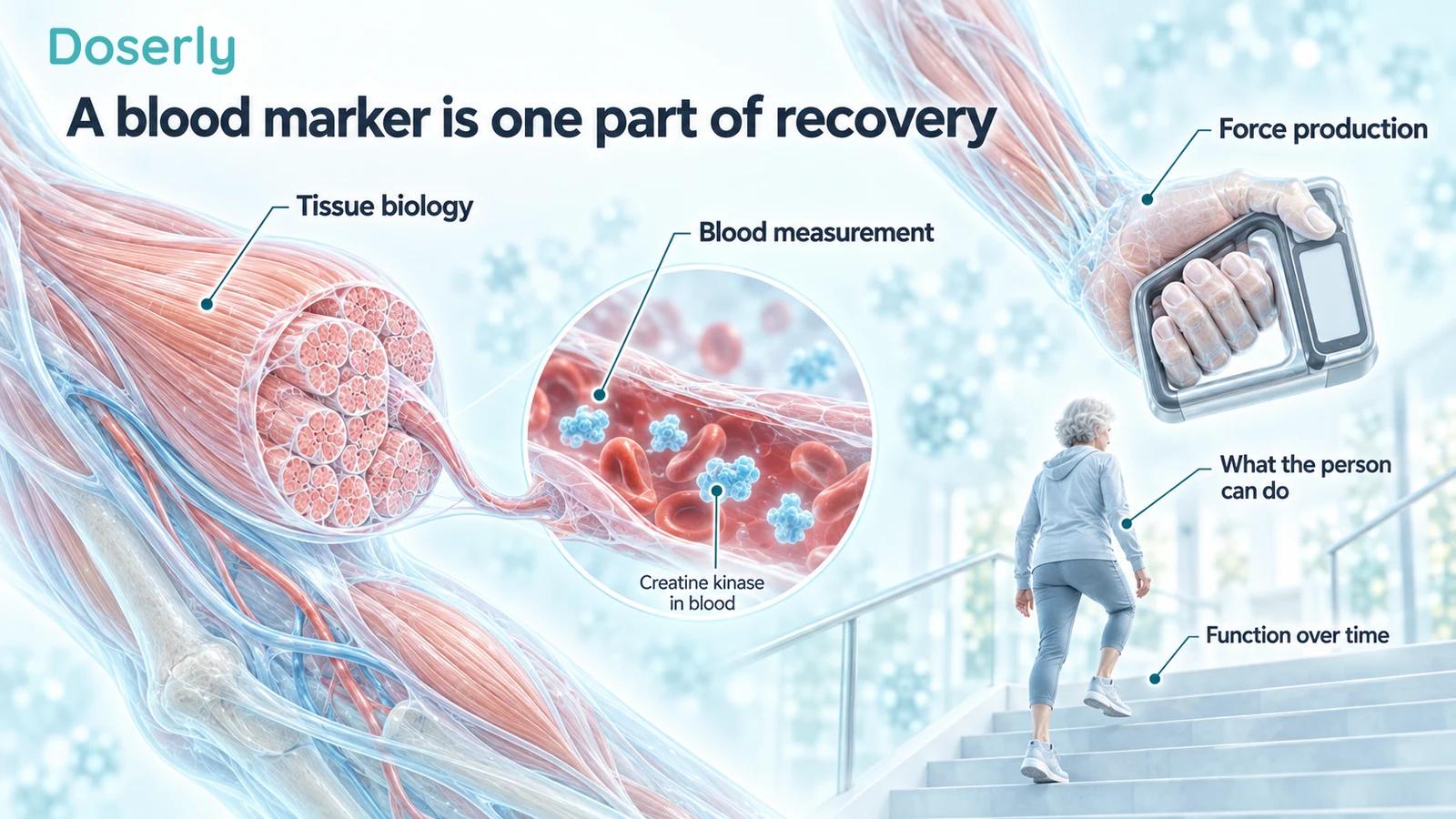
A lower muscle-damage marker is not the same outcome as a stronger muscle, a healed tendon or a safe return to training. It may be useful information. What it means depends on what was measured, when it was measured, and whether the change reliably predicts something that matters to the person recovering.
This distinction becomes especially important with PEG-MGF. Promotional recovery claims often combine research on exercise, naturally occurring IGF-1-related signals, isolated MGF peptides and animal injuries. The resulting story can sound like a single clinical finding even when no study tested the marketed product in people. Understanding the measurement is therefore only half the task: the identity of the intervention matters too.
This article explains how to read that evidence without dismissing biomarkers or mistaking them for clinical proof. For the broader terminology and evidence landscape, see the Doserly PEG-MGF guide.
Start with the recovery claim
“Recovery” can mean less soreness tomorrow, restoration of force after a workout, repair of an injured tendon, or return to a previous level of activity without another injury. Those are not interchangeable promises. A study might answer one well and say little about the others.
Before reading a paper, translate the headline into a question with a concrete outcome. Does the treatment help people climb stairs? Does it restore measured strength sooner? Does it reduce pain enough to improve sleep? Does a repaired tendon tolerate load? This step prevents a laboratory measurement from quietly replacing the outcome the headline actually promised.
Time matters as much as the outcome. An early difference can disappear later; a slower initial change might accompany a better longer-term result. A single blood draw cannot describe an entire recovery trajectory. Likewise, fewer symptoms during one session cannot establish that a person can tolerate repeated sessions over the following weeks.
None of this makes early biological observations unimportant. They can guide research and reveal how an intervention might work. But “worth investigating” and “shown to improve recovery” carry different amounts of evidence.
What creatine kinase can tell researchers
Creatine kinase, usually abbreviated CK, is commonly measured in studies of exercise-associated muscle damage. Researchers can compare the blood response with other observations, such as loss of force, swelling, soreness and imaging changes. The measurement is useful partly because it adds information that a participant's description of soreness cannot provide.
A small human study by Nosaka and Clarkson followed ten men after eccentric elbow-flexor exercise. CK responses varied widely between participants, and higher responses were associated with several other indicators of damage, including force changes and magnetic-resonance findings. That is evidence that CK can reflect a meaningful biological response in a defined exercise setting; it is not evidence that CK is meaningless or randomly disconnected from tissue injury. Nosaka and Clarkson, 1996
The limit is what that relationship establishes. The investigators did not administer PEG-MGF, compare recovery treatments, or validate a threshold for returning to sport. An association between a marker and injury severity does not automatically prove that an intervention which changes the marker also improves the injury.
A thermometer provides a useful analogy without being a model of muscle biology: measuring a response can help describe an illness, but a lower reading alone does not identify what caused the change or establish that every important consequence has improved. A useful marker still needs interpretation.
Correlation is useful, but it is not treatment validation
Another human eccentric-exercise study examined CK responses alongside strength and soreness in 119 healthy men. Higher CK responders experienced greater strength reductions and soreness than lower responders. The study supports reading CK in relation to other outcomes rather than treating it as an isolated score. It does not provide evidence for a PEG-MGF intervention. Kim and Lee, 2015
There are two different questions here. First: do people with a larger marker response tend to have worse functional changes after a particular challenge? Second: if a treatment changes that marker, does it improve function? The first can help generate the second question. It cannot answer it by itself.
For a hypothetical recovery treatment, a lower CK result could accompany improved function, unchanged function, or an outcome that the study did not measure. Those possibilities require direct testing. Selecting the favorable possibility because it fits the proposed mechanism is an inference, not an observed treatment effect.
This is why readers should look for the actual endpoint list. “Muscle damage was reduced” might summarize blood measurements, microscopic findings, performance tests, or a mixture. Open the methods and results rather than assuming the phrase means that participants regained their strength.
A marker needs a sampling plan
A before-and-after comparison sounds simple, but its timing can change the interpretation. If one measurement occurs near a response peak and another occurs later, a falling value may describe the natural course of the response. Without a suitable comparison group, it is difficult to know how much of that change would have happened anyway.
A useful experiment therefore specifies when samples are collected relative to the exercise or injury, how the challenge is standardized, and which comparison is planned. It should report missing measurements and avoid presenting one convenient time point as the complete pattern.
Baseline information matters too. If groups begin at different levels or perform different amounts of work, their later values may not answer the same question. A recovery claim should not gain credibility merely because a chart contains several decimal places.
For a reader evaluating a headline, the practical question is straightforward: was the marker difference accompanied by a meaningful, comparably measured difference in recovery? If that outcome was never collected, the study cannot supply it retrospectively.
What an MGF animal experiment actually found
The distinction between biological outcomes is particularly clear in a 2019 mouse study. Researchers combined muscle contusion with macrophage depletion, then injected MGF into the injured muscle. This was a deliberately altered injury model, not an ordinary training session in a healthy person.
The investigators reported reduced fibrosis and changes in inflammatory and oxidative-stress-related measures. Crucially, they also reported that MGF did not protect muscle-fiber regeneration in that model. A broad summary such as “MGF repaired muscle” would erase the difference between the favorable findings and the outcome that did not improve. Liu and colleagues, 2019
This is not a reason to ignore the experiment. It is a reason to describe it accurately. Fibrosis, inflammatory signals and regeneration are separate observations. A response in one does not entitle a reader to assume a response in the others.
The model also constrains translation. Macrophage depletion changes the biological setting. Local administration changes the exposure question. Mice differ from human patients. Finally, an experiment described as using MGF cannot simply be relabeled as a study of a commercial PEG-MGF preparation.

Tendon findings do not settle muscle recovery
A separate study tested a synthetic MGF E peptide, identified as MGF-C25E, in injured rat Achilles tendons. It reported favorable findings in a functional index, tendon stiffness and tissue organization compared with saline. These are more informative than citing a vague change in “healing markers,” because the reported outcomes are identifiable. Zhang and colleagues, 2016
However, the experiment still concerns a particular peptide, a rat tendon injury and the conditions of that study. It does not establish a PEG-MGF treatment effect in human skeletal muscle, nor a return-to-sport benefit in people with tendon injuries.
This matters because recovery discussions often move between tissues without saying so. Tendon and muscle are related parts of movement, but a tendon experiment is not a muscle-strength trial. The fact that both involve repair does not make their outcomes interchangeable.
A strong article can explain why a study is interesting while preserving those boundaries. A weak claim removes the species, construct and injury model until only the appealing verb remains: heals, repairs or regenerates.
The proposed mechanism is not a settled substitute
There is also disagreement within the laboratory literature. In a 2014 study, investigators attempted to reproduce claimed MGF-peptide effects in muscle-cell systems. They did not find the expected proliferation or differentiation effects under the tested conditions, while mature IGF-1 or full-length IGF-1Eb produced relevant positive responses. Fornaro and colleagues, 2014
That experiment does not prove that every possible MGF-related construct lacks activity in every setting. It does show why a confident mechanism narrative should not replace replication and direct outcome evidence.
The terms can conceal important differences. A naturally expressed IGF-1 splice variant, a full-length protein, a short E peptide and a PEG-conjugated preparation are not automatically the same test material. If a claim moves between them, the author should explain and support the bridge.
Attaching a familiar biological name to an unfamiliar preparation does not solve this problem. Readers need to know which substance was characterized and tested, not merely which family of research is cited.
What would support a human recovery claim?
A persuasive study would define the product, the participants, the injury or exercise challenge, and the recovery outcome in advance. It would use an appropriate comparison so that natural recovery, changes in training and expectations do not account for the entire apparent benefit.
Biomarkers could remain valuable secondary measurements. They might help explain a functional effect or identify unexpected biological responses. But a claim about restored strength should include strength testing; a claim about return to activity should measure that activity and follow participants long enough to assess its durability.
Safety needs its own assessment. A favorable recovery endpoint does not tell us whether there were adverse reactions, treatment discontinuations or other clinically important problems. Nor does a brief experiment answer every question about repeated exposure.
A useful report would present the size and uncertainty of the effect, not just whether a statistical threshold was crossed. Readers should be able to judge whether the observed difference would matter to a patient, rather than relying on adjectives such as dramatic or accelerated.
Consider two hypothetical reports. One finds a lower blood marker at a single visit but never measures force. The other finds similar marker values yet documents an earlier return of a prespecified functional task. Neither result should be renamed to match a preferred narrative: the first supports a marker observation, while the second supports a functional observation within its design. If an article gives both the same headline, it has hidden information readers need. Asking for the actual outcome is more useful than arguing over whether all biomarkers are good or bad.
Why the missing human safety data still matters
FDA's current compounding safety page states that it has not identified human exposure data for drug products containing PEG-MGF by any administration route. It also identifies concerns involving immunogenicity, peptide-related impurities and characterization of the active ingredient. That is a specific evidence gap, not a quantified prediction of how often harm will occur. FDA safety information
A favorable CK result from a different study cannot fill that gap. Neither can a microscopy image, a vendor purity figure or a person's account of feeling less sore. These observations answer different questions and have different limitations.
For someone discussing persistent pain, weakness or recovery difficulties with a clinician, a clear record of symptoms, activity changes and timing can make the conversation more useful. It should not be used as a home experiment intended to establish the safety of an uncharacterized product.
The most defensible reading of the current evidence is specific: muscle-damage markers can inform research, but they do not validate a PEG-MGF recovery claim on their own. The claim still needs the right substance, the right human comparison, meaningful recovery outcomes and a credible safety assessment.
Sources
- Nosaka and Clarkson: CK variability after eccentric elbow-flexor exercise (1996).
- Kim and Lee: CK variability, strength and soreness after eccentric contractions (2015).
- Liu and colleagues: MGF in macrophage-depleted injured mouse muscle (2019).
- Zhang and colleagues: MGF-C25E in injured rat tendon (2016).
- Fornaro and colleagues: MGF peptide replication experiments (2014).
- FDA: bulk substances that may present significant safety risks.