
Peptides
October 16, 2026
Hexarelin, cortisol and prolactin: understanding the whole hormone response
On this page
Hexarelin stimulates growth hormone release, but that is not the only endocrine response researchers have measured. Small human studies also found increases in prolactin and in hormones involved in the body's stress-response system. If you're trying to understand the compound's effects, a growth hormone chart therefore tells only part of the story.
The findings are more nuanced than “hexarelin raises cortisol” or “hexarelin is hormone-selective.” A response after one intravenous exposure can differ from a full day's measurements or from results after weeks of repeated treatment. The person's underlying pituitary or adrenal condition can also change the response. Human dose-response study
We'll separate those situations, explain what the hormones do and examine what the studies actually support. The aim is to understand the physiology without converting research test doses into a treatment schedule. Our hexarelin guide covers the broader compound background.
The hormones belong to connected but different systems
The pituitary is a small gland beneath the brain. It releases growth hormone, which participates in growth and metabolism, and prolactin, a hormone best known for its role in milk production but relevant to endocrine assessment outside lactation as well. A substance that stimulates the pituitary does not necessarily affect only one type of hormone-producing cell.
The pituitary also releases adrenocorticotropic hormone, or ACTH. ACTH signals the adrenal glands, which sit above the kidneys, to produce cortisol. The hypothalamus, an area of the brain, helps regulate this system. Together these structures form the hypothalamic-pituitary-adrenal axis, often shortened to the HPA axis.
Cortisol is a normal hormone with essential roles in responding to physiological demands. An increase is not automatically a disease, just as a single normal result does not establish that every aspect of the system is normal. The amount, duration, context and pattern of secretion all matter. Hexarelin researchers used several kinds of testing precisely because an isolated value cannot describe the whole response. Repeated-treatment endocrine study
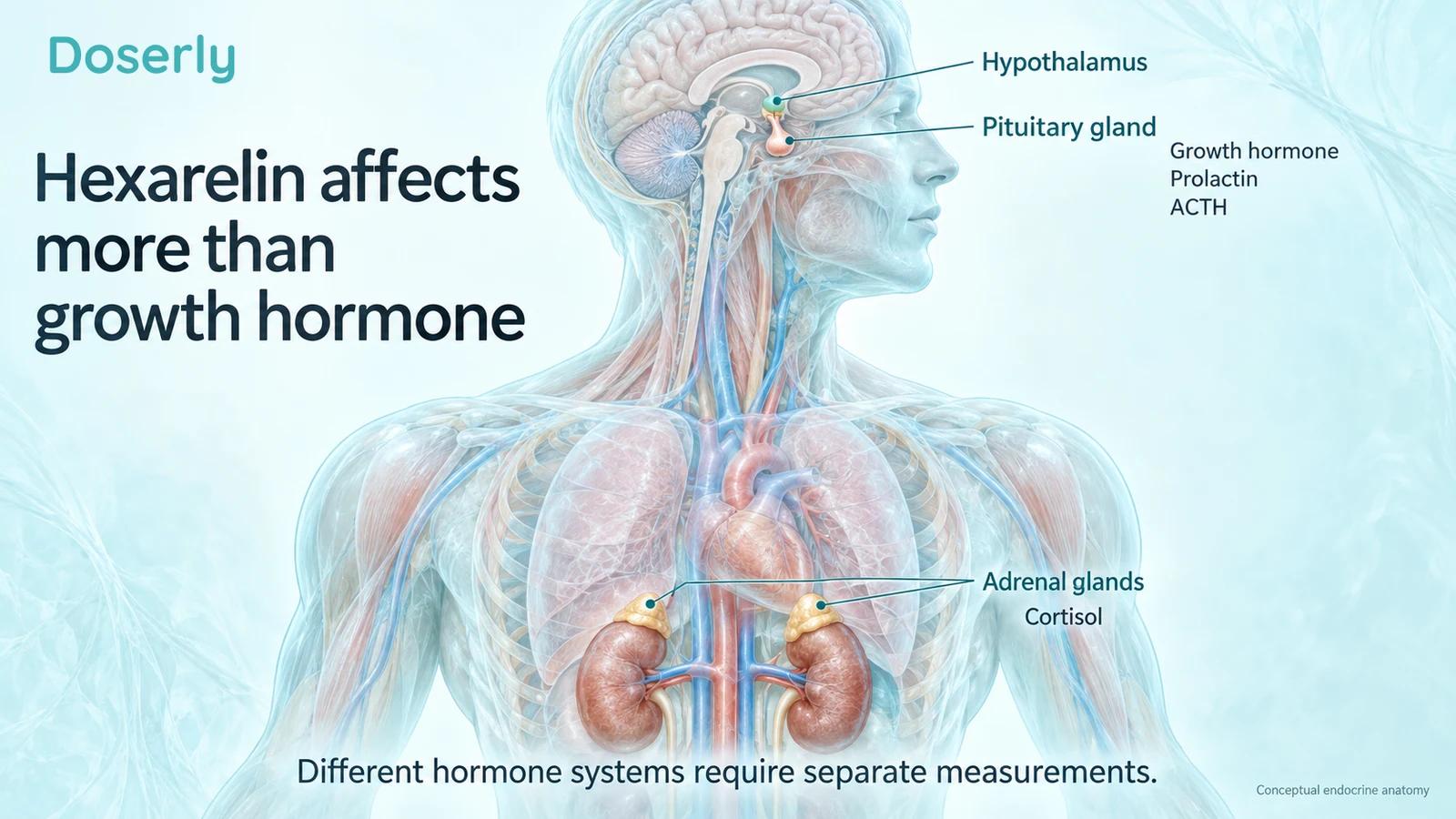
Conceptual endocrine anatomy. The labels identify glands and hormones; they do not quantify a response or imply that all hormone systems change together.
What the single-exposure study found
A 1996 experiment gave healthy adult men varying intravenous hexarelin doses and measured growth hormone, prolactin and cortisol. All three responded, but their dose-response patterns were different. Growth hormone and prolactin showed increasing responses that approached a plateau; cortisol showed a more abrupt rise within the tested range. Massoud and colleagues
The study also combined a low hexarelin exposure with growth hormone releasing hormone, or GHRH. That combination produced a large growth hormone response, a more moderate prolactin rise and no cortisol rise under those test conditions. It demonstrates an acute interaction between the stimuli. It does not establish the safety of a marketed combination used repeatedly by another route.
This is why “selective” needs a precise meaning. A treatment might produce a larger change in growth hormone than in another hormone, yet still affect both. It might also look more selective at one tested exposure than at another. A single favorable comparison cannot establish that cortisol or prolactin will remain unaffected in every person or throughout repeated use.
What researchers learned about the stress-response pathway
A 1999 study examined 15 healthy young men and compared hexarelin with two other hormonal stimuli: corticotropin-releasing hormone, called CRH, and desmopressin, an analogue of arginine vasopressin. Researchers sampled hormones for two hours after single or combined exposures. Korbonits and colleagues
Hexarelin increased ACTH and cortisol. Adding CRH increased those responses further, whereas adding desmopressin did not. The pattern led the investigators to propose that vasopressin-related signaling contributed to hexarelin's effect on the HPA axis. This was an inference from physiological challenges, not a direct image of a receptor being activated inside a participant's brain.
The distinction matters because a mechanism can be plausible without being completely mapped. The study supports a broader endocrine action than growth hormone release alone. It does not supply a reliable way for a person to predict their cortisol response from their growth hormone result, nor does it justify adding another hormone-active drug to control that response.
Why pituitary disease changes the interpretation
Researchers also studied people with Cushing's syndrome, a condition involving excessive cortisol exposure. Cushing's disease specifically refers to a pituitary source of the problem; other causes of Cushing's syndrome involve different physiology.
In a 1997 study, 12 people without the syndrome and 17 patients with Cushing's syndrome underwent hormonal challenges. Hexarelin increased ACTH and cortisol in the control group. The response was exaggerated in pituitary Cushing's disease, but the same pattern was not seen in participants whose syndrome involved an adrenal adenoma or ectopic ACTH production. Ghigo and colleagues
These were investigations of endocrine disease, not evidence that hexarelin treats excess cortisol. They show why observations in healthy volunteers cannot automatically predict responses in people with pituitary or adrenal disorders. A pre-existing diagnosis is part of the interpretation, rather than a detail to put aside when reading a peptide study.
A subsequent study examined 21 patients with Cushing's disease, including 15 with pituitary microadenomas and six with macroadenomas, compared with 27 controls. The exaggerated ACTH and cortisol response appeared in the microadenoma group but not the macroadenoma group. The terms distinguish smaller and larger pituitary tumors, but tumor size alone should not be treated as a self-assessment tool. Arvat and colleagues, 1998
This finding is useful because even a shared disease label did not produce a uniform response. It would be inaccurate to turn it into a universal prediction about everyone with Cushing's disease or to suggest that a person should test themselves with hexarelin to find out which pattern they have.
What did measurements across an entire day show?
The one-day repeated-exposure study asked a different question. Six healthy young men received two or three subcutaneous hexarelin injections during a 24-hour assessment, with blood sampled every 20 minutes. Researchers analyzed the secretion patterns rather than relying on the highest single value. Maccario and colleagues
Both schedules increased total daily growth hormone secretion to a similar extent, mainly by increasing the amount released in each burst. The study did not find changes in the secretion of prolactin, ACTH or cortisol, or in IGF-1 levels, during those one-day schedules.
This does not erase the single-exposure findings. The route, exposure pattern and measurement window were different. Moreover, six participants followed for one day cannot establish safety over months. What it does show is that the highest response after a test exposure and the integrated pattern across a day are different outcomes.
The authors also gave an intravenous challenge after each sampling period. Prior hexarelin exposure changed the subsequent responses differently across hormones. That observation reinforces the central point: the endocrine system adapts, and its components do not necessarily move together.
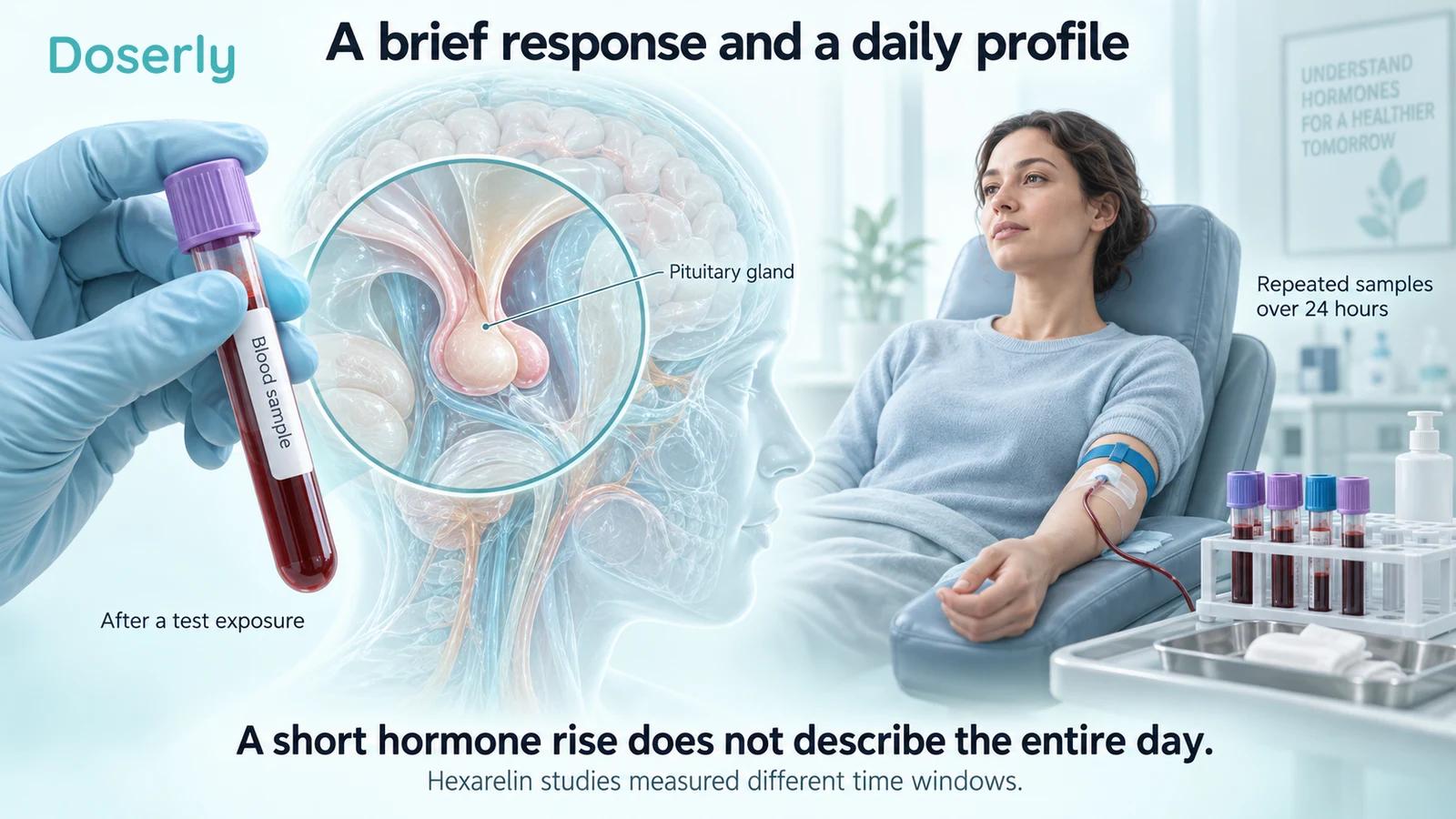
Generic sampling scenes, not study participants. The actual 24-hour experiment involved six healthy young men. An immediate peak and secretion across a day are different measurements.
Did 16 weeks produce sustained cortisol or prolactin excess?
A longer study examined twice-daily subcutaneous hexarelin over 16 weeks. Researchers measured responses to a morning exposure and also assessed basal hormones and 24-hour urinary free cortisol. The cortisol response after the test exposure was smaller at week 16 and returned toward its initial pattern after four weeks off treatment. Basal cortisol, urinary free cortisol, ACTH response and prolactin response did not change significantly. Rahim and colleagues, 1999
Within that study, the findings did not indicate sustained overstimulation of the pituitary-adrenal system or prolactin secretion. That is more informative than assuming every transient cortisol increase must accumulate into chronic excess. It is also more limited than declaring hexarelin free of endocrine risks: the study evaluated a particular schedule over a particular interval.
A companion report found that growth hormone responses diminished during repeated exposure, without significant changes in IGF-1 or body composition. Longer-term growth hormone report
These reports describe related work and should not be counted as separate large safety programs. They tell us about adaptation in a small research setting. They do not establish the effects of higher exposures, combinations, repeated cycles or years of use.
How to make sense of a personal laboratory result
A laboratory number becomes useful when its context is preserved. The clinician interpreting it may need to know when the sample was taken, what substances were used, whether the measurement was a baseline or a response to a stimulus, and whether there is a known endocrine diagnosis. A result taken soon after an exposure answers a different question from a measurement intended to reflect usual physiology.
If someone shows you a growth hormone chart as reassurance about prolactin or cortisol, ask whether those hormones were actually measured. If they were, ask whether the report describes a peak, a series of samples, a daily total or a longer-term assessment. “No significant change” should also be read with the sample size and observation period in mind.
A high or unexpected result is a reason to discuss the circumstances with a clinician, not to add a second drug on the assumption that it will cancel the first. The studies above did not test a self-managed system of correcting one hormone with another. Nor did they establish that a normal result guarantees the quality or safety of a research product.
Keeping an accurate record of exposures, symptoms and sample times can help avoid a misleading interpretation. It cannot turn unvalidated monitoring into a proven safety strategy, but it gives the clinician the information needed to understand what was measured.
Hexarelin's endocrine profile is therefore best described with both findings intact: single-exposure studies demonstrated actions beyond growth hormone, while some repeated-exposure studies did not show sustained increases in the same hormones. Those results are compatible because they describe different conditions. The practical lesson is to consider the whole hormonal response and the actual study design, rather than judging the compound from one impressive growth hormone peak.
Sources
- Massoud et al., dose-response study, 1996.
- Korbonits et al., HPA-axis challenge study, 1999.
- Ghigo et al., normal subjects and Cushing's syndrome, 1997.
- Arvat et al., microadenomas and macroadenomas, 1998.
- Maccario et al., 24-hour secretion study, 2002.
- Rahim et al., pituitary-adrenal and prolactin effects, 1999.
- Rahim et al., growth hormone status during repeated treatment, 1998.