
Peptides
October 16, 2026
Why GHRP-2 hormone testing is not the same as a wellness protocol
On this page
GHRP-2 has a legitimate role in hormone testing in Japan. A clinician gives pralmorelin, the drug's generic name, to stimulate growth-hormone release and then measures the response. That use can sound reassuring to someone considering repeated GHRP-2 for energy, recovery or general wellness. But a diagnostic test and a treatment are designed to accomplish different things.
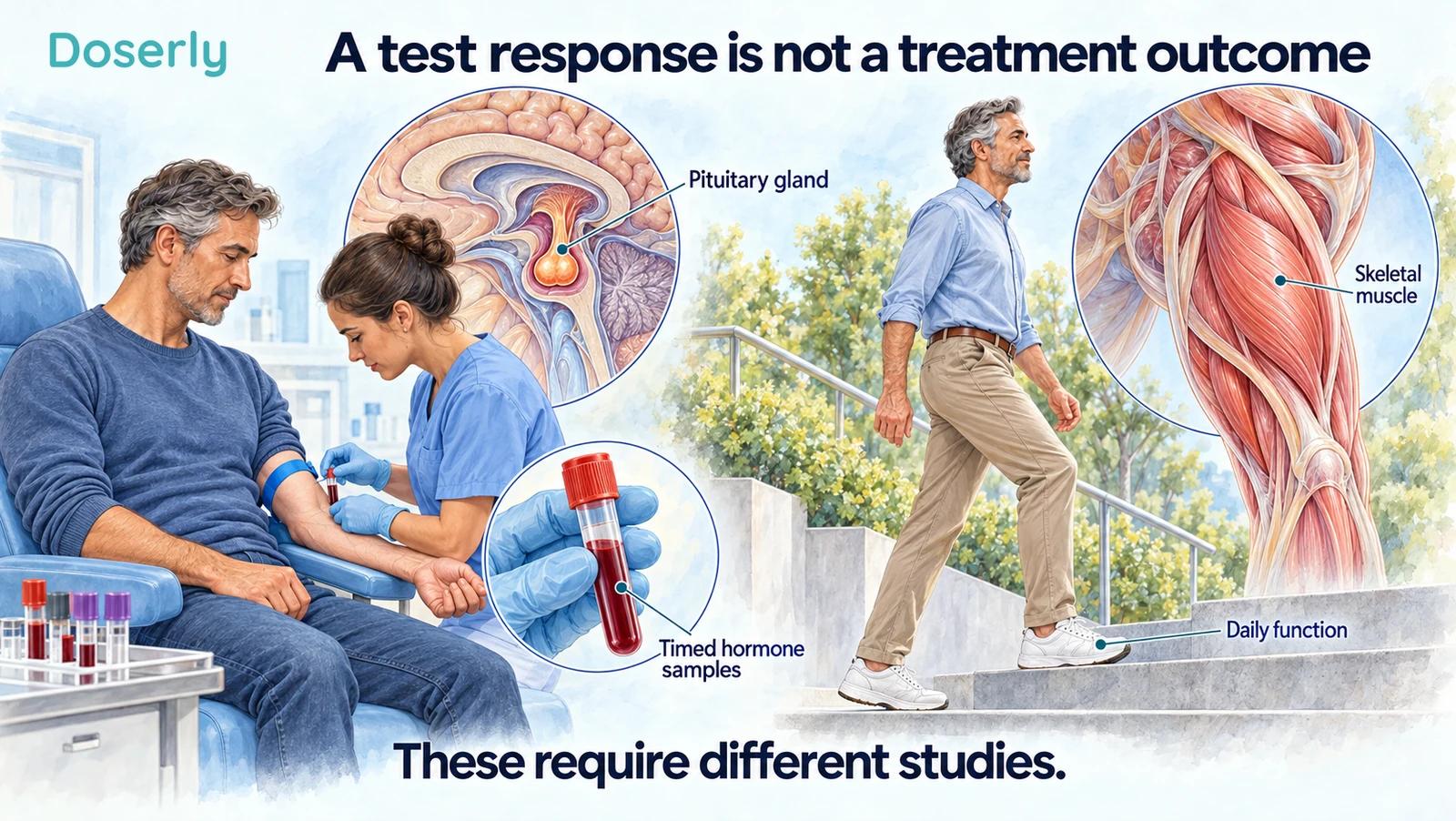
A test asks whether a hormone system can respond to a defined stimulus. A treatment asks whether repeated exposure improves a patient's health enough to justify its risks. Demonstrating the first does not establish the second.
Understanding that difference does not require dismissing GHRP-2's pharmacology. Its ability to stimulate growth hormone is precisely what makes it useful to investigate. The important step is keeping the test's purpose, population and measurements attached to its results. Our GHRP-2 guide gives additional context on the compound.
What a stimulation test is trying to find
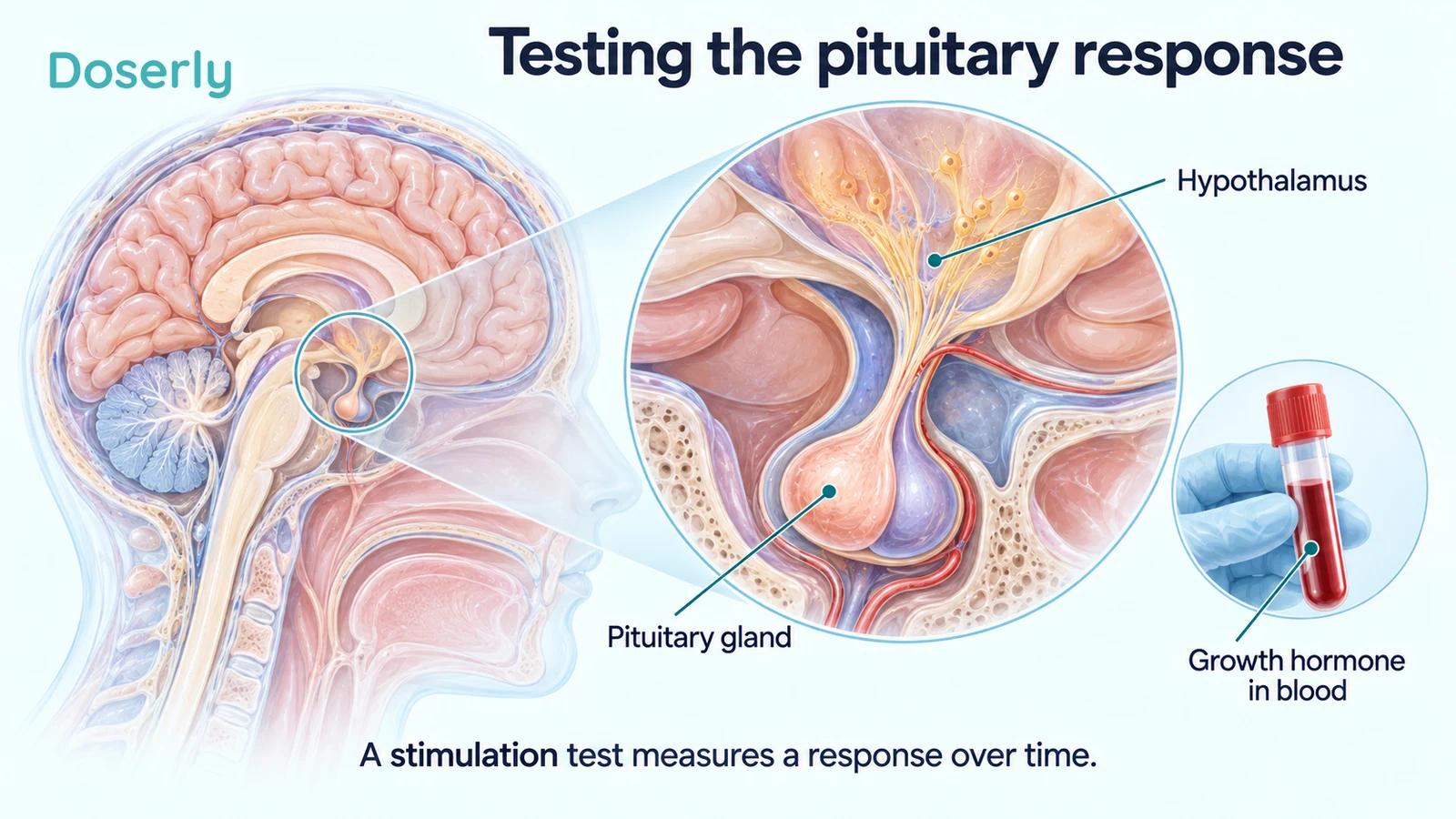
Growth hormone is released by the pituitary gland, a small gland beneath the brain. A stimulation test evaluates the response after a standardized challenge rather than treating one isolated hormone value as a complete description of the system.
The Endocrine Society's adult growth-hormone-deficiency guideline explains that confirmation through stimulation testing is usually required, with exceptions for certain established genetic or structural conditions. It also emphasizes clinical judgment about the individual's diagnosis and treatment. Endocrine Society guideline
The reason for investigating possible deficiency matters. A person being assessed after pituitary disease is different from a healthy person hoping to optimize a laboratory value. The clinical setting affects how likely the condition was before the test and how a result should influence care.
A provocative test deliberately causes a response so that it can be observed. The resulting rise is evidence about the system under those test conditions. It is not itself proof that a person needs repeated stimulation.
What the Japanese prescribing information actually covers
The Japanese GHRP Kaken prescribing information identifies pralmorelin as a diagnostic agent for growth-hormone secretion deficiency. It describes intravenous administration in a controlled setting, with blood samples taken before and at specified times after the stimulus.
The label notes that growth-hormone measurements vary with the assay and that interpretation requires appropriate reference criteria. It also describes the effects of food, stress and exercise on testing conditions. PMDA prescribing information
Those details are part of what makes the result interpretable. The product, route, conditions, sample timing and measurement method work together. Removing the drug from that setting and using it repeatedly for another purpose does not preserve the evidence simply because the molecule has the same name.
The indication is diagnostic. It is not an approval for an ongoing wellness regimen, muscle gain or treatment of ordinary fatigue. This distinction is about the specific claim supported by the label, rather than a judgment about whether the molecule has biological activity.
How the original diagnostic validation worked
A 2007 study compared 77 healthy participants with 58 patients who had severe growth-hormone deficiency according to insulin tolerance testing. After GHRP-2 administration, the investigators collected serial blood samples and measured growth hormone.
Peak concentrations occurred within 60 minutes. The patient group had much lower responses than the healthy group, and repeated testing showed favorable reproducibility. The investigators proposed a diagnostic cutoff tied to the assay's calibration. Diagnostic validation study
This is a meaningful validation question: can the test distinguish groups whose clinical status has already been characterized? It is different from asking whether giving the drug every day makes people stronger or less tired.
The healthy participants' large hormone response is sometimes the part that attracts attention. In the study, however, that response helped establish a reference for a functioning system. It was not defined as an improvement over their prior health. A larger response to a challenge need not mean a better baseline state.
Why test cutoffs cannot be borrowed casually
A laboratory cutoff is a decision rule attached to a particular method. In the validation report, the threshold changed when hormone results were calibrated using a different reference standard. The underlying patient did not change; the way the measurement was expressed did.
This is why copying a number from a paper into an unrelated laboratory report can mislead. The test stimulus, assay, units and patient population all matter. A clinician interprets them together rather than judging the result from one number alone.
Another study compared insulin tolerance, arginine and GHRP-2 tests in 71 Japanese adults awaiting surgery for pituitary tumors. Relative to insulin tolerance testing, the GHRP-2 test had a reported sensitivity of 81.3% and specificity of 94.5% for severe adult deficiency. Comparative study
Sensitivity describes how often the test identifies people classified as having the condition by the reference method. Specificity describes how often it correctly classifies those without it. Neither is a treatment-success rate. An 81.3% sensitivity does not mean 81.3% of people feel better after taking GHRP-2.
The study's pituitary-tumor population also limits how directly those values apply to people being evaluated for nonspecific symptoms. Diagnostic performance should remain attached to the setting in which it was measured.
A hormone response can have more than one component
GHRP-2 does not exclusively influence the growth-hormone measurement. Researchers have also examined its stimulation of the hypothalamic–pituitary–adrenal system, which helps regulate cortisol.
In a retrospective study of 254 people assessed for hypopituitarism, cortisol responses to GHRP-2 and insulin tolerance testing were correlated. Yet the overall sensitivity and specificity for adrenal assessment were only 64% and 79%. A selected subgroup of men without functional adenomas performed better. Adrenal-axis comparison
That finding illustrates why correlation is not enough to declare two tests interchangeable. Two measurements can tend to rise together while still disagreeing often enough to matter for individual diagnosis.
It also reinforces the need to define which hormone system is being assessed. A useful growth-hormone test does not automatically become a reliable adrenal test for everyone. Nor does an observed cortisol response validate repeated use as a way to manage stress, fatigue or an assumed adrenal problem.
What changes when the purpose becomes treatment?
Treatment requires repeated exposure over a clinically meaningful period. Researchers then need outcomes that match the proposed benefit: growth in children, physical function in an appropriate patient population, symptom improvement, or another specific health outcome.
The diagnostic studies primarily measured hormone concentrations over a short testing period. They were not designed to determine whether months of treatment improve exercise performance, prevent disease or improve quality of life.
Repeated exposure also raises questions that a single test cannot answer. Does the response remain stable? Does an early laboratory effect persist? Are there side effects that become apparent only after weeks or months? Does the treatment remain useful when compared with appropriate existing care?
These questions are not answered by increasing the size of the initial hormone response. They require a different study design.
A treatment trial shows why the distinction matters
The difference between stimulation and treatment benefit is visible in a 48-week randomized study of 126 children with growth-hormone deficiency. The children received an intranasal GHRP-2 preparation or placebo. Despite stimulated endogenous growth-hormone secretion, the study found no significant advantage in its reported growth outcome or IGF-I measurements. Pediatric treatment trial
This trial does not decide every possible use of GHRP-2. It involved children, a particular nasal preparation and a specific outcome. But it provides a direct example of why a hormone response cannot substitute for clinical results.
The same reasoning applies when a diagnostic paper is offered as support for adult wellness. The diagnosis, formulation, repeated exposure and intended benefit all need relevant evidence. A paper can be sound and still answer a different question from the one being asked of it.
What a patient can ask before testing
If a clinician recommends a stimulation test, ask what condition is being investigated and how the result will change care. It can help to understand why that particular test was chosen and whether your medications, recent illness or other circumstances affect interpretation.
Ask which laboratory method and reference criteria will be used, and how an uncertain result will be handled. A borderline result may call for interpretation alongside other findings rather than an automatic treatment decision.
For someone offered ongoing GHRP-2 on the basis that it is used medically in Japan, the follow-up question is different: “What evidence supports this repeated treatment for my condition?” The answer should identify a treatment study rather than return to the diagnostic label.
A dated record of symptoms, previous diagnoses and laboratory results can make either conversation easier. It does not replace specialist interpretation, but it helps establish what problem existed before testing and what outcome you hope care will improve.
Safety information also belongs to its setting
The Japanese label lists adverse reactions in the diagnostic context, including warmth and gastrointestinal or neurological symptoms. A monitored clinical test has a defined exposure and observation period. That safety experience should not be converted into an estimated risk for months of an untested regimen. PMDA label
Likewise, a research product described as pralmorelin is not established as equivalent to the licensed diagnostic preparation merely by sharing a name. Product identity, quality and the intended use remain separate issues.
GHRP-2 testing can provide useful information about hormone secretion when used for an appropriate diagnostic question. The evidence supports respecting that role while keeping treatment claims separate. For more detail on the studies that actually administered repeated treatment, see the GHRP-2 human research section.
Sources
- PMDA pralmorelin prescribing information.
- Endocrine Society adult deficiency guideline.
- 2007 diagnostic validation.
- 2013 test comparison.
- 2018 adrenal-axis comparison.
- 2014 pediatric treatment trial.