
Peptides
October 16, 2026
Why GHRP-2 and GHRP-6 should not share one side-effect profile
On this page
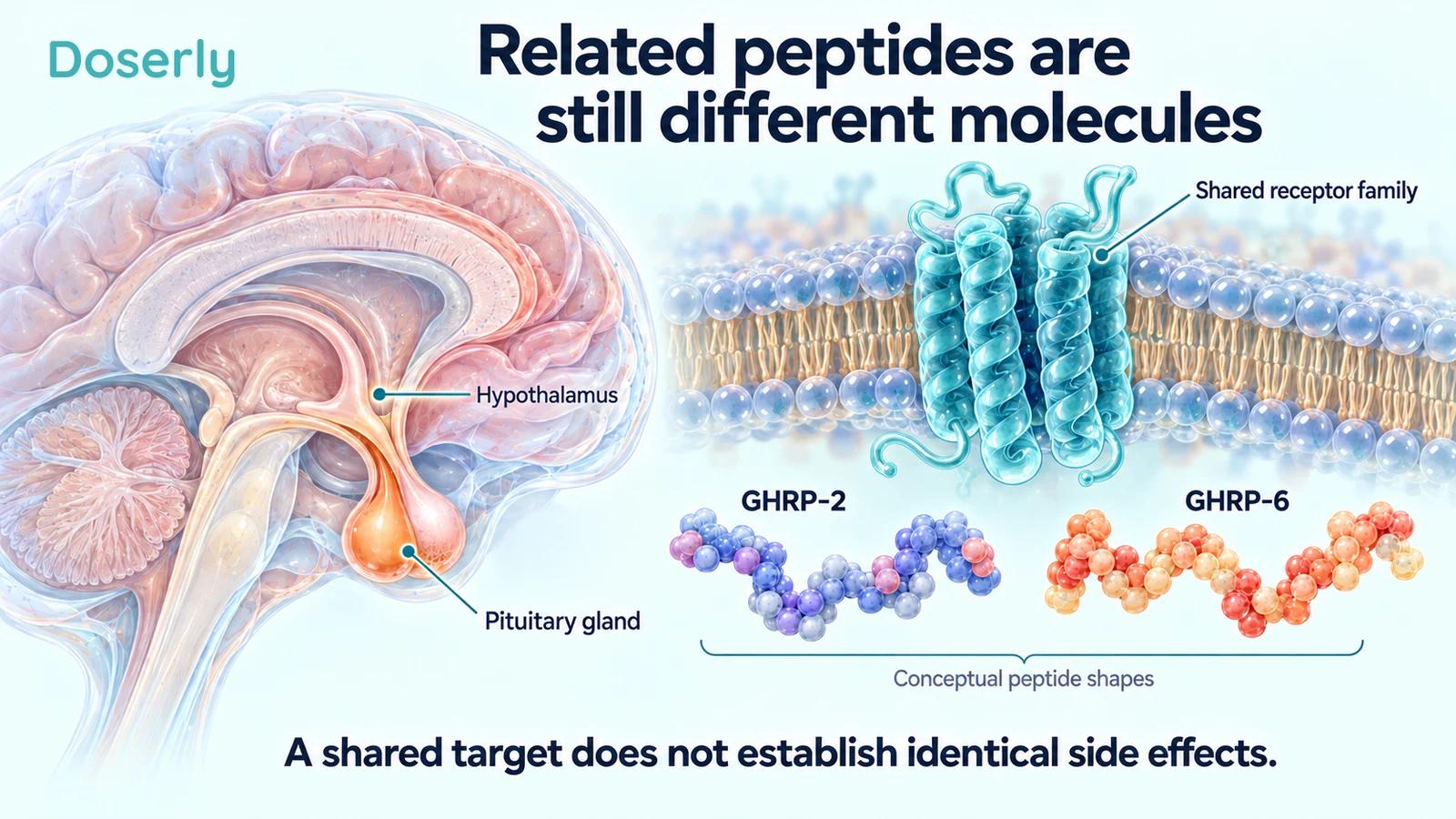
GHRP-2 and GHRP-6 belong to the same family of growth-hormone-releasing peptides, but they are different substances. Sharing a receptor helps explain why their effects overlap. It does not establish that the same symptoms occur at the same frequency, or that one is safer during repeated use.
That distinction matters when a comparison reduces the two peptides to a simple ranking: more hunger with one, more cortisol with the other, or a supposedly cleaner hormone profile. The available experiments support some specific observations. They do not provide a dependable long-term side-effect league table.
To interpret the research, it helps to separate three things: molecular activity, measured hormone changes and symptoms or clinical harms. This article explains what has actually been observed for each peptide and why evidence from related compounds cannot fill every gap. The GHRP-2 guide provides the broader background.
Related molecules can act through the same receptor
A receptor is a protein that responds to a signaling molecule. GHRP-2 and GHRP-6 act through the growth-hormone-secretagogue receptor system, which is also associated with ghrelin signaling.
An early laboratory comparison used primary rat pituitary cells. Both peptides stimulated growth-hormone release, and exposure to one could reduce the cells' response to the other. The authors concluded that the peptides acted through the same receptor mechanism in that experimental system, despite their structural differences. Rat pituitary-cell study
This is useful mechanistic evidence, but the experimental setting is essential. Cells in a laboratory do not report hunger, sleep quality, nausea or other symptoms. They also do not reproduce the absorption, metabolism and multiple interacting organs of a person.
The finding therefore supports a shared biological target. It cannot establish an identical clinical side-effect profile.
A hormone response and a side effect are different observations
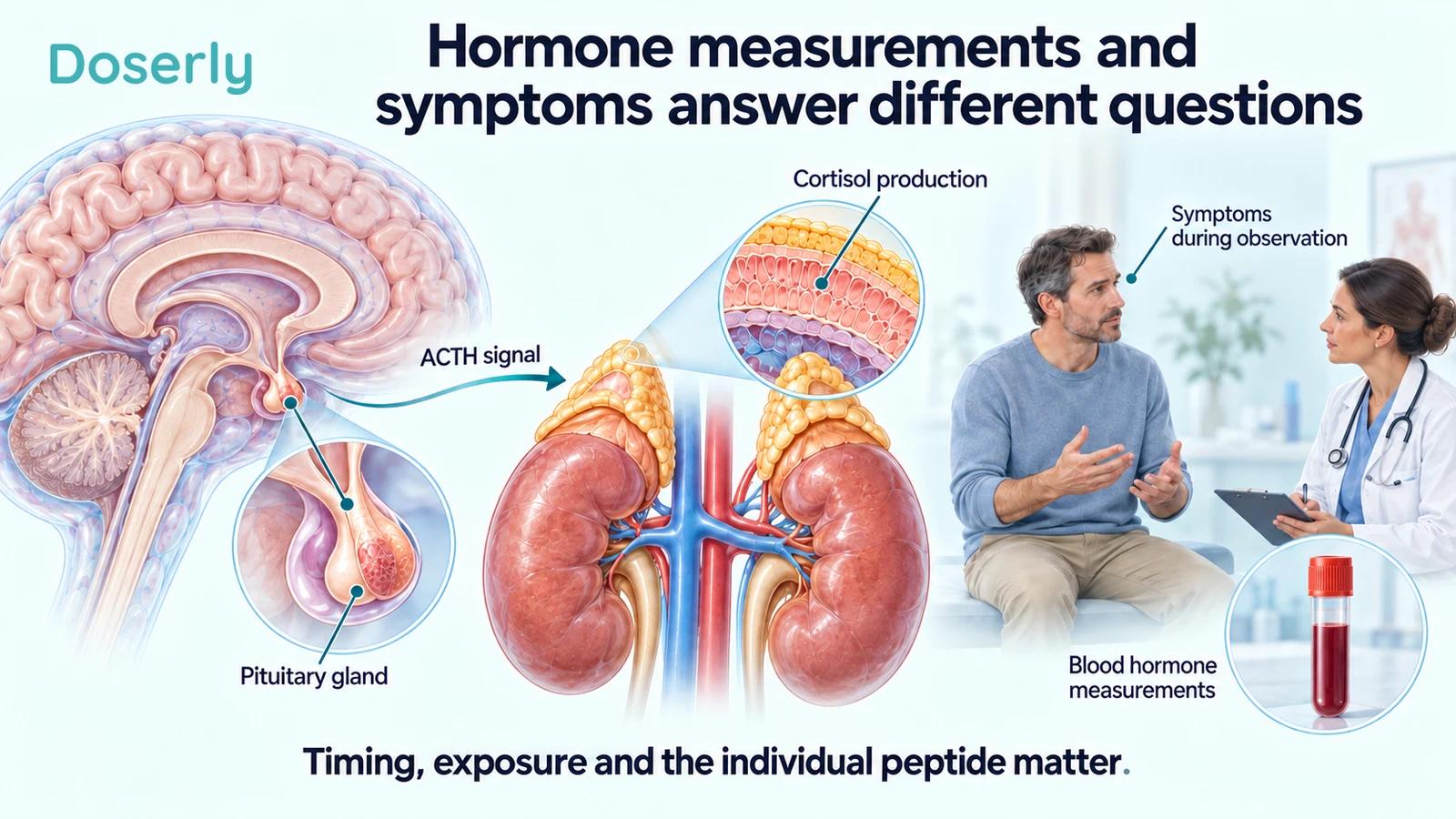
A study may find that ACTH or cortisol increased after administration without showing that participants developed symptoms from that change. Conversely, an unpleasant symptom may be important even when the measured hormones remain within a laboratory reference interval.
ACTH, or adrenocorticotropic hormone, is a pituitary hormone that signals the adrenal glands to produce cortisol. Cortisol has normal physiological functions, and its interpretation depends on timing and clinical context. A short-lived experimental rise is different from established persistent excess.
For a side-effect comparison, researchers would need to record more than the presence of a hormone response. They would need its size and duration, the participants' symptoms, other clinical measurements and what happened in the comparison group.
Without that information, a statement such as “both raise cortisol” cannot tell a reader which causes more troublesome effects during a particular pattern of use.
What the human GHRP-2 experiment measured
A 1997 study examined growth hormone, prolactin, ACTH and cortisol responses to GHRP-2 and hexarelin in six healthy young adults. The researchers also studied growth-hormone responses in six older adults.
The report found that GHRP-2's endocrine activity was not confined to growth hormone: prolactin, ACTH and cortisol also increased. Human endocrine study
The comparator detail matters. The related peptide in this experiment was hexarelin, not GHRP-6. Citing it as a direct human GHRP-2-versus-GHRP-6 safety trial would misidentify the intervention.
The experiment was also small and acute. It helps establish that GHRP-2 can stimulate additional hormonal responses. It does not estimate the frequency of clinically important effects after months of repeated administration.
Prolactin is another pituitary hormone, distinct from growth hormone and ACTH. Its inclusion in the experiment is a reminder that the label “growth-hormone-releasing peptide” describes an important action, not a guarantee that every other hormonal pathway remains unchanged.
GHRP-6 also affected ACTH and cortisol in a human study
A separate 1995 experiment compared repeated intravenous GHRP-6 administration with placebo during overnight monitoring in healthy men. Researchers measured hormone secretion and sleep using electroencephalography, which records electrical activity associated with sleep stages.
Growth hormone, ACTH and cortisol increased after GHRP-6. Stage 2 sleep increased, while slow-wave sleep and the other reported sleep variables did not show the same change. GHRP-6 sleep and hormone study
This provides human evidence that GHRP-6's effects were not restricted to growth hormone. It does not show that its cortisol response was larger or smaller than GHRP-2's under matched conditions, because GHRP-2 was not the comparator.
The sleep finding also deserves precise wording. More stage 2 sleep is not equivalent to a demonstrated improvement in restorative sleep, next-day function or recovery. Those broader claims require the corresponding outcomes.
Comparing the numbers from this nighttime experiment with another peptide's daytime study would introduce several differences at once. Time of day, exposure pattern, sampling and participants would all need consideration before interpreting a numerical contrast as a drug difference.
Why an animal comparison cannot settle a human ranking
A 1998 pharmacology paper investigated ipamorelin alongside other secretagogues in rat cells, rats and swine. In the swine experiments, GHRP-2 and GHRP-6 increased ACTH and cortisol. Ipamorelin did not produce concentrations significantly different from those observed after GHRH stimulation under the tested conditions. Preclinical comparison
This is often-relevant evidence about differences within the receptor family. It is also explicitly preclinical evidence. The endocrine selectivity comparison was performed in swine, not in a long-term trial of people choosing among peptides.
The same paper reported differences in growth-hormone potency and maximal response. Potency describes the amount needed to produce an effect in a particular experiment; maximal response describes how large the response becomes. Neither term is a synonym for safety.
A more potent compound is not automatically more harmful, and a lower maximal hormone response does not automatically make a compound safer. Those questions require assessment of unwanted effects at the exposures actually being compared.
The animal study supports further investigation of selectivity. It does not establish a human side-effect ranking for GHRP-2, GHRP-6 and ipamorelin.
Appetite claims need their own comparison
GHRP-2 has direct human evidence for an acute food-intake effect. In a crossover experiment involving seven lean men, participants consumed about 36% more at a buffet meal during GHRP-2 infusion than during saline infusion. GHRP-2 meal study
The finding matters because it shows that an appetite effect is not unique to GHRP-6. However, the experiment did not include GHRP-6, so it cannot determine which peptide produces more hunger.
Hunger ratings, meal intake and longer-term weight gain are also distinct outcomes. A person might report greater hunger without the same change in food intake as another person. One larger meal does not establish a sustained weight effect.
Whether increased appetite is experienced as helpful or unwanted depends on the clinical goal. That does not change the need for a properly matched comparison before assigning relative probabilities to the two peptides.
Diagnostic adverse-event records have a defined scope
Japan's prescribing information for pralmorelin, the diagnostic GHRP-2 product, reports adverse reactions including warmth and other symptoms such as gastrointestinal discomfort, sleepiness and hunger. The label concerns supervised testing for growth-hormone secretion deficiency. PMDA prescribing information
This is more directly relevant to human tolerability than a receptor-cell experiment. Its limits are still important: the formulation, intravenous route and brief diagnostic exposure are specific.
Those records should not be converted into expected event rates for repeated use of a different preparation. Nor do they create a GHRP-6 comparison, because the diagnostic label is for pralmorelin.
The absence of a particular event from a small study or a specific label is also not proof that it cannot occur. How long participants were observed and what the investigators actively measured affect what can be detected.
Repeated exposure adds another source of uncertainty
In nine healthy young men given GHRP-2 over five days, growth-hormone responses diminished relative to the first administration, while IGF-I did not significantly increase. Repeated-exposure study
That result concerns a measured endocrine response. It does not establish that side effects decrease at the same rate, or that any reduced response can be corrected safely by adjusting exposure.
The distinction is useful when comparing anecdotes. Reports made after a first exposure, several days or many weeks may refer to different physiological circumstances. They may also involve different formulations and other substances.
A responsible comparison would describe those conditions rather than treating all reports under a peptide's name as if they came from one standardized regimen.
What a genuine head-to-head safety study would add
A useful human comparison would assign the two peptides under clearly defined conditions and measure the same outcomes at the same times. The choice of exposure would need a stated rationale; equal amounts do not necessarily create equivalent biological effects.
Investigators would need to specify whether they were comparing short-term tolerability, endocrine responses or longer-term clinical harms. A study designed to examine a brief cortisol response may be too small or too short to assess uncommon adverse events.
Symptoms should be collected consistently in both groups. If one study asks about hunger repeatedly and another records only spontaneously reported complaints, their event counts cannot be compared straightforwardly.
The population also matters. Results from healthy young men may not describe older adults, people with pituitary disease or those taking other medications.
These requirements explain why a confident numerical ranking is difficult to justify from the studies above. The evidence contains genuine observations, but it does not assemble into a complete matched safety comparison.
How to use the evidence in a clinical conversation
If a clinician proposes one peptide as safer than another, ask which outcome supports that statement: a receptor experiment, a short human hormone study, observed symptoms or a longer-term clinical comparison.
The exact substance matters. GHRP-2, GHRP-6, hexarelin and ipamorelin should not be substituted for one another in a source summary. The species and route should remain visible as well.
For someone who has experienced symptoms after a product, keep the product information and a record of what was taken and when. That information can help a clinician assess the event; a generalized family-level side-effect list cannot establish its cause.
The available research supports overlapping biological activity and some important compound-specific observations. It does not support treating GHRP-2 and GHRP-6 as interchangeable, and it does not provide a reliable basis for declaring either universally safer.
Sources
- GHRP-2 and GHRP-6 in rat pituitary cells.
- GHRP-2 and hexarelin endocrine responses in people.
- GHRP-6 effects on sleep and hormones.
- Preclinical ipamorelin, GHRP-2 and GHRP-6 comparison.
- GHRP-2 and food intake in seven lean men.
- PMDA pralmorelin diagnostic prescribing information.
- Five-day GHRP-2 study in young men.