
Peptides
October 16, 2026
DSIP half-life: why clearance and sleep effects are separate questions
On this page
DSIP is often described as a peptide that disappears from blood within minutes yet may influence sleep much later. That apparent mismatch raises a reasonable question: if the substance is gone, how could an effect continue?
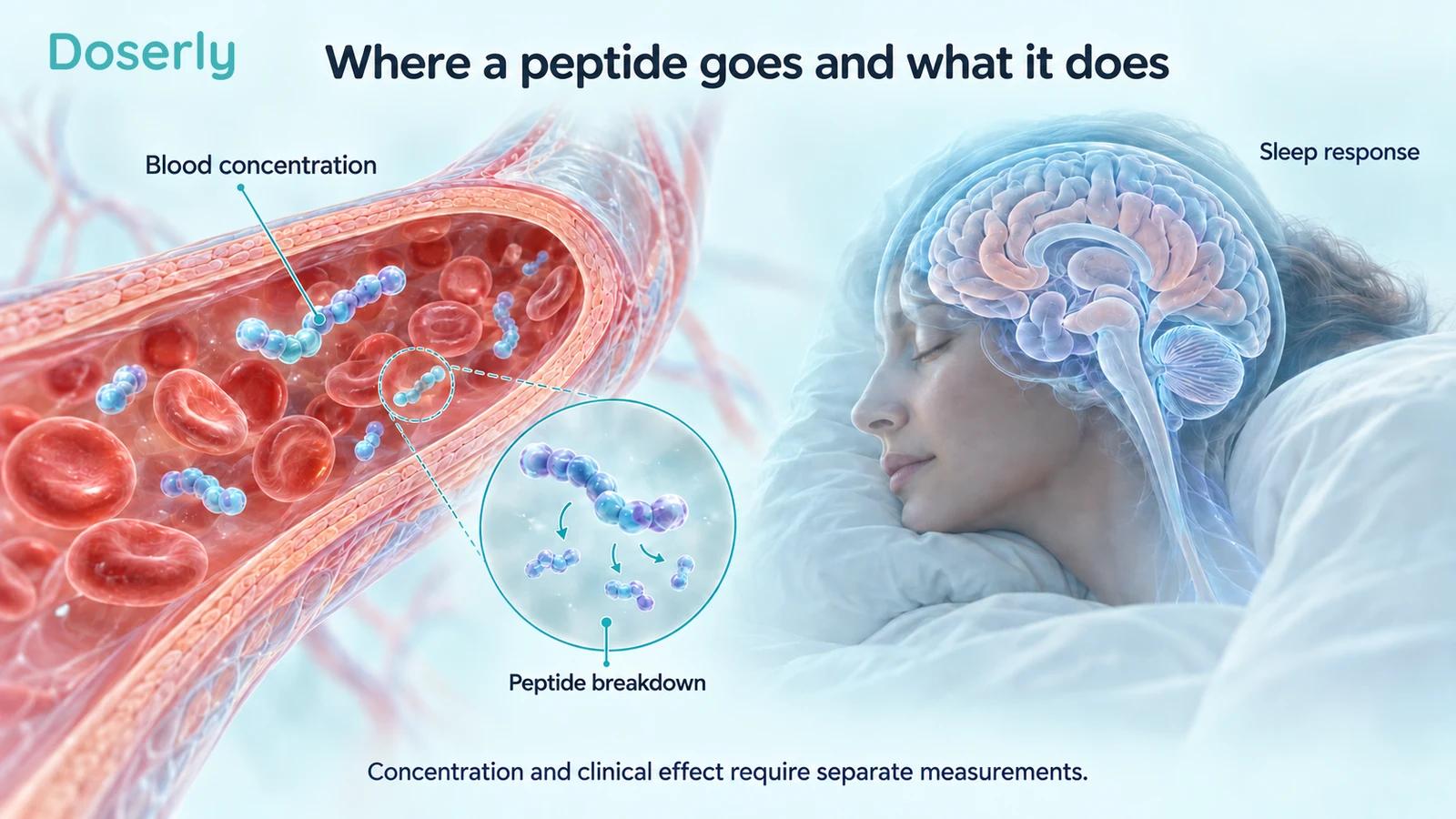
The answer starts by separating two measurements. Pharmacokinetics describes how a substance enters, moves through and leaves the body. Pharmacodynamics describes its effects. A blood concentration and a sleep response are not the same measurement, and they do not necessarily change on the same timetable.
For DSIP specifically, there is another complication. Frequently repeated half-life numbers come from different kinds of experiments, including animal studies and breakdown in blood samples outside the body. They should not be presented as a well-established human half-life for every preparation or route. Nor can they be used to calculate a proven bedtime schedule. Our DSIP guide provides the wider clinical background; here we'll trace what the clearance evidence actually establishes.
What half-life means—and what it doesn't
A half-life describes the time required for a measured amount or concentration to fall by half under specified conditions. It is a property estimated from a particular dataset and model, not a universal countdown attached to a substance's name.
As a mathematical illustration, if a concentration starts at 100 arbitrary units and falls by half during each interval, it becomes 50, then 25, then 12.5. After three such intervals, it is not zero. Those values are a hypothetical example of exponential decline, not DSIP measurements and not a guide to when an effect begins or ends.
The measurement also needs a location. A plasma concentration describes the sampled liquid part of blood. It does not directly measure the concentration in every tissue, the amount reaching the brain or the strength of a biological response. Those questions require additional measurements or a validated model linking the observations.
That is why “half-life,” “duration of action” and “time until bedtime” cannot be substituted for one another. A number can be accurate within its experiment and still be inappropriate for the decision someone wants to make.
The dog experiment behind a common number
A 1984 study developed an enzyme immunoassay to measure DSIP and applied it to clearance experiments. Researchers administered intravenous DSIP to four anaesthetized dogs and collected blood at five-minute intervals. The reported mean half-life was 4.0 ± 0.7 minutes. Additional experiments reported approximately 2.9 minutes in a monkey and 2.0 ± 0.54 minutes in three rats. Kato and colleagues
These are animal results. The dogs were research animals under anaesthesia, not patients receiving a sleep treatment, and the study does not establish a human bedtime response. The species differences themselves show why attaching one number to every context is inappropriate.
The assay method matters too. It used antibodies directed toward the peptide's C-terminal region, one end of the molecule. An assay's ability to detect a molecular feature is part of how the concentration estimate is produced. The study is useful evidence of rapid disappearance under its conditions, but it should remain identified by species, route and measurement method.
A reader encountering “DSIP has a four-minute half-life” should therefore ask the next question: measured in whom? In this case, the directly verified four-minute estimate comes from dogs. That is informative pharmacology, but it is not a human clinical dosing instruction.
Human blood in a laboratory is not a human dosing study
Another primary study investigated DSIP and two analogues in plasma and serum. Incubating DSIP in human or rat blood produced degradation products, with the process depending on temperature, time and species. The researchers concluded that rapid disappearance of native DSIP was related to breakdown, while modified analogues showed different degradation and aggregation behavior. Graf and colleagues, 1987
This is an in-vitro experiment: the relevant observations were made outside a living organism. Human blood is biologically relevant material, but an experiment in a blood sample does not reproduce absorption from an injection site, distribution among tissues or all the processes occurring in a person.
The analogue findings are another important boundary. An analogue is a modified molecule. If a modification changes stability or binding, the analogue's persistence cannot automatically be assigned to unmodified DSIP. A longer-lasting signal is not proof that the native peptide behaves the same way.
These experiments explain why researchers consider breakdown a plausible contributor to DSIP's brief presence in blood. They do not establish that a particular commercial preparation produces a predictable concentration curve in humans.
What FDA's review adds
FDA's 2026 emideltide briefing—emideltide is a name used for DSIP—summarizes rapid disappearance in animal and laboratory experiments. It reports serum-incubation estimates of roughly five to ten minutes in human serum and less than five minutes in rat serum. The human-safety section also cites a short plasma half-life from earlier literature, while describing intravenous pharmacokinetic information as limited. FDA briefing, pages 44 and 49
The same review identifies no pharmacokinetic information for the nominated subcutaneous route. This means the review cannot provide a validated human absorption-and-clearance profile for that proposed use. A short number repeated from a review should not be upgraded into an extensively measured, route-specific human result.
The most defensible conclusion is narrower: available evidence supports rapid degradation or disappearance in several experimental settings, but it does not supply the complete human pharmacokinetic information needed to predict exposure from today's varied preparations.
Why the route changes the interpretation
An intravenous administration delivers the substance into the circulation directly. After a subcutaneous injection, the substance must be absorbed from tissue before reaching the blood. A nasal formulation introduces a different delivery process again.
Bioavailability concerns the rate and extent to which an active ingredient becomes available following administration. FDA explains that changes in a product or route may require new bioavailability studies during development. That is why matching the labeled amount is not enough to assume matching exposure. FDA explanation of bioavailability
For DSIP, a claim that a subcutaneous product “lasts longer” would require measurements from that formulation and route. It cannot be established simply by reasoning that absorption must take some time. The amount absorbed, the rate of absorption and the intact peptide reaching circulation all matter.
Likewise, a nasal product cannot inherit an intravenous study's result merely because both contain the same named peptide. A useful comparison would measure exposure or demonstrate comparable clinical outcomes, rather than assuming them.
Could an effect outlast a measurable blood level?
In pharmacology, an effect can in principle continue after a circulating concentration has fallen. A biological process might respond with a delay, or a measured blood level may not describe the relevant tissue exposure completely. These are possible explanations to test, not established explanations for DSIP's sleep claims.
There are also simpler alternatives. Sleep naturally changes with time of day, the opportunity to sleep and the conditions of observation. A later improvement after an intervention might occur without a persistent drug effect. To distinguish these possibilities, researchers need controlled measurements of both exposure and response over time.
A delayed observation therefore has two separate questions attached to it. First, is the observed change convincingly caused by the treatment? Second, if it is, what biological process explains the delay? Answering the first does not automatically answer the second, and an attractive explanation cannot rescue an unconvincing treatment comparison.
What the early human sleep report can tell us
In an early blinded crossover study, six healthy volunteers received morning intravenous DSIP or placebo. The investigators described increased sleep during a 130-minute observation period and changes in the subsequent night's sleep. Early human study
That report concerns measured sleep behavior following administration. It does not establish that intact DSIP remained in the bloodstream until the following night. Without a linked concentration-time analysis, sleep observations alone cannot determine the peptide's elimination half-life.
The study also involved healthy volunteers, not a large population with chronic insomnia. Its observations are a reason to investigate delayed effects, but not a basis for telling patients when a dose will work or how long benefit will last.
Later controlled insomnia findings were less favorable. A 1992 study in 16 people found weak objective changes and no improvement in subjective sleep quality, with the authors concluding that major short-term therapeutic benefit was unlikely. The duration of an alleged effect matters only after the effect itself has been established convincingly. Bes and colleagues

Why a short half-life does not justify repeated dosing
A short blood half-life can tempt people to assume that frequent administration is necessary. That inference skips the exposure-response relationship: how a concentration relates to a useful effect and to adverse effects.
Before a schedule could be justified, researchers would need to know whether benefit tracks peak concentration, total exposure, time above a relevant threshold or some other feature. They would also need to measure tolerability across the proposed repeated use. Those relationships have not been established simply by measuring rapid disappearance in dogs or blood samples.
The opposite shortcut is also unreliable. A report of a later sleep change does not justify claiming that one exposure provides sustained benefit or that repeated use is unnecessary. Both scheduling claims require clinical evidence that directly tests them.
For the same reason, a short half-life is not a guarantee of safety. Brief exposure can still cause an adverse effect, and a measurement of intact peptide clearance does not by itself characterize a product's impurities or every biological consequence. Safety is an observed clinical question, not a conclusion obtained by counting half-lives.
What would close the gap?
A useful human study would identify the exact formulation, route and analytical method, then collect samples at times appropriate for a rapidly changing concentration. It would establish that the assay measures the intended substance with adequate specificity and sensitivity. For a peptide that degrades quickly, sample handling would need particular attention so breakdown after collection did not distort the estimated in-body concentration.
Researchers could then measure sleep with a prespecified clinical outcome and an appropriate comparator. Linking concentration and response in the same participants would be more informative than placing an animal clearance number beside an unrelated human sleep report.
Until that work is available, the useful answer to “How long does DSIP last?” is to ask what is meant by “last.” Detectable peptide in a sample, exposure in a person and improvement in insomnia are separate questions. The existing literature offers limited answers to each; it does not combine them into a validated dosing timetable.
Sources
- Kato and colleagues, DSIP assay and clearance in dogs, 1984.
- Graf and colleagues, degradation and aggregation in plasma and serum, 1987.
- FDA, emideltide briefing and pharmacokinetic limitations, 2026.
- FDA, bioavailability studies and changes in product or route.
- Acute and delayed human sleep observations, 1981.
- Bes and colleagues, controlled insomnia study, 1992.