
Peptides
October 16, 2026
Why blue color cannot prove a GHK-Cu vial's quality
On this page
GHK-Cu is associated with a distinctive blue color, so it is understandable that people use appearance as an informal check. A familiar shade may make a vial look convincing. But color cannot establish its identity, amount, sterility or suitability for injection. Those are separate questions requiring appropriate analytical methods and controlled manufacturing.
The distinction is practical, not merely theoretical. FDA enforcement records include GHK-Cu recalls for lack of sterility assurance. Such a concern is about whether the production process could reliably deliver a sterile product; it need not involve a visibly discolored vial. A photograph cannot resolve it.
This article explains what appearance can and cannot tell you, how different quality tests fit together, and what actual recall records say. It is not a method for making an uncertain research product safe at home. For background on the compound and its clinical evidence, see our GHK-Cu guide.
Why the blue appearance is recognizable
Copper tripeptide-1 is a complex of copper and a short peptide. The Cosmetic Ingredient Review report describes blue-purple crystals in a preparation of this material. That makes the familiar association with blue understandable, but the report concerns ingredient chemistry and cosmetic use. It does not establish a visual acceptance test for an injectable product. CIR safety assessment.
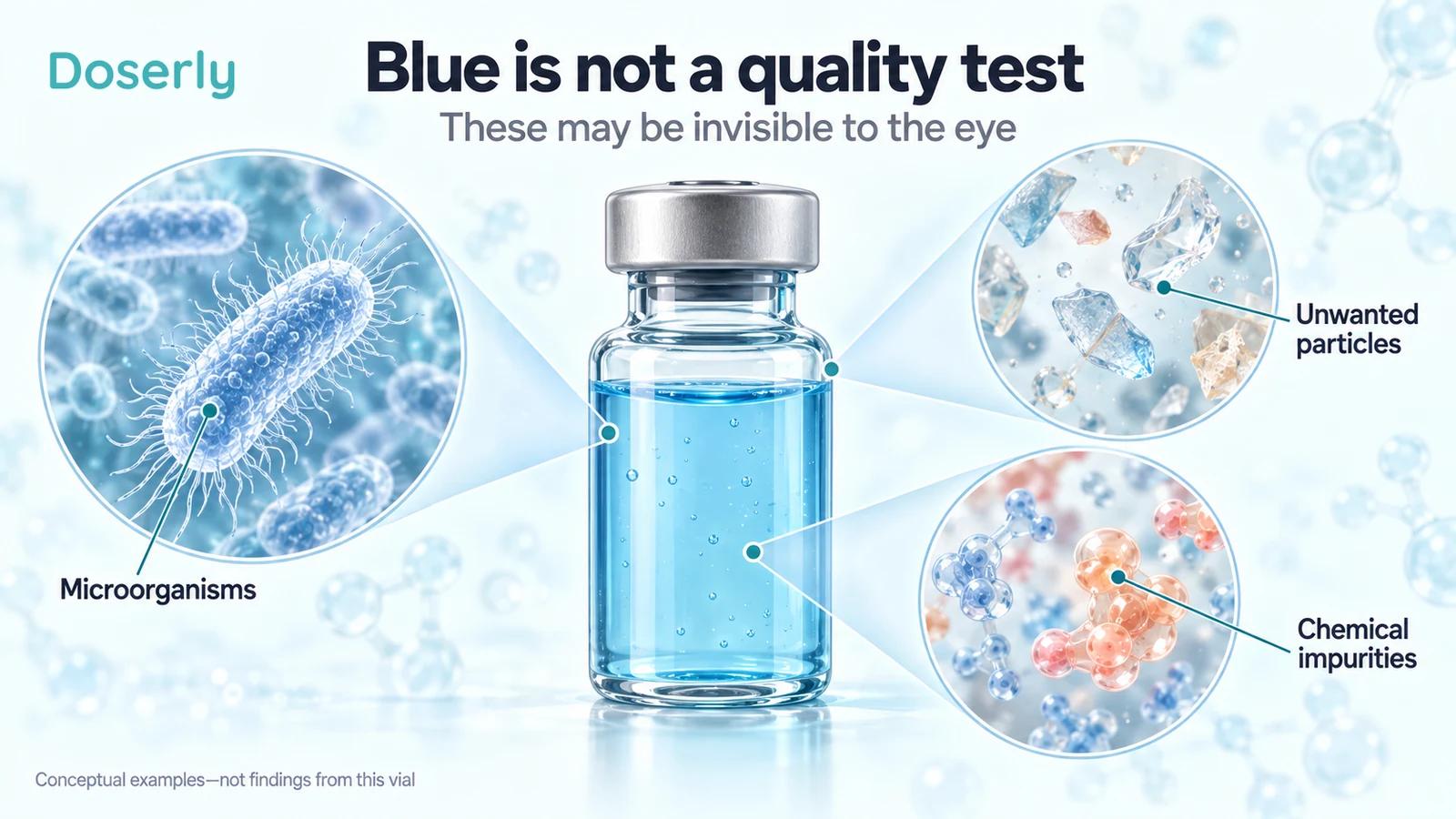
A color observation has much less information than a chemical analysis. Even if the expected compound contributes to the color, appearance does not identify everything else present. It also does not tell you how much active material is in the container. Concentration, lighting and the viewing container can change how a solution appears, making casual comparisons between photographs especially weak.
An unusual appearance may be a reason to question a product, but a familiar appearance is not proof that it passes the necessary checks. That asymmetry matters. Spotting an obvious problem can be useful; failing to spot one does not demonstrate the absence of less visible problems.
Product quality includes several distinct questions
Identity asks whether the material is the substance it claims to be. Assay or strength asks how much of the intended active ingredient is present. Impurity testing addresses unwanted chemical components. A product may perform well on one of these measurements while still having a problem with another.
For injectable medicines, microbiological and physical attributes also matter. FDA's Q6A guidance describes separate specifications for sterility, endotoxins or pyrogens, and particulate matter, alongside other product characteristics. It also emphasizes that specifications are only one part of quality assurance; development and manufacturing controls remain important. FDA Q6A guidance.
This is why a broad statement such as “lab tested” is incomplete. It tells you that some test may have been performed, but not which question it answered. The useful information is the named method, the material tested, the result, the acceptance criterion and the relationship between that sample and the product supplied.
A simple hypothetical example illustrates the distinction. A laboratory could correctly identify the intended peptide in a sample without determining the amount in each finished vial. Another test could estimate the amount while saying nothing about microorganisms. Neither result becomes false because it is incomplete; the problem arises when a narrow result is presented as comprehensive assurance.
Chemical purity is not the same as sterility
A prominently displayed purity percentage can be persuasive. But the meaning of that percentage depends on the analytical method and what it detects. A chemical purity result should not be silently interpreted as a percentage probability that a product is safe, or as proof that the container holds exactly the labeled amount.
Sterility concerns viable microorganisms. Endotoxins are bacterial components that can cause harmful reactions even when live bacteria are no longer present. These are related manufacturing concerns, but they require different assessments. FDA's aseptic-processing guidance notes that sterilizing filters and moist heat sterilization have not been shown to remove endotoxin effectively. FDA sterile manufacturing guidance.
That distinction is also why home filtering or adding a preservative is not a reliable solution to an uncertain vial. A single intervention does not establish identity, potency, microbiological quality, endotoxin control and stability. The missing evidence is about the entire product and process, not just the presence of something visible floating in the liquid.
The appropriate response to a suspected quality issue is to contact the dispensing professional or supplier through a legitimate clinical channel and follow recall or medical guidance. Trying to rescue the product can obscure the original problem without demonstrating that it has been corrected.

What the GHK-Cu recall records actually show
FDA record D-0141-2021 describes a GHK-Cu product labeled 10 mg/mL in a 5 mL vial. The recall was initiated on November 30, 2020. Its stated reason was lack of sterility assurance because production processes could not assure sterility for products intended to be sterile. The record identifies a particular lot and lists one vial in the product quantity field. FDA enforcement record.
A separate record, D-0051-2026, concerns GenoGenix GHK-Cu for injection, all strengths and presentations, with all lots within expiry affected. Its initiation date is July 30, 2025, and the stated reason is lack of sterility assurance. The record lists a nationwide US distribution pattern. The year embedded in a recall identifier is therefore not necessarily the year the recall began. FDA enforcement record.
These records demonstrate real manufacturing-assurance concerns. They do not establish that every GHK-Cu product is contaminated, that every affected vial contained a specific organism, or that a stated number of patients became ill. The public fields cited here do not support those additional claims.
They also do not offer a way to recognize affected stock by color. Recall decisions use product and lot information, not a comparison with an online photograph. When reviewing a notice, the exact product, manufacturer or compounder, lot, expiry and scope of the action matter.
A Canadian recall addresses a different issue
Health Canada's notice for GHK-Cu and BPC-157 powders identifies unauthorized active pharmaceutical ingredients. It lists specific powder presentations and lots. Its stated issue is authorization and product quality, not a reported color defect. Health Canada recall notice.
That notice should not be merged with the US records into a single story of proven contamination. Different notices can arise from different regulatory and manufacturing concerns. Accurate reporting keeps each action attached to the products, jurisdiction and reason actually specified.
For a reader checking a product, this is a reminder to use the original notice. A screenshot or summary may omit lot details or repeat a date inaccurately. If your product appears affected, contact the appropriate dispensing professional or recalling firm and follow the notice's instructions. Keep the packaging and identifying information available for that conversation.
What a certificate of analysis can help clarify
A certificate of analysis can contain useful evidence, but its value depends on its scope and traceability. Begin with the identity of the sample. Was it raw ingredient, a research sample or the finished formulation? Does its batch identifier match the supplied product? Was the sample obtained in a way that reasonably represents that batch?
Next, consider what was measured, using the distinct quality attributes described in FDA’s Q6A specifications guidance. A report showing chemical identity and a purity result may leave strength, sterility, endotoxins or other attributes unaddressed. An omitted test should not be assumed to have passed. Equally, a genuine laboratory result should not be dismissed simply because it does not answer a different question; it should be described accurately.
Dates matter because a result belongs to a sample at a particular time. It does not automatically establish stability after storage, shipping, opening or preparation. Finished-product manufacturing can also introduce concerns not addressed by a raw-material report. Quality assurance has to connect those stages rather than treating an ingredient certificate as a permanent guarantee.
These are questions to raise with a qualified pharmacist or clinician, not a consumer checklist that can authorize use of an unapproved research product. A convincing document cannot replace a legitimate medical indication, an appropriate source and evidence about the treatment itself.
Compounded does not mean FDA-approved
Compounding can meet particular patient needs when an approved medicine is unsuitable. But compounded products are not FDA-approved, and FDA does not verify their safety, effectiveness and quality before marketing in the same way it does for approved drugs. The agency identifies contamination and too much or too little active ingredient among potential consequences of poor compounding. FDA compounding questions and answers.
This distinction should not be turned into a claim that every compounded medicine is defective. It explains why the source, oversight and clinical rationale deserve attention. A professional-looking label, a prescription or a blue solution does not turn a compounded product into an approved drug with the same evidence package.
The same caution applies to “research use only.” That phrase does not supply human safety evidence or establish that a material is suitable for injection. If the intended use involves a person, the relevant questions concern clinical suitability and the finished product, not simply whether the seller can describe a chemical.
What to do with an uncertain vial
Do not rely on a color comparison to decide that an uncertain product is suitable for use. Record its name, lot, expiry, source and any change in appearance, and contact the dispensing professional if there is one. If you have already used it and feel unwell, seek medical advice and provide those details; urgent symptoms such as trouble breathing or severe illness need urgent care.
A dated photograph can document an observation, but it cannot diagnose contamination. Keep the distinction clear when reporting a concern: “the liquid looks different” is an observation; “the vial contains bacteria” is a conclusion that requires evidence. Both clear documentation and careful wording help a professional investigate.
The strongest reason to look beyond color is that the important questions are answerable only through other means. Identity, amount, microbiological quality, stability and clinical benefit are separate pieces of information. A blue vial may look familiar while leaving all of them uncertain. The Doserly GHK-Cu guide explains the compound's evidence; the product in hand still requires its own legitimate quality assurance.
Sources
- CIR: safety assessment of tripeptides and related cosmetic ingredients.
- FDA: Q6A specifications and quality assurance.
- FDA: sterile drug products produced by aseptic processing.
- FDA recall D-0141-2021.
- FDA recall D-0051-2026.
- Health Canada: unauthorized GHK-Cu and BPC-157 APIs.
- FDA: compounding questions and answers.