
Peptides
October 16, 2026
Semax and long-term cognitive safety: what short studies leave unanswered
On this page
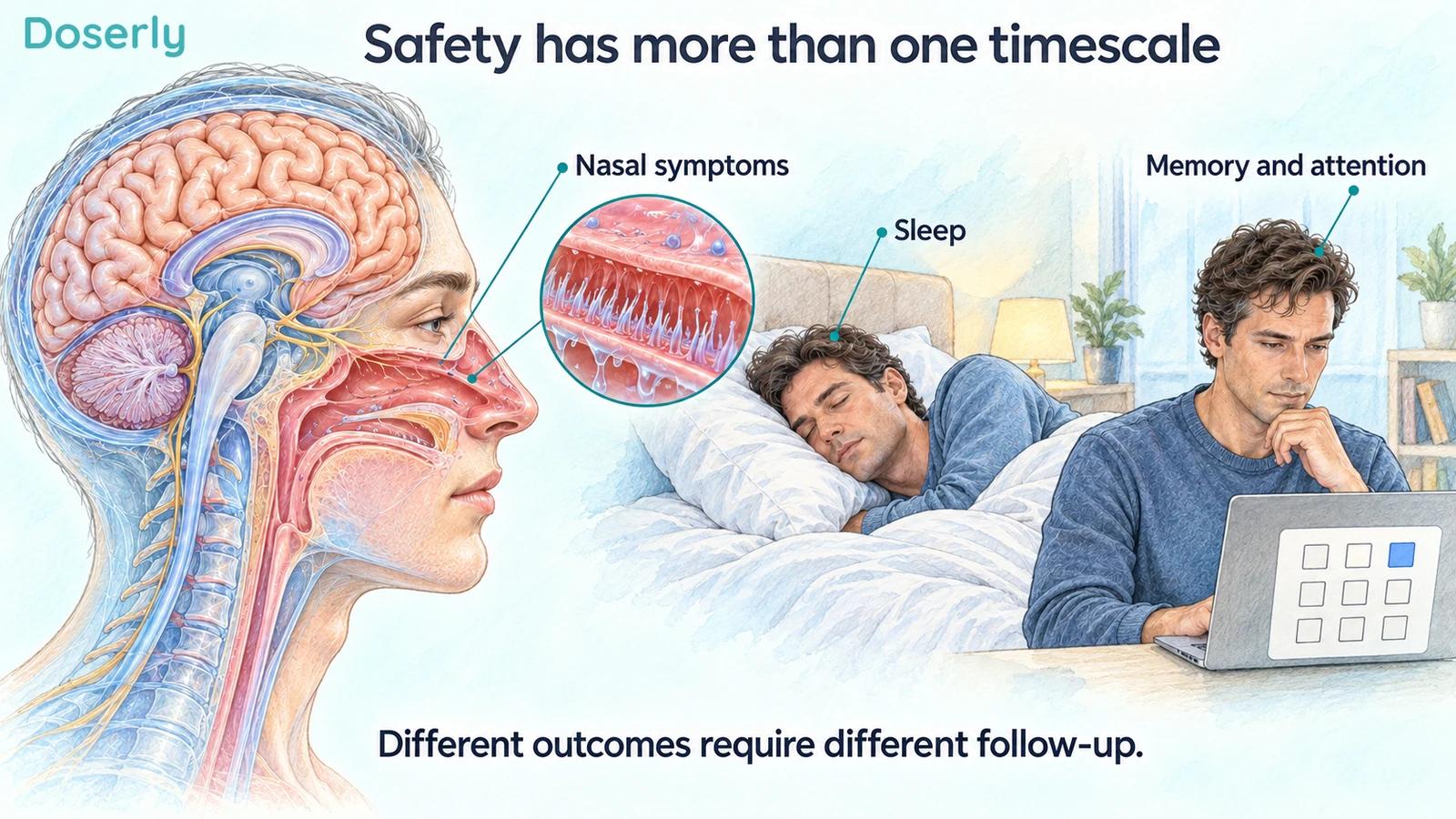
Semax is studied for effects on the brain, so questions about memory, attention and long-term safety belong together. Someone interested in cognitive benefits may reasonably ask whether repeated use could eventually affect sleep, mood or thinking in an unwanted way. A report that people tolerated a short course cannot fully answer that question.
The available human literature includes small imaging studies and clinical reports in people with neurological disease. It offers observations worth understanding, but it does not establish the safety of continuous or repeated cognitive-enhancement use over years. The right interpretation is uncertainty about that pattern of use, not proof that harm will occur.
Our Semax guide explains the compound's broader evidence. Here, we'll examine what the human reports actually observed, how cognitive safety differs from general tolerability and why follow-up needs to continue after treatment ends.
What does cognitive safety include?
Cognition is the collection of abilities used to learn, remember, attend, plan and make decisions. A person may notice a change in one ability without noticing another. Feeling more mentally energetic, for example, is not the same measurement as remembering information accurately.
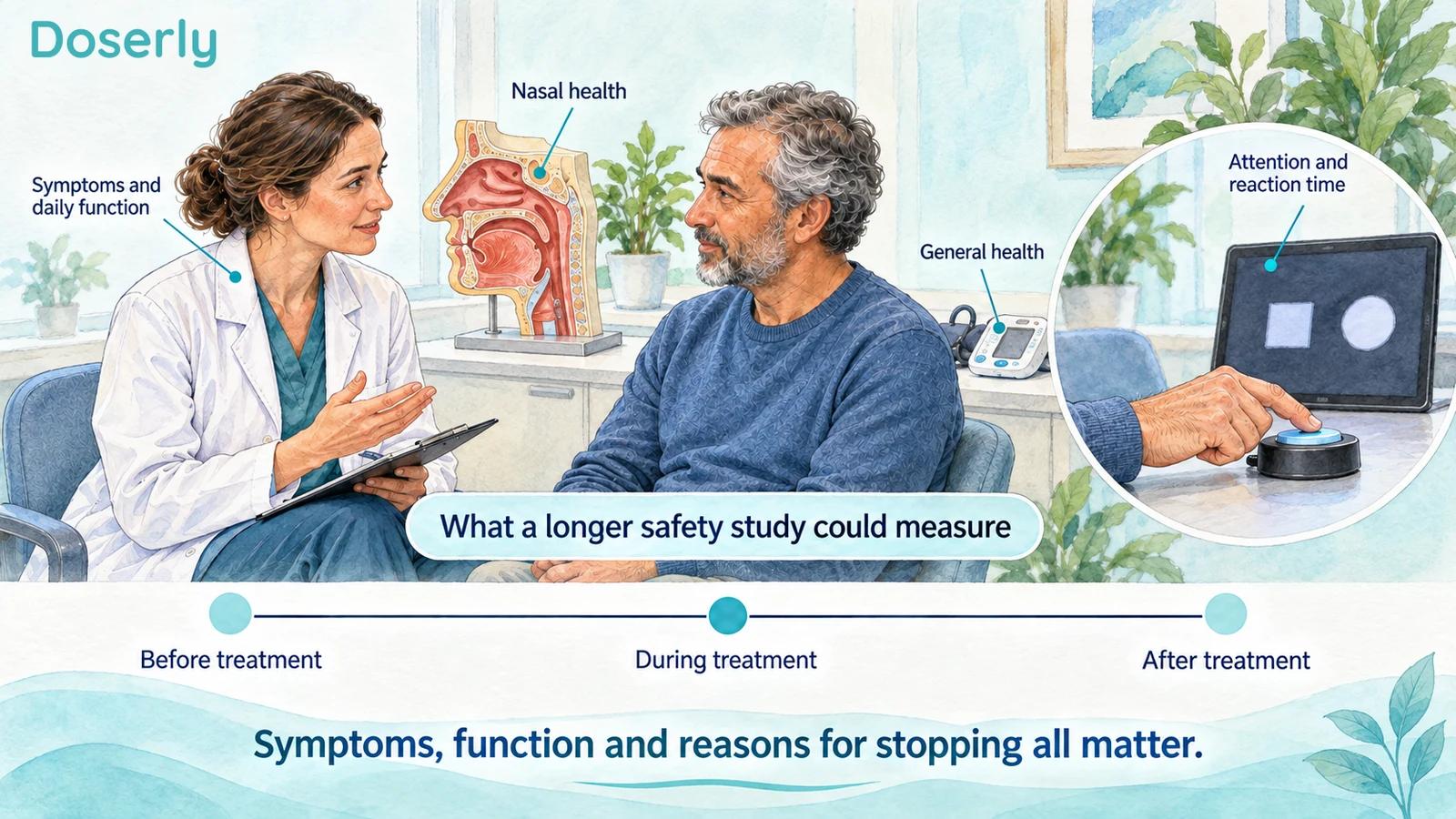
A safety assessment therefore needs more than a general question about whether someone feels well. Researchers might examine attention, working memory, reaction time, errors on tasks and the ability to function in daily life. They would also need to record symptoms such as changes in sleep or mood that could influence performance.
The aim would be to identify unwanted changes as well as benefits. A treatment could improve one measure while worsening another. Reporting an average improvement alone may conceal a subgroup who experienced problems or left the study.
This is a proposed framework for evaluating a brain-active treatment, not a list of established Semax adverse effects. The distinction matters: sensible things to monitor should not be presented as things the drug has already been proven to cause. The FDA's long-term safety guidance provides the broader context of evaluating exposure over time.
What can the short human imaging study tell us?
A 2018 study examined resting-state brain-network signals in 24 healthy volunteers after intranasal Semax or placebo. Assessments were made before administration and five and twenty minutes afterward. The investigators reported an imaging difference in part of the default mode network. Original study.
That is a short observation window for an acute biological measurement. It is not a long-term cognitive-safety study. The accessible abstract does not establish whether repeated exposure affects memory months later, whether symptoms appear after stopping, or how often uncommon adverse events occur.
There is nothing inherently wrong with a small mechanistic study. It can help researchers identify a signal and plan the next experiment. The problem arises when the scope of the conclusion becomes larger than the scope of the observation.
A scan can also look different without showing that someone thinks better or worse. Functional imaging and cognitive performance need to be connected through actual measurements. Neither a visible imaging effect nor its absence provides an all-purpose safety certificate.
Do stroke-rehabilitation studies answer a longer-term question?
The population and treatment pattern matter as much as the calendar. In a 2018 report, 110 people after ischemic stroke were assessed during rehabilitation, with subgroups receiving Semax and subgroups not receiving it. The reported regimen involved two treatment courses rather than uninterrupted indefinite use. Outcomes included motor performance, daily activities and a blood biomarker. Stroke-rehabilitation report.
That setting differs from a healthy adult taking a product repeatedly to improve work performance. Participants were recovering from brain injury and receiving rehabilitation. Their baseline risks, potential benefits and expected changes were different.
A follow-up visit months after a short course also does not mean participants received the drug continuously for those months. Follow-up duration and exposure duration are separate quantities. Both should be described when a study is used to discuss long-term safety.
For cognitive enhancement, the important missing comparison would involve the actual proposed pattern of use and cognitive outcomes measured throughout it. A neurological recovery score cannot substitute for that assessment, even when the underlying study is useful for its original clinical question.
What does the older EEG report contribute?
A 1999 report examined Semax in 73 people with posthypoxic encephalopathy, brain dysfunction following inadequate oxygen supply. The abstract describes episodes of paroxysmal activity on electroencephalography in some cases after administration. An EEG records electrical activity of the brain. Original posthypoxic encephalopathy report.
This is a specific observation in a medically affected population. The abstract does not supply enough detail to calculate a reliable incidence, establish causation or apply the finding directly to healthy users. Paroxysmal EEG activity should not automatically be retold as a confirmed clinical seizure in every affected participant.
It is nevertheless a reason not to summarize the clinical history as “no neurological safety signals.” A useful review includes unfavorable observations alongside reports of benefit and explains the limitations of both.
The publication also illustrates why full methods matter. Without detailed information about baseline EEG findings, other treatments, timing and individual events, a reader cannot resolve every alternative explanation. Those missing details justify careful interpretation, not either dismissal or alarm.
What did FDA conclude about the safety information?
In its 2026 Semax compounding review, FDA found insufficient clinical information to characterize the safety of the evaluated free-base and acetate substances. It identified missing human pharmacokinetic information and a lack of clinical safety evidence for the proposed subcutaneous route. FDA Semax briefing, pages 37–40 and 43.
The agency's review also discusses limitations in adverse-event reporting in the available studies. That is important because “no adverse events reported” can mean several things: none occurred, none were detected, or the report did not describe them adequately.
The briefing is an assessment of evidence for a regulatory advisory process. It should not be described as a clinical experiment or a final determination that every Semax product causes harm. Its practical contribution is to identify where the available information is insufficient.
It also prevents a common shortcut: borrowing the safety history of one nasal preparation for a differently formulated injectable product. Even if short nasal studies were reassuring, a new route would need its own justification.
Why small studies miss uncommon events
Sample size affects what a study can detect. Suppose, purely as an illustration, that an adverse event has a 1% chance of occurring during a defined treatment period and that each participant's outcome is independent. In a study of 30 people, the probability of seeing no such event would be approximately 74%, calculated as 0.99 raised to the power of 30.
That is a mathematical example, not an estimate of any Semax risk. It shows why observing no events in a small group cannot rule out an event that matters clinically.
Time creates a separate limitation. A study lasting days cannot directly observe an effect that typically develops only after months of exposure. Adding more participants to the short study helps with some rare immediate events, but does not replace longer observation.
Drug-development guidance explicitly considers the extent and duration of exposure needed to evaluate medicines intended for long-term use. There is no single small study that answers every safety question. FDA/ICH E1A guidance.
Why “people have used it for years” is incomplete
Experience outside trials can reveal important problems, especially if clinicians recognize and report them. But the number of anecdotes is not the same as a defined population followed systematically.
To estimate risk, researchers need to know how many people were exposed, what they used, for how long and how outcomes were sought. People who stop because of symptoms may be less visible in communities centered on ongoing use. People who feel well may never undergo objective cognitive testing.
Spontaneous adverse-event databases have related limitations. FDA explains that reports cannot establish causation or calculate event rates by themselves. A report is a signal to investigate, while an absence of reports is not proof of safety. FDA adverse-event dashboard explanation.
This does not make personal experience meaningless. It makes careful documentation more useful than a broad declaration that a product is harmless. The exact preparation, timing, other treatments and course after stopping can all help a clinician interpret an event.
What a useful longer study would measure
A study intended to answer the cognitive-safety question would first define the product and intended use. It would distinguish occasional courses from continuous exposure and enroll people who resemble the population likely to use it.
Baseline testing would establish each participant's starting point. Repeated assessments would then examine both performance and symptoms, with an appropriate comparison group. Alternate versions of cognitive tests could help address practice effects, where people improve simply because they have seen a task before.
The study would also record reasons for stopping. If participants with troublesome symptoms disappear from the final analysis, a result based only on those who remain may look more reassuring than the full experience warrants.
After-treatment follow-up would address a further question: do changes resolve, persist or first become apparent when exposure ends? This is different from testing whether the treatment's benefit lasts.
Can self-tracking fill the gap?
A dated record can make a clinical conversation more specific. It can describe sleep, perceived concentration, symptoms, product changes and other medicines. If a problem arises, the record may help establish what changed and when.
It cannot replace blinded comparison, analytical product testing or formal neuropsychological assessment. Daily scores are influenced by workload, illness, expectations and how often the same test is repeated. A reassuring pattern does not exclude a problem that the chosen measure cannot detect.
Tracking is most helpful when it supports care rather than becoming a reason to continue an uncertain treatment. New neurological symptoms or substantial changes in thinking should be assessed clinically, rather than treated as a normal adjustment period based on an online explanation.
There is also no established “cycling” schedule in the studies reviewed here that proves repeated cognitive-enhancement use safe. A planned break may change exposure, but its protective value would itself require evidence. It should not be presented as a validated solution to an unmeasured risk.
How to frame the decision
Ask what benefit is expected, how directly it has been demonstrated for your situation and what safety information matches the proposed duration and product. A short clinical report can contribute to that discussion without being asked to settle a lifetime question.
If the main concern is memory or attention, clarify what is causing the difficulty and what other approaches have supporting evidence. The tolerance for uncertainty may differ when treating a serious illness versus seeking an enhancement in otherwise normal function.
For Semax, the reviewed reports do not demonstrate long-term cognitive harm, but they also do not establish long-term cognitive safety for repeated enhancement use. That is the specific gap to keep visible. The Semax guide provides the wider biological and clinical context for discussing it.
Sources
- Semax and the default mode network, 2018.
- Semax during stroke rehabilitation, 2018.
- Semax in posthypoxic encephalopathy, 1999.
- FDA Semax briefing, 2026.
- FDA/ICH E1A long-term safety exposure guidance, 1995.
- FDA adverse-event dashboard and interpretation limits.