
Peptides
October 16, 2026
Oxytocin safety: why a familiar hormone still needs careful study
On this page
Oxytocin is a hormone the body makes, and many people first hear about it in connection with childbirth, breastfeeding or social bonding. That familiarity can make a spray or peptide product sound unusually gentle. But the safety of an administered hormone depends on the product, route, exposure and person receiving it.
Human intranasal studies offer some reassuring short-term findings: several controlled trials found similar adverse-event patterns with oxytocin and placebo. They do not establish that every preparation is harmless, that long-term use has been fully studied, or that a person excluded from those trials has the same risk profile.
The useful approach is to examine what was actually monitored and for how long. Our oxytocin guide explains the different medical and experimental uses; here, we'll focus on what the human safety evidence can support.
“Natural” describes origin, not a safe exposure
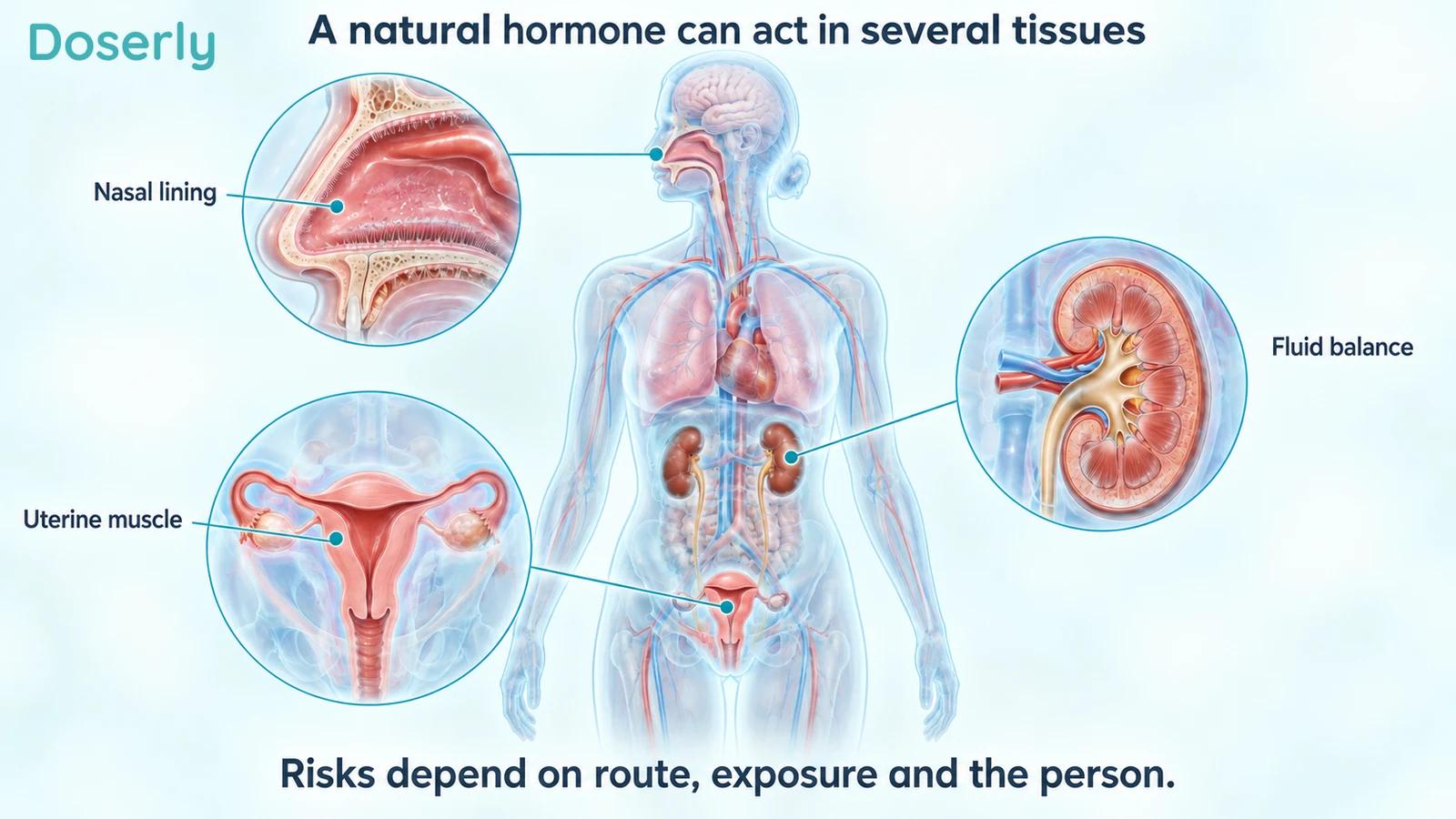
A hormone's normal presence in the body does not tell us what happens when additional amounts are administered. The body regulates where signals are produced, when they are released and which tissues respond. A medicine creates an exposure determined partly by its formulation and route.
The same substance may also act in more than one tissue. Oxytocin's uterine effects are clinically important, while its antidiuretic activity—its ability to influence water retention—matters in particular exposure settings. Official product information therefore contains context-specific warnings rather than describing the hormone as universally benign. Syntocinon professional information.
This doesn't mean that a normal bodily signal is inherently dangerous. It means “your body makes it” is the beginning of a biological explanation, not the end of a safety assessment.
For someone considering treatment, the more useful questions are concrete: what is the preparation, how is it administered, what benefit is expected, and what information supports its use in someone like you?
What four weeks in older men showed
A randomized, blinded trial examined repeated intranasal oxytocin in generally healthy older men without major physical or cognitive impairments. Ninety-five participants received treatment, with 49 assigned to oxytocin and 46 to placebo, over four weeks.
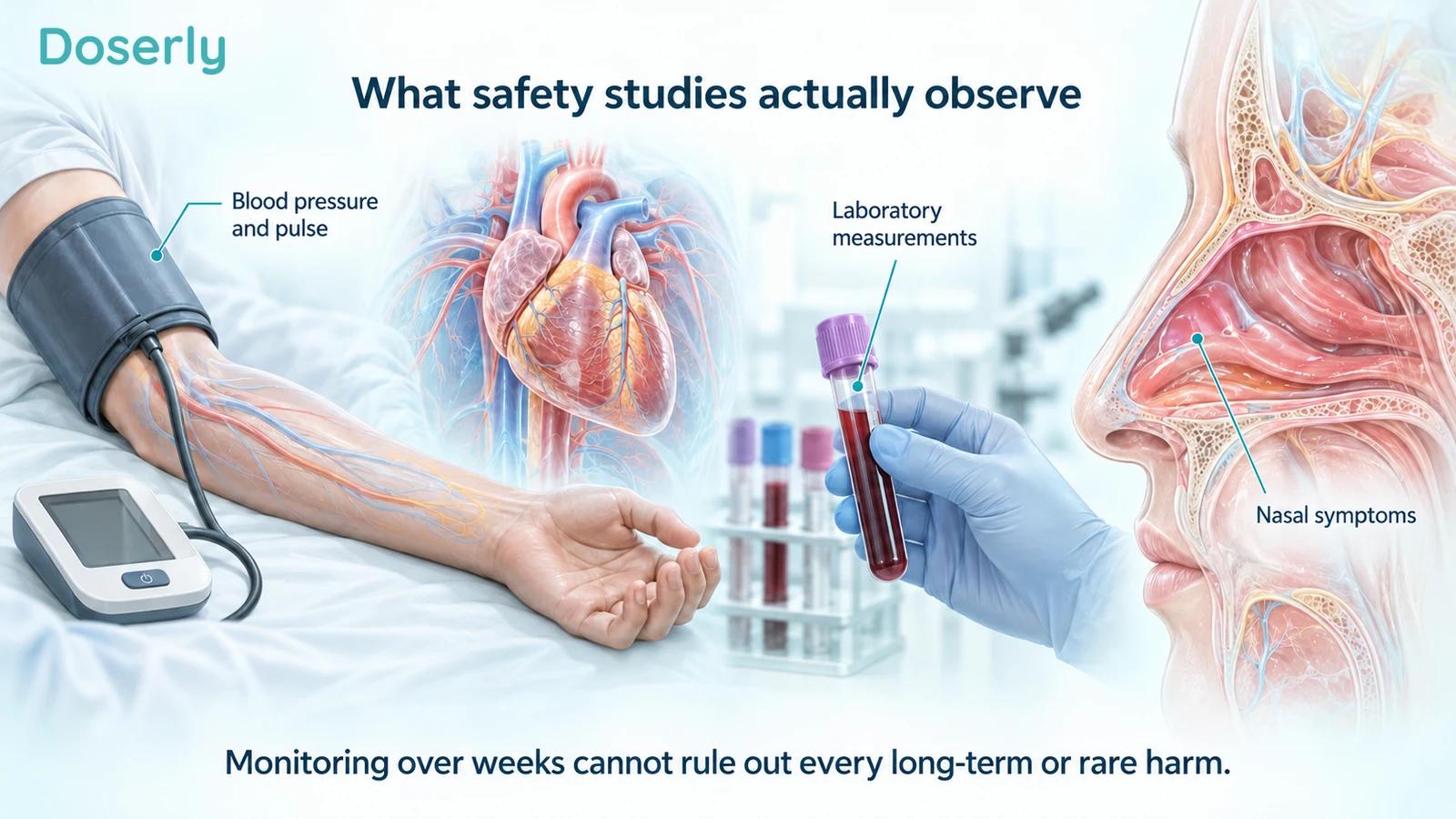
Researchers checked heart rate, blood pressure, urine osmolality—a measure of urine concentration—and blood metabolic markers. They also collected adverse events. Oxytocin did not significantly change these measured safety outcomes or increase the number or severity of reported events relative to placebo. Events were generally mild and uncommon. One oxytocin participant and two placebo participants withdrew because of adverse events. Older-men safety trial.
This supports tolerability under the conditions studied. The participant selection is part of that conclusion: generally healthy older men are not the same population as pregnant people, children, or adults with complex medical conditions.
Four weeks is also a defined observation window. It cannot answer what happens with years of repeated use or a different preparation. Keeping those boundaries visible preserves the reassurance the study provides without extending it beyond its design.
What the larger pediatric trial adds
The SOARS-B trial studied intranasal oxytocin for 24 weeks in 290 children and adolescents aged 3–17 years with autism spectrum disorder. The incidence and severity of adverse events were similar between groups. Its main social-function outcome did not show a significant treatment benefit. SOARS-B primary report.
This was more informative about repeated exposure than a one-session experiment. It also involved clinical screening and ongoing oversight; publisher methods describe laboratory and other safety assessments. A monitored trial is different from assuming that absence of a complaint during unsupervised use proves safety.
The efficacy result matters alongside tolerability. A treatment can be reasonably tolerated in a study and still fail to provide the benefit being sought. If benefit is uncertain, even modest inconvenience or unwanted effects can change the balance.
The trial does not establish a general pediatric wellness use. Its participants had a defined diagnosis, and it tested a particular treatment approach within a research program. Nor should findings in this group be used to imply that autism itself represents an oxytocin deficiency requiring replacement.
A reported symptom is not automatically a drug effect
A smaller crossover trial in 31 young children with autism reported thirst, urination and constipation among common adverse events. The nasal preparation was described as generally well tolerated. Pediatric crossover study.
An adverse event is an unwanted health occurrence during a study. It is not automatically a proven adverse reaction caused by the treatment. Symptoms can occur because of underlying conditions, unrelated illnesses, other medicines or chance.
That is why the placebo comparison matters. Researchers ask whether events occur more often, are more severe, or have a different pattern with active treatment. Individual timing can be suggestive, but an event after a dose does not by itself establish causation.
The reverse mistake is also possible: if a symptom isn't statistically more common in a small study, it doesn't become irrelevant. A participant still needs appropriate assessment. Statistical uncertainty and an individual's need for care are different questions.
What the obesity studies observed
An eight-week trial in 61 adults with obesity reported no serious adverse events and similar overall adverse-event incidence and severity between groups. The detailed report described nasal discomfort in six oxytocin participants and two placebo participants. Obesity trial.
Those counts are worth recording without turning them into a precise estimate for every product. The study was small, and a local symptom can depend on the solution, delivery device and repeated contact with the nasal lining as well as the active ingredient.
A separate pilot in hypothalamic obesity randomized 13 participants and monitored symptoms, heart rate, blood pressure and electrocardiographic measures. Some prolonged QTc findings were present before treatment or across both conditions. Overall tolerability was similar between oxytocin and placebo. Hypothalamic-obesity pilot.
That detail prevents a misleading summary that assigns every abnormal cardiac measurement to oxytocin. It also shows why baseline assessment is useful: without knowing what was present before exposure, interpretation becomes much harder.
Neither obesity trial established a significant weight benefit. Safety findings should be discussed with that efficacy result, not used alone to imply that treatment is worthwhile.
Why “no serious events” cannot rule out rare harm
A trial can only observe the people enrolled for the period they are followed. If an unwanted effect is uncommon, a study with a few dozen participants may see none even if the effect is real.
The same applies to delayed effects. A four-week study cannot directly observe an event that generally appears after much longer exposure. Researchers can investigate plausible risks and collect follow-up, but the duration still limits the answer.
“No serious adverse events were reported” is therefore a factual description of an observed sample. It is not equivalent to “serious adverse events are impossible.” The distinction should remain visible even when a paper's conclusion uses reassuring language.
Larger studies also have limits. They improve the opportunity to detect some problems but still may exclude people with particular illnesses, interacting medicines or pregnancy. A broad safety claim needs evidence that matches the population being addressed.
Pregnancy deserves its own question
The Swiss professional information for Syntocinon nasal spray lists pregnancy as a contraindication. That is particularly relevant when a product is being presented as a familiar or naturally occurring hormone. Official nasal-product information.
This is product- and jurisdiction-specific information. It should not be confused with oxytocin's use during professionally managed childbirth, where the intended effect and monitoring are different.
The same professional information discusses water intoxication and low sodium in the context of prolonged high-dose intravenous exposure combined with excessive fluid intake. It would be inaccurate to present that as a measured complication rate from ordinary nasal research. It would also be inaccurate to erase the warning because oxytocin is endogenous.
If pregnancy is possible or planned, a clinician needs to know before any proposed use. Changing the route or calling a product “wellness” doesn't remove the need to evaluate that context.
Product quality creates a separate layer of uncertainty
A clinical trial studies a defined preparation. An online vial or compounded spray may differ in concentration, ingredients, manufacturing controls and delivery. Even an accurate account of a trial cannot certify the quality of an unrelated product.
FDA explains that compounded drugs are not FDA-approved and do not undergo the same premarket review for safety, effectiveness and quality. It identifies contamination and too much or too little active ingredient as examples of potential quality failures. Compounding can still meet legitimate patient needs when an appropriate approved option cannot. FDA compounding explanation.
This separates two questions: whether the molecule has a favorable benefit-risk profile for a use, and whether the particular preparation reliably contains what it should. Evidence for one cannot substitute for the other.
A certificate describing chemical purity would not, by itself, demonstrate a clinical benefit or settle every formulation and microbiological-quality question. Those claims require their own evidence.
Making safety discussions more concrete
A useful record identifies the exact product, route, dates of exposure, other medicines and symptoms. If someone simply records “oxytocin,” important differences between an infusion, nasal preparation and another product disappear.
Timing can help a clinician evaluate a possible reaction, especially when several things changed at once. But repeatedly trying a product to reproduce a symptom is not a substitute for professional assessment. A serious or rapidly worsening symptom needs attention rather than another informal test.
Ask which safety findings apply to your circumstances, which people were excluded from the supporting research, and how long participants were followed. Also ask what benefit would justify the exposure and what would lead to stopping or changing the plan.
The available studies provide useful short-term tolerability information for selected populations. They do not turn a familiar hormone into a universally benign product. The oxytocin guide brings these findings together with the evidence for different intended uses.
Sources
- Older-men safety trial, 2021.
- SOARS-B pediatric trial, 2021.
- Young-children crossover trial, 2016.
- Adult obesity trial, 2024.
- Hypothalamic-obesity pilot, 2023.
- Swiss Syntocinon professional product information.
- FDA compounding questions and answers.