
Peptides
October 16, 2026
Why kisspeptin's libido research does not establish a universal aphrodisiac
On this page
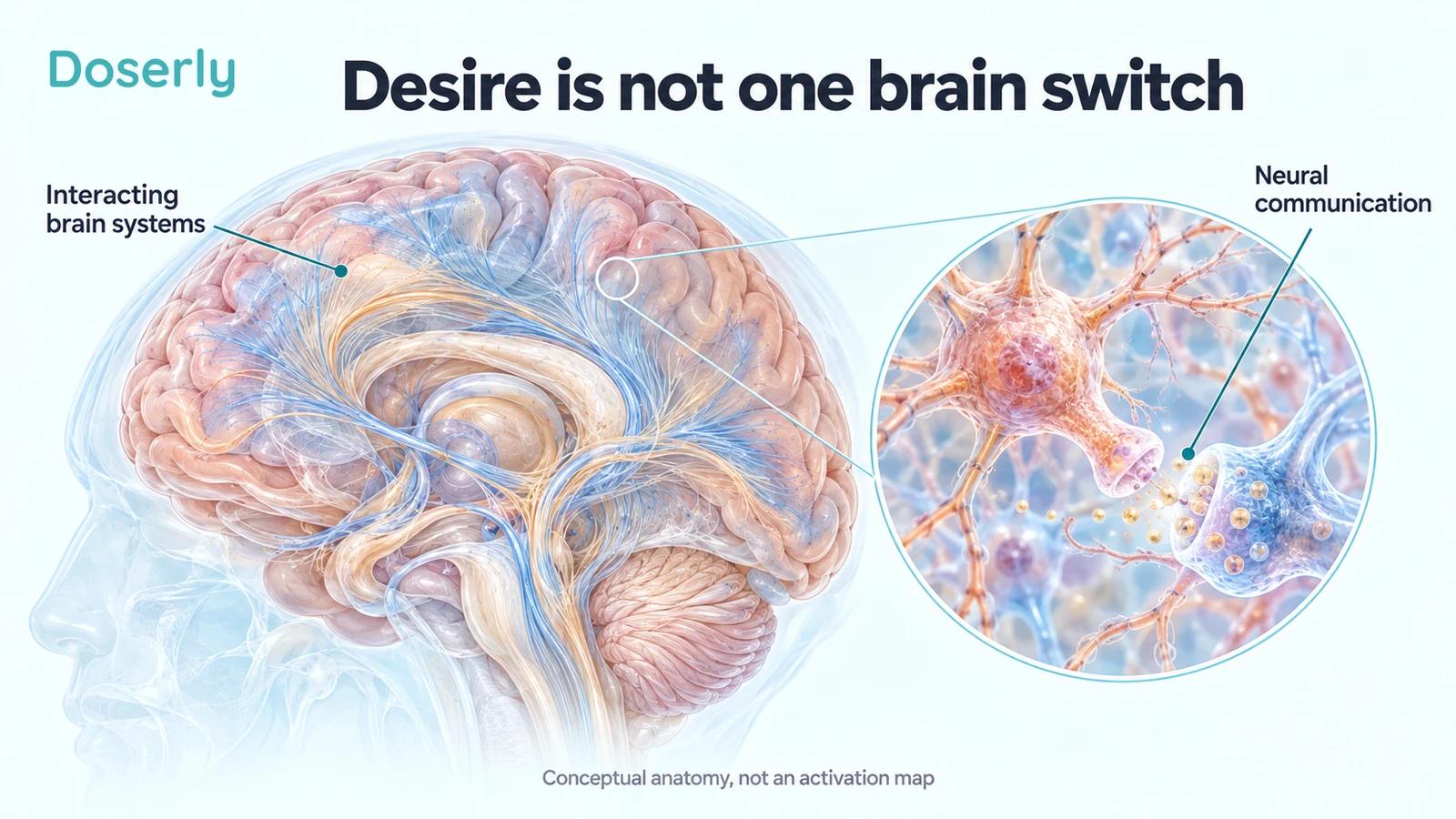
Sexual desire is not a single switch. It involves interest, attention, bodily responses, emotional context and the meaning a person gives to an experience. A promising finding in one part of that system can be important without predicting what everyone will feel.
Kisspeptin research offers a useful example. Controlled human studies have found changes in brain responses to sexual stimuli, and one study in men found an increased physiological arousal response. These findings support further investigation of kisspeptin-54 for people with distressing low desire. They do not establish a substance that reliably increases desire in everyone, in every setting or with repeated use. Women's trial; men's trial
The most helpful way to read the research is to ask whose problem the study was trying to address. A treatment for a defined disorder, an experiment in healthy volunteers and a general enhancement claim are three different things.
Lower desire is not automatically a disorder
People differ in how often they want sexual activity and in the circumstances that make it appealing. A lower level of interest than a partner's, a friend's or an imagined average does not by itself establish a medical problem.
Hypoactive sexual desire disorder, usually shortened to HSDD, concerns persistently reduced desire accompanied by distress. Professional guidance emphasizes assessment of the person's history and circumstances, using a biopsychosocial approach: biological, psychological and social contributors are considered together. ISSWSH expert consensus
That is different from treating every variation in sexual interest as a hormone deficiency. Some people want help with a distressing change; others are comfortable with their level of desire. The relevant goal is the person's own wellbeing, not meeting someone else's preferred frequency of sex.
A treatment claim should therefore identify both the population and the problem. “Studied in people with HSDD” cannot be shortened to “works for anyone with low libido” without losing clinically important information. It also cannot become a promise of enhancement in people who do not have the studied condition.
Desire, arousal and satisfaction are related but distinct
Desire describes interest or motivation. Arousal includes subjective excitement and physiological responses. Satisfaction concerns how someone experiences and evaluates sexual activity. Distress describes how troubling the problem is to them.
These dimensions can move together, but a study should not assume that they always do. A genital response during a laboratory task is not a direct measurement of wanting sex in daily life. A change in brain activity is not a readout of personal satisfaction. An answer to one question does not capture a whole relationship or a sustained change in wellbeing.
Consent is another distinct matter. It is an informed, voluntary decision, not something that can be inferred from a bodily response, a scan or the use of a substance. Research about arousal provides no basis for assuming that someone wants sexual contact.
These distinctions are not reasons to dismiss physiological measurements. They are reasons to describe them accurately. A promising treatment program can investigate several levels of outcome, while remaining clear about which ones have actually improved.
What the early healthy-volunteer study contributed
A 2017 experiment investigated kisspeptin-54 in healthy young heterosexual men. Twenty-nine participants were included in the analysis after exclusions for excessive movement during imaging. The study examined brain responses to sexual and emotional material during controlled infusion visits.
Kisspeptin altered activity in relevant brain networks and produced associations with some measures of sexual and emotional processing. However, the study did not show a general improvement across the sexual-arousal questionnaire domains. It was an investigation of mechanism in healthy volunteers, not a trial of daily treatment for a diagnosed desire disorder. Primary report
This distinction matters because a mechanistic finding can motivate a clinical trial without already supplying its answer. It can suggest where to look and what to measure. It cannot establish that the same intervention will produce lasting benefits in a different group of people.
What the HSDD trials added
A 2022 randomized crossover trial recruited premenopausal heterosexual women with HSDD. Forty were randomized and 32 completed both visits. Each received kisspeptin-54 and placebo on separate visits, with brain imaging during sexual and attraction-related tasks.
A 2023 trial used a similar crossover approach in men with HSDD; 37 were randomized and 32 completed both visits. It assessed brain responses and also measured penile tumescence, a physiological change associated with arousal. Both experiments involved brief, monitored infusions. Women's trial; men's trial
The studies found changes in sexual-stimulus processing. The men's study also found increased tumescence, while selected questionnaire items changed in both studies. These were encouraging signals, but they were not equivalent to a broad improvement across the full sexual-arousal questionnaire. The experiments did not measure months of everyday treatment benefit.
The widely repeated “up to 56%” figure from the men's study referred to a tumescence comparison at the end of an eight-minute video task. It was not a 56% improvement in libido, a 56% treatment success rate or a result experienced identically by every participant. Keeping the original outcome attached to the number prevents a physiological finding from becoming an unsupported promise.
Who was not represented by those results?
The women's trial studied premenopausal participants under controlled cycle-timing conditions. It does not establish the same effect after menopause, during pregnancy or during postpartum recovery. Those circumstances can involve different hormonal and practical contributors to sexual concerns.
The men's study involved eugonadal participants, meaning their testosterone status met the study's normal-range criteria. It excluded important alternative explanations, including underlying erectile dysfunction and active depression. Its results therefore cannot be assumed to describe men whose main problem is one of those conditions. Men's eligibility criteria
The trials also enrolled heterosexual participants and used selected sexual stimuli. They do not establish equivalent responses across sexual orientations, gender identities or every kind of sexual context. Underrepresentation is a limitation of the evidence, not evidence that an unstudied group cannot benefit.
These boundaries matter in both directions. It is inaccurate to claim universal effectiveness, and it is also inaccurate to infer universal ineffectiveness outside the studied groups. The honest conclusion is that those questions require appropriately inclusive research.
Standardized stimuli improve control but narrow the setting
A laboratory experiment needs consistency. Showing selected videos under controlled conditions helps researchers compare responses between treatment and placebo visits. Randomizing the order and having participants serve as their own controls can reduce some sources of variation.
Daily sexual experience is less standardized. Interest can depend on a partner, privacy, fatigue, trust, pain, timing and whether someone feels pressured. A stimulus used in a scanner may not resemble what a person finds appealing or meaningful in ordinary life.
A treatment could alter processing during a task without changing those circumstances. Conversely, a person might experience a worthwhile daily benefit that a particular laboratory task does not capture well. That is why later trials need outcomes outside the scanner as well as a sound physiological rationale.
The research setting is not a flaw to be apologized for. It is a deliberate way to answer an early question. The problem begins when a result from that setting is presented as if the everyday treatment question has already been answered.
Low desire can have several contributing causes
NHS guidance lists relationship difficulties, stress, anxiety, depression, sexual problems, some medicines and long-term health conditions among possible contributors to low desire. Changes around pregnancy, caring for a baby and menopause may also be relevant. Treatment depends on the cause. NHS guidance
That range of possibilities explains why a universal aphrodisiac claim is so demanding. An intervention that influences one neural pathway is not automatically a solution for pain during sex, a medication effect, exhaustion or an unsafe relationship. Several contributors can also coexist.
For someone seeking help, understanding those contributors can change the treatment goal. The priority might be reducing discomfort, reviewing a medicine, addressing mental health or improving communication. These possibilities do not make a biological treatment irrelevant; they help determine what benefit would actually be useful.
A person should not stop a prescribed medicine because a general article lists it as a possible contributor. A clinician can assess the timing, other explanations and appropriate options. The aim is to investigate the concern without creating a new problem through an unplanned treatment change.

Why a testosterone explanation is too simple
Kisspeptin participates in reproductive hormone signaling, which can make it tempting to explain every sexual response as a testosterone effect. Yet the brief HSDD experiments were designed to examine responses during a period without a significant testosterone change.
In the men's trial, the observed brain and tumescence findings were not accompanied by a significant testosterone increase during the study window. In the women's trial, sex-steroid measurements likewise did not establish an acute testosterone-driven explanation. Men's report; women's report
That does not prove precisely how every observed effect arose. It does show why “kisspeptin raises testosterone, therefore it increases desire” is not an adequate description of these experiments. The mechanism under investigation is more specific than a generic hormone-boosting claim.
The peptide form also matters. These desire trials used kisspeptin-54. Their findings should not be transferred automatically to kisspeptin-10 or to a preparation described only as kisspeptin. The kisspeptin guide explains the related forms and their separate evidence.
What would make a stronger treatment claim possible?
A useful next step would test repeated treatment over a meaningful period in people with a clearly defined clinical concern. It would assess changes that matter to participants: desire in ordinary life, distress, satisfaction and the ability to pursue their own sexual goals.
Such a trial should report average changes and how many people experienced a meaningful improvement. It should also describe people who stopped treatment, experienced adverse effects or did not benefit. A favorable average is easier to interpret when the range of experiences is visible.
Safety requires more than the absence of reported side effects during a short infusion visit. Repeated exposure, interactions, tolerability and longer-term outcomes need appropriate study. The reassuring acute experience in these small trials cannot answer all of those questions.
More representative recruitment would also help establish who the findings apply to. That includes testing relevant age groups, hormonal circumstances and sexual contexts, rather than assuming that one narrowly selected sample represents everyone.
Keeping the promise proportional to the evidence
Kisspeptin's desire research is interesting because it connects reproductive signaling with brain processing and carefully measured physiological responses. It gives researchers a credible direction to pursue for people troubled by low desire.
For a reader, the most useful questions are specific: was this the same clinical problem, the same peptide form and the same kind of outcome? Did the study measure a brief response to a video, or a lasting improvement in daily wellbeing? Did participants feel meaningfully better, and for how long?
A universal aphrodisiac claim skips those questions. A careful interpretation keeps them visible. The studies support further clinical investigation of kisspeptin-54; they do not promise desire on demand or define how much desire a person ought to have. For more on the evidence, see the kisspeptin research guide.
Explore the research
- Healthy-volunteer sexual and emotional processing study, 2017
- Randomized trial in women with HSDD, 2022
- Randomized trial in men with HSDD, 2023
- ISSWSH consensus on HSDD assessment
- NHS guidance on low desire and possible causes