
TRT
October 16, 2026
When a TRT Study Reports “No Significant Difference”: What Does That Mean?
On this page
“No significant difference” is one of the easiest research phrases to overread. In a testosterone study, it may become “TRT does nothing,” “both options are identical,” or “there is no risk.” None of those conclusions follows automatically.
The phrase usually means a particular statistical analysis did not cross its chosen threshold for detecting a difference. To understand what the study actually learned, you also need the size of the observed difference, its uncertainty, the outcome measured and the question the trial was designed to answer.
This is not a reason to dismiss disappointing results. A well-designed study that fails to demonstrate the promised benefit deserves attention. The goal is to give a negative result its proper weight without making it answer a question it never tested.
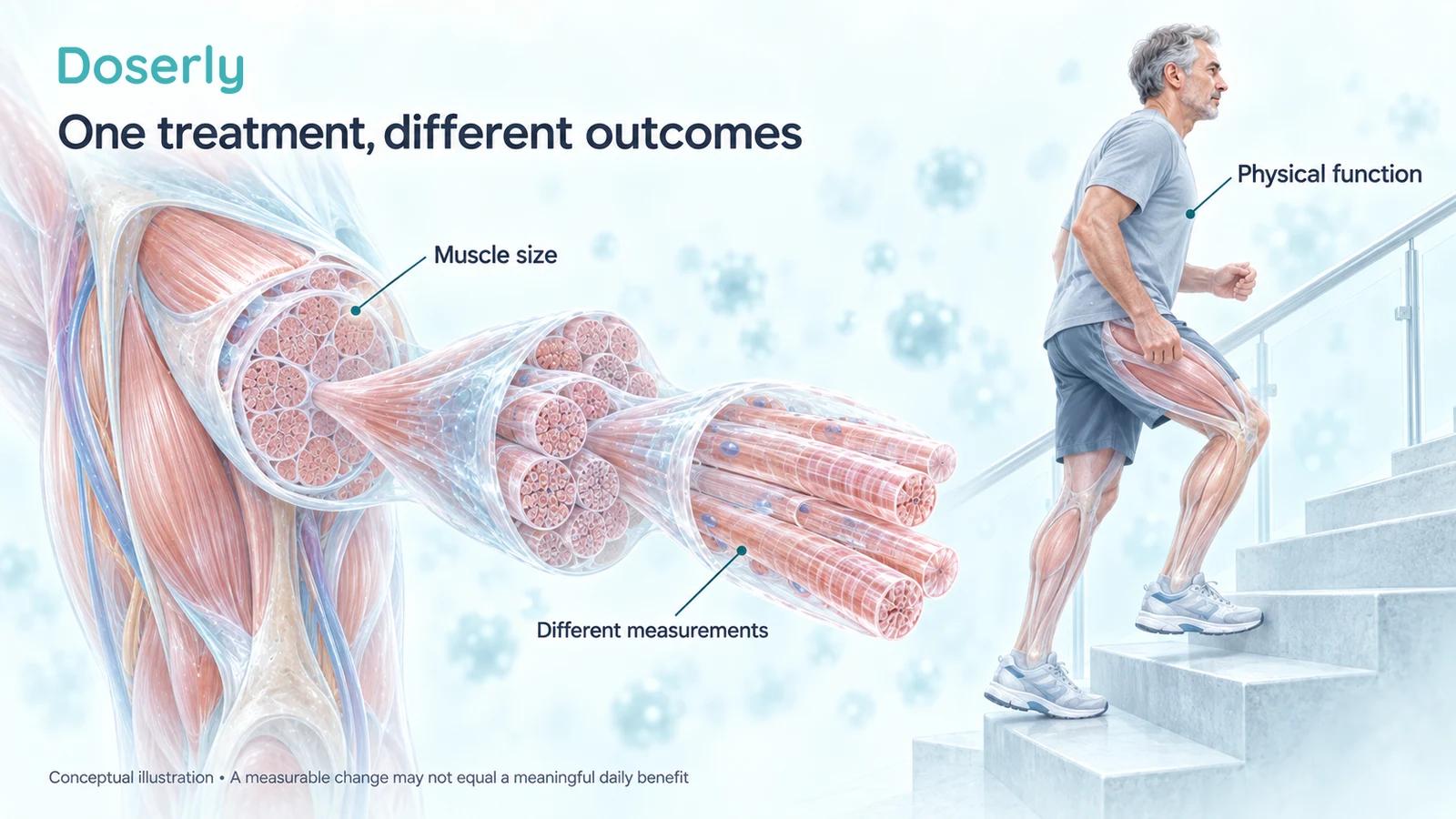
Start with the comparison hidden inside the sentence
A result is not simply “significant” or “not significant” for testosterone as a whole. It concerns a defined comparison: for example, the change in a fatigue score with testosterone gel versus the change with placebo over a particular period.
That wording contains several boundaries. It identifies the treatment, comparator, outcome and follow-up. Remove any of them and the headline can become much broader than the evidence.
Before looking at the P value, complete this sentence: “In these participants, this treatment was compared with this alternative for this outcome over this duration.” If the article does not supply those details, the missing information matters more than whether the headline sounds positive or negative.
A trial measuring blood testosterone concentrations answers a different question from one measuring sexual desire. A study of heart attacks cannot stand in for a fertility study. Those distinctions remain true even when every analysis is statistically impeccable.
What the P value does—and does not—say
A P value describes how incompatible the observed data are with a specified statistical model, under that model's assumptions. It is not the probability that the treatment works, that the result happened “by chance,” or that the no-difference hypothesis is true.
The American Statistical Association also emphasizes that a P value does not measure an effect's size or clinical importance. A tiny difference can cross a statistical threshold in a sufficiently precise study; an important possible difference can remain uncertain in a small study. ASA statement
For a reader, the practical consequence is straightforward: a threshold is one part of the result. It cannot replace the result's magnitude, study quality or relevance to the patient's concern.
Two papers on opposite sides of the conventional 0.05 threshold may therefore tell quite similar stories. Treating one as a discovery and the other as proof of nothing can create a false disagreement.
Uncertainty tells you what remains unresolved
A confidence interval adds information about the precision of an estimate. A wide interval may be compatible with effects that would lead to very different clinical decisions. A narrow interval around little or no difference may provide stronger evidence against a large benefit.
This is why failing to detect a difference is not the same as showing two treatments equivalent. Altman and Bland's original statistical explanation highlights how an imprecise, nonsignificant result can leave clinically important effects unresolved. Original BMJ explanation
Consider a hypothetical symptom scale, not data from a TRT trial. If the estimated difference is small but the uncertainty spans substantial improvement and substantial worsening, the result is inconclusive for that decision. If the plausible range is tightly concentrated around a negligible difference, it is more informative against a large average effect.
The interval still depends on the analysis and its assumptions. It is not a promise about what will happen to a particular patient.
A real example: fatigue in the Testosterone Trials
The Testosterone Trials enrolled 790 men aged 65 or older with low testosterone. Participants received testosterone gel or placebo for one year. In the Vitality Trial, the primary outcome was a specified improvement on a fatigue scale; testosterone did not significantly improve that endpoint compared with placebo. Some secondary measures showed small favorable differences. Testosterone Trials
Two interpretations go too far. “Testosterone can never help anyone who feels tired” generalizes beyond the participants and endpoint. “The study proved testosterone fixes fatigue” promotes secondary findings over the primary result.
A more faithful reading is that this trial did not demonstrate the prespecified primary vitality benefit in these older men. That is clinically useful information, particularly when fatigue relief is the main expectation driving a treatment decision.
It also suggests a concrete appointment question: if energy is the goal, what improvement would count as meaningful, and what will happen if testosterone normalizes but the symptom persists?
A small acute experiment answers a smaller question
Another randomized study tested a single mixed-testosterone-ester injection in healthy, recreationally active young men. Nineteen were randomized, with 18 completing post-treatment assessment. Testosterone increased, but measured strength and power did not clearly improve at 24 hours. Acute strength study
This is evidence against assuming that a rapid hormone increase must produce an immediate performance benefit. It is not a test of months of replacement treatment in men with established hypogonadism.
The study's size and duration both matter. Calling it small does not erase its observations; calling it randomized does not expand its scope. Its useful contribution is narrow: the biochemical change and the measured immediate performance change did not move together as a simple “more hormone, more strength” story predicts.
The general lesson is to keep the time window in the conclusion. “No benefit at 24 hours” should not become “no benefit at any time.”
Noninferiority is a different kind of question
Some trials are designed to test whether a treatment is not unacceptably worse than a comparator by a prespecified margin. This is called noninferiority. It is different from testing whether a treatment is better, and different again from establishing equivalence within defined bounds.
Reporting guidance requires interpreting the result against the planned margin and hypothesis. A nonsignificant superiority test cannot simply be relabeled a successful noninferiority trial after the fact. CONSORT extension
TRAVERSE illustrates the distinction. Its primary cardiovascular outcome occurred in 7.0% of the testosterone group and 7.3% of the placebo group. The hazard ratio was 0.96, with a 95% confidence interval of 0.78 to 1.17. The upper limit was below the trial's prespecified noninferiority boundary of 1.5, satisfying that criterion. TRAVERSE
The small P value reported for noninferiority does not mean testosterone prevented cardiovascular events. It supports the trial's particular noninferiority conclusion. The interval also crosses 1, so this result does not establish superiority for reducing that composite outcome.
A favorable primary result does not settle every safety question
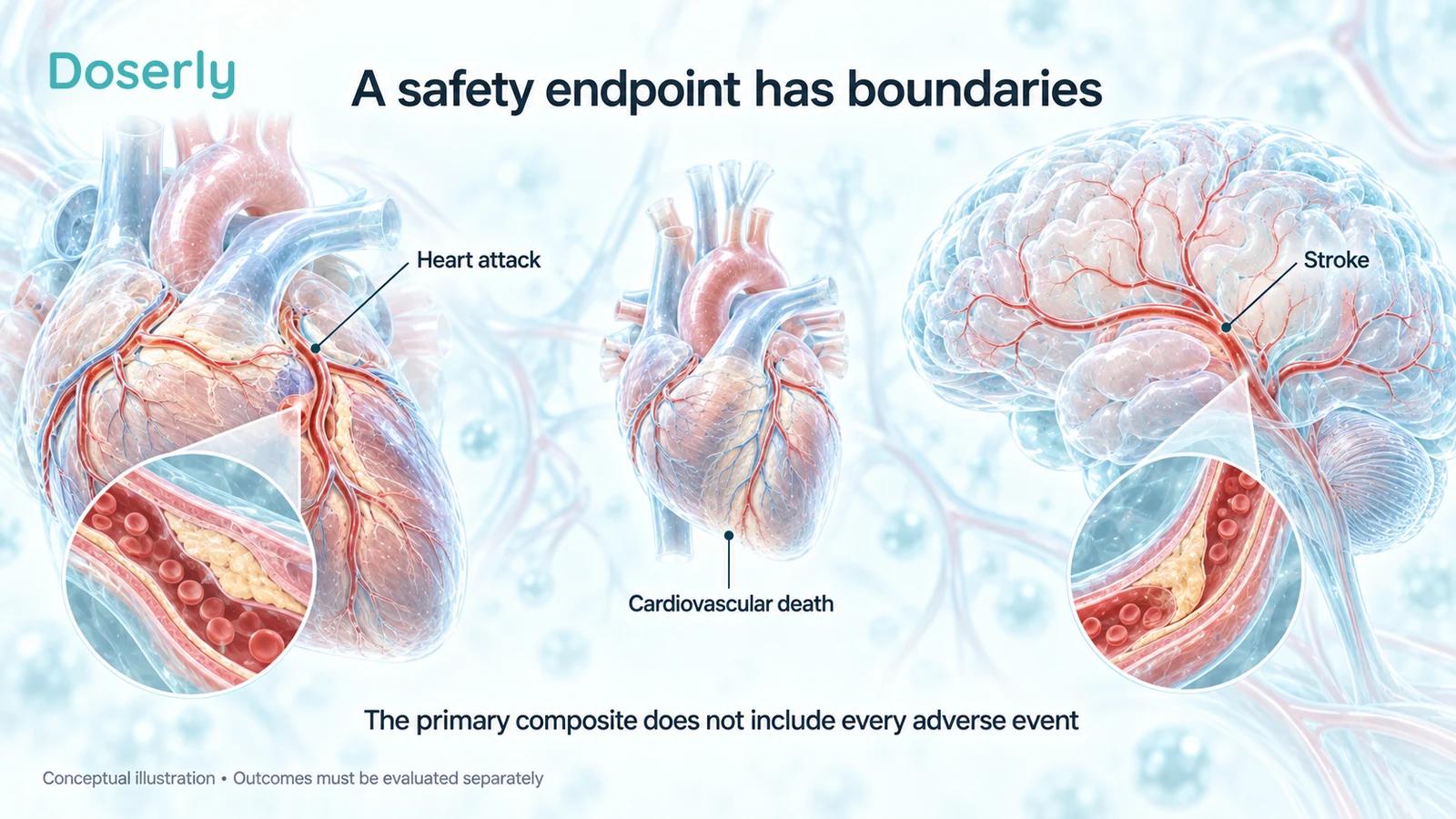
TRAVERSE enrolled men aged 45 to 80 with hypogonadism and cardiovascular disease or elevated cardiovascular risk, using testosterone gel. It observed higher incidences of atrial fibrillation, acute kidney injury and pulmonary embolism with testosterone. Those findings belong in the discussion alongside the primary result. TRAVERSE
The TRAVERSE guide provides more background on the population and endpoints. The important reading habit is to name the safety outcome rather than compressing the entire study into “safe” or “unsafe.”
A composite combines selected events for analysis. It does not convert unmeasured outcomes into reassuring findings, and it does not guarantee that every component or secondary event behaves identically.
“No events observed” has its own limitation
A 2026 randomized trial enrolled 136 carefully selected men with hypogonadism after radical prostatectomy for low-grade, organ-confined prostate cancer. Participants had undetectable PSA for at least two years. During a short trial with 12 weeks of treatment, no participant in either group experienced biochemical recurrence. Prostate-cancer survivor trial
The authors explicitly state that the study was too small and too short to evaluate long-term safety or clinical recurrence. Zero observed events does not demonstrate a zero underlying risk, particularly for an outcome that may emerge over a longer period.
That result is still worth reporting. It describes what happened in a defined group during a defined observation period. The error occurs when the time and population limits disappear from the claim.
This distinction is especially consequential in cancer survivorship, where a short-term symptom benefit and a long-term recurrence question require different evidence.
Statistical improvement may not answer the patient's question
A randomized trial in young male cancer survivors found that testosterone improved body composition but did not improve measured quality of life. It is possible for both findings to be correct because they concern different outcomes. Cancer-survivor trial
Imagine someone considering treatment mainly to feel less exhausted during work. A favorable lean-mass measurement would not, by itself, establish that the desired daily benefit occurred. Conversely, the absence of a quality-of-life effect does not mean the body-composition finding was imaginary.
This is a useful defense against selecting whichever endpoint fits a preferred conclusion. Ask which result motivated the trial, which result matters to the patient, and whether they are the same.
The same principle applies to personal monitoring. A blood result and a symptom record serve different purposes; the blood-work guide explains why laboratory timing and interpretation need their own context.
Improvement within one group is not the treatment comparison
A common reading mistake happens before the significance question even begins: people notice that participants improved after testosterone and assume the treatment caused the improvement.
Consider a hypothetical trial in which symptom scores improve in both the testosterone and placebo groups. The treatment question concerns the difference between those groups, under the trial's analysis, rather than whether one group's final score differs from its starting score. Reporting a favorable before-and-after result alone leaves out the comparison that randomization was intended to make possible.
This matters when a chart shows only the treated participants or when a summary says “men improved on testosterone” without describing the placebo group. The statement may be literally accurate yet insufficient to establish a treatment advantage.
Likewise, a statistically significant change in one group and a nonsignificant change in the other do not, by themselves, establish that the groups differ significantly from each other. Look for the actual between-group analysis. If it is absent from the summary, do not try to reconstruct it by comparing two separate P values. Gelman and Stern
For personal tracking, this is a reason to document other changes—sleep, illness, exercise or additional treatment—alongside symptoms. The record can improve a clinical conversation even though it cannot reproduce a controlled trial.
A practical way to read the next headline
When a TRT story reports no significant difference, look for five details:
- The outcome: What exactly was measured, and was it the primary endpoint?
- The estimate: How large was the observed difference?
- The uncertainty: Does the confidence interval leave important benefit or harm unresolved?
- The design: Was this a superiority, noninferiority or equivalence question?
- The boundaries: Who participated, what treatment did they receive, and for how long?
Then write a one-sentence conclusion that preserves those details. “This study did not demonstrate the specified fatigue benefit over one year in selected older men” is more useful than “TRT failed.”
For your own care, record the treatment goal before judging the response. A dated symptom history, prescribed-treatment record and clinician-directed measurements can make follow-up clearer. Doserly can help organize those observations, but a personal trend is not a randomized comparison and cannot establish causation.
A careful reader can take a negative result seriously while retaining uncertainty. That is how research becomes useful: the conclusion stays proportional to what the study actually measured.
Sources
- ASA statement on statistical significance and P values
- Absence of evidence is not evidence of absence
- CONSORT noninferiority and equivalence reporting guidance
- TRAVERSE
- Testosterone Trials
- Acute strength and power experiment
- Young male cancer-survivor trial
- 2026 prostate-cancer survivor trial
- Gelman and Stern: comparing significance levels