
Supplements
October 16, 2026
B-complex supplements: one bottle, eight separate decisions
On this page
B vitamins help the body use nutrients, maintain cells and carry out reactions needed for normal nerve and blood-cell function. Putting them together in one supplement is convenient. It also means that a decision about one concern—perhaps low B12, a restricted diet or feeling tired—becomes a decision about several ingredients at once.
A B-complex is not one standardized treatment. Two bottles can contain very different amounts and forms, and one may add minerals or herbs that the other doesn't contain. The useful question is not simply whether B vitamins are important. It's whether this combination, at these amounts, fits the reason you're taking it.
Our B-complex guide provides the broader background. Here we'll look at the evidence for common stress and energy claims, the ingredients that deserve special attention, and how to review a combination without losing sight of the original problem.
What is actually in a B-complex?
The eight recognized B vitamins are thiamin (B1), riboflavin (B2), niacin (B3), pantothenic acid (B5), vitamin B6, biotin (B7), folate (B9) and vitamin B12. The missing numbers aren't missing nutrients that a complete bottle must supply. Historical naming changed as researchers learned which substances qualified as vitamins.
Their functions overlap, but they aren't interchangeable. Niacin contributes to coenzymes involved in energy-related reactions. Vitamin B6 supports many enzyme reactions, including amino-acid metabolism. Folate and B12 participate in processes important for normal cell production, and B12 is also important for neurological function. NIH niacin fact sheet, NIH B6 fact sheet, NIH B12 fact sheet
This biological cooperation doesn't establish that all eight need to be supplemented together. A mixed product may be reasonable in a particular nutritional situation, but “they work together” is not a dose-selection method. It doesn't explain why one bottle contains a modest amount of a vitamin and another contains dozens of times as much.
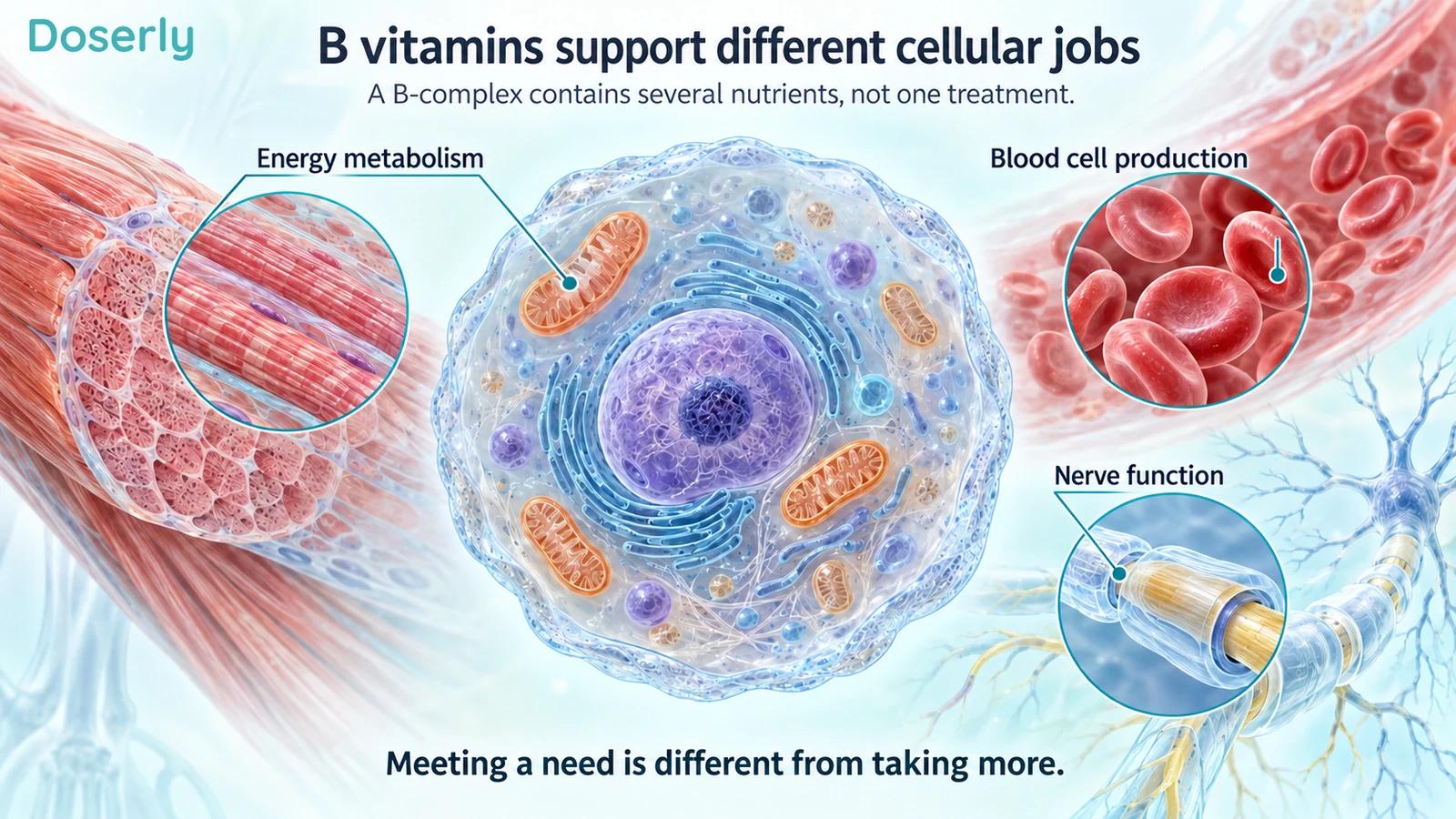
Does helping energy metabolism mean more energy?
A nutrient can be necessary for normal metabolism without acting as a stimulant. If a deficiency is contributing to symptoms, correcting it addresses a real problem. That is different from adding more of the same nutrient when intake and function are already adequate.
Vitamin B12 provides a useful example. Deficiency can cause anemia and neurological problems, and some people have increased risk because of diet, medications or impaired absorption. NIH does not find that B12 supplementation improves energy or endurance in people with adequate B12 status. NIH B12 fact sheet
For a tired reader, the practical implication is to define the problem before choosing a bottle. Does “low energy” mean sleepiness, shortness of breath with activity, low motivation or muscle weakness? Those descriptions are more informative than a general request for an energy vitamin. A B-complex trial cannot substitute for evaluating persistent symptoms, particularly when the cause hasn't been established.
It also helps to separate a nutritional goal from a feeling immediately after taking a tablet. A noticeable sensation is not proof that metabolism was previously impaired. If the product contains ingredients beyond B vitamins, attributing any effect to the vitamin complex becomes even harder.
A confirmed deficiency still needs the right treatment
Even when B12 deficiency is established, choosing any B-complex is not necessarily the next step. The cause matters. Pernicious anemia impairs the stomach's production of intrinsic factor, a protein needed for normal B12 absorption. Gastrointestinal surgery and other absorption problems can also change treatment needs despite an adequate dietary intake. NIH B12 fact sheet
Injections bypass gastrointestinal absorption; sufficiently high oral B12 doses can also work in some circumstances. That decision belongs to the deficiency treatment plan, rather than to a general promise that a combination supports energy. Increasing a B-complex to get more B12 simultaneously increases its other ingredients, including B6 or niacin. A targeted product allows those decisions to be separated. Keep the prescribed replacement plan and follow-up clear before substituting a combination.
What did the work-stress trial find?
A 2011 double-blind randomized trial examined high-dose B-complex supplementation over three months. Sixty participants completed the study. After accounting statistically for personality and work demands, the supplement groups reported less personal strain and improvements in confusion and depressed/dejected mood after 12 weeks. Other mood and anxiety measures did not show treatment-related changes. Stough and colleagues
This is a reason to study nutritional interventions for stress, not a finding that all B-complex products treat an anxiety disorder. The study was small, the results depended on the specific formulations and analyses, and the outcomes concerned participants' reported experience of work-related strain. “Sixty completed” also should not be rewritten as a claim about the number originally randomized.
If a product cites this trial, compare its actual ingredients with what was studied. Even a positive result for one mixture doesn't identify which ingredient contributed, whether every ingredient was necessary or whether larger amounts would improve the result. Those questions require different comparisons.
How does that fit the wider mood evidence?
A 2019 systematic review included 16 trials with 2,015 participants, studying combinations of at least three B vitamins for at least four weeks. Its pooled stress analysis found a small standardized effect, 0.23, with a 95% confidence interval of 0.02–0.45. The pooled results did not establish a significant benefit for depressive symptoms or anxiety. Young and colleagues
A standardized effect combines different questionnaires on a shared scale. It doesn't mean stress fell by 23%, and it doesn't tell you the chance that your particular product will help. Differences in formulations, starting nutritional status and participants limit a simple translation to one shelf product. Some authors disclosed support from the nutrition and supplement industry, which belongs in the context of the findings.
The review supports a restrained possibility of benefit for stress in some circumstances. It doesn't support replacing established mental-health care or assuming that a broadly labeled “stress B-complex” has been clinically tested. The original reader question still matters: which symptom, in which person, with which formulation?
Why vitamin B6 deserves a separate line in your review
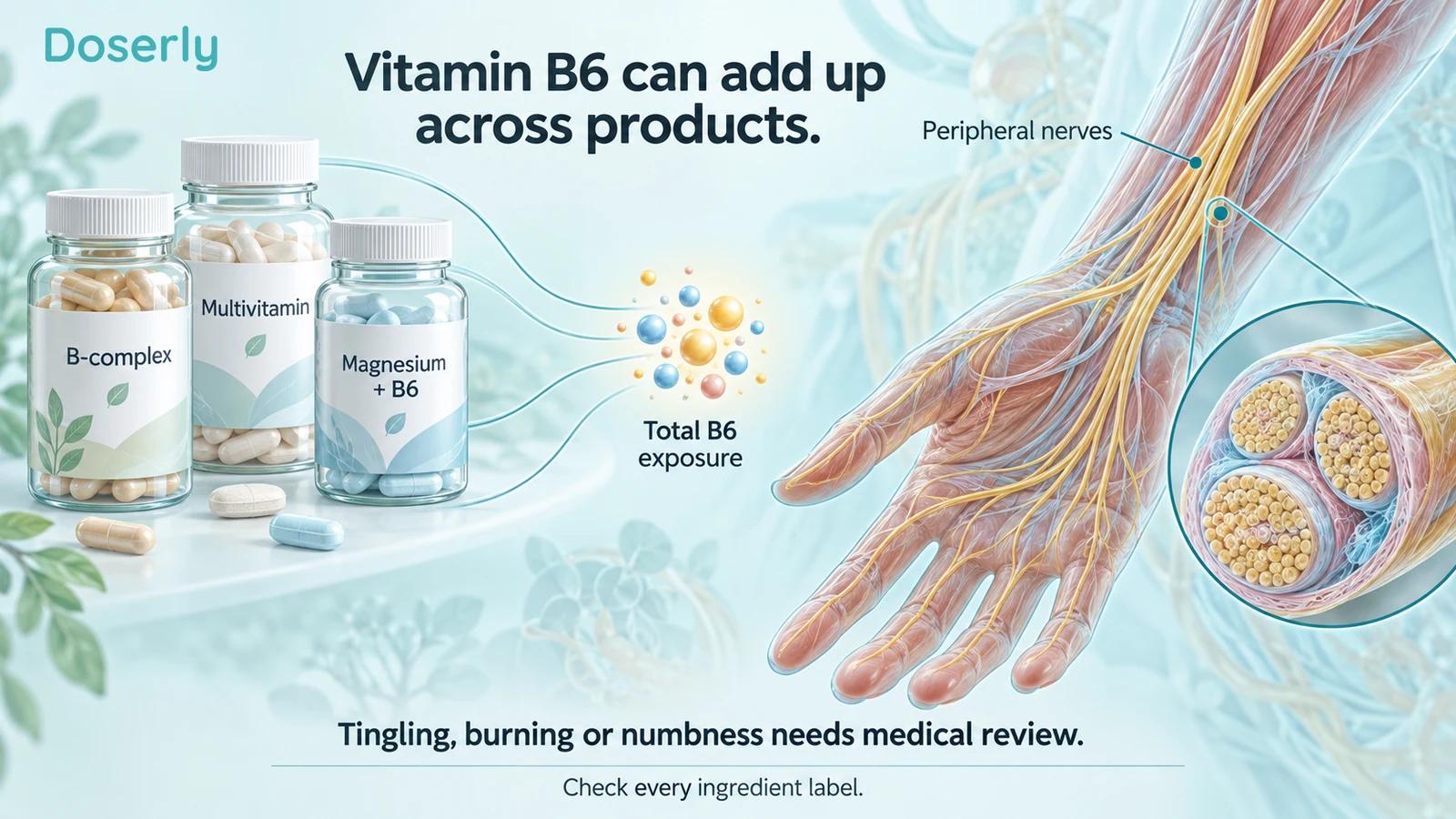
Vitamin B6 is essential, but excessive supplemental exposure can cause peripheral neuropathy: damage or dysfunction involving nerves outside the brain and spinal cord. Symptoms can include tingling, burning or numbness, often noticed in the hands or feet. Australia's Therapeutic Goods Administration has warned about cases involving lower-dose products and people taking more than one supplement containing B6. TGA safety alert
The important label may be on a bottle that doesn't say B-complex on the front. Magnesium combinations, multivitamins and other products can add to the total. Reports of harm do not establish the exact probability for an individual, but they do show why reviewing only the most obvious B-vitamin product can miss relevant exposure.
If tingling, burning or numbness appears while taking a B6-containing supplement, seek medical advice and tell the clinician about every product. TGA advises stopping the product and consulting a health professional when these symptoms occur. Don't assume that a “nerve support” label rules out the supplement as a contributor. TGA safety alert
Upper limits are not daily targets
In its 2023 assessment, the European Food Safety Authority set an adult B6 upper intake level of 12 mg per day, based on peripheral neuropathy evidence and uncertainty about the relationship between amount and duration. The US Food and Nutrition Board's adult upper limit is 100 mg per day. These are different assessments, not two competing recommendations to take those amounts. EFSA scientific opinion, NIH B6 fact sheet
A tolerable upper limit is intended to guide risk management in a population. It is not a guarantee that everyone below it is protected or that everyone above it will develop symptoms. Neither limit tells you whether you need a B6 supplement in the first place.
The discrepancy is a good reason to avoid treating the highest number found online as a safety allowance. A pharmacist can help calculate the actual total and assess whether the product fits your circumstances. Prescribed treatment for a specific condition is a separate decision that should include a reason, monitoring and a review point.
Niacin: the form matters as well as the number
Niacin labels may name nicotinic acid or nicotinamide, also called niacinamide. Nicotinic acid can cause flushing, warmth and itching at supplemental amounts. Higher pharmacological exposures can carry more serious risks, including liver toxicity. Nicotinamide has a different adverse-effect profile; the absence of flushing does not establish that any amount is appropriate. NIH niacin fact sheet
This distinction helps explain why two apparently similar B-complex products can feel different. A flush is not a useful sign that a deficiency has been corrected, and it isn't a necessary step toward getting nutritional benefit. Record the ingredient form when discussing a reaction rather than simply saying “B vitamins made me feel strange.”
Do not borrow a prescription lipid-treatment rationale to justify a high-niacin combination supplement. A medical use at a pharmacological amount requires its own evidence and supervision. The other seven B vitamins don't make that exposure safer merely by sharing the capsule.
Folate and biotin create different issues
High folate intake can improve the anemia associated with B12 deficiency without addressing the underlying neurological problem. That is why an unexplained blood-count change or neurological symptom deserves appropriate assessment instead of simply adding a high-folate product. NIH folate fact sheet
Biotin presents a laboratory issue: enough supplemental biotin can interfere with susceptible assays, producing misleading results. The effect depends on the test method and exposure. Tell the clinician and laboratory about the B-complex before planned testing, including the biotin amount and last dose. NIH biotin fact sheet
These problems are distinct from B6 neuropathy or niacin flushing. A single statement such as “water-soluble vitamins are harmless because excess leaves in urine” fails to account for the different ways an ingredient can matter. The review needs to consider each relevant exposure, not just the category printed on the bottle.
A practical way to review the bottle
Start with the intended benefit in one sentence. For example: “My clinician identified low B12,” or “I'm using this because I feel stressed at work.” The first is a specific nutritional finding; the second is a symptom goal. They lead to different questions about product selection, follow-up and alternatives.
Next, make one list covering everything you take. Use actual servings, not the suggested serving if you take something different. Record the B6 amount, niacin form and amount, folate form and units, B12 content and biotin content. Note any additional ingredients. For a hypothetical example, 10 mg of B6 from one product plus 5 mg from another totals 15 mg from supplements; the arithmetic does not establish whether that combination is suitable.
Then agree on what would count as success. If deficiency is being treated, the clinician may use symptoms and appropriate tests. If the aim is less stress, a dated symptom record can help describe the course, but it cannot prove causation when sleep, workload or other treatments also change.
Finally, decide when the product will be reviewed. Convenience is a legitimate reason to prefer a combination, but it shouldn't make an indefinite regimen automatic. The B-complex guide can help you understand the ingredients; the final choice should remain connected to your actual need.
Sources
- NIH: Vitamin B6.
- NIH: Niacin.
- NIH: Vitamin B12.
- Stough et al., 2011: three-month work-stress trial.
- Young et al., 2019: systematic review of mood outcomes.
- TGA: B6 and peripheral neuropathy.
- EFSA: B6 upper intake level, 2023.
- NIH: Folate.
- NIH: Biotin.