
Peptides
October 16, 2026
What would a convincing BPC-157 tendon trial look like?
On this page
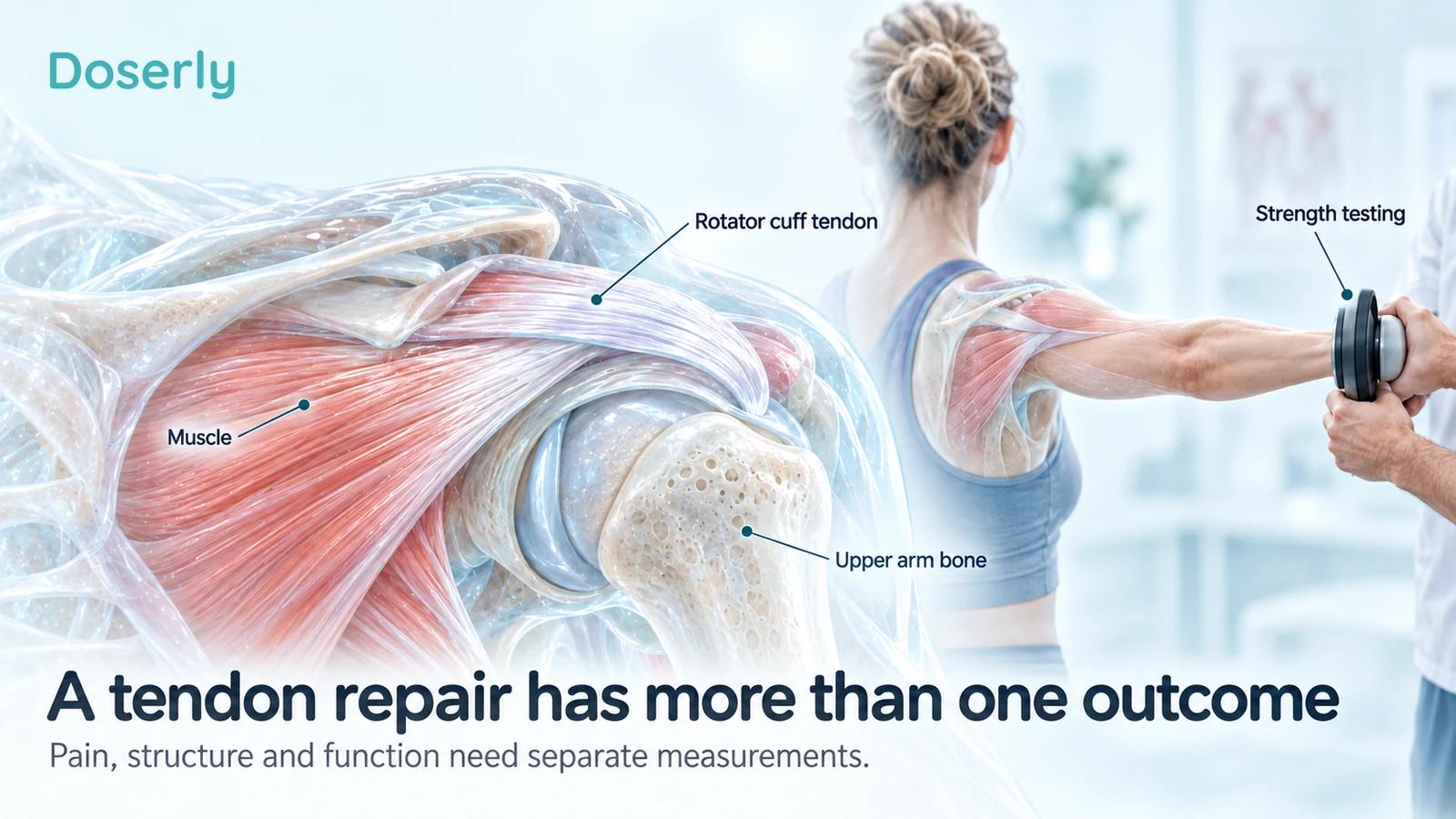
A tendon connects muscle to bone and helps transmit the force needed to move. When one is painful or torn, recovery means more than a lower pain score: you want to lift, walk, work or play sport with enough strength and confidence to use the limb again.
BPC-157 attracts interest because laboratory work suggests effects on cells involved in tissue repair. But a treatment that changes tendon-cell behavior in a dish still needs to show that it helps people recover from a defined injury. A convincing trial would measure whether BPC-157 adds worthwhile benefit to appropriate care, including rehabilitation, while also looking for harms.
There is now a registered study of recovery after rotator cuff repair, but it has no results yet. Its public record also contains a control-group inconsistency worth understanding. The distinction between a promising research plan and a successful treatment trial is especially important when someone is deciding what to do about an injury today.
First, define the injury being treated
“Tendon problems” include several different clinical situations. Persistent load-related pain, an acute tear and recovery after a surgically repaired tear do not start from the same point. A study of one cannot automatically answer the others.
For example, a trial after shoulder surgery would need to describe the repaired tendon, tear size, surgical procedure and timing of the experimental treatment. A study of chronic Achilles pain would instead need a clear clinical definition, symptom duration and baseline loading capacity. Pooling them into a broad “injury recovery” category could conceal important differences.
The 2025 American Academy of Orthopaedic Surgeons guideline discusses rotator cuff management in terms of specific tear characteristics, treatment options and rehabilitation questions. It also distinguishes patient-reported improvement from structural progression. That clinical detail is the background against which an added treatment should be tested. AAOS rotator cuff guideline.
For a reader, the first useful question is therefore simple: was the study about the problem I actually have? A favorable finding in a knee-pain series is not automatically evidence that a repaired shoulder tendon has become stronger.
What the early tendon research contributes
A primary laboratory study examined BPC 157 in rat tendon explants and tendon fibroblasts, cells involved in maintaining connective tissue. It reported effects involving cell outgrowth, migration and survival, with changes in FAK–paxillin signaling, a pathway associated with how cells attach and move. Chang and colleagues, 2011.
That provides a biological reason to investigate recovery. It does not establish a clinical recovery time or prove that a person can safely load a healing tendon sooner. A dish experiment cannot reproduce the complete interaction of surgical fixation, rehabilitation, pain, strength and everyday activity.
A useful human trial would connect the proposed biology with outcomes patients recognize. It could also collect structural or biological measurements to explore how an effect occurs. But the mechanism should support the clinical question, rather than replace it. Our BPC-157 guide explains the broader repair hypotheses.
Why the knee report is not a tendon trial
A 2021 retrospective report reached 16 patients after intra-articular injections for different types of knee pain. Twelve had received BPC 157 alone, and four had received BPC 157 with TB4. Eleven of the 12 in the first group and three of the four in the combination group reported significant improvement. Primary knee-pain report.
These were uncontrolled observations, not randomized comparisons. The groups were small, the diagnoses varied and pain improvement was the focus. The report did not establish tendon healing with a standardized structural and functional assessment.
There are several possible explanations for improvement during such follow-up: the intervention, other care, changes in activity, ordinary recovery, expectations or combinations of these. A comparison group is what helps determine how much improvement would have happened without the experimental treatment. The report is a reason to ask better questions, not a reliable estimate of the benefit a tendon patient should expect.
What the new rotator cuff registration actually says
As checked on October 15, 2026, ClinicalTrials.gov listed the University of Arkansas study, NCT07803250, as not yet recruiting, with an estimated enrollment of 30 and an estimated start in January 2027. It describes a randomized phase 1 study after arthroscopic rotator cuff repair. Trial registration.
The listed primary outcome is shoulder strength, assessed with a handheld dynamometer at baseline, 12 weeks and five months after surgery. The eligibility criteria specify a particular full-thickness rotator cuff tear population, rather than all shoulder pain.
The record contains a material inconsistency: its control-arm description says participants receive saline injections, while the intervention description says the sham group receives neither active treatment nor placebo injections. Although the record lists quadruple masking, that contradiction means the actual control and masking procedures require clarification. Both arms are described as receiving standard postoperative rehabilitation.
These are registered plans, not completed outcomes. The record has no posted results. The discrepancy does not establish that the study is invalid; it means readers should wait for a clarified protocol and eventual report before treating its design as settled.
Rehabilitation needs to be comparable
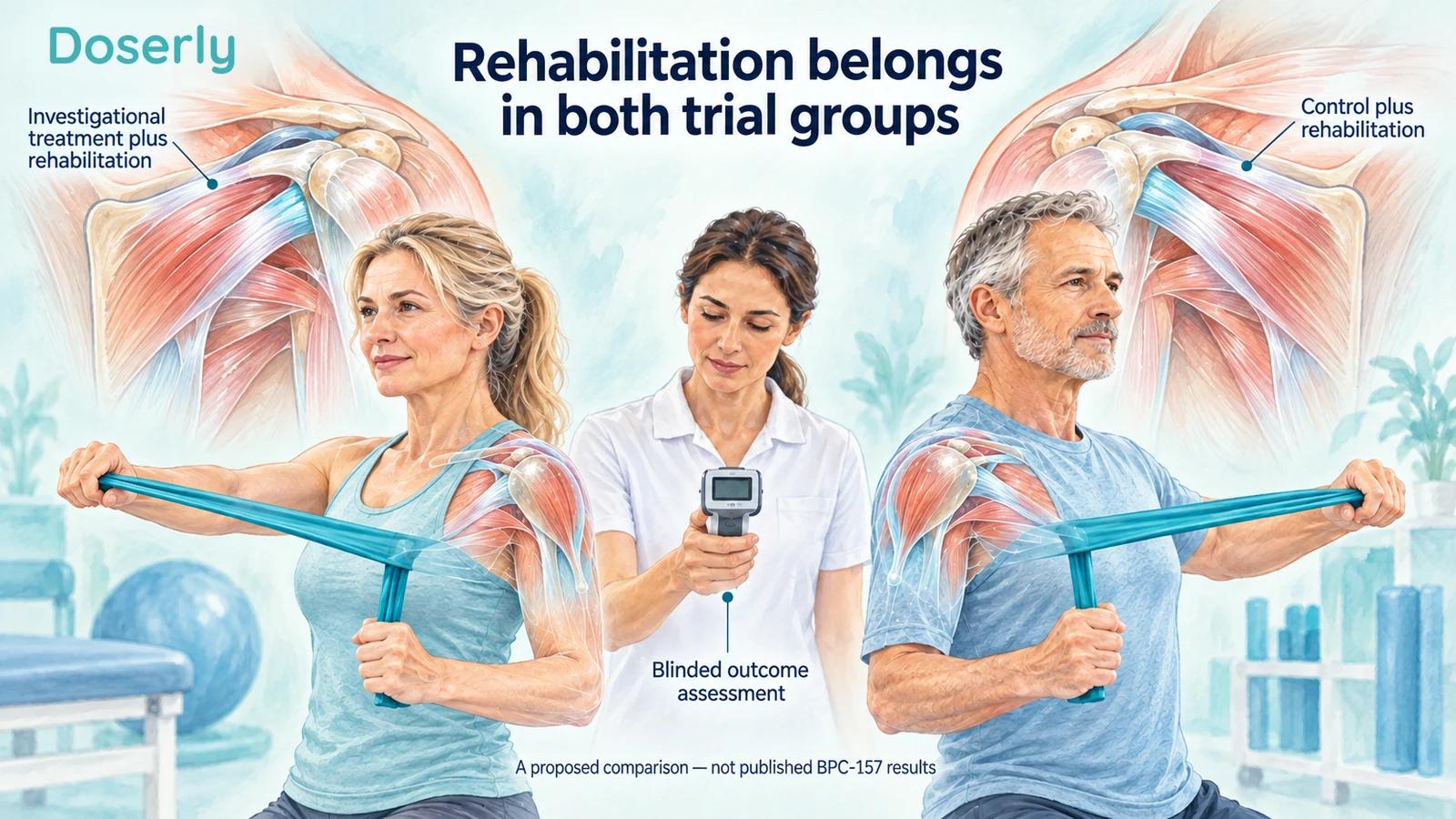
If BPC-157 is added to rehabilitation, the trial should compare it with a control group receiving comparable rehabilitation. Otherwise, a difference in strength might reflect different exercise progression, therapist contact or adherence rather than the peptide.
“Comparable” does not require ignoring individual safety needs. It means the rules governing progression, restrictions and allowed additional care should be clear and applied consistently. Researchers should report how much rehabilitation participants actually completed, not merely what they were prescribed.
Consider a hypothetical shoulder study in which one group receives more supervised sessions. If that group improves more, the trial has tested a package of extra attention and treatment. It cannot isolate the peptide's contribution. The same problem arises if one group resumes demanding activity earlier without a common decision process.
The AAOS guideline addresses postoperative mobilization and supervised versus unsupervised exercise as distinct care questions. An experimental drug study needs enough rehabilitation detail to let clinicians understand the comparison. AAOS guideline.
Pain, function and structural healing answer different questions
Pain relief matters. Someone sleeping better or able to get dressed more comfortably has experienced a meaningful change. But less pain alone does not establish that a torn tendon has healed, that repair strength has increased or that unrestricted sport is safe.
Function concerns what someone can do. It may include a validated questionnaire and physical tasks relevant to the tendon involved. Physical capacity tests can measure strength or endurance under standardized conditions. Participation concerns whether the person returns to work, usual activities or sport, which also depends on opportunity and personal circumstances.
An international consensus study involving professionals and patients identified nine core health-related domains for tendinopathy. These included pain, function, disability, physical capacity, participation and quality of life. Imaging was not accepted as a universal substitute for these domains; its relationship with symptoms can be uncertain. ICON consensus study.
For a repaired tear, imaging may still be a valuable secondary measure when structural healing is part of the claim. It should be interpreted alongside function rather than used to erase a patient's symptoms or replace meaningful recovery. A study promising “healing” should say exactly how healing was defined.
Choose the main outcome before seeing the results
A trial can measure many things: pain at rest, pain during loading, strength, range of motion, imaging and return to activity. Those are useful measurements, but searching among them afterward for whichever improved most can overstate a treatment's reliability.
A convincing trial identifies its main outcome and main assessment time in advance. It also explains what size of improvement would matter to patients. A tiny difference can be statistically detectable without changing daily life; a potentially worthwhile difference can remain uncertain in a small study.
For strength testing, the method needs attention. Position, instructions, familiarization and the assessor's technique can affect measurements. A blinded assessor who does not know treatment assignment helps reduce expectation-related differences. The registered shoulder study's planned dynamometer assessments are relevant for precisely this reason, though their final implementation remains to be seen.
The analysis should compare groups, not just announce that treated participants improved from their own baseline. After surgery, improvement over time may occur in both groups. The question is whether adding BPC-157 changes the recovery beyond that comparison.
Follow-up should match the claim
A study can show an early change without establishing a durable benefit. If the promise is faster initial recovery, early assessments matter. If the promise is stronger repair and sustained return to sport, later function, re-injury and additional treatment matter too.
Researchers should report participants who stop treatment, miss visits or change care. A result based only on those who completed everything may leave out people who experienced side effects or failed to improve. The reader needs to know how missing data were handled and how many people contributed to each outcome.
A small phase 1 study can provide useful feasibility and early safety information. It generally cannot settle uncommon harms or deliver a precise estimate across many different injury types. Thirty planned participants should not be described as a definitive recovery trial before anyone has been enrolled and followed.
This is also why an older BPC-157 safety registration does not fill the gap. PCO-02 has no posted results in the record reviewed here. It cannot supply missing tendon outcomes. PCO-02 registration.
Product quality and safety belong in the design
The tested preparation needs a clear identity, formulation and route. Researchers should characterize the product, document handling and prospectively collect adverse events. A favorable result with one characterized preparation would not automatically validate every product carrying the same peptide name.
FDA's 2026 briefing identifies substantial limitations in BPC-157 evidence, including gaps in human pharmacokinetics for several routes and limited safety information. A trial should address those uncertainties openly rather than assume that the absence of a reported problem means the product is safe. FDA BPC-157 briefing.
For a tendon study, safety also includes the recovery context. If a participant feels better and increases activity, the investigators need to understand whether that occurs within the rehabilitation plan and whether later setbacks follow. A pain benefit and safe loading capacity should not be assumed to move together.
What this means for someone recovering now
The trial you would want to see starts with a recognizable injury, compares well-characterized treatment with an appropriate control, provides comparable rehabilitation and measures patient benefit as well as harms. It reports the actual differences with their uncertainty, including disappointing findings.
Until such results are available, the most productive clinical conversation concerns your diagnosis, current limitations and recovery plan. Ask which completed study supports any proposed addition, whether its patients resemble you and whether it measured the outcome you care about. Our BPC-157 human-evidence section can help prepare that discussion.
The registered shoulder study shows that a relevant question is being pursued. It does not yet show that BPC-157 improves tendon recovery. Its eventual value will depend on the clarified design, the participants actually studied and the outcomes actually reported.
Explore the research
- Chang et al., 2011: tendon explant and fibroblast mechanism experiments.
- Knee-pain report, 2021: small retrospective uncontrolled clinical series.
- Rotator cuff repair registration: future study, no results; control descriptions inconsistent at review.
- AAOS rotator cuff guideline, 2025: clinical care and rehabilitation context.
- ICON core-domain consensus: patient-relevant tendinopathy outcomes.
- PCO-02 registration: no posted results; not a completed tendon trial.
- FDA BPC-157 briefing, 2026: product and safety evidence limitations.