
Peptides
October 16, 2026
How to read translated Semax studies without overstating the evidence
On this page
Semax discussions often arrive with a translated abstract, a screenshot of a Russian paper or a confident summary of an older study. These sources may contain useful research. The language barrier is a reason to examine them carefully, not a reason to dismiss them.
But a translation can also make a limited result sound broader than it was. “Recovery of neurological function” may become “better cognition.” A change in a brain-imaging component may become “brain growth.” A study that included a comparison group may be described as randomized even when the accessible methods do not establish that.
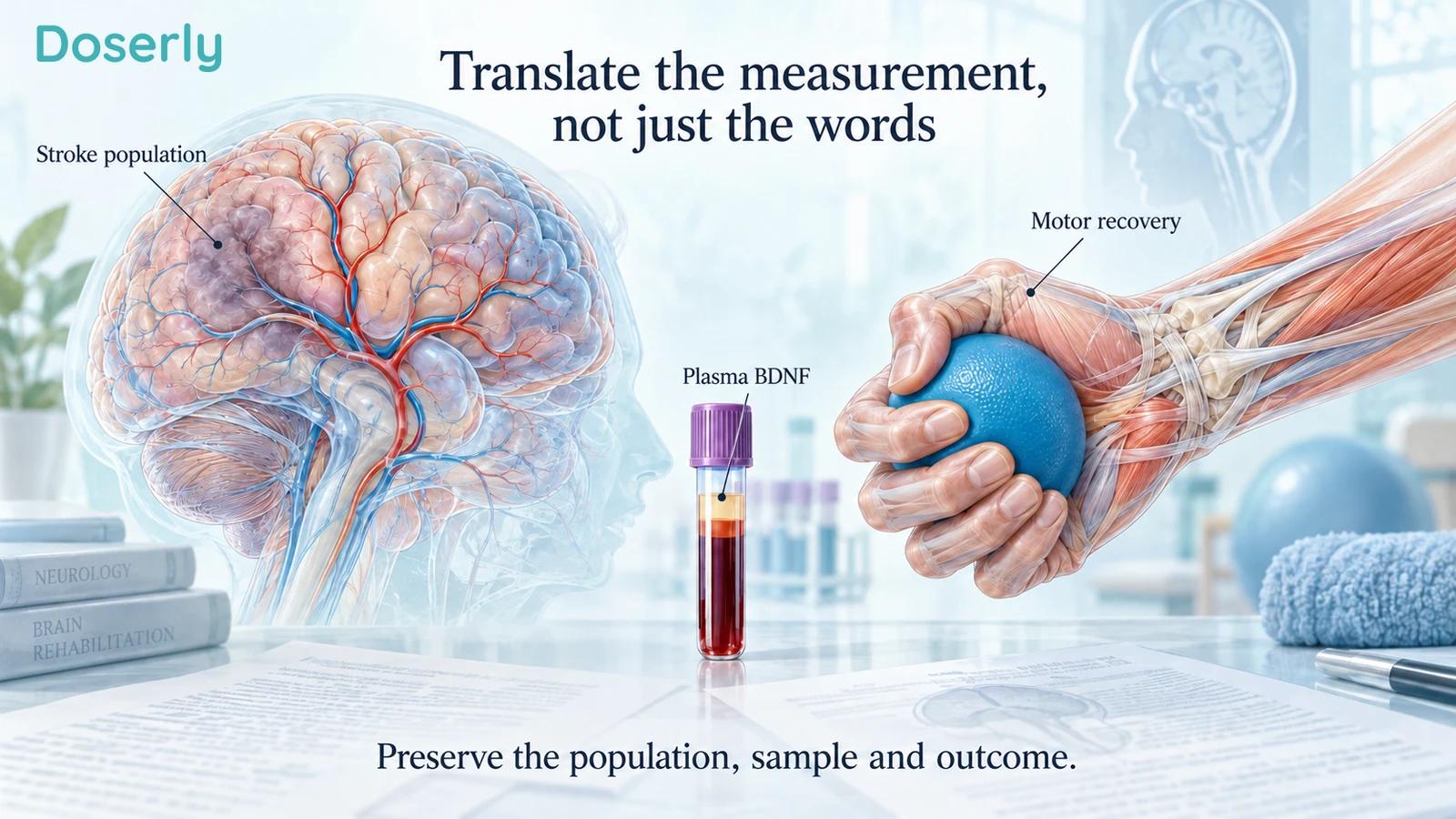
The task is to preserve the experiment while making its wording understandable. A readable translation should leave the population, treatment, comparator and measured outcome intact. Our Semax guide covers the compound itself; this article explains how to judge what a translated paper can support.
The original report is the starting point
A title, abstract and full paper provide different amounts of information. An abstract can identify the research question and summarize results. It usually cannot show every detail needed to assess allocation, missing data, outcome definitions and adverse-event collection.
A secondary summary adds another layer of interpretation. If it cites an abstract, the reader should not assume the writer reviewed the full methods. If it cites a review, the review's references still need to be traced to the original experiments for precise claims.
This is particularly important with older literature, where a paper may appear under slightly different translated titles or on several websites. Multiple links can lead to the same study. Counting them as independent confirmation makes the evidence base seem larger than it is.
A reliable account therefore identifies the authors, year, journal and actual study report. The question is not how many pages mention the result, but how many independent experiments support it.
Translate clinical meaning, not just familiar words
The English title of a 1997 Semax report uses “ischemic insult,” a literal rendering that refers to ischemic stroke in that context. The paper concerns recovery of neurological deficits, with Semax added to background care. It should not be retold as a generic experiment in healthy cognition. Original report.
Medical terms need that kind of contextual reading. A phrase describing regression of a deficit means the deficit lessened; it does not mean the patient deteriorated. Likewise, a term translated as “reliable” in a statistical sentence may concern statistical significance, not certainty that every patient benefits.
A good translation should be checked against the surrounding methods, tables and outcomes. A fluent sentence can still be scientifically misleading if it changes the subject or strength of the original claim.
That is why machine translation can assist access but cannot replace methodological review. The important errors are often plausible-sounding rather than obviously ungrammatical.
Preserve who was studied
The population belongs in the result. Adults after stroke, healthy volunteers and children with a diagnosis are not interchangeable simply because all studies concern the nervous system.
The 2018 Semax rehabilitation abstract describes 110 patients at different stages after ischemic stroke, with plasma BDNF and recovery-related measurements. An accurate summary keeps the recovery stage and clinical setting visible. It does not turn those participants into healthy adults seeking a focus boost. Rehabilitation report.
Age, baseline impairment and concurrent treatment can also affect applicability. If a report does not provide enough detail to judge those features, that is an uncertainty to retain rather than fill with an assumption.
A useful test is to imagine replacing the study population in the sentence with the person being advised. If that replacement changes the clinical question, the original study cannot alone support the advice.
A control group does not automatically mean randomization
A paper can compare treated and untreated groups without assigning participants randomly. Groups may instead be formed through clinical decisions, timing, availability or another process.
The phrase “divided into groups” does not tell you how that division happened. Similarly, saying groups were comparable at baseline does not establish that concealed random allocation prevented selection bias.
Blinding is a separate question. Random assignment does not automatically mean participants, clinicians and outcome assessors were unaware of treatment. Different people can be blinded in different ways, and the report should say which.
When these details are missing from an accessible abstract, the accurate statement is that they could not be established from that source. It would be unfair to assert that the study definitely lacked a method simply because the abstract omitted it. It would also be unjustified to assume the method was present.
Keeping “not reported here” separate from “not done” is one of the most useful habits in reading translated research.
Keep the denominator attached to every number
Sample size can change meaning as a paper moves through summaries. A total enrollment figure may be mistaken for the number receiving the drug, or a subgroup result may be applied to the whole sample.
The 2018 default-mode-network study included 24 healthy participants, with 14 receiving Semax. The 2020 connectomic report described 52 volunteers across Semax, Selank and placebo conditions. Neither total is a count of people all treated with Semax. 2018 imaging report, 2020 connectomic report.
The same care applies to analysis populations. The number enrolled, the number treated and the number with usable follow-up measurements can differ. A result should state which group supplied the data.
When reading a percentage, ask “percentage of whom?” When reading an average, ask which observations entered it. These simple questions often reveal a stronger claim being built from a smaller or different group.
Preserve the measurement, especially in imaging
A word such as “volume” can be particularly misleading when removed from an imaging method. It may describe the spatial extent of a component in an analysis rather than an increase in the physical amount of brain tissue.
In the Semax default-mode-network report, the finding concerns a functional-network component in resting-state imaging. Translating it into a claim that Semax grows a healthy person's brain would change what was measured. Imaging report.
Blood measurements require similar care. Plasma BDNF is not the same sample as brain tissue. Gene expression is not the same measurement as protein concentration. A label that simply says “BDNF increased” can erase those distinctions.
The solution is not to overwhelm a reader with laboratory jargon. It is to retain the few details that determine the meaning: sample, assay level and outcome. A clear sentence can be both accessible and precise.
Improvement needs a comparison and a time point
“Patients improved” is incomplete evidence for a treatment effect. The important question is how their outcome compared with the appropriate control under comparable conditions.
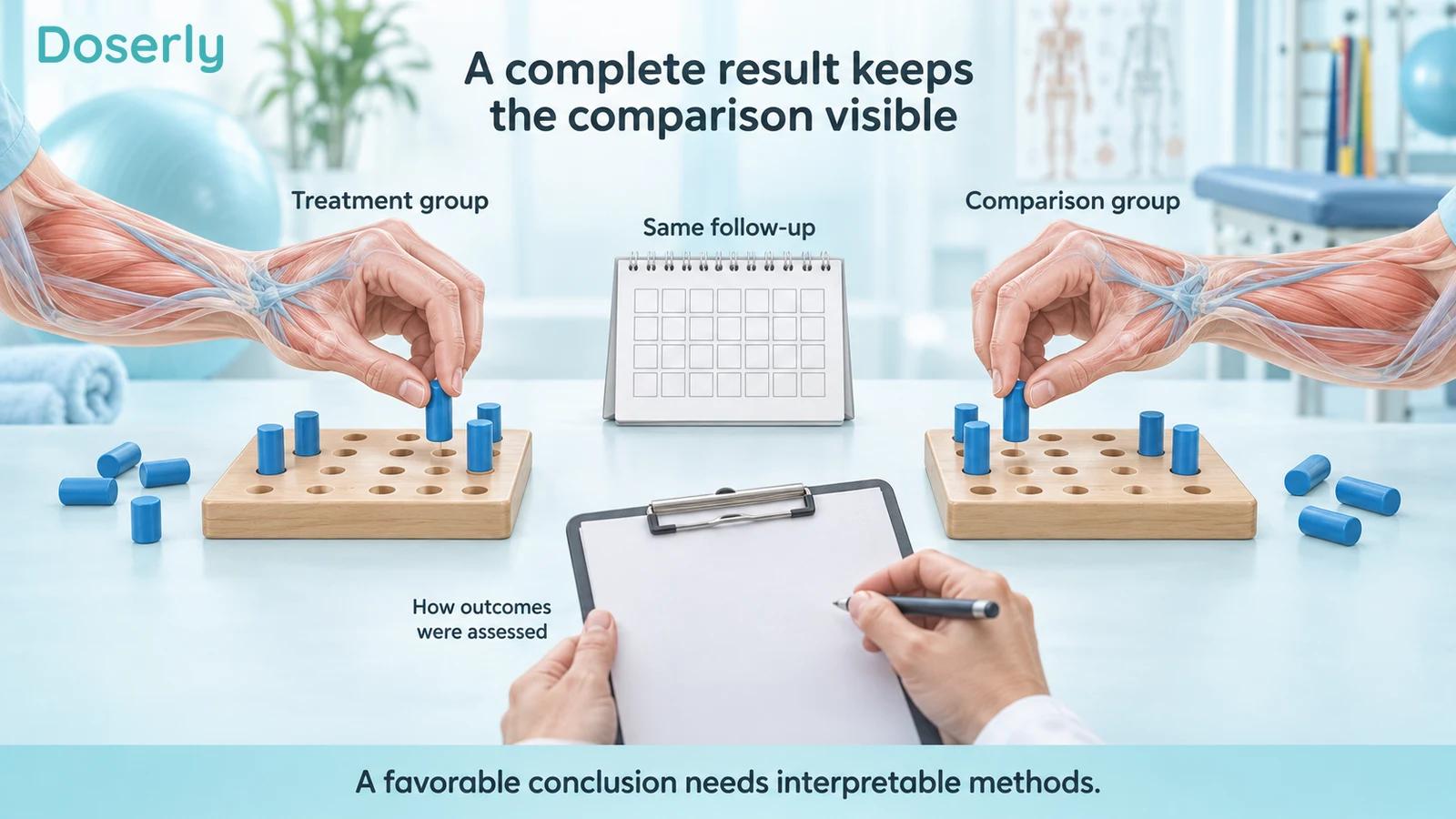
Imagine that both groups improve during rehabilitation. A treatment claim depends on the difference between groups, not only the change within the treated group. If the groups began at different levels, the analysis also needs to account for what those differences mean.
Time matters. A difference observed early in follow-up may persist, shrink or disappear. A summary that mentions only the most favorable day can imply a durable benefit the study did not demonstrate.
The primary outcome matters as well. If a paper measures many scales and time points, one favorable comparison should not automatically become the study's overall verdict. The reader needs to know what was planned as the main test and what was exploratory.
These questions apply in every language. Translation does not create the methodological problem, but a shortened translated summary can make it harder to see.
Statistical significance is not a complete treatment estimate
A p-value does not tell you the size of an effect in practical terms. It also does not show how precisely that size was estimated or whether the benefit matters to daily life.
A useful report gives the group results, the between-group difference where appropriate and uncertainty such as a confidence interval. It identifies the scale and whether a higher or lower score represents improvement.
Without those details, “significant improvement” can sound much more informative than it is. The reader may be unable to distinguish a small change from a substantial one, or a precise estimate from a very uncertain one.
Another common error is comparing significance labels instead of effects. A significant change in one group and a nonsignificant change in another does not, by itself, establish a statistically significant difference between groups.
An accurate translation should preserve those distinctions rather than upgrade the authors' statistical language into a stronger clinical conclusion.
Reporting guidance helps expose unanswered questions
CONSORT 2025 provides a 30-item reporting checklist and a participant-flow diagram for randomized trials. It is intended to make reports clear enough for readers to understand and assess what happened. CONSORT statement.
This is useful as a reading framework, not a certificate that a study is sound. A well-written report can describe a weak design, while a poorly reported study may leave a good method impossible to verify.
Older papers should also be understood in their historical context. They did not have access to every current reporting convention. That does not make their observations worthless, but it does not remove the information a present-day clinical claim needs.
For a reader, the practical task is to identify the unresolved questions. Missing allocation details, incomplete follow-up or unclear outcome definitions should remain visible in the conclusion.
What FDA's translation limitation actually means
The 2026 FDA Semax advisory briefing stated that several Russian-language articles were not included in its efficacy evaluation because complete verified English translations were unavailable. That is an access and review limitation. It is not a finding that those papers contained negative results or did not exist. FDA briefing.
The opposite interpretation would also be wrong: excluded papers do not automatically prove efficacy simply because they were not fully considered. Their methods and results still require appraisal.
The document was staff material for an advisory process, rather than a final regulatory ruling. A summary should preserve that status and the scope of what was reviewed.
This example shows why source-access limitations need plain language. “Not evaluated,” “evaluated and inconclusive,” and “evaluated and negative” are different statements with different implications.
A responsible conclusion can remain specific
A strong summary says what the study observed, then identifies what it leaves uncertain. It does not need to declare the entire literature either convincing or worthless.
For a translated Semax paper, the essential record is compact: the actual compound and route, the people studied, how the comparison was formed, what was measured and when, the magnitude of the result, and how unwanted effects were collected.
If the accessible source cannot answer one of those questions, say so. Do not invent a missing method, infer safety from silence or convert an author's broad interpretation into a directly measured outcome.
Translation is valuable when it brings evidence into view. Its job is to preserve the study's meaning—including its limits—so that the clinical claim can be judged on what was actually done.
Sources
- Original 1997 stroke report
- 2018 rehabilitation report
- 2018 default-mode-network report
- 2020 connectomic report
- FDA 2026 Semax advisory briefing
- CONSORT 2025 primary statement