
Peptides
October 16, 2026
Bremelanotide long-term study: what RECONNECT adds
On this page
A treatment for distressing low sexual desire needs more than a short-term result. People considering bremelanotide, also called PT-141, reasonably want to know whether benefits persist and whether new problems emerge with continued use. The RECONNECT extension followed women beyond the original placebo-controlled trials, adding useful information about longer experience with the medicine. It also changed the way the evidence could be interpreted.
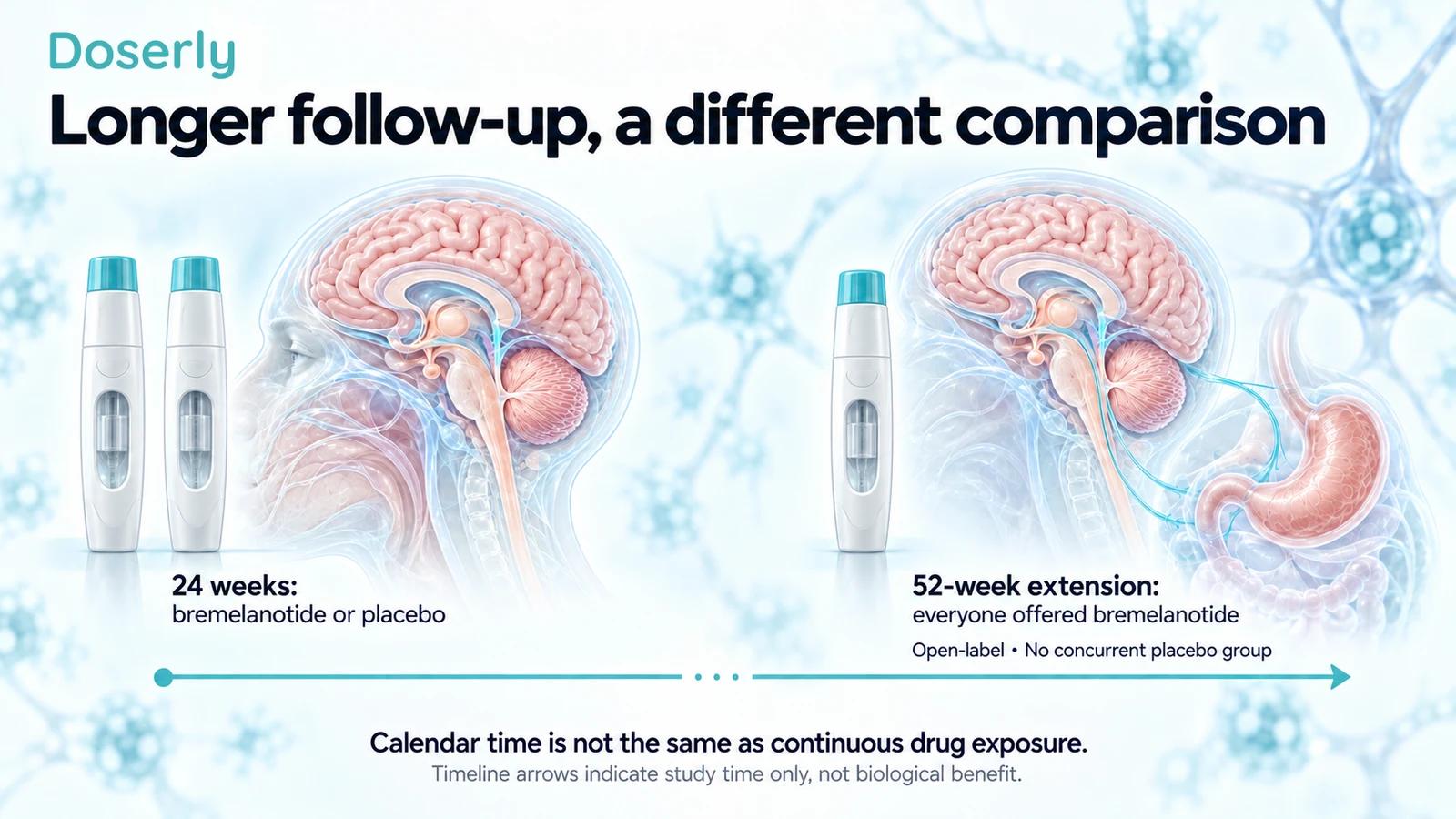
The extension lasted up to 52 weeks and was open-label: participants and researchers knew that bremelanotide was being given. There was no continuing placebo group. Of 684 women who entered, 272 completed the extension. Those details belong beside any statement about long-term improvement or safety. Original extension report
What changed after the first 24 weeks?
The original RECONNECT program comprised two similar randomized trials in premenopausal women with acquired, generalized hypoactive sexual desire disorder, or HSDD. Participants received bremelanotide or placebo for 24 weeks, with treatment assignment concealed. The main outcomes assessed sexual desire and distress associated with low desire. Original randomized trials
Eligible women who completed that phase could choose to join the extension, provided they had not experienced serious adverse events during the core phase. Everyone entering was offered bremelanotide, including those previously assigned placebo. Statistical analyses in the extension were descriptive rather than another blinded test against a contemporaneous control. Extension design
This creates two treatment histories. One group had already received bremelanotide and continued. The other switched from placebo and began active treatment. The groups could help describe different experiences, but their extension-period comparison was not equivalent to a fresh randomized comparison of continued treatment versus placebo.
The distinction is easy to miss because the same study name and questionnaires appear in both publications. A common label does not preserve a study's original design after the comparator and masking change. The extension adds follow-up; it does not repeat every protection of the original experiment.
Who remained in the study?
The extension report identifies 856 eligible core-phase completers, 684 who elected to participate, and 272 who completed the extension. Calculated from those counts, about 80% of eligible completers entered, while about 40% of entrants completed. These percentages describe different steps and use different denominators. Participant flow
It would be incorrect to say that 60% stopped specifically because of side effects by subtracting the completion percentage from 100. Noncompletion can have different reasons, and the arithmetic alone does not identify them. It would also be incorrect to describe 272 as everyone who had longer-term exposure: some people contributed follow-up before leaving.
Selection begins before the extension itself. Women who withdrew during the controlled phase were generally not available to enter a study requiring completion. The group continuing therefore cannot fully represent every patient who starts treatment. This is especially relevant for a medicine with tolerability-related discontinuation.
That observation does not make the extension useless. It tells us who its findings most directly describe: selected participants who reached the end of the earlier phase and chose further treatment. It also explains why a reassuring later experience cannot be assumed to predict the first months for every new patient.
What did the symptom scores show?
The authors reported continued improvements in desire and distress among women receiving bremelanotide. In participants treated with bremelanotide during the core phase, reported changes from the original baseline to the end of the extension ranged from 1.25 to 1.30 points in the desire domain and −1.4 to −1.7 points in the distress item across the two studies. For participants originally given placebo, the corresponding changes were 0.70–0.77 and approximately −0.9. Extension results
These are changes from baseline within groups, not placebo-adjusted extension effects. They should not be set beside the original controlled difference as if a larger numerical change proves that the drug becomes more effective with time. The comparison has changed, the population has changed, and treatment is known.
The desire instrument ranges from 1.2 to 6, with higher values indicating more desire. The distress item ranges from 0 to 4, with lower values indicating less bother. A score increase and a score decrease can therefore both represent improvement, depending on the instrument. Neither is a percentage of sexual function restored. Instrument definitions in the label
For a patient, the observation is encouraging in a limited sense: some continuing participants reported benefit over a longer period. The unanswered causal question is how they would have felt over that same period without active treatment, or with another form of care. The extension did not keep a concurrent placebo group to answer it.
Why knowing the treatment matters
Desire and distress are personal experiences, so patient reports are essential. Calling them subjective does not mean they are unimportant. But awareness of treatment can influence expectations, reporting, and decisions to continue. An open-label study cannot separate these influences as cleanly as a blinded comparison.
The direction or magnitude of that influence cannot simply be calculated from the design. It would be too strong to say all reported improvement was expectation, just as it would be too strong to attribute every point to the drug. The defensible conclusion is that the study observed longer-term symptom patterns under known treatment.
The same applies to people who switched from placebo. Their improvement after switching is informative, but it occurred without a group making an equivalent switch to continued placebo under the same conditions. A before-and-after difference is not the same estimate as a randomized between-group effect.
What longer follow-up adds to safety
A longer observation period can reveal recurring symptoms, delayed concerns, and whether people remain willing to use a medicine. The extension's most frequent treatment-related adverse events were nausea, flushing, and headache, reported in 40.4%, 20.6%, and 12.0% of participants, respectively. The authors reported no new safety signals. Extension safety results
“No new safety signals” means the investigators did not identify a new pattern in this dataset. It does not mean there were no adverse events, no serious events, or no possible uncommon risks. A study with hundreds of selected participants cannot rule out every rare problem, and it does not establish what happens after many years.
The broader safety-program publication reviewed 3,500 subjects across 43 studies, while drawing some key rates from the same phase 3 program. That broadens the development history but is not an independent repetition of RECONNECT. It also cannot make an uncontrolled extension into a controlled long-term efficacy trial. Development-program safety report
Calendar time is not the same as frequent exposure
Bremelanotide was used as needed. The label reports a median of 12 injections during the uncontrolled extension, and notes that most patients used the product two or three times per month and no more than weekly. A year of availability therefore should not be described as a year of daily administration. Vyleesi clinical-study exposure
This distinction matters for readers encountering much more frequent online schedules. The number of calendar months does not tell you the total amount of drug exposure. Safety under intermittent use cannot automatically validate daily use because the same molecule appears in both descriptions.
The label separately warns about temporary blood-pressure changes and focal hyperpigmentation, meaning localized skin darkening. Pigment changes were more frequent with daily dosing in a separate study, and resolution after stopping was not confirmed in every affected patient. Those findings reinforce why frequency belongs in the safety discussion. They are not findings that the extension established every possible schedule as safe. Warnings and precautions

What the extension does not justify
The extension does not expand the approved population to men or postmenopausal women. It does not prove that higher-frequency use is safe, that research-vial products are equivalent, or that escalating treatment will produce more benefit. The approved Vyleesi indication and safety limits remain the relevant product framework. Current label
It also should not be used to tell someone to continue indefinitely in the hope that an absent response will eventually emerge. The label recommends discontinuation after eight weeks if symptoms have not improved. A long follow-up in selected continuing participants does not cancel that reassessment instruction.
For someone already using prescribed treatment, a useful review considers the benefit that is still present, unwanted effects, frequency of use, other medications, and any change in health status. Recording those details over time can help identify a pattern worth discussing. It cannot prove that every change is caused by the medicine.
Reading the two phases together
The controlled trials provide the better estimate of how bremelanotide changes the measured outcomes compared with placebo over 24 weeks. The extension adds information about selected participants' continued experience, symptom reports, and safety observations during further intermittent use. Both have value when their questions remain distinct.
If a clinician cites RECONNECT to support long-term treatment, ask which phase and which result they mean. Are they referring to a randomized treatment difference, a change from baseline among continuing participants, or the absence of a new safety pattern? A clear answer makes it easier to connect the research with your own goals and tolerability.
The PT-141 human evidence guide places the extension alongside the earlier trials. The extension supports a careful conversation about ongoing treatment; it is not a second blinded proof that everyone benefits safely for a year.
Sources
- Simon and colleagues: Long-Term Safety and Efficacy of Bremelanotide, 2019.
- Kingsberg and colleagues: RECONNECT randomized trials, 2019.
- Vyleesi prescribing information.
- Clinical development-program safety report, 2022.