
Peptides
October 16, 2026
What the missing PEG-MGF human data means for safety claims
On this page
When human safety data are missing, the responsible conclusion is uncertainty—not a clean bill of health and not a precise prediction of harm. For PEG-MGF, that uncertainty concerns basic questions: what people are exposed to, how the preparation behaves in the body, what adverse responses occur, and whether repeated exposure changes the picture.
FDA's current safety page says it has not identified human exposure data for drug products containing PEG-MGF by any administration route. It also identifies potential immune-response risks and difficulties involving peptide-related impurities and active-ingredient characterization. That is a direct statement about an evidence gap, rather than a clinical adverse-event rate. FDA PEG-MGF safety entry
Understanding what is missing helps evaluate reassuring claims such as “well tolerated,” “only local effects” or “safe because it resembles something natural.” Each statement requires evidence that a familiar name or a laboratory certificate cannot provide.
For an overview of the terminology and preclinical literature, see the Doserly PEG-MGF guide. This article focuses specifically on what would be needed to make a defensible human safety assessment.
“No identified data” is a carefully limited statement
FDA's wording should be preserved rather than expanded into an absolute claim about every person who has ever used a product. An agency saying it has not identified human exposure data is not saying that no informal exposure has ever occurred.
It also differs from a trial reporting no serious adverse events. In the latter case, readers can examine how many participants were observed, what they received, how events were collected and how long follow-up lasted. When those data are absent, there is no comparable study population to evaluate.
The distinction matters because an online testimonial may be offered as a rebuttal: someone used a product and felt fine. That account does not turn an undefined exposure into a characterized clinical dataset. It may be relevant history, but it cannot supply all the missing information.
The reverse overstatement is also inappropriate. Missing data do not tell us that every exposure will cause a particular injury. A credible safety discussion should resist both reassurance without evidence and alarming specificity without evidence.
A named product is not yet a defined exposure
Safety findings attach to what was actually administered. The preparation's identity, composition and formulation are therefore part of the evidence, not minor technical details that can be ignored once a product has a recognizable label.
MGF terminology is particularly easy to blur. A full-length protein, a short E peptide and a PEG-conjugated preparation are different materials. Research on one does not automatically establish the behavior of another.
In a laboratory receptor study, full-length MGF and short MGF-related constructs produced different findings. The full-length material activated the IGF-I receptor in the tested assay, while the shorter human MGF and stabilized analogue did not. The study demonstrates why construct identity matters; it does not establish human safety for a PEG-MGF product. Janssen and colleagues, 2016
A safety claim should therefore identify the exact preparation behind the claim. A general reference to “MGF research” is insufficient if the material, formulation or route differs.
Human exposure is more than the amount on a label
A label describes an intended quantity. Human exposure research asks what happens after administration: how much of the relevant material is present, where it can be measured, how it changes over time and how much people differ.
Without appropriate human measurements, confident statements about duration or exclusively local action remain unsupported. A modification intended to change persistence is not itself proof of a particular human half-life. Nor does a local biological role establish that an externally administered preparation remains confined to one tissue.
These are separate questions from whether someone notices an immediate effect. A person can feel no obvious change while important exposure questions remain unanswered. Conversely, an immediate sensation does not identify the substance responsible or quantify its distribution.
A meaningful safety program would connect observations to characterized exposures. Otherwise, even a carefully recorded event may be difficult to interpret because the preparation and the actual exposure are uncertain.
Why immune responses require their own evidence
Immunogenicity refers to a product's capacity to provoke immune responses. FDA's guidance for therapeutic protein products recommends a risk-based assessment that considers product and patient factors. It is a general scientific framework, not a PEG-MGF clinical study. FDA immunogenicity guidance
The distinction is useful because chemical purity and immune response are not the same measurement. A purity test addresses the material analyzed by that method. It does not observe how a person's immune system responds over time.
Similarly, the absence of an immediate visible reaction does not answer every immunogenicity question. Appropriate research may need defined sampling, suitable assays and interpretation in relation to clinical findings. A symptom diary cannot replace those measurements.
The point is not to assume a particular immune complication will occur with PEG-MGF. It is that an unresolved immune-response question cannot be dismissed by pointing to an unrelated quality result or to a few uneventful experiences.
A defensible article should describe this as a concern requiring assessment, rather than inventing a frequency, severity or diagnostic pattern that has not been established.

What a certificate can and cannot add
A credible analytical report can answer valuable questions about a tested sample. It might help establish identity or describe measured impurities, depending on the methods and the report's scope. Those are useful contributions to product characterization.
But the report should not be read as if it were a human study. It does not reveal the rate of adverse events, the consequences of repeated exposure, or how a preparation behaves in people with different health conditions.
Even the relationship between a certificate and a particular product needs evidence. The tested sample, batch, collection process and methods matter. A document circulating online may not describe the material a person actually obtained.
This creates two distinct levels of uncertainty. First, does the analytical information apply to the material in question? Second, even if it does, what human safety evidence exists for that material? Resolving the first question does not automatically resolve the second.
A high-quality product-development program needs both reliable characterization and appropriate clinical evaluation. Treating either as a substitute for the other leaves a gap in the reasoning.
Laboratory benefit is not a safety finding
A favorable cell or animal result may justify further investigation, but it does not establish that a product is safe for human use. The experiment may have measured a narrow biological response rather than systematically examining adverse effects.
The MGF literature also contains negative replication findings. Fornaro and colleagues did not reproduce several proposed MGF-peptide effects in muscle-cell experiments, despite responses to relevant controls. That limits confidence in a simple mechanism narrative; it is not a human toxicity study. Fornaro and colleagues, 2014
Benefit and safety should therefore be assessed separately. An intervention could fail to improve the intended outcome while still producing other effects. A favorable outcome in one setting also cannot demonstrate the absence of unwanted effects in another.
This is why “it did nothing in this assay” and “it was beneficial in this animal model” are both inadequate answers to a question about human tolerability. Neither provides the missing clinical observation.
The most useful summaries name the experiment's purpose and endpoints. If safety was not measured in a way relevant to the claim, readers should not infer it from the tone of the paper's conclusion.
What early clinical studies would contribute
FDA describes clinical development as a progression in which early human studies examine safety and how a drug interacts with the body, while later studies evaluate additional questions in larger populations. This is a general framework; it does not imply that PEG-MGF has completed those stages. FDA clinical-research overview
For a new preparation, useful early evidence would identify who participated, what they received, the duration of observation and how adverse events were sought. Researchers would need a reasoned monitoring plan tied to the product and the available nonclinical evidence.
A small early study could provide important information without settling long-term safety. Rare events, delayed effects and responses in populations excluded from the study would remain questions for further work.
This makes “tested in humans” a starting description rather than a final verdict. The study design and results still matter. A single exposure in a few participants would support a narrower conclusion than sustained observation across a larger, relevant population.
Readers should ask what the study was capable of detecting, not only whether its authors used the word safe.
Why few reports cannot establish a low risk
Spontaneous reports can help identify possible safety concerns, but they are not a complete count of all exposures and outcomes. FDA's adverse-event monitoring information explains that a report does not establish causation and that report counts cannot determine incidence. FDA adverse-event monitoring limitations
The same basic caution applies when someone points to a quiet online forum as evidence of safety. There may be no reliable denominator: how many people used the product, which preparation they received, how long they were followed, and how consistently problems were reported.
For example, ten uneventful posts do not establish the risk among all users. Ten reports of symptoms do not establish that the product caused every symptom. Both observations may warrant attention, but neither supplies the design of a clinical safety study.
It is also important not to combine unlike exposures into one reassuring total. Different product identities, batches, routes and co-used substances can make a collection of anecdotes difficult to interpret.
The appropriate use of such reports is to preserve information and investigate possible signals. Their limitations should remain visible in any claim about frequency or causation.
Monitoring does not create a validated protocol
A person may assume that frequent laboratory tests make an uncertain product manageable. Monitoring can identify some problems, but it cannot validate an exposure whose expected effects, relevant tests and stopping criteria have not been established.
Normal results are also bounded by what was measured and when. They do not prove that every possible effect was absent, and they cannot guarantee what will happen after another exposure.
For a clinician evaluating someone who has used PEG-MGF, accurate information is more useful than a reconstructed mechanism story. Product names, packaging, dates, other medicines and supplements, and the timing of symptoms can help describe the exposure.
This article does not provide a testing schedule or a threshold for continuing use. Those would imply a validated management strategy that the available evidence does not establish. New or concerning symptoms warrant clinical assessment rather than attempts to interpret them solely through internet peptide discussions.
Read regulatory wording in its current context
As checked on October 15, 2026, the FDA page places PEG-MGF in its section for bulk substances whose nominations were withdrawn. The safety entry remains present. That administrative context should not be confused with a new clinical finding or approval. Current FDA listing
A change in a list's organization does not by itself demonstrate that a product has become safe. Equally, the page should not be used to make sweeping claims about every jurisdiction's laws or every possible circumstance of use.
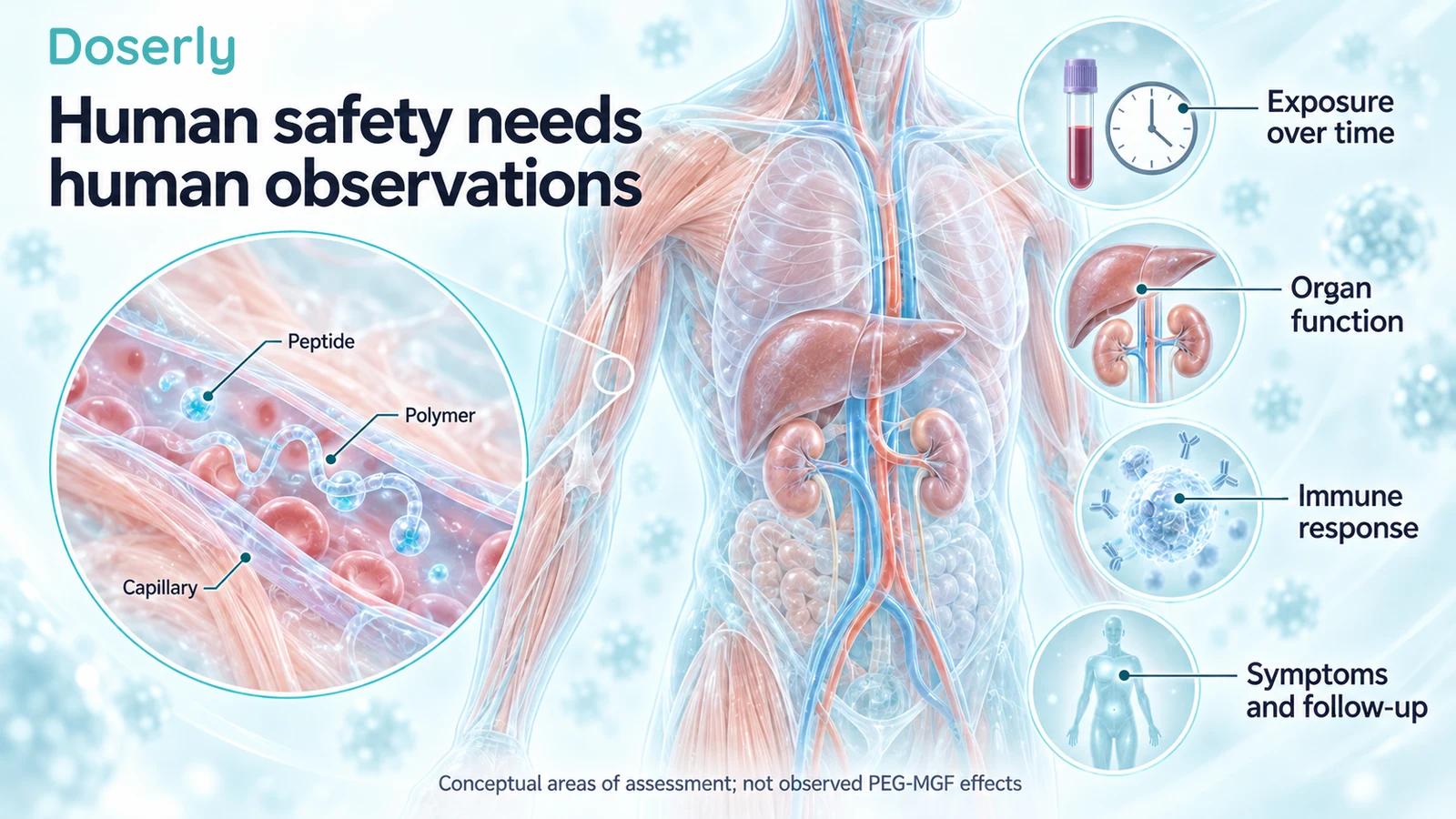
The central scientific conclusion is narrower and more durable: the identified human evidence is insufficient to substantiate confident PEG-MGF safety claims. Product characterization, human exposure, immune responses and clinical follow-up each require evidence.
“Unknown” is not an empty answer. It tells readers which assurances have not been earned and which questions a credible research program would need to resolve.
Sources
- FDA: PEG-MGF compounding safety entry and current listing context.
- Janssen and colleagues: construct-specific receptor responses (2016).
- FDA: immunogenicity assessment for therapeutic protein products (2014).
- Fornaro and colleagues: MGF-peptide replication experiments (2014).
- FDA: clinical research in drug development.
- FDA: adverse-event monitoring and interpretation limits.