
Peptides
October 16, 2026
What the July 2026 FDA peptide hearing changes
On this page
A favorable advisory vote about peptide compounding is not FDA approval of a medicine. That distinction is the most useful starting point for understanding the July 23–24, 2026 Pharmacy Compounding Advisory Committee meeting.
The meeting considered whether several peptide-related bulk drug substances should be added to the section 503A bulks list. That list is part of the legal framework for certain pharmacy and physician compounding. It is not a catalog of finished medicines that FDA has reviewed and approved for treating particular diseases. FDA meeting record
For BPC-157, the distinction is especially important. A change in the route toward lawful compounding would not, by itself, establish that an injection repairs tendons, restores cartilage or treats an undefined “gut problem.” Those remain clinical questions requiring their own evidence. The BPC-157 guide covers that separate evidence base.
This article distinguishes the meeting, its reported recommendation and the regulatory text checked on October 15, 2026. It explains the process rather than determining whether a particular prescription or pharmacy practice is lawful.
What the committee was asked to consider
The official voting questions asked separately about BPC-157 free base and BPC-157 acetate, followed by related questions for the other substances. The question was whether each substance should be placed on the list. It was not whether a finished BPC-157 drug should receive marketing approval. Official voting questions
On the first day, the agenda covered BPC-157, KPV, TB-500 and MOTS-c. The second day covered emideltide, also called DSIP, Epitalon and Semax. The evaluated uses differed: BPC-157's listed use was ulcerative colitis, while the other substances had their own specified uses. Those details limit what can fairly be inferred from a headline about “peptides.”
A peptide is a kind of molecule, not a single treatment category with a shared approval status or shared evidence. One substance's assessment cannot be transferred to another simply because both are peptides. Even free-base and acetate forms were presented as separate bulk substances in this process.
FDA's briefing also explains that the relevant nominations had been withdrawn, but the agency elected to continue evaluating the substances. Withdrawal of a nomination did not itself establish either approval or a finding of clinical effectiveness. FDA briefing introduction
The staff assessment and the committee recommendation are different records
Before the meeting, FDA's scientific briefing proposed that BPC-157 free base and BPC-157 acetate not be included on the list. That was the agency staff's proposal for discussion. It should not be mislabeled as the committee's eventual vote.
Associated Press reporting from July 23 described a favorable advisory recommendation for BPC-157, with an 8–6 vote and one abstention. That tally is attributed here to the contemporaneous reporting; the official meeting page checked for this article did not provide a posted written vote summary or minutes. AP meeting report
This distinction prevents two opposite errors. Reading only the premeeting briefing can make it sound as though the committee rejected the substance. Reading only a favorable-vote headline can make it sound as though FDA approved a drug. Neither description accurately identifies the document and decision involved.
Advisory committees provide nonbinding advice. FDA can consider that advice alongside the scientific review, public input and other relevant information before taking its own action. The committee is influential, but its vote does not itself rewrite the regulation. FDA explanation of the committee's role
What had changed in the regulatory text by the research date?
For this article, the electronic Code of Federal Regulations was checked through its official API. The latest available Title 21 issue was October 13, 2026. Section 216.23, which contains the 503A bulks list, did not include BPC-157 in its list of included substances. Official eCFR text, October 13 issue
That is a specific, dated finding about a specific regulation. It is more useful than assuming that the July vote automatically changed the list. It is also narrower than a blanket statement about every possible route of access, enforcement circumstance or state-law question.
A regulatory update should identify the actual action, its scope and its effective date. An announcement of a future intention, an advisory recommendation, a proposed rule and a final rule are different stages. A reader should be able to tell which one a claim refers to.
The FDA briefing says the agency intended to make its final determination after considering the advisory process and completing its reviews. The bulks-list process involves notice-and-comment rulemaking. A favorable recommendation can move the discussion forward without completing that process. FDA description of the 503A process
Why list inclusion would still not mean drug approval
Section 503A provides exemptions from certain federal drug requirements when its conditions are met. The bulk-substance requirement is one part of that framework. Meeting one condition is not the same as satisfying every condition that applies to a compounded preparation.
The regulation itself is unusually explicit about the distinction from approval. Section 216.23 states that inclusion does not establish adequate data demonstrating the safety or efficacy of a compounded product made with that substance. It also addresses misleading representations that such a product is FDA-approved or endorsed.
This is why “on the compounding list” and “FDA-approved treatment” should never be used interchangeably. The first concerns a defined regulatory pathway for compounding. The second concerns an agency review of a particular drug product for particular uses, with associated manufacturing and labeling requirements.
FDA explains that compounded drugs are not FDA-approved and are not reviewed for safety, effectiveness or quality before marketing in the same way as approved drugs. They can meet important patient needs, but that role does not erase the difference in review. FDA explanation of compounded-drug risks
What the scientific review said about BPC-157
The BPC-157 briefing assessed physical and chemical characterization, safety, effectiveness and historical compounding use. These are separate considerations that FDA balances in evaluating a substance for the list.
For effectiveness in ulcerative colitis, FDA identified a small, short study reported as a meeting abstract. The agency described missing methodological details and concluded that the available data were inadequate to support the studied treatment's efficacy and safety. The briefing also discussed limited human exposure information and potential immunogenicity concerns associated with some routes, impurities and aggregation. FDA BPC-157 scientific briefing
A favorable advisory recommendation does not make those missing data appear. It may reflect a judgment about access or the overall regulatory question, but it does not turn an uncontrolled report into a randomized trial or supply years of safety follow-up.
The same boundary applies in the other direction. An identified uncertainty is not a measured rate of harm. The scientific position should remain specific: the human evidence is limited, important questions are unresolved, and claims should not exceed the data available for the particular condition and route.
Why the condition and formulation still matter
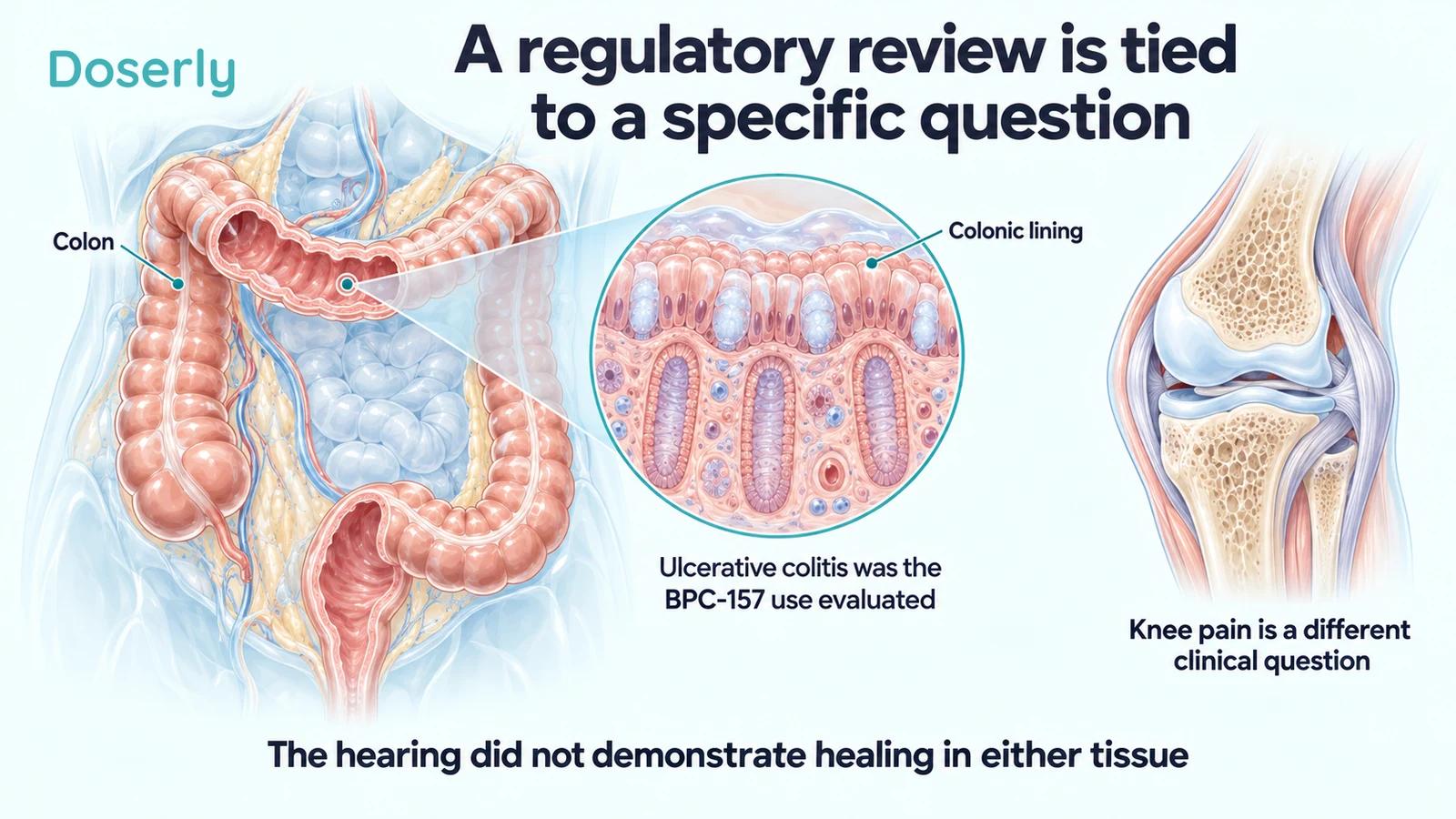
The fact that ulcerative colitis appeared in the FDA review does not establish BPC-157 as a treatment for all gastrointestinal symptoms. Ulcerative colitis is a defined inflammatory disease. Bloating, abdominal discomfort, Crohn's disease and celiac disease are not interchangeable study populations.
The briefing did not evaluate every nominated use as though the evidence were equally developed. It explains that information supporting some other proposed conditions was insufficient for evaluation. A broad claim about “gut healing” therefore reaches beyond the scope of the actual review.
Formulation matters for similar reasons. A rectal preparation, oral product and injected product do not automatically deliver equivalent exposure to the same tissues. Evidence involving one preparation does not establish effectiveness or safety for every product bearing the same peptide name.
The free-base and acetate distinction also belongs in this discussion. It reflects the importance of chemical identity and product characterization. It should not be interpreted as proof that every product sold under either label is equivalent to material described in a study or regulatory submission.
A certificate of analysis answers a narrower question
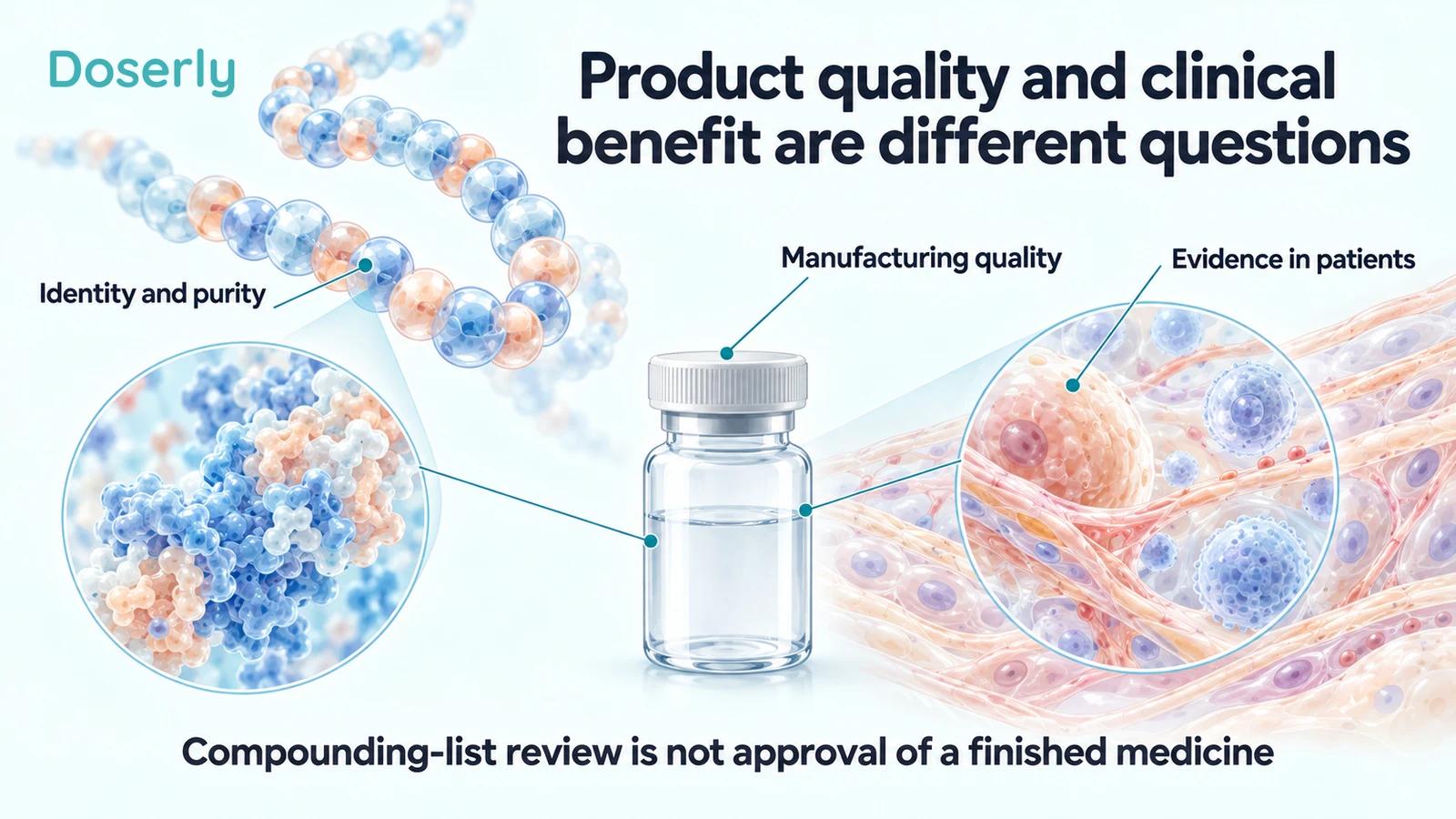
FDA's 503A information identifies requirements concerning a valid certificate of analysis and the establishment that manufactured the bulk substance. Those product-quality requirements are meaningful, but a certificate is not a clinical trial. It cannot show that a preparation relieves symptoms, changes disease activity or improves long-term outcomes.
Likewise, a study suggesting benefit cannot verify the quality of an unrelated preparation. A clinician may need to consider both questions at once: whether a treatment has evidence for the patient's condition and whether the actual product is adequately characterized. A favorable answer on one side leaves the other question intact.
This is why an advertisement that combines a laboratory certificate with news of an advisory vote can sound more conclusive than either item warrants. The certificate concerns tested material; the vote concerns a regulatory recommendation. Neither, alone or together, establishes approval of a finished medicine or the clinical benefit being advertised.
What Category 1 and Category 2 language can—and cannot—tell you
Online discussions often collapse the bulks list and FDA's interim-policy categories into one approval system. They are different.
FDA describes Category 1 as involving sufficiently supported nominations that may be eligible for the list, with an interim enforcement policy subject to conditions. Category 2 involves identified significant safety risks pending evaluation and is outside that Category 1 policy. Neither label is approval of a finished drug.
FDA also says its revised policy does not place substances newly nominated on or after January 7, 2025 into these categories. Historical category statements therefore need a date and a current official source; an old screenshot cannot establish today's position. FDA's current category and interim-policy explanation
This article does not infer BPC-157's current category from its historical placement or from the meeting vote. Nor does it treat removal from a category, by itself, as permission to compound. The relevant question is which current rule or policy applies, under what conditions and to which activity.
How to read the next regulatory headline
A useful update should identify who acted: an advisory committee, FDA itself or another authority. It should specify the substance and form, say whether the action was a recommendation or a rule, and link to the underlying record. Any legal change should have an identifiable scope and timing.
The next question is clinical: what new patient evidence, if any, accompanied the action? A change in access policy may occur without a new efficacy trial. Conversely, a newly published study can add evidence without immediately changing regulatory status.
For someone discussing a proposed treatment with a clinician or pharmacist, useful questions include which diagnosis is being treated, what human evidence supports that use, how the preparation's identity and quality are established, and what current regulatory basis applies. These questions address different parts of the decision; none can stand in for all the others.
The July hearing matters because it brought these substances through a formal advisory review and generated recommendations for FDA to consider. It did not establish BPC-157 as an approved medicine or demonstrate the broad healing claims attached to it. As of the dated regulatory check above, BPC-157 had not appeared in the included-substances text of section 216.23.
Sources
- July23–24 2026 Pharmacy Compounding Advisory Committee meeting.
- PCAC official voting questions.
- FDA briefing introduction for July2026 PCAC.
- Associated Press report: FDA panel narrowly backs unapproved peptide drugs.
- 21CFR216.23 official eCFR XML,2026-10-13.
- Bulk Drug Substances Used in Compounding Under503A.
- Understanding the Risks of Compounded Drugs.
- BPC-157-related bulk drug substances FDA briefing.