
Peptides
October 16, 2026
KPV in 2026: what human research still needs to answer
On this page
KPV attracts interest because laboratory studies connect it with reduced inflammatory signaling, particularly in intestinal cells. If you have a stubborn inflammatory condition, that raises a practical question: could this small peptide eventually become a useful treatment?
The question became more prominent during the 2026 US discussion about peptide compounding. Yet a discussion about access and a study demonstrating benefit are separate events. The evidence reviewed here does not establish a KPV treatment for patients with bowel disease, skin inflammation or wounds. What it does offer is a set of specific biological findings worth testing more directly.
The next useful step is not simply another statement that KPV is promising. It is research that identifies the actual substance, shows where it goes in the body, measures meaningful benefits and follows adverse effects. Understanding the existing experiments helps explain why each of those steps matters. For the broader compound background, see our KPV research guide.
What happened in the 2026 discussion?
FDA's July 23–24, 2026 Pharmacy Compounding Advisory Committee materials included KPV free base and KPV acetate, evaluated for wound healing and inflammatory conditions. The agency's meeting page explains that advisory committees provide nonbinding recommendations. They advise FDA; they do not themselves approve a medicine. Official meeting page.
In the associated briefing, FDA staff recommended against placing the evaluated KPV substances on the 503A bulk-substances list. The review cited characterization problems and an absence of identified human effectiveness and safety data. That was the staff's scientific assessment prepared for the advisory process. It should not be described as a completed clinical trial or, by itself, a final determination about every compounding circumstance. FDA KPV briefing.
For a patient, the central distinction is straightforward. A policy process can address whether and under what conditions a substance may be used in compounding. It cannot tell you how much it reduces pain, which patients benefit, or what adverse effects occur after repeated use unless those questions have actually been studied.
This article therefore focuses on the clinical questions that remain. It does not present a committee discussion as prescribing authorization or give a current legal-status determination for an individual pharmacy or patient.
KPV is small, but its identity still matters
The letters KPV refer to lysine, proline and valine. These amino acids form a tripeptide, a chain of three amino acids. The sequence corresponds to the end of alpha-melanocyte-stimulating hormone, usually shortened to alpha-MSH.
A fragment can behave differently from the larger hormone. Chemical changes to its ends, a different salt form, or a specialized delivery formulation can also affect what researchers are studying. Consequently, a paper mentioning an alpha-MSH fragment is not automatically a trial of the material in a product labeled KPV.
FDA's review specifically distinguished free base and acetate and identified inconsistent naming in supporting materials. Its conclusion about missing human data applied to the evaluated substances. A future study needs to identify its investigational product precisely enough that another team could reproduce it and a clinician could understand whether the findings concern the same formulation. FDA KPV briefing.
That basic identity work is especially important when a field has many familiar names but little clinical development. Without it, adding more observations can make the literature larger without making its conclusions clearer.
Why the intestinal research is interesting
The intestinal lining is an active interface between the contents of the gut and the rest of the body. Epithelial cells form its surface, while immune cells respond to signals from nearby tissue. Researchers are interested in whether KPV can modify inflammatory communication in these cells.
Dalmasso and colleagues studied human-derived intestinal and immune cell lines, then tested oral exposure in mice with experimentally induced colitis. They found that PepT1, a transporter for small peptides, helped carry KPV into cells. The experiments connected uptake with reduced NF-kappaB and MAPK signaling, pathways involved in inflammatory responses. Mouse findings included reduced inflammatory measures in chemically induced disease models. Dalmasso and colleagues, 2008.
This gives the research a plausible delivery-and-signaling question: can enough of the appropriate KPV substance reach relevant cells and change a process that matters to disease? It does not establish that a patient taking an oral capsule or an injection achieves that exposure.
Xiao and colleagues explored the delivery problem using KPV-loaded nanoparticles in a hydrogel designed for oral administration. Their mouse study investigated a particular engineered system, including targeting features intended to improve delivery to intestinal cells. It offers a reason to study formulation carefully, not a reason to assume all oral KPV products behave alike. Xiao and colleagues, 2017.
Does “human research” mean people received KPV?
Not necessarily. A study can use human cells or tissue without treating a living participant. That is valuable research, but it answers a different question.
Pawar and colleagues examined KPV movement through human skin samples in a laboratory delivery system. Passive permeation was below a detection limit of 0.01 microgram/mL. Microneedles and iontophoresis, which uses an electrical current to aid delivery, increased transport under the tested conditions. The study measured delivery through tissue; it did not show that KPV improved eczema, closed a wound or relieved symptoms in patients. Pawar and colleagues, 2017.
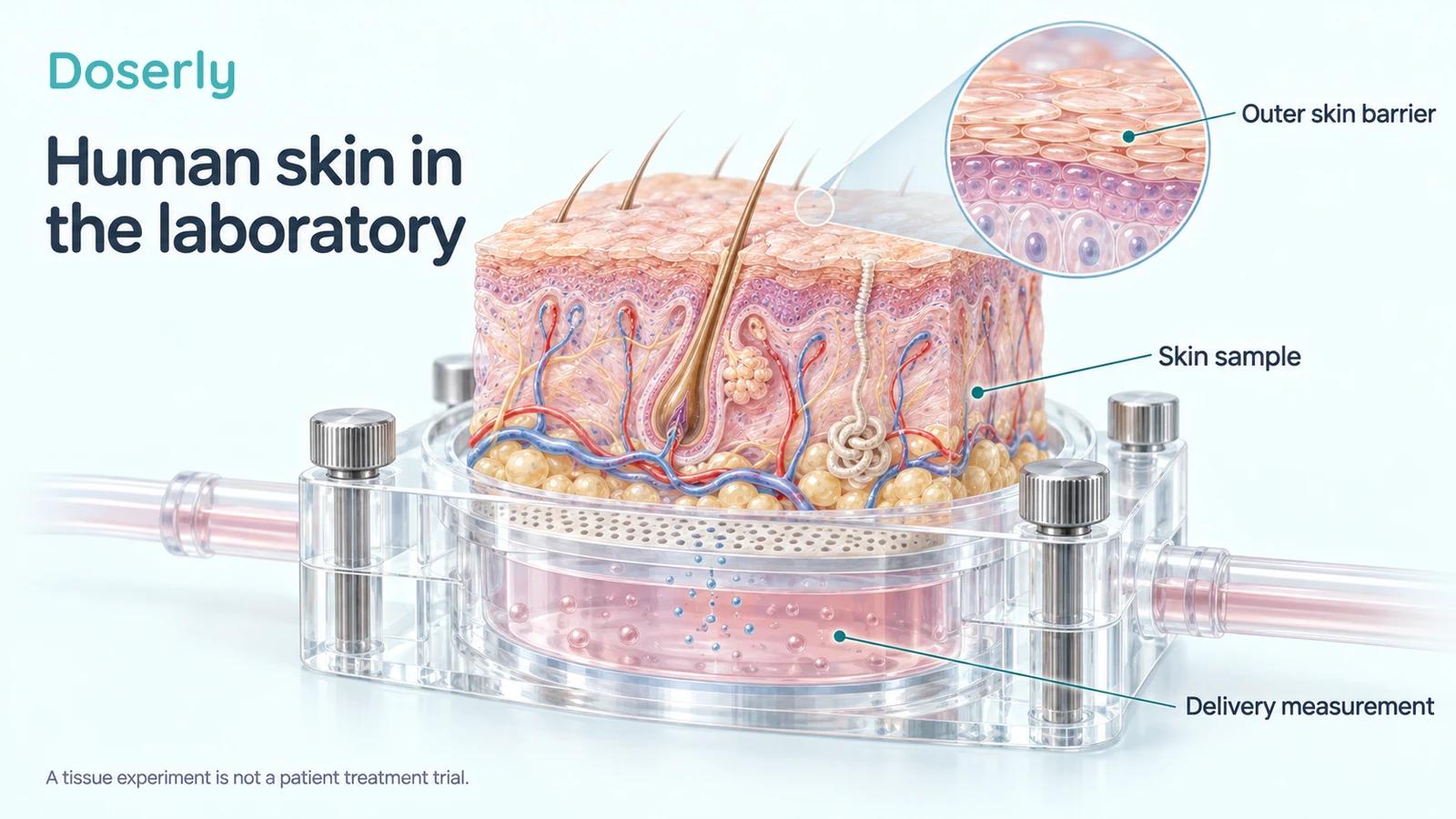
The distinction also changes how to interpret an apparently negative result. Undetectable passive passage under one set of experimental conditions does not prove every topical formulation is ineffective. It tells formulation researchers that simply placing this preparation on that tissue did not produce measurable passage with that assay.
Likewise, better delivery is not necessarily better treatment. Researchers must still establish that the exposure reaches an appropriate level, produces a worthwhile effect and avoids unacceptable harm. Skin penetration and symptom improvement are separate measurements.
The K(D)PT trial is real, but it is not a KPV trial
A nearby name in this literature is K(D)PT, a different tripeptide. Kucharzik and colleagues published a randomized, double-blind phase IIa study in people with mild-to-moderate active ulcerative colitis. Oral K(D)PT was added to background medication and compared with placebo at several dose levels. The primary objective concerned sustained improvement in a colitis activity index by week eight. Kucharzik and colleagues, 2017.
The report described favorable findings at some time points, a high placebo response, and attainment of the primary endpoint after additional analyses. Those details make it an exploratory clinical signal requiring careful interpretation, rather than a simple proof of a broadly effective peptide treatment. The paper's assessment of tolerability belongs to the specific compound and trial conditions it studied.
Most importantly, the participants received K(D)PT. They did not receive KPV free base or KPV acetate. Chemical resemblance and overlapping research interests do not make medicines interchangeable. This trial shows why searching only for “anti-inflammatory tripeptide” can produce an apparently relevant human paper that answers a different treatment question.
It is reasonable for KPV research to learn from neighboring drug-development efforts. It is not reasonable to transfer their outcomes, doses or safety conclusions to KPV without direct evidence.
What should the first patient studies establish?
Before asking whether KPV treats a disease, researchers need to understand the exposure they are creating. Pharmacokinetics describes what the body does to a substance: its absorption, distribution and elimination. These measurements help determine whether a formulation behaves as expected and whether repeated exposure changes the pattern.
For a treatment intended to work locally in the intestine, a blood level may not fully describe exposure at the lining. Conversely, detecting something in blood does not prove it reached the intestinal cells of interest. Researchers would need measurements suited to the proposed route and location of action.
The same issue applies to skin. A formulation intended to remain near the surface creates a different question from one designed to cross the barrier. The earlier skin-delivery experiment shows why investigators cannot infer the answer from the ingredient name alone.
Early studies would also need to document tolerability and laboratory changes using a characterized product. A few participants reporting no immediate problem would be useful but limited information. It would not settle the risks of months of use, use in people with other illnesses, or exposure alongside other medicines.
What would convincing bowel-disease results look like?
A treatment study needs a defined condition. “Gut inflammation” can refer to a diagnosis, a suspected mechanism, a laboratory finding or a nonspecific collection of symptoms. Those are not interchangeable enrollment criteria.
NIDDK describes ulcerative-colitis diagnosis as a combination of history, examination and testing. Blood and stool testing can help evaluate inflammation and other explanations, while endoscopy with biopsies allows examination of the intestinal lining. A person cannot be assigned that diagnosis merely because a supplement or peptide seemed to help digestive symptoms. NIDDK diagnosis overview.
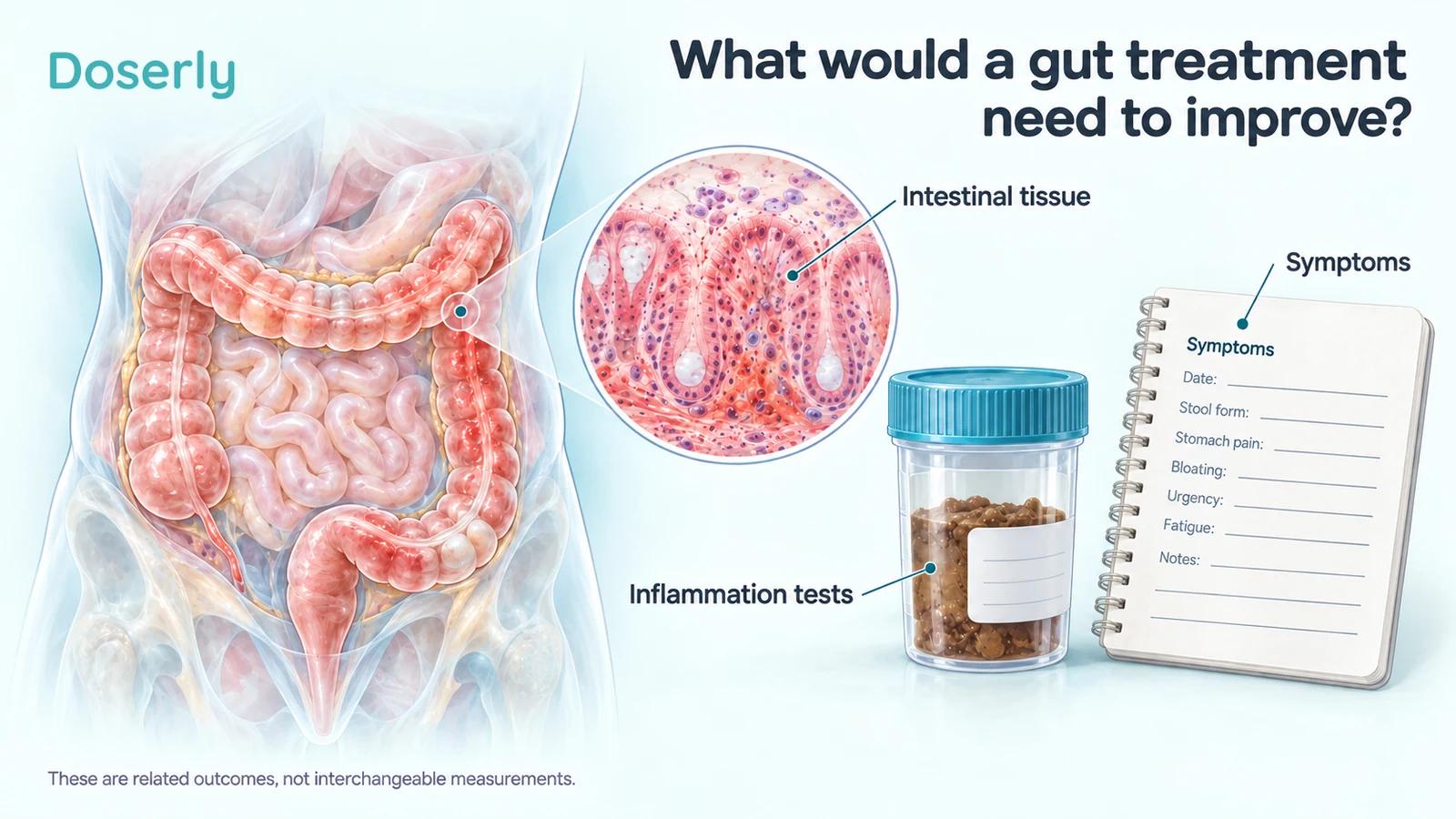
A useful KPV trial would specify whether its main goal was symptom relief, improvement in an objective inflammation measure, or a defined remission outcome. It would explain background treatment so readers could tell whether KPV was an addition to usual care. It would also report results for the people assigned to treatment, including those who stopped, rather than selecting only the participants who completed it successfully.
Those choices matter to everyday decisions. A treatment that improves a blood or stool marker without improving how a patient feels may still be worth studying, but it answers a narrower question. A treatment that reduces symptoms while disease remains active would require a different interpretation again.
What would convincing skin or wound results look like?
A skin study needs similar precision. A chronic wound, eczema and a laboratory skin sample represent different biological and clinical settings. A delivery experiment cannot establish all three uses.
For a wound study, investigators would need a clear definition of healing, consistent background care and follow-up long enough to assess whether closure lasts. For an inflammatory skin condition, they would need a defined diagnosis and measures appropriate to that condition, alongside tolerability. These are examples of research questions, not findings already demonstrated for KPV.
The formulation itself also needs a fair comparison. If a cream contains other active ingredients or a vehicle that improves skin hydration, researchers need to distinguish that contribution from KPV's. Otherwise, improvement may be attributable to the overall preparation without identifying the peptide's effect.
What information would change the conversation?
A well-reported human study would identify the substance and formulation, the participants, the comparison, the duration, the planned main outcome and the adverse events. A positive result would still need replication and an explanation of who is likely to benefit. A negative result would help refine or reject the proposed use.
For now, the most constructive clinical conversation begins with the condition you want treated and the evidence for the exact product being proposed. Ask whether the cited study involved living patients, whether they received KPV itself, and what outcome improved. These questions preserve the useful laboratory science while avoiding claims it cannot yet support.
The 2026 discussion has made KPV more visible. The next scientific advance will come from answering those treatment questions directly, with the same care devoted to identifying harms as to finding benefits.
Explore the research
- FDA July 2026 advisory meeting: scope and nonbinding advisory role.
- FDA KPV briefing, 2026: characterization and human-data gaps.
- Dalmasso et al., 2008: PepT1 uptake, cell signaling and mouse colitis.
- Xiao et al., 2017: engineered oral nanoparticle delivery in mice.
- Pawar et al., 2017: KPV delivery through human skin samples.
- Kucharzik et al., 2017: exploratory patient trial of the different peptide K(D)PT.
- NIDDK, diagnosis of ulcerative colitis: clinical assessment and testing.