
Peptides
October 16, 2026
What PepT1 adds to the KPV story
On this page
PepT1 helps explain why researchers became interested in KPV for intestinal inflammation. It provides a possible route for a small peptide to enter a cell, connecting the substance outside the cell with the signaling machinery inside it. That is a more specific idea than simply saying that KPV is “anti-inflammatory.”
But a transporter is not a treatment outcome. Showing that PepT1 can participate in KPV uptake does not establish how much of an oral product reaches a person’s intestine, whether it reaches the relevant cells or whether that person benefits. Those are separate questions that need separate measurements.
There is also an important complication: studies of PepT1 in inflamed colon have not all found the same pattern. The most useful account explains the mechanism without turning a context-dependent experimental observation into a universal claim about every inflamed gut. The KPV guide provides the broader background; here, the focus is the transporter itself.
A transporter moves material across a cell membrane
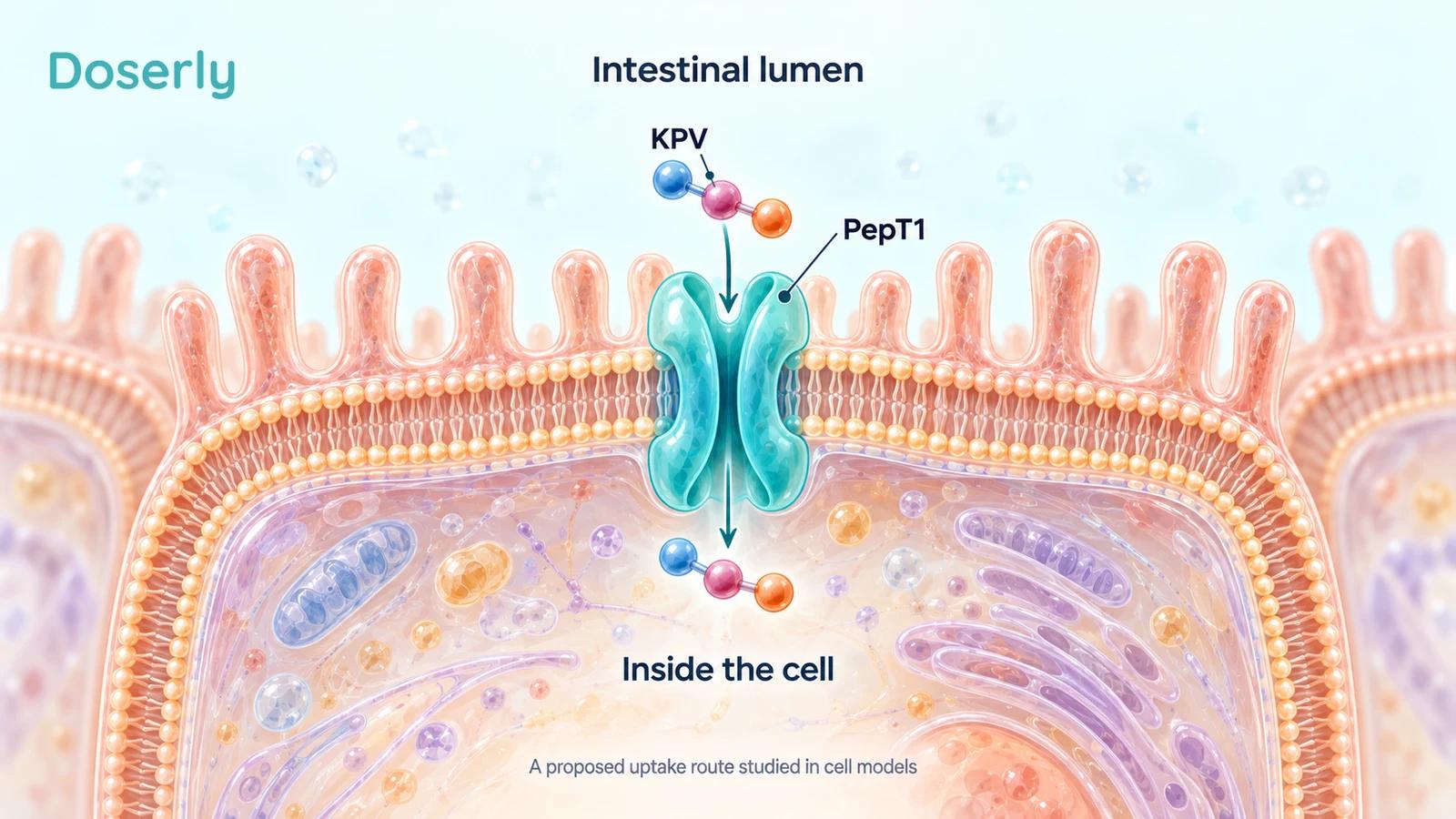
PepT1 is a membrane protein that transports small peptides, including dipeptides and tripeptides. It is associated with intestinal uptake and is also called peptide transporter 1; the gene name SLC15A1 may appear in research papers. In intestinal epithelial cells, the apical membrane is the surface facing the intestinal lumen, where digested material is present. Original intestinal transporter study.
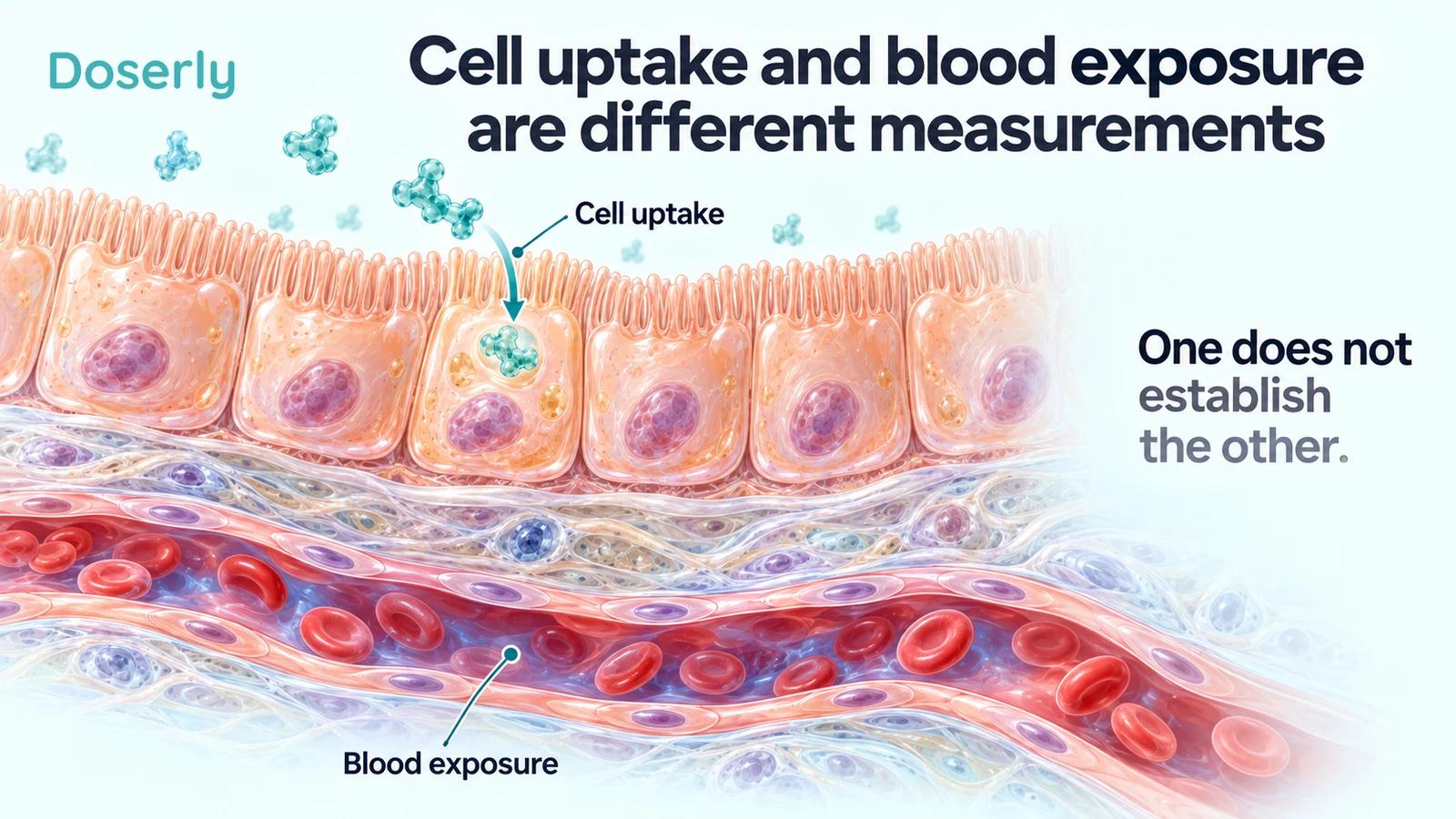
This spatial distinction matters. A peptide in the intestinal contents has not necessarily entered an epithelial cell. A peptide entering that cell has not necessarily reached blood. And material reaching blood has not necessarily reached another target tissue in an active form. “Absorption” can become misleading when these different steps are collapsed into one word.
For KPV, the cellular-entry question is especially relevant because some proposed effects involve intracellular inflammatory signaling. Researchers need to know how exposure outside the cell might connect to events inside it. PepT1 supplies a testable candidate mechanism for that connection.
What the KPV uptake study contributed
In 2008, Dalmasso and colleagues examined KPV in intestinal epithelial cell lines and a human T-cell line. Their experiments linked PepT1-mediated uptake with reduced inflammatory signaling, including effects involving NF-κB and MAP kinase pathways. They also studied KPV in drinking water in chemically induced mouse colitis. Original KPV study.
The value of this work is the connection between a transport mechanism and a biological response in defined experimental systems. It gives researchers something more concrete to investigate than a general claim that a peptide “supports the gut.” The cell types, exposure conditions and measured responses become part of the explanation.
It still does not supply a clinical success rate. Human-derived cell lines are not patients, and the mouse experiments are not human pharmacokinetic studies. A concentration used in a cell dish cannot be converted directly into a capsule amount. Doing so would skip questions about formulation, digestion, tissue exposure and the relationship between concentration and response in a person.
The mechanism also does not answer which digestive symptoms would improve. Inflammatory signaling is relevant to many biological processes, but a change in a pathway is not a diagnosis and does not identify the cause of an individual’s pain, diarrhea or bloating.
Why early studies focused on inflamed colon
A 2001 study examined colonic tissue from small groups of people with ulcerative colitis, Crohn’s disease, microscopic colitis and normal colon. The investigators detected hPepT1 expression in samples from the ulcerative-colitis and Crohn’s groups but not the other two groups. They also used engineered cell models to examine uptake of a bacterial peptide and an associated immune-related surface signal. Merlin and colleagues.
Those findings helped motivate the idea that altered transporter expression might matter in intestinal inflammation. They did not establish that every patient with either diagnosis has the same transporter distribution. The human tissue groups were small: six ulcerative-colitis samples, four Crohn’s samples and four in each comparison group.
Nor did the study administer KPV to those patients. Its human component concerned tissue expression. That makes it relevant to a proposed mechanism, but not a direct test of a KPV therapy. Separating these components avoids making the evidence look more clinically advanced than it is.
A later study challenged the simple upregulation story
Wuensch and colleagues reported a different pattern in 2014. They studied experimental inflammation in mice and descending-colon samples from 11 people with inflammatory bowel disease and 17 controls. PEPT1 expression was reduced during inflammation in their systems, including the human samples during acute inflammation. They also found that certain experimental immune responses did not require PEPT1. Original 2014 study.
This does not erase the earlier observations. It does prevent a responsible explanation from saying that inflammation always increases PepT1 or guarantees KPV uptake. Different experimental settings can yield different results, and the source material should remain visible when discussing the discrepancy.
The abstract does not resolve every reason the studies differ. It would be speculative to attribute the disagreement confidently to one factor, such as biopsy location, disease phase or laboratory technique, without a direct comparison. Those are questions researchers could investigate, not settled explanations to insert into a consumer article.
For a reader, the practical implication is straightforward: a diagnosis of inflammatory bowel disease is not proof that a particular transporter-based product will reach its intended target. A product claim needs evidence for the actual formulation and population, not just a diagram of a possible entry route.
The transporter may carry more than a helpful cargo
PepT1 is not a KPV-specific switch. The early work also examined transport of bacterial peptides, and researchers have explored how transporter activity might interact with inflammatory signaling. Calling it a “healing transporter” would give the protein a purpose that the evidence does not establish.
A later mouse study illustrates this complexity. Investigators manipulated PepT1 expression in a model of colitis-associated cancer. Overexpression and deletion produced different tumor and inflammation findings; KPV’s inhibitory effects on tumorigenesis in wild-type mice were not seen in PepT1-knockout mice. Human colorectal tissue was examined for transporter expression, but people were not treated with KPV. Viennois and colleagues, 2016.
The coexistence of these findings is important. A transporter can be involved in a disease process while also offering a possible route for an experimental intervention. That does not mean increasing the transporter is beneficial, or that suppressing it is a safe treatment. The role depends on what is being transported and the biological setting.
There is no basis here for trying to “boost PepT1” through a supplement combination or for using a presumed transporter response to select a personal KPV dose. The experiments tested specific hypotheses; they did not establish a home strategy for manipulating intestinal transport.
Uptake is different from systemic bioavailability
An oral product must first present its active material to an accessible surface. Cellular uptake concerns movement into cells. Systemic exposure concerns the amount and timing of active material or relevant metabolites in the circulation. A good experiment identifies which of those questions it actually measured.
For example, measuring a response in cultured cells exposed directly to KPV can show an effect under those exposure conditions. It cannot establish that swallowing a product reproduces the same conditions. Conversely, detecting a compound in blood would not by itself prove a local anti-inflammatory effect in the colon.
A useful comparison comes from research on another PepT1-related drug-delivery question. Investigators gave valacyclovir to wild-type and PepT1-knockout mice and measured blood concentrations of its active metabolite, acyclovir, over time. That study directly investigated absorption and pharmacokinetics rather than inferring them from a cell-signaling response. It was not a KPV study and does not provide KPV exposure values. Original valacyclovir experiment.
The comparison shows what an additional kind of evidence looks like. Transporter participation, circulating exposure and biological effect can be investigated separately and then connected. One cannot fill in the missing measurements for KPV by borrowing numbers from another molecule.
What is missing for a human KPV product?
The FDA’s July 2026 briefing reported that the agency had not identified human clinical pharmacokinetic or pharmacodynamic studies of KPV free base or acetate by any route. It also found no clinical studies or human exposure data sufficient to characterize human safety. FDA KPV assessment.
This leaves several practical questions unresolved. What does a particular oral formulation release, and where? How much intact peptide reaches the relevant tissue? How variable is that exposure among people? Does a measurable biological response correspond to a meaningful benefit? What adverse effects emerge with repeated administration or other medicines?
These are not answered merely by identifying PepT1. A plausible route can guide the design of experiments, but the experiments still have to be done. Nor does a lack of established bloodstream exposure prove that an oral approach is impossible. Local delivery is a legitimate research question; its success must be demonstrated for the specific product and intended effect.
How to read a transporter claim on a product page
Start with the wording. “KPV is transported by PepT1 in experimental systems” is a bounded mechanistic statement consistent with the original uptake experiments. “Your inflamed gut will absorb KPV and heal” adds claims about a person’s transporter expression, delivery, efficacy and outcome. The second statement requires much more evidence than the first.
Next, check what was measured. Protein expression, messenger RNA, uptake of a labeled substrate and symptom improvement are different observations. A paper may measure more than one, but a summary should not silently substitute one for another. A rise in a transporter-related laboratory signal does not automatically establish more functional transport at the relevant membrane.
Finally, identify the comparator. Was uptake compared with another substrate, a cell lacking the transporter or an animal with a gene deletion? Those designs can help isolate mechanisms. They do not automatically compare the proposed product with standard clinical care or with placebo in the people who might use it.
A convincing clinical claim would connect the product, exposure and outcome in the intended population. Until then, PepT1 is best understood as an informative part of the research rationale. It helps explain why KPV has been studied, while leaving the central human questions—benefit, dose and safety—open.
Sources
- Merlin et al., human colonic tissue and hPepT1.
- Dalmasso et al., KPV uptake and experimental inflammation.
- Wuensch et al., reduced PEPT1 during inflammation.
- Viennois et al., PepT1 and mouse colitis-associated cancer.
- Valacyclovir absorption in wild-type and knockout mice.
- FDA, KPV-related bulk substances briefing.