
Peptides
October 16, 2026
What GHRP-2 tells us about ghrelin receptors beyond bodybuilding
On this page
GHRP-2 is often introduced as a growth-hormone peptide, but its receptor connects to a wider set of questions about appetite and gastrointestinal physiology. That broader biology explains why researchers have used it to study eating behavior, and why it sometimes appears in discussions of severe undernutrition.
The key is to distinguish GHRP-2, a synthetic compound, from ghrelin, a hormone made naturally in the body, and from other drugs that act at the same receptor. A result for one is not automatically a treatment result for the others.
This article follows the receptor from its discovery through human appetite studies and gastrointestinal research. The goal is to explain what the biology helps us understand without converting it into a claim that GHRP-2 treats digestive disease. Our GHRP-2 guide covers its wider clinical and safety background.
The receptor was studied before its natural hormone was identified
Scientists studied synthetic growth-hormone secretagogues before discovering ghrelin. These compounds stimulated growth-hormone release through a receptor distinct from the receptor for growth-hormone-releasing hormone, or GHRH.
In 1999, researchers purified a natural receptor ligand from rat stomach and named it ghrelin. A ligand is a molecule that binds to a receptor. The paper also described the corresponding human peptide. Ghrelin's chemical modification at a particular amino-acid position was important to its activity in the experiments. Original discovery
Finding a hormone in the stomach that interacted with a growth-hormone-related receptor expanded the research question. Scientists could investigate communication between the gut and endocrine system, rather than thinking only about increasing a pituitary hormone.
GHRP-2 became one experimental way to probe that system. It is not stomach-derived ghrelin in another package. It is a separate molecule whose effects need to be characterized in its own right.
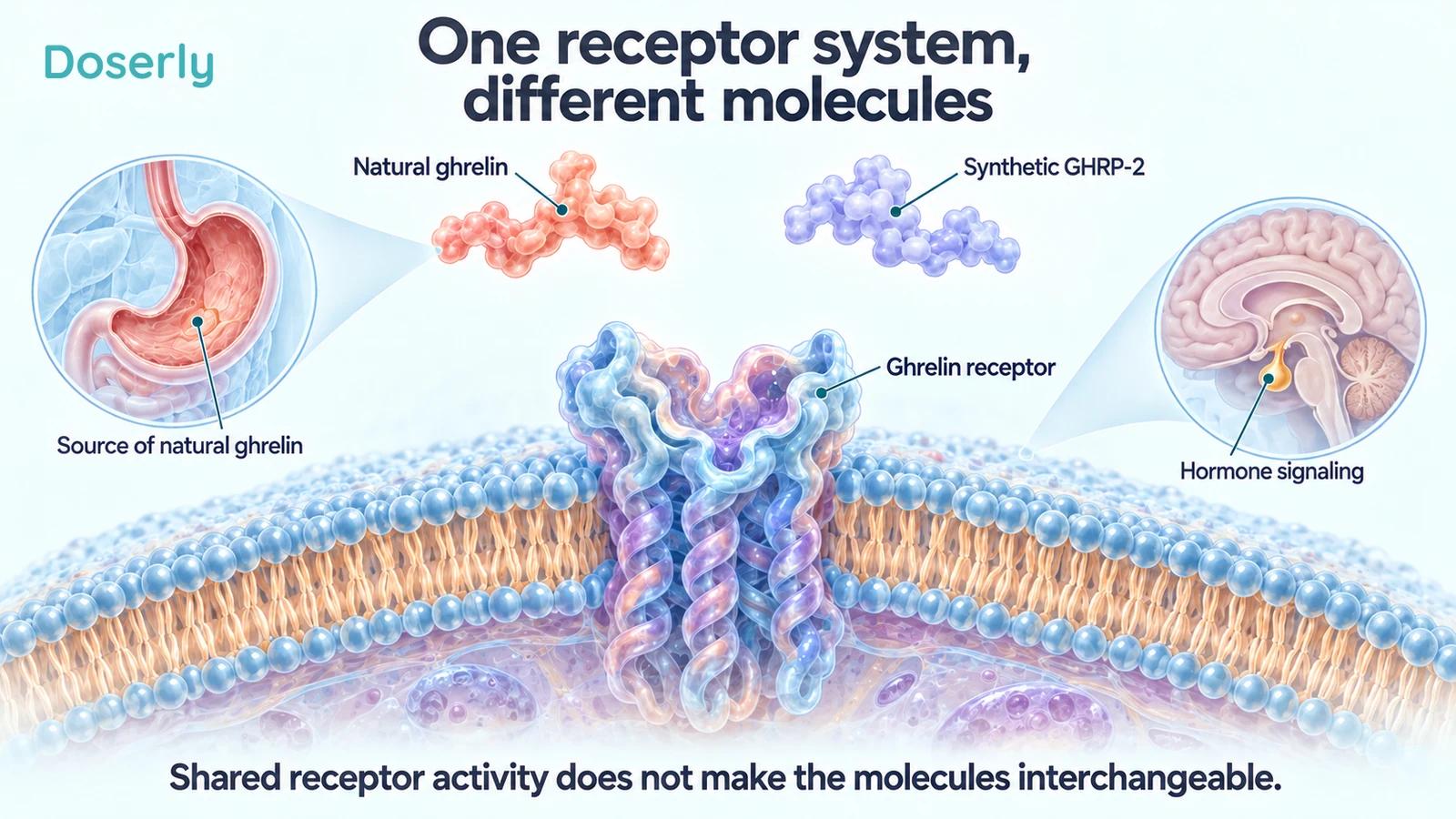
What it means to activate a receptor
A receptor is a protein through which a cell responds to a signal. An agonist activates a receptor. That definition describes an interaction; it does not specify every effect that will follow in a person.
The tissues exposed, the amount and duration of exposure, and the surrounding physiology all matter. The same receptor system can participate in more than one process. A hormone-release response and a change in eating behavior can therefore belong to the same research program without being the same outcome.
It is also possible for two agonists to differ in how they reach tissues or how long their effects last. Knowing that they share a target is useful for developing hypotheses, but it does not establish equivalent clinical effects or safety.
This is why “ghrelin mimetic” should be read as a pharmacological description rather than a promise to reproduce every normal action of ghrelin. It also does not establish that someone has a ghrelin deficiency requiring treatment.
Human appetite studies gave the receptor a behavioral context
Controlled GHRP-2 experiments showed that its effects were not limited to a laboratory growth-hormone measurement. In one small study of lean men, participants consumed more food at a buffet meal during GHRP-2 exposure than during saline exposure. Human food-intake study
A later randomized crossover study included 19 lean and obese adults. It measured hormone responses, hunger ratings and food intake across three visits. The higher GHRP-2 exposure produced a larger food-intake effect than the lower exposure, and participants with obesity retained a response. Follow-up study
These studies helped establish a human behavioral effect of a synthetic ghrelin-receptor agonist. They do not identify which part of the complete neural network caused each person's behavior, and they were not long-term nutritional-treatment trials.
For a reader, the important distinction is between a physiological tool and a proven therapy. A compound can help researchers investigate how appetite works while remaining inadequately studied as a treatment for a particular disease.
Appetite is not the same as gastric emptying
Gastric emptying is the movement of stomach contents into the small intestine. Gastrointestinal motility describes the muscular activity that moves and mixes material through the digestive tract. Hunger is an experience; food intake is an observed behavior. Each can be measured separately.
A person may feel hungry while having difficulty tolerating a meal. Another may have abnormal stomach emptying without describing hunger as their main problem. It is therefore important to ask which measurement a study actually examined.
The buffet studies measured how much food participants ate under controlled conditions. They were not direct demonstrations that GHRP-2 normalized stomach emptying in people with a motility disorder.
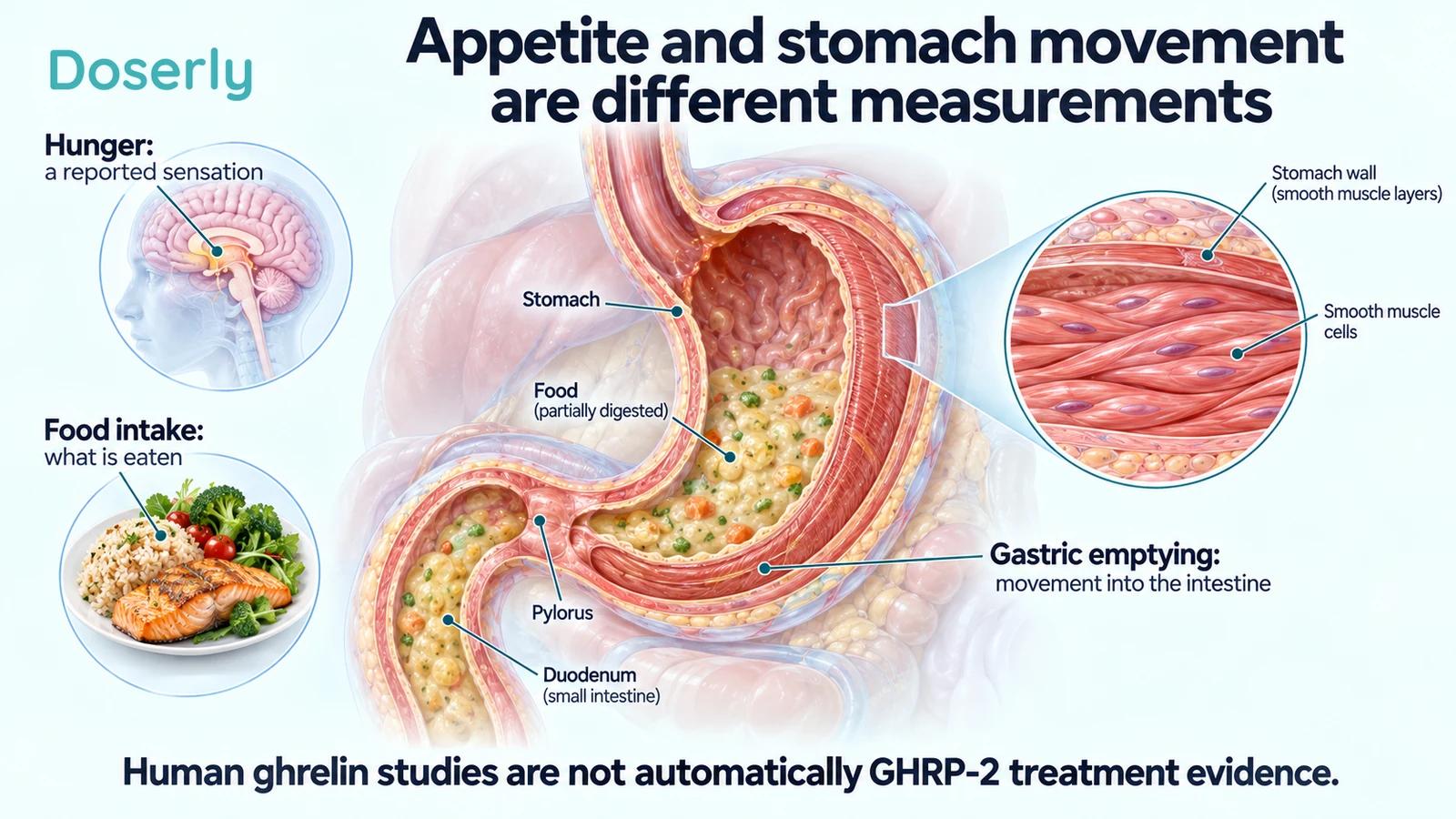
This distinction is particularly important when several papers are grouped under “ghrelin research.” The same broad biological topic can contain trials of different molecules and experiments measuring different processes.
Native ghrelin has been tested directly in human motility studies
A randomized crossover study in nine healthy volunteers examined native ghrelin and saline during fasting. Researchers measured stomach and duodenal activity using specialized equipment. Ghrelin brought forward a phase of the fasting motor pattern and increased proximal stomach tone. Interdigestive motility study
Another randomized crossover investigation used a labeled solid meal to measure emptying during ghrelin or saline infusion. It reported faster emptying with ghrelin. The study also considered growth-hormone replacement in a separate deficient-patient context, and the authors did not attribute the emptying effect simply to increased growth hormone. Gastric-emptying study
These are human findings about administered ghrelin. They support interest in the receptor system beyond bodybuilding. They do not establish an equivalent effect for GHRP-2, and they should not be cited as if participants received it.
The distinction also protects the useful result. There is no need to change the drug's identity to explain why the findings matter. They show that ghrelin biology can influence gastrointestinal function in humans, which gives researchers a reason to investigate specific candidate therapies.
Why isolated tissue experiments can look different
Whole-body studies include nerves, circulation and interacting organs. An isolated tissue preparation removes much of that context so investigators can study a more restricted mechanism.
A study of human and rat gastrointestinal tissues found differences in receptor-associated staining and functional responses between species and regions of the gut. Ghrelin enhanced nerve-evoked contractions in one rat stomach preparation but did not produce the same effect in the colonic preparations tested. Receptor and tissue study
A later study of isolated human stomach tissue compared several drug classes. Under its assay conditions, ghrelin did not consistently enhance the measured neuromuscular response. Human stomach experiments
These findings do not simply cancel the human infusion studies. They help define where a direct local effect was or was not demonstrated, and why whole-body effects may involve additional pathways. They also show why a result from rat tissue should not be presented as a clinical result in people.
For drug development, such differences matter. A plausible receptor target is only the beginning; the actual candidate must produce a useful effect in the relevant human condition.
What the severe anorexia case adds
A published case described intranasal GHRP-2 in a severely underweight patient with longstanding anorexia nervosa, persistent digestive symptoms and difficulty increasing intake. The clinicians reported improvements in hunger, early satiety, hypoglycemia and weight during prolonged observation. Case report
This report is relevant because it connects the receptor discussion with a real clinical problem. It is still one patient's course, with no randomized comparison and ongoing care. It cannot separate every possible contributor to improvement.
The case also should not be reclassified as a trial establishing that GHRP-2 treats gastroparesis, constipation or eating disorders generally. Described symptoms and clinical observations are not the same as a controlled efficacy result for each diagnosis.
Its value is in identifying a carefully defined research question: could a particular agonist help selected patients whose inadequate intake persists despite other care? Answering that would require studies designed around the condition, nutritional outcomes and safety.
Why the ghrelin receptor and the GHRH receptor are distinct
GHRP-2 and GHRH can both stimulate growth-hormone release, but they do not act through an identical receptor. Human research in people with an inherited GHRH-receptor mutation helps illustrate the distinction.
In a study of 11 affected individuals and eight controls, GHRP-2 produced a small residual growth-hormone response in the mutation group. The response was far below that of controls. Receptor-mutation study
The finding supports some GHRH-independent activity. It does not mean GHRP-2 restored normal function or bypassed every consequence of the mutation. A measurable increase from a very low baseline can remain low in absolute terms.
This is a useful example of how a peptide can reveal physiology without becoming an established replacement treatment. The experiment probes what the remaining system can do. A treatment trial would ask whether repeated administration improves meaningful outcomes.
What this broader biology means for a patient
The receptor's involvement in several systems makes it scientifically interesting. It also makes a one-purpose description incomplete. A substance discussed for growth hormone may affect appetite, and a natural ligand studied for motility may have endocrine effects.
That does not establish that all of those effects will be beneficial together. Increased hunger might be useful in one clinical situation and unwanted in another. A measurable change in stomach activity might not relieve the symptom a patient actually wants treated.
If a proposed treatment is justified with “ghrelin research,” ask which molecule the study administered, whether it involved people or isolated tissue, and whether it measured the relevant outcome. A precise answer might identify native ghrelin, a different agonist or a GHRP-2 experiment. Those distinctions are the substance of the explanation, not minor naming details.
GHRP-2 has helped researchers explore a receptor system that reaches beyond growth-hormone release. The available findings support that broader biological interest while leaving disease-specific treatment questions open. The GHRP-2 evidence section provides a wider view of the human studies.
Sources
- Ghrelin discovery.
- GHRP-2 food-intake study.
- Follow-up appetite study.
- Native ghrelin and fasting motility.
- Native ghrelin and gastric emptying.
- Rat and human gastrointestinal tissue.
- Isolated human stomach experiments.
- Severe anorexia case report.
- GHRH-receptor mutation study.