
Peptides
October 16, 2026
What functional brain imaging adds to kisspeptin research
On this page
Kisspeptin helps connect the brain with the reproductive hormone system. Researchers also want to understand its relationship with sexual desire: could changing kisspeptin signaling alter how someone responds to sexual or emotional cues? That question matters to people whose persistently low desire causes distress, particularly when a hormone result alone doesn't explain their experience.
Functional magnetic resonance imaging, usually shortened to fMRI, offers one way to investigate this. It lets researchers compare patterns of brain response during kisspeptin and placebo exposure. The result is more specific than simply asking whether a peptide raises reproductive hormones. It can help identify the processes involved when someone sees a sexual image, evaluates a face or experiences an emotional stimulus.
The findings are encouraging enough to justify further research. They don't yet show that an infusion produces a lasting improvement in someone's sex life. To understand why both statements can be true, it helps to separate three things: the scan signal, a person's immediate response and a treatment benefit that persists outside the laboratory. Our kisspeptin guide explains the broader reproductive biology; here, we'll focus on what the imaging contributes.
What does the scanner actually measure?
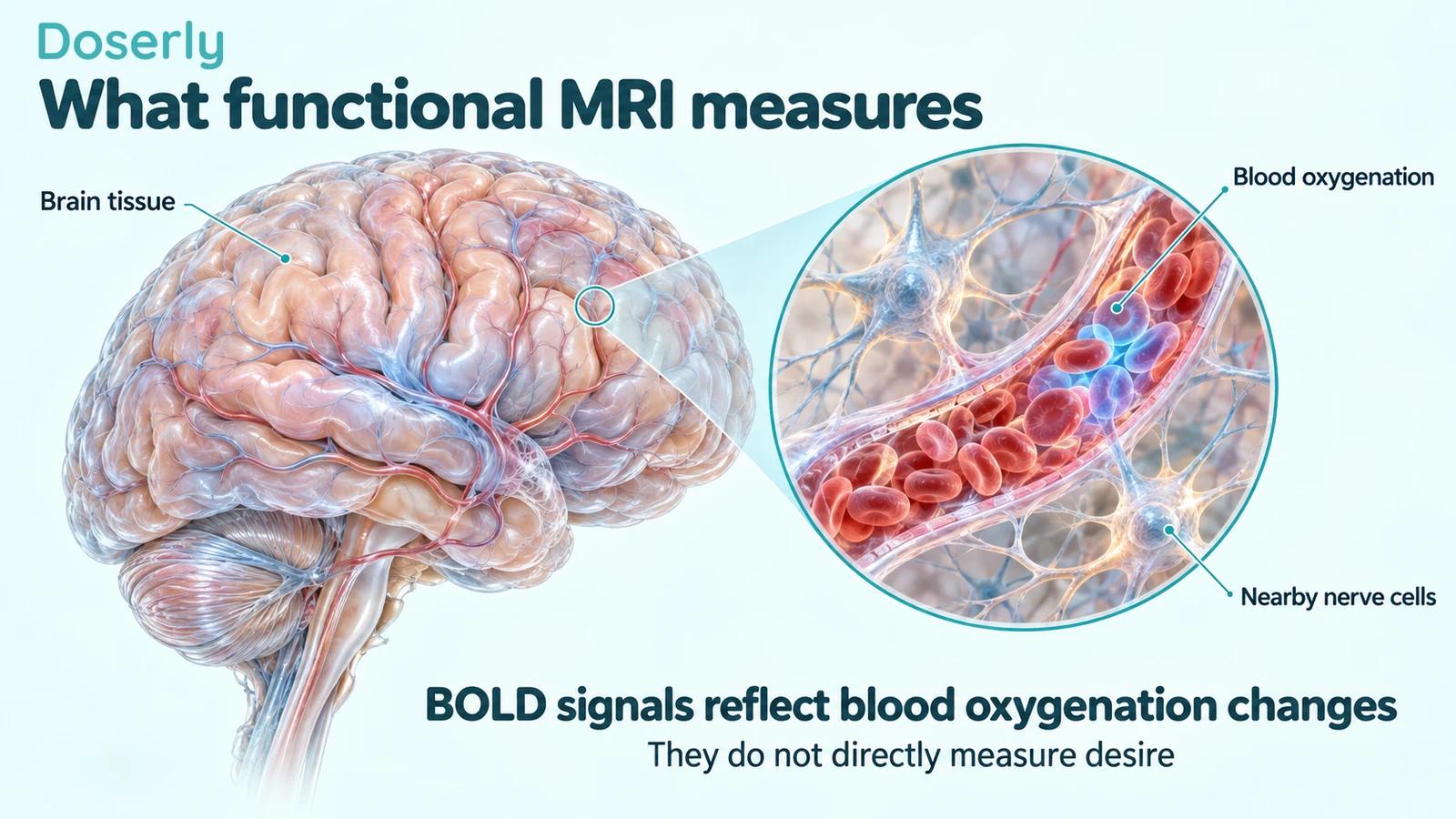
The studies discussed here use a signal called blood oxygen level dependent, or BOLD. When local brain activity changes, blood flow and oxygen use change too. The scanner detects magnetic differences associated with blood oxygenation. It does not count thoughts or directly record the electrical activity of every nerve cell.
A foundational experiment combined electrical recordings with fMRI in the visual cortex of monkeys. It found a closer relationship between the BOLD response and local field potentials, signals reflecting activity within neural populations, than with the firing output of individual neurons. This was animal physiology research explaining the measurement, not a kisspeptin treatment study. Logothetis and colleagues, 2001.
That distinction is useful when looking at a colorful scan. A shaded region identifies a statistical difference under the conditions of the analysis. It isn't a photograph of pleasure, attraction or distress. A researcher still needs a task, a comparison and other measurements to interpret what the difference might mean.
Why study kisspeptin in the brain at all?
Kisspeptin is best known for its role upstream of gonadotropin-releasing hormone, or GnRH. GnRH stimulates the pituitary gland to release luteinizing hormone and follicle-stimulating hormone, which help regulate the testes and ovaries. But reproduction also involves motivation, attention, emotion and responses to other people.
An early randomized crossover experiment examined 29 healthy heterosexual young men. Each attended kisspeptin and control visits, allowing comparison within the same person. Kisspeptin altered responses to sexual and bonding images in several limbic and related brain regions. Some changes were associated with questionnaire measures, including sexual aversion. The imaging sessions took place before a downstream testosterone rise, and the study did not find changes in testosterone, cortisol or oxytocin during the relevant assessments. Comninos and colleagues, 2017.
That timing makes the experiment interesting: the imaging findings cannot simply be described as the result of a demonstrated testosterone increase during scanning. It still doesn't identify every biological step between administering kisspeptin and observing a response. The study provided a reason to investigate brain processing more directly, including in people seeking help for low desire.
What changed in women with low sexual desire?
A 2022 trial enrolled premenopausal women with hypoactive sexual desire disorder, or HSDD. This diagnosis concerns low desire associated with distress; it is not a judgment that everyone should want sex equally often. Forty participants were randomized and 32 completed both visits. Each received a 75-minute intravenous infusion of kisspeptin-54 and, on a separate visit, placebo. The study used masking and randomized treatment order.
The main outcomes were BOLD responses to erotic videos and faces. Kisspeptin increased responses in some regions and decreased them in others. Associations with distress and aversion measures added context. No adverse effects were reported during this short experiment. Thurston and colleagues, 2022.
The mix of increases and decreases is worth understanding. “More brain activity” is not a universal definition of improvement. Depending on the task, a lower response in a region might be compatible with less distracting self-monitoring, while a higher response elsewhere might reflect greater attention to the stimulus. These are interpretations of a pattern, not measurements of a single desire center.
Nor does completing two infusion visits tell us how someone feels after several months of treatment. The study's population, route and observation period define the question it answered.
What did the trial in men add?
A separate 2023 crossover trial randomized 37 heterosexual men with HSDD; 32 completed the study. They received kisspeptin-54 or placebo during two 75-minute infusion visits. In addition to brain imaging, researchers measured penile tumescence, a physical measure of swelling during sexual arousal, and subjective responses.
Kisspeptin changed brain responses to sexual videos. Secondary analyses found greater tumescence and an improvement in a questionnaire item about happiness regarding sex. The reported tumescence increase was up to 56% relative to placebo during the task; it was not a 56% increase in libido or a proportion of men whose condition resolved. Mills and colleagues, 2023.
Having several kinds of measurement strengthens the biological picture. It shows that the scan was not the only response observed. But an acute physical response and a person's sense of wellbeing remain different outcomes. Someone may experience physical arousal without wanting a particular sexual interaction, or feel desire without a strong physical response at a particular moment. Neither a scan nor a physiological measurement should be used to override what that person says.
Why the comparison matters as much as the picture
Consider two possible research questions: “Does the brain respond to this video?” and “Does kisspeptin change the response to this video compared with placebo?” They require different comparisons. The first concerns the effect of the task. The second concerns the added effect of the intervention.
A crossover design is helpful because each person contributes observations under both conditions. Many stable personal differences are therefore shared across the comparison. Randomizing visit order helps reduce the chance that practice, familiarity or simply attending a second visit explains the result. Masking reduces the influence of knowing which infusion is being given. These features are described in the 2017 study's methods.
These design choices improve an acute experiment without turning it into a long-term treatment trial. Repeatedly viewing similar material can still affect attention. The setting can shape how comfortable someone feels. A structured laboratory task also captures only a limited part of a person's sexual experience. Those are reasons to interpret the experiment in context, rather than reasons to disregard it.
An especially useful follow-up would ask whether a repeatable imaging response predicts a meaningful improvement for the same individual later. That would require tracking both measures over time, with a prespecified analysis. The existing acute studies do not establish that clinical prediction rule.
What about the brain at rest?
Researchers can also examine functional connectivity: how the timing of signals in different regions varies together. In a 2018 analysis of 29 healthy men, kisspeptin changed several patterns of resting connectivity, including connections involving limbic structures. These changes were related to task responses and psychometric measures obtained during the same study visits. Comninos and colleagues, 2018.
“Connectivity” here doesn't mean the scan shows new physical nerve connections growing. It describes a statistical relationship between measured signals. Two regions varying together might participate in a shared process, respond to another region or share physiological influences. The measurement alone doesn't establish the direction of communication.
This also explains why counting papers can be misleading. A new analysis can answer a valuable new question using participants from an existing experiment. It should not automatically be counted as an independent replication in a new patient group. For a prospective patient, reproducibility across separate studies and populations will matter alongside the number of publications.
Can scent and attraction tasks tell us something different?
A 2020 randomized crossover experiment studied 33 healthy heterosexual men using scent and facial-attractiveness tasks. Intravenous kisspeptin changed brain responses to a pleasant feminine scent and to faces, including activity in regions associated with sensory and attraction processing. Yang and colleagues, 2020.
This broadens the research beyond responses to sexual videos. Attraction involves multiple senses and ways of evaluating a situation. Studying different tasks can help researchers distinguish a narrowly stimulus-specific effect from a response that appears across several related contexts.
Nevertheless, a standardized scent and a collection of photographs are not the same as interacting with a partner. They help isolate components of experience precisely because they simplify it. The value of the experiment lies in what it can reveal about those components; it doesn't establish that kisspeptin improves relationships or makes a particular person more attractive.
Why questionnaires belong beside imaging
A questionnaire can seem less impressive than a scanner, yet it can measure the very problem a patient wants help with. Distress about low desire is an experience. A treatment intended to reduce that distress needs to ask about it directly. The trial in women with HSDD included psychometric assessments alongside imaging, allowing researchers to examine relationships between these different measurements.
The quality of the question matters. A momentary rating during a laboratory visit answers a different question from a validated assessment covering several weeks. Satisfaction, desire, discomfort, relationship concerns and frequency of sexual activity also describe different aspects of life. A useful trial needs to choose outcomes that match its intended benefit.
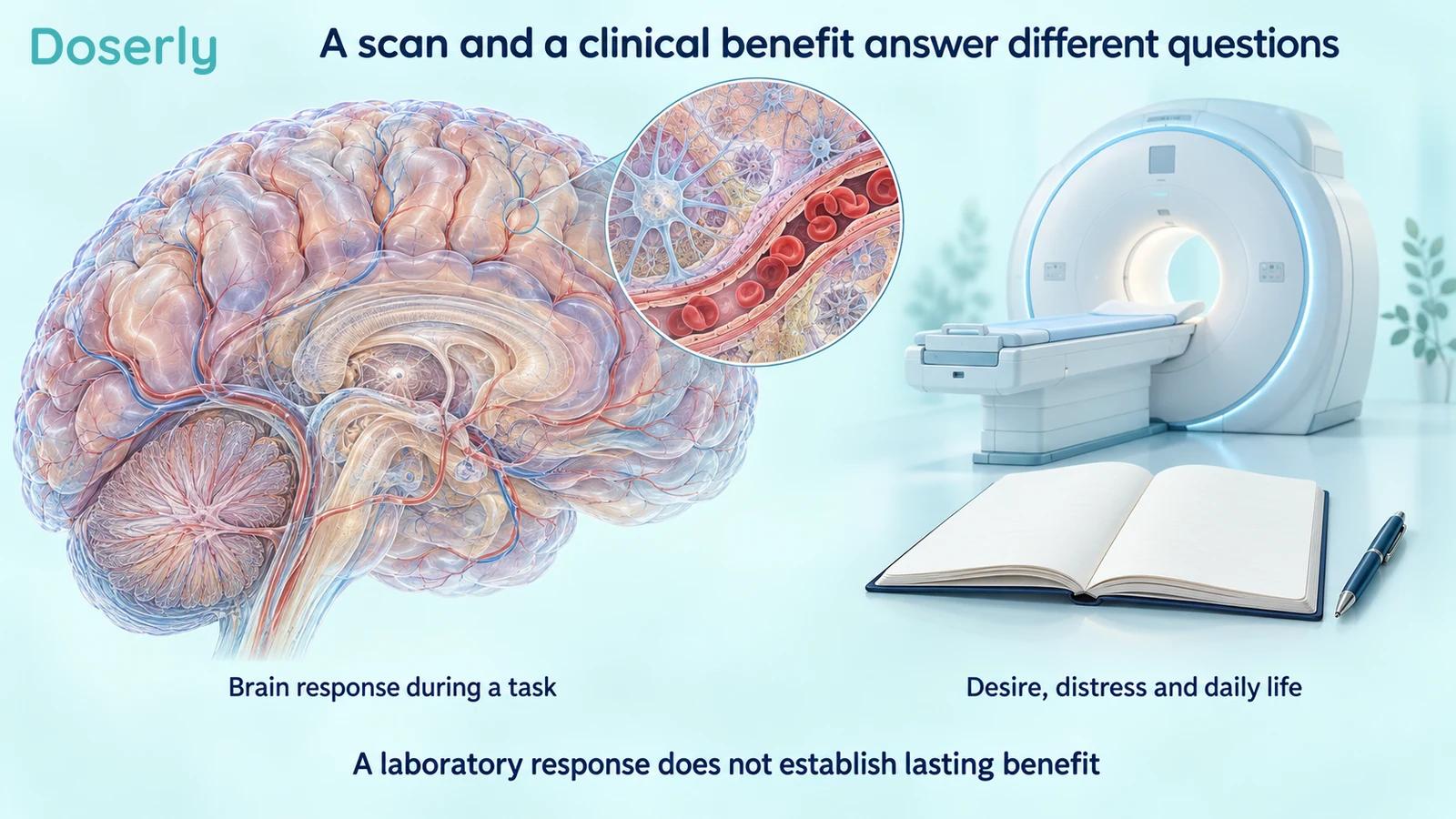
Imagine someone whose scan changes after an infusion but who notices no worthwhile improvement afterward. For that person, a biological response alone would be an incomplete reason to continue treatment. Conversely, an improvement in a well-measured patient outcome would remain clinically relevant even if researchers had not yet explained every corresponding brain change. Imaging can explain and refine a treatment; it does not replace the goal of helping the patient.
What would make these results clinically useful?
The next step is more than obtaining a brighter scan. A treatment program would need a defined patient group, a formulation people can use, and evidence that benefit persists with repeated exposure. Researchers would also need to describe tolerability, discontinuations and what happens after treatment stops.
For imaging specifically, useful questions include whether the response is reproducible, whether it changes with repeated treatment, and whether it predicts improvement beyond information already available from clinical assessment. A scan that adds no practical predictive information may still be valuable for understanding biology, without becoming a routine clinical test.
The route is another important distinction. These studies used controlled intravenous kisspeptin-54 infusions. Their findings do not validate an online kisspeptin-10 product, an intermittent injection schedule or a combination with other peptides. Changing the molecule's length, route and exposure changes the intervention being evaluated.
Bringing the research back to your own question
If low desire is troubling you, it is reasonable to describe both the change and why it matters: when it began, whether it varies by situation, whether there is pain or another symptom, and whether medicines or major life changes occurred around the same time. These details help a clinician understand the concern more directly than an isolated hormone number or an image from somebody else's experiment.
If kisspeptin is proposed, ask what outcome the supporting study actually measured and how your own improvement would be assessed. “Did it change a scan?” and “Did it help people feel better over time?” are both worthwhile questions, with different answers so far.
Functional imaging has added a credible human research avenue to kisspeptin's reproductive biology. It helps investigate how the brain processes cues under controlled conditions. The person's experience remains central when deciding whether those changes amount to a useful treatment. The human research section of our kisspeptin guide places these experiments alongside the hormone and fertility studies.
Explore the research
- Logothetis et al., 2001: neural recordings and the basis of BOLD. Foundational monkey physiology, not human treatment evidence.
- Comninos et al., 2017: sexual and emotional brain processing. Acute randomized crossover study in healthy men.
- Thurston et al., 2022: women with HSDD. Imaging trial with 32 participants completing both visits.
- Mills et al., 2023: men with HSDD. Imaging, physiological arousal and behavioral outcomes.
- Comninos et al., 2018: resting brain connectivity. Relationships between resting signals and responses within study visits.
- Yang et al., 2020: olfactory and visual attraction cues. Acute crossover experiment in 33 healthy men.