
Peptides
October 16, 2026
Hexarelin and CD36: why a second receptor changes the research story
On this page
Hexarelin is usually introduced as a growth-hormone-releasing peptide. Its interaction with CD36 adds a different line of research: a peptide can affect a tissue through a binding target that is separate from the receptor responsible for its familiar endocrine action.
That discovery helps explain why researchers investigated hexarelin in the heart. It does not mean that CD36 is a dedicated “heart repair receptor,” or that binding it must produce a benefit. One of the key experiments actually measured coronary vasoconstriction in isolated animal hearts. CD36 identification study.
The useful story is how researchers moved from an unexplained cardiac response to a candidate molecular target—and what that target still cannot tell a person considering hexarelin for heart health.
CD36 already had a biological job
CD36 is a protein found on the surface of several cell types. It participates in handling lipids and in cellular recognition and signaling. It is not present solely to respond to hexarelin.
Early work connected a rat fat-cell membrane protein with the binding or transport of long-chain fatty acids and identified its close relationship to human CD36. Later CD36-knockout mouse experiments showed changes in fatty-acid handling, circulating lipids and macrophage uptake of oxidized LDL. Together, these experiments helped establish that the protein was involved in several aspects of lipid biology. Original cloning work, CD36-null mouse study.
Oxidized LDL refers to chemically modified low-density lipoprotein particles. Macrophages—immune cells that take up material from their surroundings—can accumulate lipids after taking up these particles. CD36's role in that process links it to atherosclerosis research, but the protein's actions depend on the cell and biological setting.
This background makes the phrase “activates CD36” incomplete as a health claim. Which cells are affected? Which ligand is binding? What changes downstream? Those details determine whether a particular effect is potentially useful, harmful or simply a measurable response.
The first clue came from isolated rat hearts
In 1999, investigators studied hexarelin in a Langendorff preparation: an isolated rat heart supplied with a controlled perfusion solution. This allowed them to examine cardiac and coronary responses outside the full endocrine environment of a living animal.
Hexarelin increased coronary perfusion pressure in a dose-dependent manner. The team also used a radioactive, light-activated hexarelin derivative to label a binding protein in cardiac membranes. The protein differed from the familiar pituitary receptor story. Two other GH secretagogues did not displace the labeled compound from those cardiac binding sites and did not produce the same vasoconstrictive response. Original cardiac-binding study.
The result supported the existence of a distinct cardiac target. It did not yet identify every function of that target, and it certainly did not show improved blood supply in patients. Coronary perfusion pressure in an isolated-heart experiment is a laboratory measurement, not a direct report of a person's symptoms or coronary health.
That is why keeping the direction of the result matters. Replacing “coronary vasoconstriction in this preparation” with “better circulation” would reverse the biological observation.
Identifying the protein made the hypothesis testable
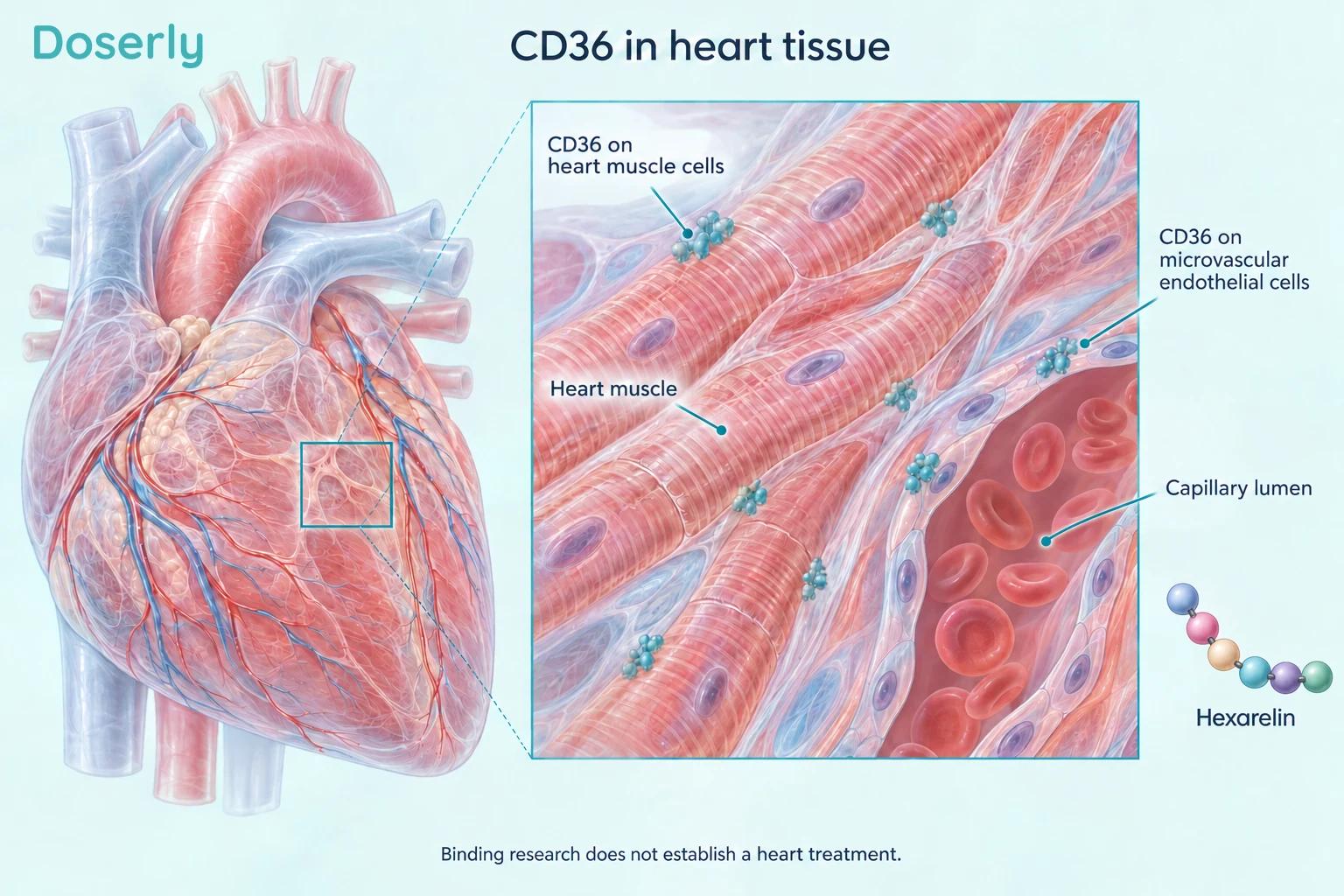
The 2002 follow-up identified the labeled cardiac binding protein as CD36. Researchers found it in cardiomyocytes, the muscle cells of the heart, and in microvascular endothelial cells, which line small blood vessels.
They then compared heart preparations with and without functional CD36. The hexarelin-induced increase in coronary perfusion pressure was absent in CD36-null mouse hearts and in hearts from a rat strain genetically deficient in CD36. The response also tracked with CD36 expression. Bodart and colleagues.
That is stronger evidence than finding a peptide and receptor in the same tissue. Removing the candidate target changed the response, supporting a causal role for CD36 in that particular experiment.
The scope remains important: it establishes dependence of a specific coronary response on CD36 under those experimental conditions. It does not establish that every cardiac action of hexarelin, every human response or every long-term outcome uses the same route.
Binding is a step in the explanation, not the whole explanation
A molecule can bind a protein without producing the clinical effect someone hopes for. Even when binding changes cellular signaling, the next steps depend on how much of the molecule reaches the tissue, how long it remains there and what other processes are active.
This is why receptor affinity and clinical efficacy are different measurements. Affinity concerns interaction under defined experimental conditions. Efficacy for a health problem concerns outcomes in an organism or patient. A stronger laboratory binding result is not automatically a better treatment.
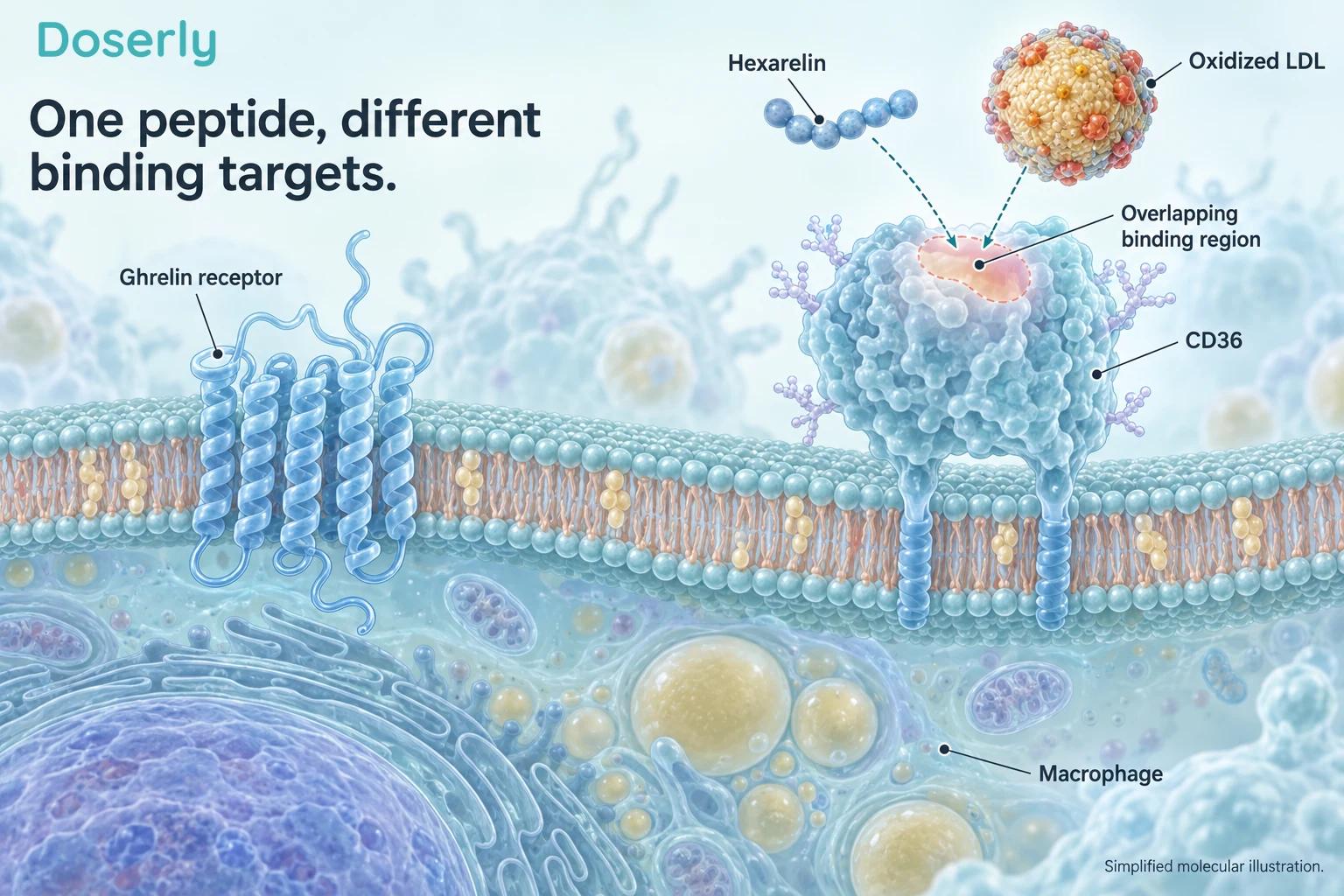
The distinction is especially relevant for hexarelin because it has more than one relevant target. The ghrelin receptor participates in its endocrine actions, while CD36 provides a separate line of mechanistic evidence. A blood GH measurement cannot quantify CD36 engagement in the heart, and a CD36 binding assay cannot establish a useful GH response.
The Doserly hexarelin mechanism section explains the broader receptor context. The presence of a second target makes the pharmacology more complex; it does not make the benefit-risk judgment simpler.
The overlap with oxidized LDL is intriguing—but easy to overstate
A 2004 study used photoaffinity labeling and controlled protein cleavage to locate the hexarelin-binding region on CD36. The identified region overlapped a region implicated in oxidized-LDL binding. Competition experiments also showed that related peptides, including GHRP-2 and GHRP-6, interacted with the binding system. Binding-site study.
The investigators proposed that hexarelin might interfere with CD36-mediated handling of modified lipoproteins. That is a mechanistic hypothesis grounded in biochemical experiments. It does not show that hexarelin clears plaque from human arteries or substitutes for treatments used to manage cardiovascular risk.
Think about the missing steps. A binding overlap does not by itself establish the effect on lipid uptake in every cell. A change in uptake does not establish the net effect on an arterial lesion. A change in an animal lesion does not establish fewer heart attacks in people. Each step is a distinct testable question.
The same paper also prevents a uniqueness claim. CD36-related binding was not exclusive to hexarelin among the peptides examined. That does not make the compounds clinically interchangeable, because similar binding is only one part of their pharmacology.
What genetic deletion tells us about atherosclerosis
In a separate study, investigators crossed CD36-null mice with a strain lacking apolipoprotein E and prone to atherosclerosis. The double-null mice developed less atherosclerotic lesion area under the tested conditions, and their macrophages took up less modified LDL. CD36/apoE mouse experiment.
That result is relevant to why CD36 became a drug-development target. It is not a hexarelin treatment trial. Removing a protein genetically throughout development is a very different intervention from administering a ligand that interacts with it for a limited period.
This distinction also prevents an oversimplified conclusion that CD36 is simply good or bad. Its involvement in normal lipid handling and disease-related processes means that the desired intervention would have to be evaluated in a particular context. A genetic experiment can identify a promising question without supplying a safe way to manipulate the system in people.
For a reader, the practical test is to keep the intervention attached to the result. If the experiment deleted CD36, the result belongs to genetic deletion. It should not silently become a claim that any CD36-binding peptide produces the same outcome.
A related peptide is not hexarelin
EP 80317 is an especially important example. Researchers studied this CD36 ligand, derived from the GHRP family but without GH-releasing activity, in apoE-deficient mice. Treatment reduced atherosclerotic lesion development and altered cholesterol handling; these effects were not observed in mice lacking both apoE and CD36. EP 80317 experiment.
The study supports investigation of CD36-directed drug development. Its results belong to EP 80317 in that mouse model. They should not be relabeled as human hexarelin results simply because the compounds are related.
The absence of GH-releasing activity is part of what makes the experiment informative. It helps separate a candidate CD36-related action from stimulation of the GH axis. Treating every member of the peptide family as identical would discard precisely the distinction the researchers were using.
Likewise, a rat pressure-overload heart-failure study found favorable cardiac changes with several GHRPs, including hexarelin, GHRP-1, GHRP-2 and GHRP-6. That suggests that some experimental cardiac effects are shared. It does not establish identical receptors, equal efficacy or safe substitution in people. Multi-peptide rat study.
Why another experiment can find vessel dilation
If CD36 experiments found vasoconstriction, why do some hexarelin papers describe coronary dilation? The experiments did not all examine the same preparation or signaling pathway.
A later rat study used synchrotron imaging and reported acute coronary microvascular dilation involving the ghrelin receptor and vascular signaling mechanisms. Repeated hexarelin did not prevent right-ventricular hypertrophy or impaired relaxation in its pulmonary-hypertension model. Rat microvascular study.
The useful interpretation is not that hexarelin must always constrict or always dilate coronary vessels. Its observed effects depend on the preparation, vascular compartment and pathway under investigation. The negative longer-term finding also shows why an acute change in vessel behavior cannot be assumed to prevent disease.
These differences are a reason to preserve the details rather than choose whichever result sounds most favorable. A molecule with multiple targets may produce several effects, and their net clinical significance requires a study of the actual clinical use.
The human heart findings do not identify CD36 as the cause
Small human experiments found brief increases in left ventricular ejection fraction after intravenous hexarelin. In one study, the cardiac response differed from that after recombinant GH despite similar overall GH exposure. That supports the idea of an effect beyond simply raising circulating GH. Human cardiovascular experiment.
It does not prove that CD36 caused the response in those participants. The study did not establish human CD36 target engagement as the explanation, and it did not test long-term prevention of cardiovascular events.
This distinction matters when a mechanistic story is used to strengthen a treatment claim. Animal receptor evidence and human physiological evidence can be compatible without completing the chain of proof. Putting them beside each other is useful; presenting the proposed connection as directly measured in people is not.
What CD36 genuinely adds
CD36 adds a plausible, experimentally investigated binding target and a way to ask more precise questions about hexarelin's non-endocrine actions. It helps distinguish a growth-hormone response from other tissue responses, and it opens research questions about vascular tone and lipid handling.
It also adds complexity. CD36 has multiple ligands and roles; related peptides share some interactions; and the observed vascular effects are not uniformly favorable across experimental settings. The receptor's name cannot function as a guarantee of cardiac protection.
For someone evaluating a heart-health claim, ask for the human outcome and the exact intervention behind it. The hexarelin evidence overview is a useful place to separate receptor studies, animal treatment experiments and short human challenges. None should be mistaken for an established indication simply because the biological explanation is detailed.
The discovery is scientifically meaningful. Its value is in making the next experiment more specific—not in bypassing the need for that experiment.
Explore the research
- Fatty-acid transport protein cloning.
- CD36-null mice and lipid handling.
- Original cardiac hexarelin binding study.
- Identification of CD36 and knockout-heart comparisons.
- Hexarelin binding-region mapping.
- CD36 deletion and atherosclerosis in mice.
- EP 80317 in apoE-deficient mice.
- Several GHRPs in rat heart failure.
- Rat microvascular imaging and right-ventricular findings.
- Acute human cardiovascular study.