
Peptides
October 16, 2026
Survodutide liver endpoints: what would show meaningful clinical benefit?
On this page
A liver can contain less fat on an MRI without a trial having shown that patients will avoid cirrhosis. A biopsy can show improved disease activity without establishing fewer transplants or longer survival. These are not reasons to disregard encouraging results. They are reasons to describe the benefit at the level actually measured.
Survodutide research makes this distinction especially useful. Its liver studies include different populations, tests and outcome definitions. The question is therefore more specific than whether the drug “helps the liver”: which feature improved, how reliably was it measured, and what does that tell us about future health?
A clinically meaningful liver result may involve less tissue injury, slower progression, fewer serious complications, better daily functioning or longer survival. Those goals are connected, but a study must establish the connection it claims. The Doserly survodutide guide covers the broader development program; this article explains how to judge its liver endpoints.
Start with the feature the test can see
Metabolic dysfunction-associated steatotic liver disease, or MASLD, encompasses more than one disease state. Fat accumulation, inflammatory injury and fibrosis are separate features. MASH refers to the inflammatory form, while fibrosis describes scar tissue.
Tests observe those features in different ways. MRI proton-density fat fraction estimates liver fat. Liver biopsy provides a tissue sample that can be examined for fat, inflammation, cell injury and scarring. Elastography assesses stiffness, which helps evaluate fibrosis risk but is not the same measurement as microscopic fibrosis stage. Blood tests add information that clinicians interpret alongside the wider assessment. NIDDK diagnostic overview.
That means a headline should preserve the noun after “improved.” Improved liver fat is a fat result. Improved biopsy disease activity is a tissue-activity result. Improved stiffness is a stiffness result. Calling all three “reversed liver damage” removes information needed to understand the evidence.
The distinction also works in the other direction. A test that does not measure a particular feature cannot reliably exclude it merely because another measurement looks reassuring. An individual's results require clinical interpretation; a trial's results require the same discipline at group level.
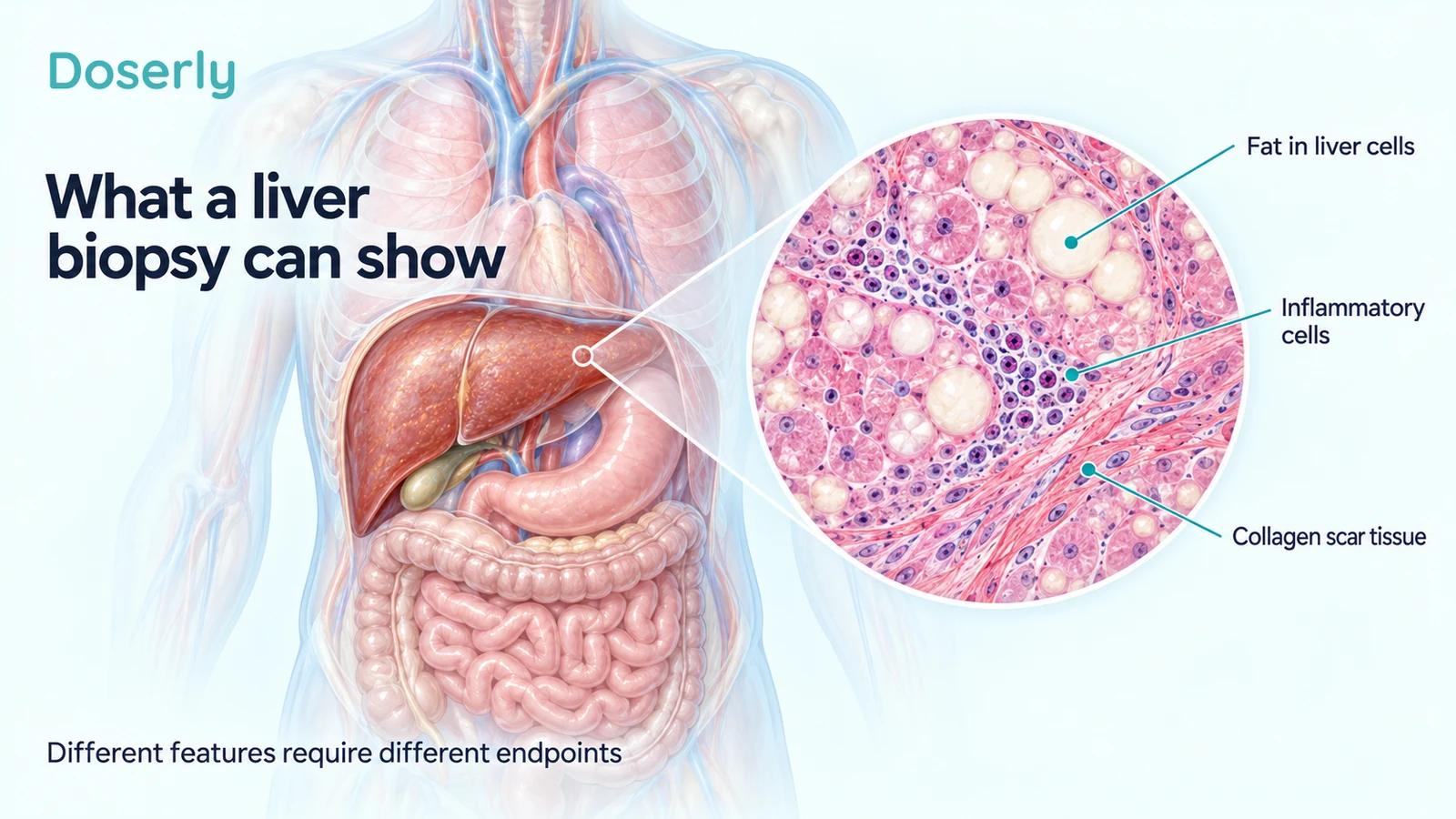
What the phase 2 biopsy trial actually asked
The 2024 phase 2 trial enrolled adults with biopsy-confirmed MASH and fibrosis stages F1 through F3. It compared three survodutide target doses with placebo over 48 weeks. The primary endpoint was improvement in MASH without worsening fibrosis.
The definition matters: improvement in disease activity is not the same as complete resolution of MASH, and “without worsening” does not mean fibrosis improved. The endpoint combines a required improvement in one domain with protection against deterioration in another.
The primary response occurred in 47%, 62% and 43% of participants in the three survodutide groups, compared with 14% with placebo. Improvement in fibrosis by at least one stage was a separate result: 34%, 36% and 34%, compared with 22%. These percentages should not be swapped or presented as different descriptions of the same success. Phase 2 MASH trial.
A precise interpretation is that the trial found a stronger response on its defined MASH activity endpoint with survodutide. A claim that nearly two-thirds of participants had scar tissue reversed would misidentify what the largest percentage measured.
This is not a merely semantic issue. Someone concerned about progressive fibrosis may reasonably care about an endpoint different from the one producing the most striking headline.
Why fibrosis is important, but not a complete answer
Fibrosis deserves attention because disease stage relates to future risk. In a prospective study, 1,773 adults with fatty liver disease were followed for a median of four years. Advanced fibrosis was associated with more liver-related complications and death. Prospective outcomes study.
That evidence gives a clinical reason to investigate treatments that prevent progression or improve fibrosis. It does not prove that every treatment-induced change in a fibrosis score will produce the same reduction in events.
The difference is between prognosis and intervention. A prognostic study observes that people starting with more advanced disease tend to have worse outcomes. A treatment trial must establish what happens when a particular intervention changes a measurement, including any benefits and harms that accompany treatment.
For example, a one-stage biopsy improvement may be encouraging. Its practical meaning still depends on the starting stage, durability, comparison with placebo and eventual clinical outcomes. It should not be converted into a percentage reduction in transplant risk unless a suitable study measured that risk.
Why intermediate endpoints are used
Waiting for enough serious liver complications to occur can require large studies and years of follow-up. Intermediate endpoints can provide earlier evidence about disease activity and help decide whether further development is justified.
An FDA draft guidance from December 2018 illustrates this approach. It describes certain histological improvements as endpoints reasonably likely to predict clinical benefit, while also describing trials intended to verify benefit through progression and clinical events. The document is draft, nonbinding guidance, not a survodutide approval decision. Its value here is the distinction between an earlier tissue-based signal and confirmation of outcomes that matter directly to patients. FDA draft development guidance.
Calling an endpoint intermediate does not mean it is unimportant. It means the measurement stands between treatment and the ultimate outcome of interest. Confidence grows when the endpoint is well defined, consistently assessed, responsive to treatment and supported by evidence linking it to later health.
The challenge is to retain both parts of that reasoning: the result can justify optimism, and the eventual benefit can remain uncertain.
What MRI-based results add
SYNCHRONIZE-MASLD examined survodutide in adults with overweight or obesity and MASLD using an MRI-based liver-fat endpoint alongside body-weight change. At 48 weeks, 68.5% of the survodutide group and 28.6% of the placebo group reached a relative liver-fat reduction of at least 30% under the primary treatment-regimen analysis. SYNCHRONIZE-MASLD trial.
“Relative” matters. As an illustration, a 30% reduction from a liver-fat fraction of 20% would bring it to 14%, not to zero and not to a negative value. That arithmetic example is not a trial participant's result.
The study strengthens evidence that treatment can change measured liver fat in its enrolled population. It does not make the MRI endpoint identical to a biopsy endpoint, or establish that the same proportion experienced fibrosis regression.
The paper's different stiffness assessments also require care: a favorable change in one measurement should not be summarized as universal agreement across all fibrosis-related tests. That is another reason to name the actual test and endpoint.
“No worsening” is a condition, not a cure
Compound endpoints can be difficult to read because their wording contains more than one requirement. Consider “improvement in fibrosis without worsening MASH.” A participant needs to meet the fibrosis criterion and avoid the specified worsening in disease activity.
Now compare “MASH resolution without worsening fibrosis.” The required positive change is different. Both formulations are clinically motivated, but neither can be shortened to “liver disease cured.”
A person who fails a composite response definition may still improve on one component. Conversely, someone who meets it may retain other disease features. A response rate summarizes the prespecified rule; it does not describe every aspect of each participant's health.
When two studies use different rules, their response percentages are not directly interchangeable. Before comparing them, check the definition, the starting disease stage, the time point and how missing assessments were handled.
Clinical events make the next claim more direct
Some outcomes describe disease consequences more directly: progression to cirrhosis, new decompensation, liver transplantation or death. Decompensation can include complications such as ascites, bleeding from varices or hepatic encephalopathy.
These events differ in severity and frequency. A trial may combine several into one composite endpoint so that it can detect a treatment difference within a feasible period. The overall composite then needs interpretation alongside its components. A reduction driven mainly by one component is not automatically evidence of a reduction in every other component.
The registered LIVERAGE study reflects the distinction between early histological assessment and longer-term outcomes. Its plan includes week-52 biopsy endpoints and a later composite concerned with disease progression and clinical events. A separate study, LIVERAGE-Cirrhosis, examines a population with compensated MASH cirrhosis. These are study plans, not completed benefit claims. LIVERAGE registry, LIVERAGE-Cirrhosis registry.
The records checked on October 15, 2026 did not have posted results. Their existence shows what researchers intend to test. It cannot be used as evidence that survodutide already prevents those outcomes.
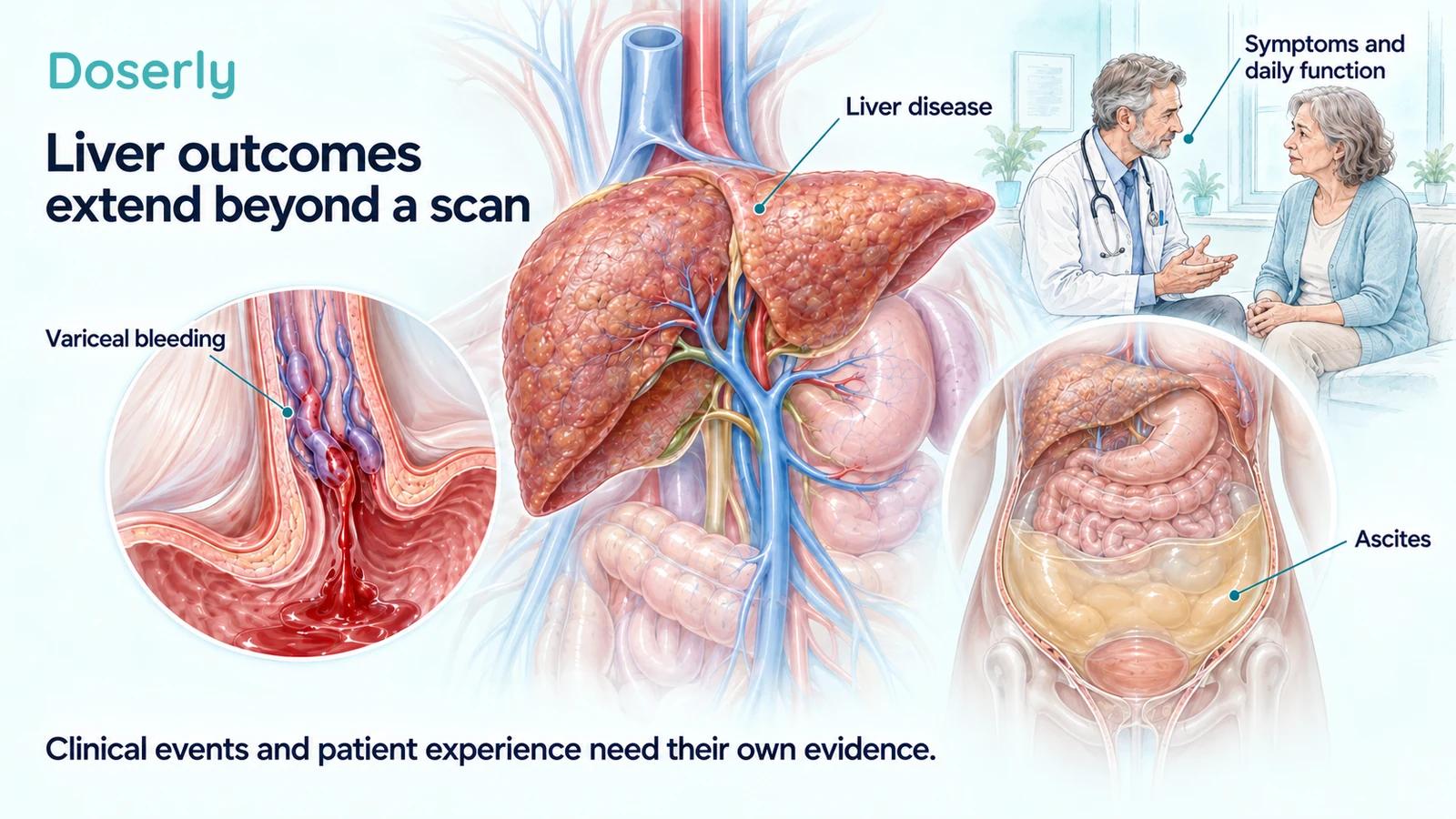
Feeling better is also an outcome worth measuring
A patient may care most about fatigue, physical functioning or the burden of treatment. Those concerns deserve direct assessment rather than being inferred from an improved scan.
A study can include validated patient-reported measures to evaluate how people feel or function. To interpret them, readers need to know what questionnaire was used, when it was administered, how much change occurred and whether that difference is meaningful in the relevant population.
This is a statement about what a useful trial can measure, not a claim that the liver studies above established a specific symptom benefit. The point is that biological improvement and lived experience are related questions that may require different instruments.
Treatment burden belongs in that discussion too. A favorable liver endpoint does not make nausea, treatment discontinuation or monitoring requirements irrelevant. Benefit and tolerability must be considered together, particularly when treatment is intended to continue for a long time.
The denominator can change the apparent result
An endpoint percentage is incomplete without an analysis population. Does it describe everyone randomized, everyone treated, people who stayed on treatment, or people with an available follow-up scan or biopsy?
These groups can differ. If people with poor response or difficult adverse effects are less likely to have a later assessment, simply summarizing those with complete measurements may give an incomplete picture. A trial's approach to missing data therefore contributes to the meaning of its result.
Similarly, a hypothetical analysis estimating what would happen with continued adherence answers a different question from an analysis incorporating treatment discontinuation. Neither should be quietly substituted for the other when choosing a headline.
For a liver study, useful reporting identifies the treatment strategy, endpoint definition, time point and handling of unavailable assessments together. Those details let a reader understand what the estimated benefit represents.
A practical way to read the next liver headline
Before accepting a broad claim, work through five questions:
- Who was enrolled? Fatty liver identified through imaging, biopsy-confirmed MASH, noncirrhotic fibrosis and compensated cirrhosis are different populations.
- What changed? Name the measurement: fat fraction, tissue activity, fibrosis stage, stiffness, symptoms or clinical events.
- Compared with what? Look for the placebo or active-comparator result, rather than the treated group's change alone.
- Over what period? A week-48 tissue result is not a multi-year outcome.
- What remains unproven? Identify the next claim that would require a different endpoint or longer follow-up.
Applied to survodutide, this approach preserves the promise of its liver research without overstating the evidence. The biopsy and MRI studies provide meaningful information about measured disease features. Whether those effects translate into fewer serious complications, improved daily life or longer survival requires evidence designed around those outcomes.
Sources
- NIDDK: diagnosis of fatty liver disease — diagnostic background.
- Survodutide phase 2 MASH trial — randomized biopsy-based trial, 2024.
- Prospective outcomes in fatty liver disease — observational cohort, 2021.
- FDA draft guidance on noncirrhotic NASH drug development — draft methodological context, 2018.
- SYNCHRONIZE-MASLD — randomized MRI-based trial, 2026.
- LIVERAGE — registered trial plan, checked October 15, 2026.
- LIVERAGE-Cirrhosis — registered trial plan, checked October 15, 2026.