
Peptides
October 16, 2026
What a longer kisspeptin treatment trial needs to show
On this page
Kisspeptin helps the brain regulate reproductive hormones. Human experiments show that giving it can raise luteinizing hormone, or LH, and influence other parts of the reproductive system. For someone hoping to improve fertility, restore menstrual cycles or address distressing low desire, the next question is whether that response can become a useful continuing treatment.
The answer cannot come from the first blood sample alone. Researchers need to know whether the intended benefit lasts, whether repeated exposure changes the response and whether the treatment remains acceptable and safe. They also need to study the particular condition being treated. An LH rise in a healthy volunteer doesn't answer the same question as ovulation in someone with a reproductive disorder.
There is already more than single-dose research to consider. Studies have followed repeated kisspeptin exposure for days or weeks, including a 2026 report of stimulation through 12 days. Those findings help identify what a longer trial should test. They do not establish one ongoing regimen for all the reasons people are interested in kisspeptin. Our kisspeptin guide explains the different molecules and research settings.
Start with a condition and a benefit
A longer trial needs a clear purpose before it needs a longer calendar. “Improving reproductive health” is too broad to define a meaningful result. A trial aimed at ovulation should assess ovulation. A trial for low desire should assess the person's desire and associated distress. A trial seeking to support sperm production needs semen outcomes, with enough observation to see whether they change.
Hormones remain useful in all of these settings. They can show that a treatment engages the intended pathway and help explain different responses. But their role changes depending on the question. LH might be the main endpoint of a physiological experiment and a supporting measurement in a fertility trial.
This is also why investigators should specify the diagnosis carefully. Hypothalamic amenorrhea involves reduced hypothalamic reproductive signaling and absent periods. Polycystic ovary syndrome, or PCOS, is a different and heterogeneous condition that can involve disrupted ovulation. A treatment that stimulates the pathway might behave differently in these groups, even if both include people with irregular or absent periods.
What the repeated-exposure studies already tell us
A 2009 study in women with hypothalamic amenorrhea found strong initial hormone responses to subcutaneous kisspeptin-54, followed by a diminished response during repeated administration. This fading response is called tachyphylaxis. It showed why a successful first exposure was not enough to predict sustained stimulation. Jayasena and colleagues, 2009.
A subsequent study followed a twice-weekly pattern for eight weeks. It found partial desensitization, rather than the more complete tolerance seen with twice-daily exposure, and retained reproductive hormone responses compared with saline at eight weeks. No adverse effects were observed in that study. Jayasena and colleagues, 2010.
These are useful pharmacological findings: they describe how the response changes when exposure changes. They do not establish that eight weeks of the regimen reliably restores fertility. A longer efficacy trial would need to connect maintained signaling with a patient-relevant outcome, rather than assuming that a persisting laboratory response is the whole benefit.
How much does the 12-day study advance the question?
In 2026, researchers reported subcutaneous kisspeptin-10 experiments in healthy men. Fifteen men were recruited across three components, and 12 men served as controls. The study included acute exposure, five days of continuous infusion and daily eight-hour infusions over 12 days.
With the intermittent pattern, gonadotropin responses remained detectable on day 12. With five days of continuous exposure, testosterone remained elevated, but gonadotropin concentrations were similar to vehicle. A bolus after the intermittent regimen could still produce a hormone response. Yeung and colleagues, 2026.
The result is a meaningful step beyond a single injection. It demonstrates that a particular repeated-exposure pattern can maintain endocrine stimulation in a small group. The next step is not simply to rename 12 days “long-term treatment.” Researchers need to investigate a relevant patient population, observe the intended benefit and follow repeated treatment long enough to characterize its durability.
A daily infusion lasting hours also raises a practical question. Would the same person be willing and able to continue that delivery method for months? An effective exposure in a supervised experiment can still be difficult to turn into an acceptable everyday treatment.
Ovulation illustrates the gap between signaling and function
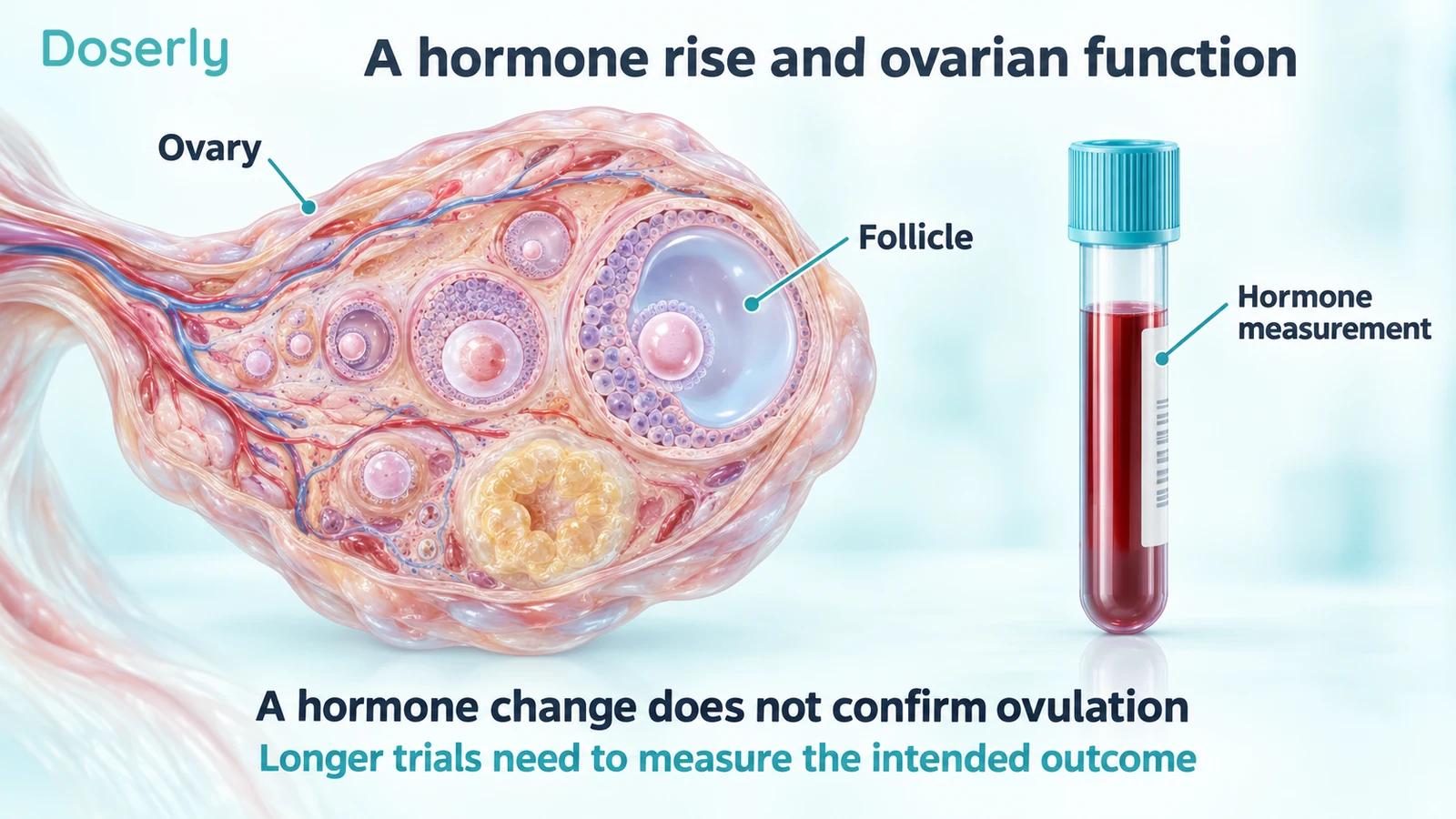
A 2019 study included a pilot cohort of 12 women with anovulatory PCOS, alongside separate rat experiments. The women received repeated kisspeptin-54 over 21 days. Two developed a dominant follicle and subsequently ovulated; another had follicle growth without ovulation. One showed desensitization, and the remaining women had no follicular response. Romero-Ruiz and colleagues, 2019.
The small uncontrolled human component cannot estimate a reliable treatment success rate. It does, however, show why ovarian function needs to be assessed directly. A hormone change, follicle growth and ovulation are related steps, but observing one doesn't guarantee the next.
A larger trial would need a suitable comparator and clearly defined eligibility. It would also need to distinguish ovulation per treatment cycle from the proportion of women who ever ovulate, and both from pregnancy or live birth. These denominators matter to someone trying to understand their chance of benefit over time.
Low-desire treatment needs its own longer trial
The acute sexual-desire studies address a different clinical goal. In a 2023 trial, 32 men with hypoactive sexual desire disorder completed two visits comparing a 75-minute kisspeptin-54 infusion with placebo. Brain responses changed, with associated findings in physiological arousal and behavioral measures. Mills and colleagues, 2023.
That experiment provides a rationale for further study. A continuing treatment would need to improve outcomes that matter outside the scanner: desire, distress, satisfaction or other prespecified aspects of sexual wellbeing. Investigators should avoid assuming that more sexual activity is automatically the right endpoint for every participant.
Repeated patient reports could help distinguish a brief laboratory response from a durable improvement. They would also show whether benefit varies, fades or is outweighed by inconvenience or adverse effects. A meaningful outcome should reflect the person's own priorities rather than a clinician's interpretation of a scan alone.
Delivery has to work in daily life
Intravenous infusions allow researchers to control exposure closely. They are less convenient as an ongoing outpatient treatment. Other routes therefore deserve direct study rather than assumptions about equivalent effects.
A 2025 study investigated intranasal kisspeptin-54 in 12 healthy men, 12 healthy women and 10 women with hypothalamic amenorrhea. The human experiments examined acute hormone responses, with repeated blood sampling after administration. They provide evidence that the nasal route can stimulate gonadotropin release under studied conditions. Intranasal kisspeptin study.
That finding does not validate every nasal product or show that repeated use restores ovulation or wellbeing. A longer trial would need to characterize delivery reliability, handling, adherence and local tolerability. If some participants miss treatment because it is burdensome, that is part of the practical result, not merely a detail to remove from the analysis.
The formulation matters just as much. Kisspeptin-10, kisspeptin-54 and modified analogues should be named separately. The same nominal amount or frequency does not demonstrate equivalent exposure across molecules and routes.
What should researchers measure over time?
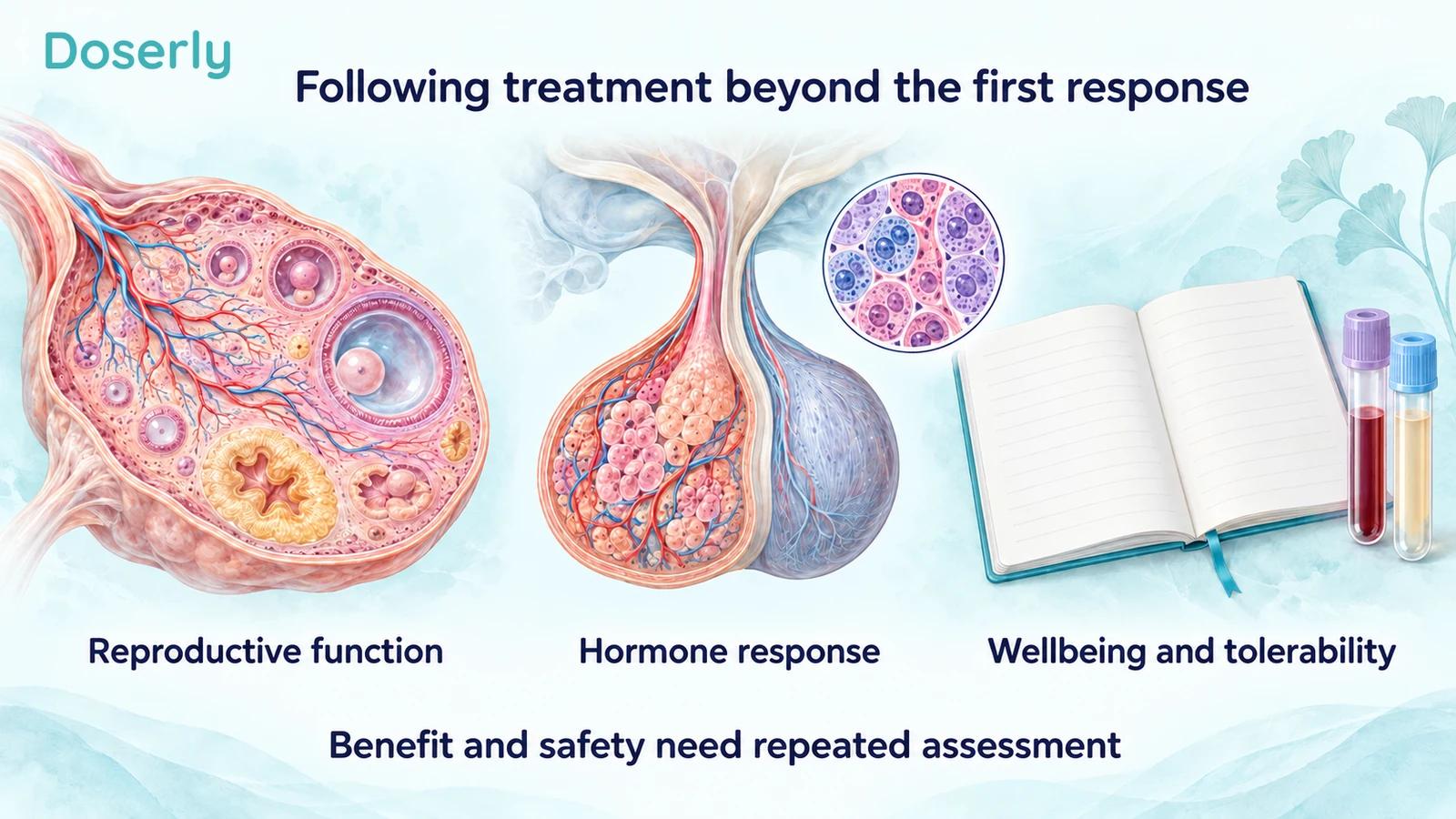
A good trial would assess both the response and the process of receiving treatment. Baseline measurements establish the starting point. Follow-up measurements show whether changes are sustained, while visits after discontinuation can help distinguish continued drug effect from recovery of endogenous function.
For a hormone-related indication, sampling needs to account for time since administration and, where relevant, menstrual-cycle phase. Otherwise a higher post-dose measurement can be compared with a lower pre-dose measurement and mistaken for a broader improvement. Repeated samples or carefully standardized timing are often more informative than collecting a single convenient value.
For a fertility indication, investigators would need to prespecify the functional outcome and observation period. For a symptom indication, they should use a suitable assessment and define what magnitude of improvement patients would find worthwhile. The plan should also explain how missing observations and changes to other treatments will be handled.
These are proposed requirements for useful future evidence, not an established kisspeptin monitoring protocol. The exact measurements should follow the clinical question rather than a fixed checklist applied to every participant.
Safety needs more than “no events observed”
Small trials can identify common immediate problems, but they provide limited information about uncommon harms or repeated exposure over much longer periods. An absence of observed adverse effects in a small study is reassuring within that experience; it is not proof that no relevant risks exist.
FDA has identified concerns about compounded kisspeptin-10, including potential immunogenicity, peptide-related impurities and difficulties characterizing the active ingredient. Immunogenicity means the possibility of triggering an immune response. These concerns also show why product quality is part of safety rather than a separate administrative issue. FDA compounding safety information.
A longer study should systematically record adverse events, treatment interruptions and reasons people withdraw. It should describe the actual product used and how its quality was controlled. Results obtained with a characterized clinical research formulation cannot automatically establish the safety of a product bought elsewhere.
The size of the study matters as well as its duration. Following a handful of people for longer adds valuable information about them, but does not necessarily provide a precise estimate of a rare risk across a much larger population.
How should a longer trial compare treatments?
A placebo comparison can help determine whether an intervention produces an effect beyond expectations and background changes. An active comparator can answer a different question: whether it improves on, or offers a useful alternative to, an established treatment. The appropriate design depends on the indication and what care participants would otherwise receive.
Random assignment helps balance factors that could influence the result. Masking can reduce expectation effects when feasible. But the main practical issue is whether the comparison resembles the decision facing a patient. A labor-intensive infusion might need to offer an advantage that justifies its burden compared with another available approach.
Researchers should also report the whole treatment experience. A favorable result among people who completed every visit can look different when many participants stopped early. Knowing who discontinued, why they stopped and whether their outcomes were still collected helps readers assess how usable the intervention might be.
What a patient can reasonably ask today
If someone proposes continuing kisspeptin treatment, ask which condition the evidence addresses, which molecule and formulation were studied and what improved beyond a hormone number. Ask how long participants were followed and whether the proposed delivery pattern matches the research.
It is also useful to agree on the intended outcome before treatment: what would count as worthwhile improvement, how it would be assessed and what would lead to reconsidering the plan. Recording symptoms and test dates can support that conversation, but cannot replace controlled evidence or establish why a change occurred.
Longer kisspeptin trials need to turn a biological response into a clear clinical answer. Existing human studies provide useful starting points, including maintained stimulation with some repeated-exposure patterns and limited functional responses in selected patients. Durable benefit, acceptable delivery and adequately characterized safety still need to be demonstrated for each proposed continuing use. The human research section of the kisspeptin guide places those questions in the broader evidence base.
Explore the research
- Jayasena et al., 2009: tachyphylaxis during repeated kisspeptin-54 exposure.
- Jayasena et al., 2010: eight-week endocrine study.
- Yeung et al., 2026: subcutaneous kisspeptin-10 through 12 days.
- Romero-Ruiz et al., 2019: exploratory human PCOS cohort and separate rat experiments.
- Mills et al., 2023: acute study in men with HSDD.
- Intranasal kisspeptin administration, 2025.
- FDA: compounding substances with potential significant safety risks.