
Longevity
October 17, 2026
VO2 max and longevity: building fitness that matters in everyday life
On this page
A flight of stairs is an unusually honest fitness assessment. It asks whether your heart, lungs and muscles can meet a familiar demand without leaving you exhausted. It does not care whether your watch calls your cardiovascular fitness excellent, average or below average. For healthy aging, that everyday capacity is the reason to care about VO2 max in the first place.
VO2 max describes the highest rate at which your body can use oxygen during demanding exercise. Higher cardiorespiratory fitness consistently accompanies better long-term health in observational research. Exercise trials also show that training can improve fitness and preserve useful abilities. Those findings support taking aerobic activity seriously, while leaving room for an important distinction: a fitness measurement is not a personal lifespan prediction.
You do not need an athlete’s score to make worthwhile progress. The useful questions are whether your current activity is sustainable, whether familiar tasks are becoming easier, and whether your measurements are reliable enough to guide a decision. Evidence reviewed through October 16, 2026 points toward building capacity over time, with less emphasis on optimizing a single number.
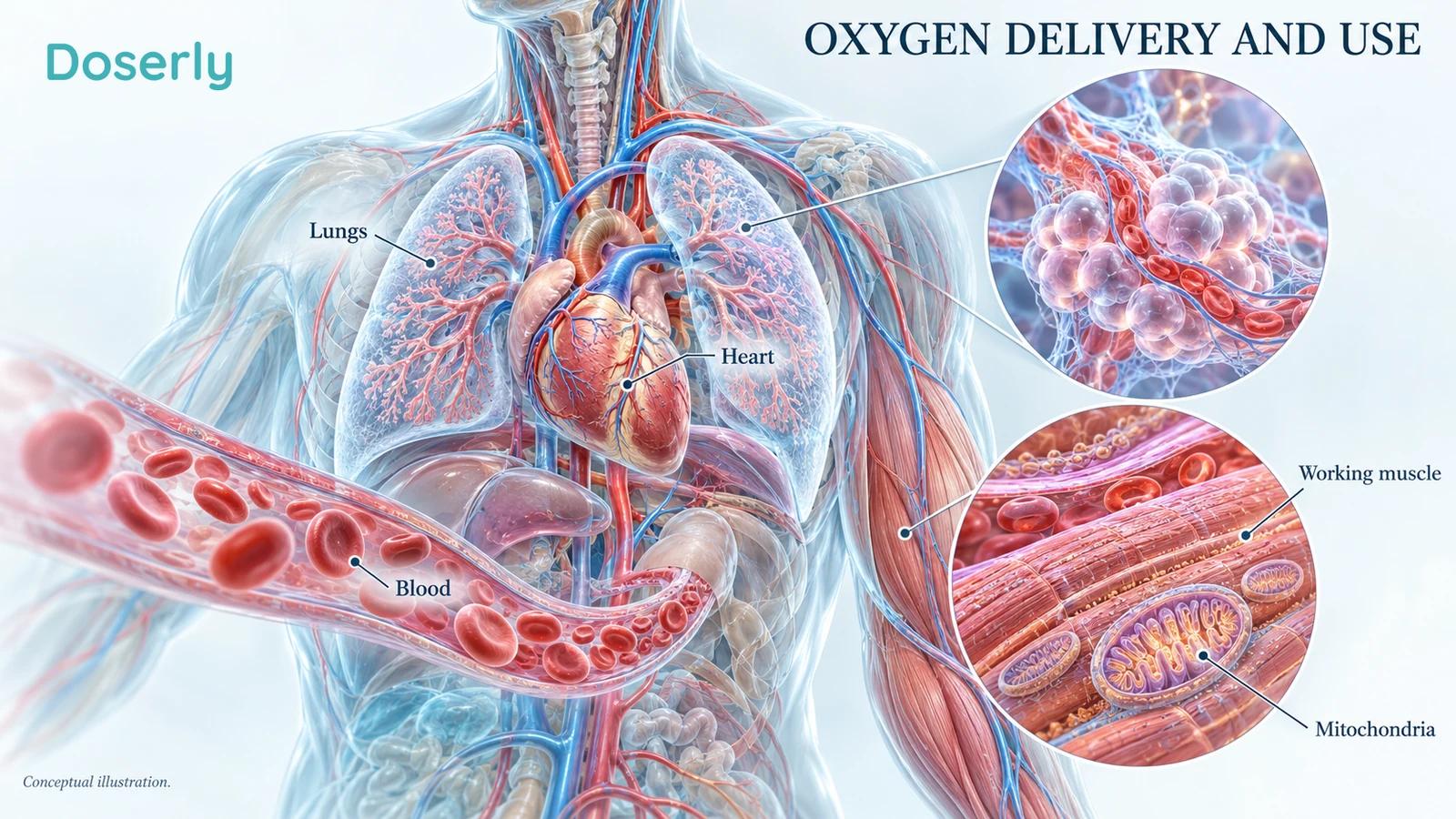
Oxygen delivery and use involve several organs. VO2 max summarizes their combined performance under demanding exercise; it does not diagnose each component separately.
What the number actually represents
During exercise, oxygen moves from the air into the lungs, enters the blood and travels to working tissues. The heart must circulate that blood, and muscle cells must extract and use its oxygen. A limitation anywhere along this system can influence exercise capacity. Strong performance reflects coordinated physiology, rather than a special property located in the lungs alone.
Laboratory assessment usually involves progressively harder exercise while equipment measures the gases you breathe. A treadmill and a stationary bicycle create different tasks, so the testing method matters when comparing results. Clinical reports may use VO2 peak for the highest value reached in a particular test, especially when a clear physiological maximum cannot be demonstrated. The practical interpretation belongs alongside the test conditions and reason for testing.
VO2 is often expressed in millilitres of oxygen per kilogram of body weight per minute. That denominator deserves attention. A relative score can rise when body weight falls even if absolute oxygen use has not increased by the same proportion. A change in the number therefore needs context about training, body composition and health. It should not become an incentive to lose useful muscle simply to improve a ratio.
A laboratory test also offers information that a watch cannot directly provide, including measured gas exchange during controlled exercise. Whether that information is needed depends on the question. Investigating unexplained exercise intolerance is different from keeping track of a walking habit. Recent device validation studies use indirect calorimetry as their comparison precisely because a wearable estimate and a measured oxygen response are different kinds of information. Series 10 validation study.
Why fitness gets so much attention in longevity research
In a 2018 study of 122,007 people referred for treadmill exercise testing, lower fitness was associated with higher mortality over follow-up. The contrast between the lowest and elite fitness groups was substantial. However, participants were not randomly assigned to become unfit or exceptionally fit, and treadmill performance was used to classify fitness. This was a clinical cohort, not a trial proving that a particular training plan extends life by a particular amount. Mandsager and colleagues.
That distinction does not make the result unimportant. A strong association can identify a useful marker while still leaving uncertainty about causes. Illness may reduce someone’s capacity before it is fully diagnosed. People who maintain high fitness may also differ in smoking, resources, medication use or access to care. Statistical adjustment helps, but cannot recreate every advantage of random assignment.
Change over time adds another perspective. A 2026 UK Biobank analysis followed 11,530 participants who completed two submaximal cycling assessments. Improvements in estimated VO2 max were associated with lower subsequent cardiovascular disease and cardiovascular mortality, after adjustment for several other factors. The study strengthens the case for paying attention to fitness trajectories, but remains observational and uses estimated capacity in people able to attend repeated testing. Longitudinal UK Biobank study.
A separate large study of repeated treadmill tests likewise associated changes in fitness with mortality. Agreement across populations makes the pattern more persuasive than a single striking statistic. It still does not turn an extra point on a device into a guaranteed number of additional years. The reasonable response is to improve opportunities for movement and investigate unexpected decline, rather than calculate a personal survival forecast from a fitness category. Kokkinos and colleagues.
What randomized trials can actually establish
Randomized studies answer a more direct question: what happens when people are offered a specific exercise program? They can establish changes in measured fitness or function more readily than changes in lifespan, because deaths are relatively uncommon during the time most trials can afford to follow participants. They also test the program and support provided, not an abstract instruction to exercise more.
The Norwegian Generation 100 trial randomized 1,567 adults aged 70–77 to moderate continuous training, high intensity intervals or a control group advised to follow national activity recommendations. After five years, mortality did not differ significantly between the combined exercise groups and controls. The interval group had a favorable numerical result, but its comparison with controls was not statistically conclusive. Controls were active, and some performed intervals themselves. This was not exercise versus years of complete inactivity. Generation 100 trial.
A smaller two-year randomized study in healthy, previously sedentary middle-aged adults found improved VO2 max and reduced left ventricular stiffness with progressive training. The exercise group’s VO2 max increased by about 18%. That demonstrates meaningful physiological adaptation under the study conditions. It does not establish an 18% improvement in longevity, nor prove that established heart failure can be reversed by copying the program. Participants were carefully screened and received substantial training support. Howden and colleagues.
These trials make a practical point without requiring a lifespan promise. The body can adapt, and the adaptation depends on the program, population and outcome being measured. The benefits you hope to notice may arrive as more comfortable walking or greater confidence on hills. Those are worth tracking even when a study cannot tell you how many birthdays exercise will add.
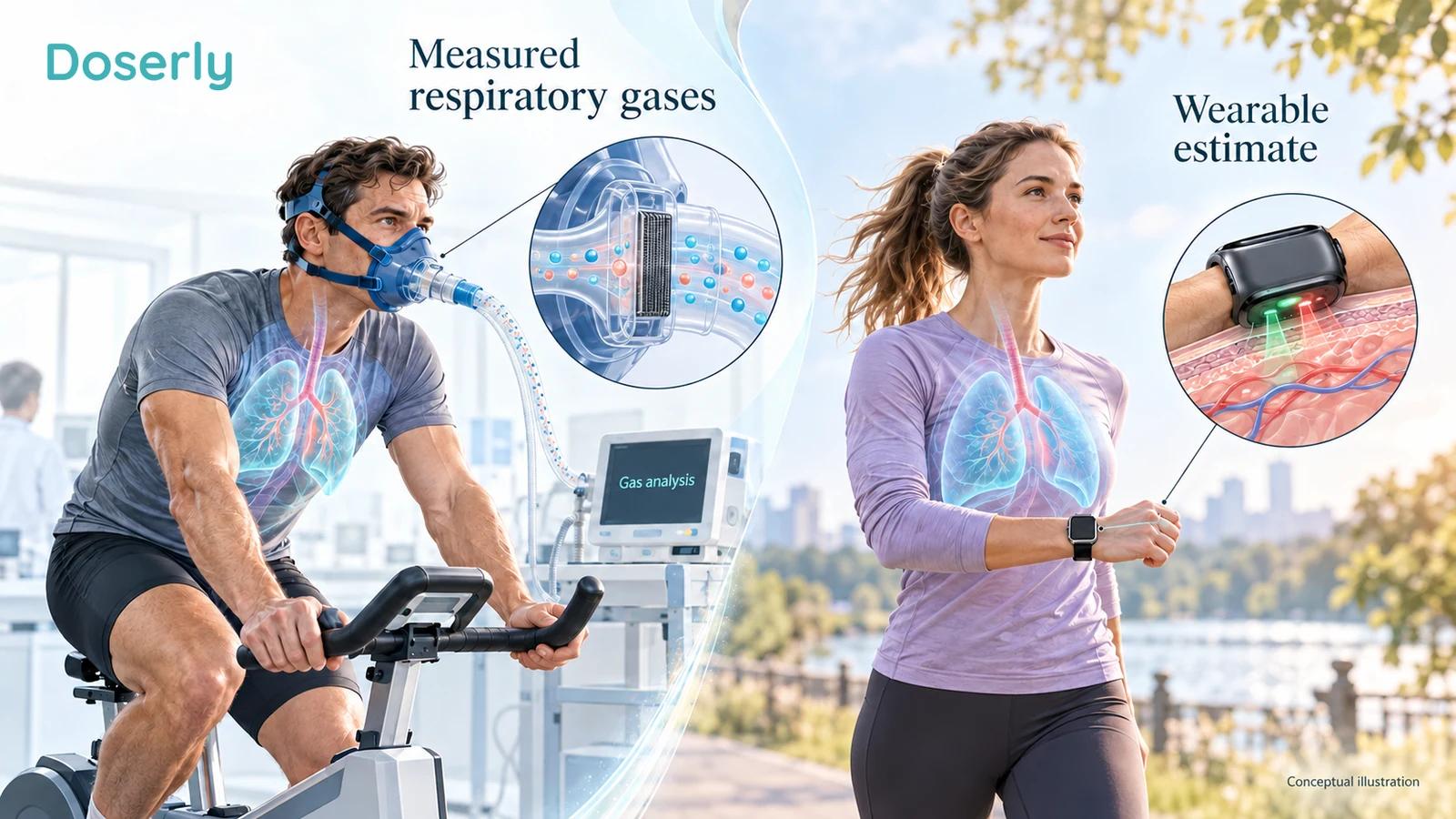
A laboratory test measures respiratory gases; a watch estimates fitness from signals and personal information. The two should not be treated as interchangeable.
Everyday mobility is a meaningful outcome
The LIFE trial focused on an outcome closer to daily independence. It enrolled 1,635 sedentary adults aged 70–89 who had physical limitations but could initially walk 400 metres. A structured program combining walking, resistance work and flexibility reduced major mobility disability compared with health education over an average 2.6 years. Disability occurred in 30.1% versus 35.5%, an absolute difference of 5.4 percentage points. LIFE randomized trial.
That result is more informative than a promise that walking keeps everyone young. It identifies the participants, the comparison and a concrete ability the program helped preserve. It also cannot isolate aerobic exercise from the other elements or the support surrounding them. Serious adverse events were common in both groups in this older population; their occurrence should not all be attributed to exercise, but safety still belongs in the interpretation.
Think about what mobility allows in your own life. Walking to a nearby shop, moving through an airport or taking a grandchild to a park may matter more than a percentile. A useful goal names that activity and the limitation you want to change. If balance, joint pain or weakness is the main obstacle, improving aerobic fitness alone may not solve it.
This is why an exercise plan can include several kinds of work without becoming complicated. Endurance supports sustained activity. Strength helps you produce force. Balance and task practice address other demands. A higher VO2 max should sit within that broader picture of function, alongside the activities you can comfortably repeat and the recovery they require.
Zone 2 is a training label, not a longevity threshold
The phrase zone 2 can create unnecessary precision. Different training systems divide intensity into different numbers of zones, and a device’s default heart-rate boundaries are not the same as individually measured physiological thresholds. Before following a zone target, establish what the label means in that particular system. A shared name does not guarantee a shared workload.
For general activity, perceived effort is often more useful than debating a few beats per minute. The CDC describes moderate intensity as an effort at which you can talk but not sing, while vigorous activity makes speaking more than a few words difficult without pausing for breath. This is a practical guide to effort, not a diagnostic test or an exact substitute for laboratory thresholds. CDC intensity guidance.
Comfortable, sustained sessions can be valuable because they are repeatable. A pace that leaves you able to return tomorrow may fit your life better than one that makes every outing a performance test. That is a planning advantage, not proof that moderate exercise activates a unique longevity pathway unavailable at other intensities.
Consider an ordinary week. If a brisk walk fits between work and dinner and does not aggravate symptoms, it may be a dependable foundation. If hills make the same route much harder, slowing down or choosing flatter terrain can preserve the intended effort. The useful adjustment is to the actual person and conditions, rather than to a rigid interpretation of a watch color.
Where intervals can fit
Intervals alternate harder efforts with easier recovery. They can provide a strong training stimulus, but the word includes a wide range of activities. A supervised cycling interval, a fast run and a short uphill walk are not equivalent exposures. Fitness, symptoms, impact tolerance and familiarity all influence which version is appropriate.
In a small randomized study of 40 moderately trained men, interval programs improved VO2 max more than the comparison programs over eight weeks. This supports intervals as one way to improve aerobic capacity. Its short duration, small sample and male participants limit what it can say about older adults with multiple conditions, long-term adherence or mortality. It did not discover a universal anti-aging workout. Helgerud and colleagues.
For someone already comfortable with regular aerobic activity, a qualified professional can help decide whether occasional harder work adds something useful. For someone restarting after illness or inactivity, building tolerable participation may be the more immediate priority. The distinction is about readiness and purpose, not whether one person is sufficiently committed to longevity.
Recovery also belongs in the plan. If adding intensity makes you abandon the next several sessions, the impressive workout may be undermining the larger habit. Track how the whole week goes, including sleep, soreness and willingness to continue. A sustainable plan is allowed to contain easy days and to change when work, caregiving or health changes.

Training can change physiological capacity. These anatomical structures explain where adaptation can occur; the illustration does not show measured before-and-after results.
What a wearable estimate can and cannot tell you
A watch can make a trend visible without requiring repeated clinic visits. It can also make an uncertain estimate feel authoritative by displaying it to a decimal place. The visual precision of the interface should not be confused with measurement accuracy. An estimate remains dependent on the activity recorded, the signals available and the algorithm used.
A 2025 validation study compared Apple Watch estimates with laboratory measurement and found an average underestimation of about six millilitres per kilogram per minute, with substantial individual error. A 2026 Series 10 study in 40 healthy adults similarly reported an average underestimation of 6.25, with wide limits of agreement. These findings apply to the tested devices, software and participants; they do not establish the error for every watch or every wearer. 2025 validation, 2026 validation.
Apple’s current documentation says its cardio-fitness estimate uses eligible outdoor walking, running or hiking activity and personal information such as age, weight and height. Medication that limits heart rate can affect interpretation, and software changes can revise estimates. That is a reason to keep settings accurate and understand the measurement, not to change prescribed medication to improve a score. Apple cardio-fitness documentation.
A trend can prompt a useful question, but it does not diagnose the answer. If your score falls while your usual walk feels unchanged, check the context before treating the display as a health event. If your actual exercise tolerance is falling, that deserves attention even when the device looks reassuring. Symptoms and function have priority over a consumer category.
Build a baseline you can actually use
Choose one or two familiar activities and record enough detail to make later comparisons fair. A regular walk might include the route, approximate duration, perceived effort and whether you needed extra stops. The purpose is to make your own experience easier to interpret, not to create a second job managing exercise data.
Keep the comparison reasonably consistent. A flat route in mild weather is different from a hilly route during a heat wave. Carrying shopping, pushing a stroller or walking while recovering from an infection changes the task. A note about those circumstances can explain a result more usefully than another decimal place.
Look for patterns across several occasions. One unusually easy session is encouraging, but it may not represent a durable change. Likewise, one difficult day does not erase previous progress. If you retest in a laboratory, use comparable methods and ask the clinician how much change exceeds the test’s expected variability. More measurement is worthwhile when it can improve an actual decision.
When the score and the experience disagree
Imagine two people whose devices display the same value. One comfortably walks to work but rarely records an eligible workout. The other records every run, has recently changed body weight and feels unusually fatigued. Their matching numbers do not create matching clinical situations. The first useful conversation concerns activity and symptoms, followed by the reliability and meaning of the estimate.
An apparent plateau can also have several explanations. Maintaining the same capacity while managing a difficult period may be a successful outcome. A familiar activity may feel easier because you have learned its rhythm or improved confidence, even before a laboratory measure changes. Conversely, chasing a higher test value can distract from pain or fatigue that makes ordinary life harder. Decide in advance which improvement would actually matter to you.
If a measurement leads you to change your plan, make the reasoning explicit. For example, a comfortable walking routine that has become easy may justify discussing a modest progression. An unexplained loss of capacity may justify assessment. A single surprising device update may justify checking the measurement conditions. These are different decisions, and none requires treating a fitness score as a verdict on how well you are aging.
Adapt the plan to the person doing it
Public-health guidance provides a broad destination: adults should work toward 150–300 minutes of moderate aerobic activity, or 75–150 minutes of vigorous activity, each week, alongside muscle strengthening. Older adults also benefit from including balance work. People starting below those amounts can build from what they can manage; the recommendation is not an entry requirement for receiving any benefit. US physical activity guidance.
The form can be adapted. Someone who dislikes running might prefer walking, cycling or water-based activity. Someone with painful weight-bearing joints may need help selecting an option they can tolerate. Someone whose main barrier is fear of falling may need supervised practice and an accessible setting before duration becomes the central concern.
A clinician or exercise professional can help when symptoms, established cardiovascular disease or substantial functional limitations complicate the plan. New chest discomfort, fainting or marked unexplained breathlessness should not be reframed as evidence that a session was productive. Stop the activity and seek appropriate medical assessment rather than using the watch to decide whether the symptom matters.
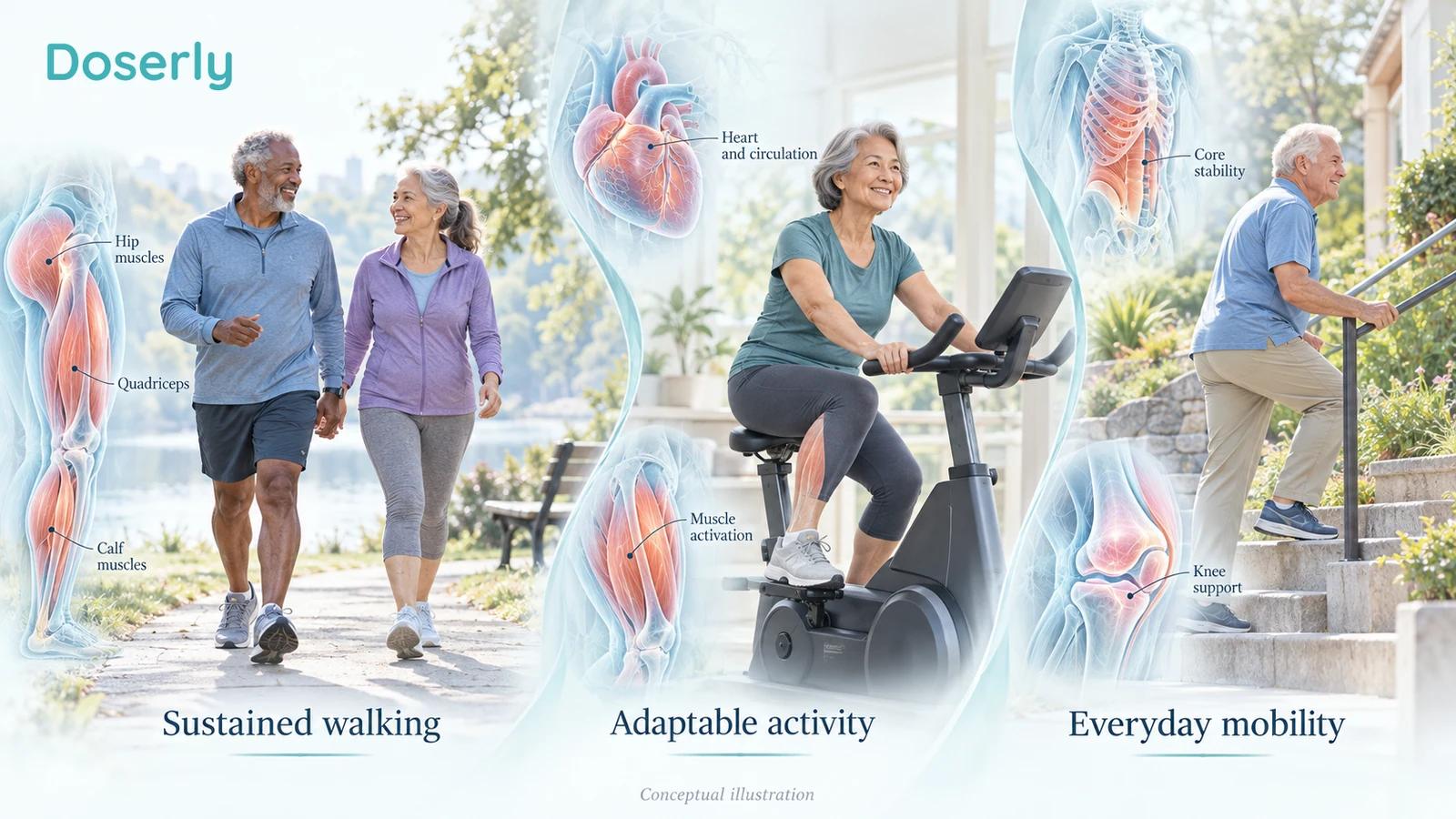
Useful fitness supports activities you value. The route toward it can accommodate different starting points, preferences and physical limitations.
An accessible plan also needs a fallback. If outdoor walking depends on good weather, identify an indoor option before the weather changes. If a group session provides motivation, consider how to stay active when that session is cancelled. If your schedule permits only a short period, use it without assuming that an imperfect week is a failed week. These are ordinary design choices that make the intended activity easier to repeat.
Review the plan after it has had a fair chance to become familiar. Keep the parts that fit, adjust the parts that repeatedly create obstacles, and recognize maintained ability as a worthwhile outcome. The question is whether the routine is supporting your life over time, not whether every session produces a new personal record.
The best long-term scorecard includes participation, capacity and recovery. Are you moving regularly enough to build a habit? Can you do something useful more comfortably than before? Does the plan leave room for strength, balance and the rest of life? VO2 max can contribute to those answers, especially when it is measured well, but the goal is a life you can participate in more fully.