
Supplements
October 16, 2026
Valerian for insomnia: why the extract and the sleep problem matter
On this page
Valerian is a flowering plant whose roots and underground stems have a long history of medicinal use. Today, its familiar place in sleep teas and capsules can make it feel like an established solution for restless nights. The harder question is whether a particular preparation reliably improves the sleep problem you have.
The human research is mixed. Some trials report better sleep with specific extracts; others find little or no advantage over placebo. Those differences deserve explanation rather than a blanket verdict that every valerian product works or that the herb has never shown a benefit. NCCIH overview
A useful starting point is to distinguish the plant from the product and occasional poor sleep from persistent insomnia. We'll look at trials in older women, a larger community study, a newer standardized-extract trial and recent valerian–hops research. The Doserly valerian guide provides additional background on the herb and its preparations.
A root, a tea and an extract are different interventions
A product name can conceal considerable variation. Dried root powder contains plant material. An extract is made by drawing out constituents using a specified process. The amount printed on a capsule may describe the extract, the starting plant equivalent or a mixture that also contains carriers. Those numbers cannot automatically be compared milligram for milligram.
The newer clinical study discussed below, for example, used a preparation characterized as containing 2% total valerenic acid. That is a description of the tested material, not proof that this concentration is optimal or that the named constituent explains every effect. Standardized-extract trial
This has a straightforward implication for shopping: matching the word “valerian” on a label to the word in a study is only the first step. You would also need to match preparation, amount, schedule and accompanying ingredients before claiming that the trial tested the same intervention.
There is no need to become an extraction chemist to recognize the problem. If one study used a defined capsule and another used a different extract, disagreement may reflect genuine differences between products, differences in participants or ordinary study uncertainty. It cannot be resolved simply by selecting whichever result best matches your expectations.

Botanical preparation illustration. The magnified tissue is conceptual, and the pictured capsule is unbranded; it is not the tested product from any one trial.
What happened in older women with insomnia?
A small randomized crossover trial included 16 women with insomnia, with an average age of about 69. Each received concentrated valerian extract and placebo in separate treatment periods. The valerian regimen was 300 mg before bed for two weeks. Sleep was assessed through laboratory polysomnography, daily sleep logs and wrist actigraphy.
Valerian did not significantly outperform placebo for time to fall asleep, time awake after initially falling asleep, sleep efficiency or self-rated sleep quality. The result was negative across several ways of assessing sleep rather than just one questionnaire. Taibi and colleagues, 2009
For an older person with persistent insomnia, this is directly relevant evidence about a tested extract. Sixteen participants are too few to settle every possible effect, and two weeks cannot establish what happens over months. Nevertheless, the study does not support promising that the same treatment reliably improves sleep in similar women.
It also illustrates why “I felt relaxed” and “my insomnia improved” can diverge. A treatment may be pleasant to take without shortening prolonged wakefulness or improving next-day functioning. If repeated awakenings are your main concern, it is particularly useful to see whether a trial measured them instead of assuming that a general sleep claim includes them.
A larger community trial found, at most, modest effects
A Norwegian study recruited through television and the internet and analyzed 405 participants who supplied sleep-diary data after starting valerian or placebo. Treatment lasted two weeks. Its main outcome was a predefined improvement in self-rated sleep quality.
About 29% in the valerian group and 21% in the placebo group met that threshold. The reported difference was 7.5 percentage points, with a 95% confidence interval from −0.9 to 15.9 points; p=0.08. The interval included no difference. A separate overall assessment of whether sleep was better favored valerian, but the main result was not statistically clear. Oxman and colleagues, 2007
This is more nuanced than either “no one improved” or “valerian worked.” Some people improved in both groups. The question is how much extra improvement the treatment produced. The estimate allowed for a modest advantage, but also for little or no advantage.
For a consumer, that uncertainty changes the expectation. The findings do not resemble a reliably large sleep benefit. They also remind us that different questions on the same questionnaire can produce different-looking answers. A favorable secondary response should not erase uncertainty around the outcome the study was designed primarily to test.
Positive trials also belong in the picture
A 2011 trial studied 100 postmenopausal women aged 50–60, assigning valerian extract or placebo for four weeks. The study assessed sleep quality using the Pittsburgh Sleep Quality Index. Thirty percent of women receiving valerian and 4% receiving placebo were reported to improve. Postmenopausal-women trial
That positive result should not be ignored because another study in women was negative. The participants were younger, the intervention differed and the outcome assessment relied on reported sleep quality. “Women with insomnia” is not a sufficiently precise description to make the trials interchangeable.
Sleep during the menopausal transition may also be part of a broader clinical conversation. A person describing nighttime waking may be seeking help for the experience of poor sleep, regardless of the cause. The relevant consultation should identify what is waking them and how it affects their day, rather than assuming that every night waking calls for the same supplement.
The two studies together support an honest discussion: there are positive patient-reported findings, but there is not a consistent result across preparations and methods. A clinician can help connect the specific symptom pattern to treatments with evidence for that problem.
What does the newer standardized-extract trial change?
A trial published online in 2023 and in a 2024 journal issue randomized 80 adults with sleep complaints to a standardized valerian preparation or placebo for eight weeks. Seventy-two completed the study and were included in the efficacy assessment: 37 taking valerian and 35 taking placebo.
The trial reported benefits on sleep-quality scores and wrist-actigraphy measures, with polysomnography performed in a subset. The preparation was given at 200 mg daily and characterized by 2% total valerenic acid. The population had relatively mild insomnia symptoms without major accompanying conditions. Shekhar and colleagues
This broadens the evidence beyond a purely subjective signal. It does not establish that every valerian preparation will reproduce the result. The efficacy analysis used completers, so people who did not finish were not included in that analysis; that can matter if completion is related to response or tolerability. The sample and follow-up also remain limited for assessing uncommon harms or sustained benefit.
The appropriate update is to recognize a promising product-specific result and look for replication. It would be misleading to claim that an older guideline had already evaluated this later study. Equally, one newer positive trial does not automatically settle the entire literature or establish superiority over established insomnia treatments.
Why sleep measurements can disagree
Sleep quality includes experience: whether the night felt restful, whether waking was distressing and whether you felt capable the next day. A questionnaire is therefore measuring something important, even though it depends on recall and perception.
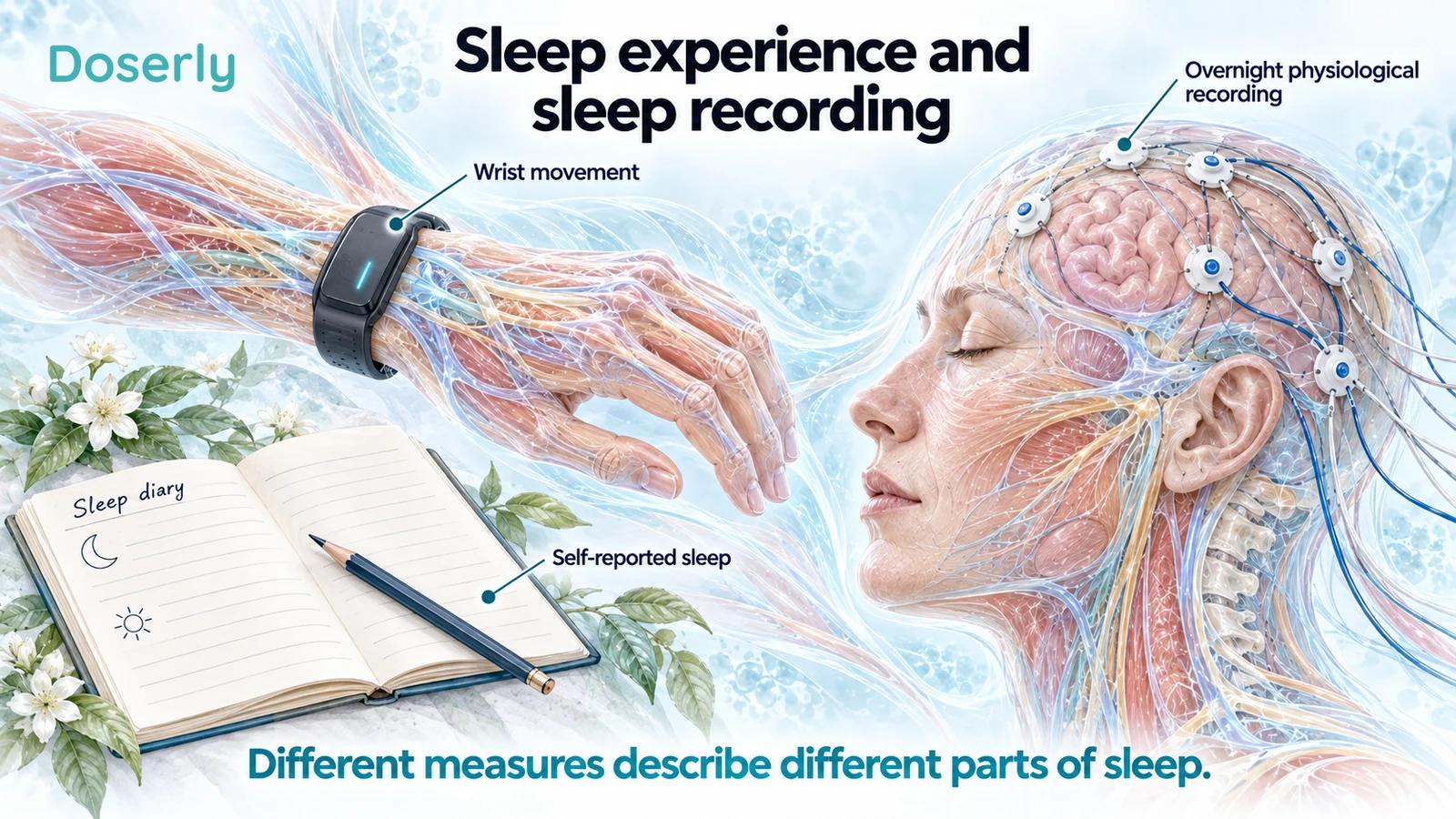
Actigraphy estimates sleep and wake from movement recorded at the wrist. Polysomnography uses physiological signals, including brain activity, to characterize sleep more directly. These approaches are useful but do not ask identical questions. The older-women trial deliberately combined home and laboratory measures, while the newer study included laboratory recording only in a subset. Older-women trial
A person can lie still while awake, and a laboratory night can differ from an ordinary night at home. That is why agreement across methods can increase confidence, while disagreement needs interpretation. Neither a watch score nor a single questionnaire should be treated as the complete story of someone's sleep.
A valerian–hops result belongs to the combination
A 2025 randomized feasibility study examined a valerian–hops product in 40 people with occasional sleep problems. After a 21-day run-in, treatment continued for 21 days. Exploratory analyses found a mean daily increase in wearable-measured sleep duration of 21.7 minutes relative to placebo, without significant differences in the cognitive or psychological outcomes assessed. Valerian–hops feasibility trial
That is a useful signal for the tested combination, but the study's feasibility purpose and exploratory analyses limit how firmly to interpret it. It also cannot identify valerian's individual contribution: hops was part of the intervention. The result does not show that valerian alone adds 22 minutes of sleep or that longer recorded sleep necessarily improves daytime performance.
This matters because combination products are common. Adding multiple ingredients does not allow their evidence to be added together as though each effect were independently established. If you are choosing a product based on a trial, the whole formulation is the relevant match.
Safety and the next treatment decision
NCCIH describes short-term adult use as generally well tolerated, while emphasizing uncertainty about long-term safety. Reported problems include stomach upset, headache, mental dullness and vivid dreams. It advises against combining valerian with alcohol or sedatives and notes limited information for pregnancy and breastfeeding. Rare liver-injury reports often involved multi-herb products, making attribution difficult. NCCIH safety guidance
Bring the actual label to a pharmacist or clinician if you take medicines or use other sleep aids. Include how often you use the product and whether you feel impaired the following morning. “Herbal” describes its origin; it does not answer the interaction question.
The AASM's 2017 pharmacologic guideline made a weak recommendation against valerian for adult sleep-onset or sleep-maintenance insomnia, reflecting the limited evidence available then. Its 2021 behavioral guideline strongly recommends multicomponent CBT-I for chronic insomnia. AASM pharmacologic guideline and behavioral-treatment guideline
Valerian's history gives us a reason to investigate it, and newer trials offer specific findings to discuss. For a treatment decision, the useful questions remain concrete: which preparation, for which sleep problem, with what expected benefit and what risks? The answer should come from those details, not from the age of the tradition.
Sources
- Taibi et al., 2009: older women crossover trial
- Oxman et al., 2007: community web-based trial
- Taavoni et al., 2011: postmenopausal sleep-quality trial
- Shekhar et al., 2024: standardized-extract trial
- Schicktanz et al., 2025: valerian–hops feasibility trial
- NCCIH: valerian usefulness and safety
- AASM pharmacologic guideline, 2017
- AASM behavioral-treatment guideline, 2021