
TRT
October 18, 2026
TRT and SGLT2 inhibitors: when two treatments raise red blood cell counts
On this page
A blood count that was steady on testosterone can begin climbing after another prescription is added. Sometimes the new medicine is an SGLT2 inhibitor, such as empagliflozin or dapagliflozin, prescribed for diabetes, heart failure or kidney disease. The testosterone dose may be unchanged. The patient may feel well. Yet the combination deserves attention because both treatments can increase red-cell measurements.
This is a coordination problem as much as a laboratory problem. The clinician managing testosterone may not have prescribed the heart or kidney medicine, and the second prescriber may not routinely review the testosterone monitoring record. A complete medication timeline can connect findings that otherwise look unrelated.
The evidence now goes beyond isolated reports. Human cohort studies associate combined treatment with more erythrocytosis, meaning elevated red-cell measures, than either treatment alone. European regulators have also addressed the interaction. What remains less certain is how much additional clotting risk the combination creates, and which management strategy best preserves treatment benefits while controlling the count.
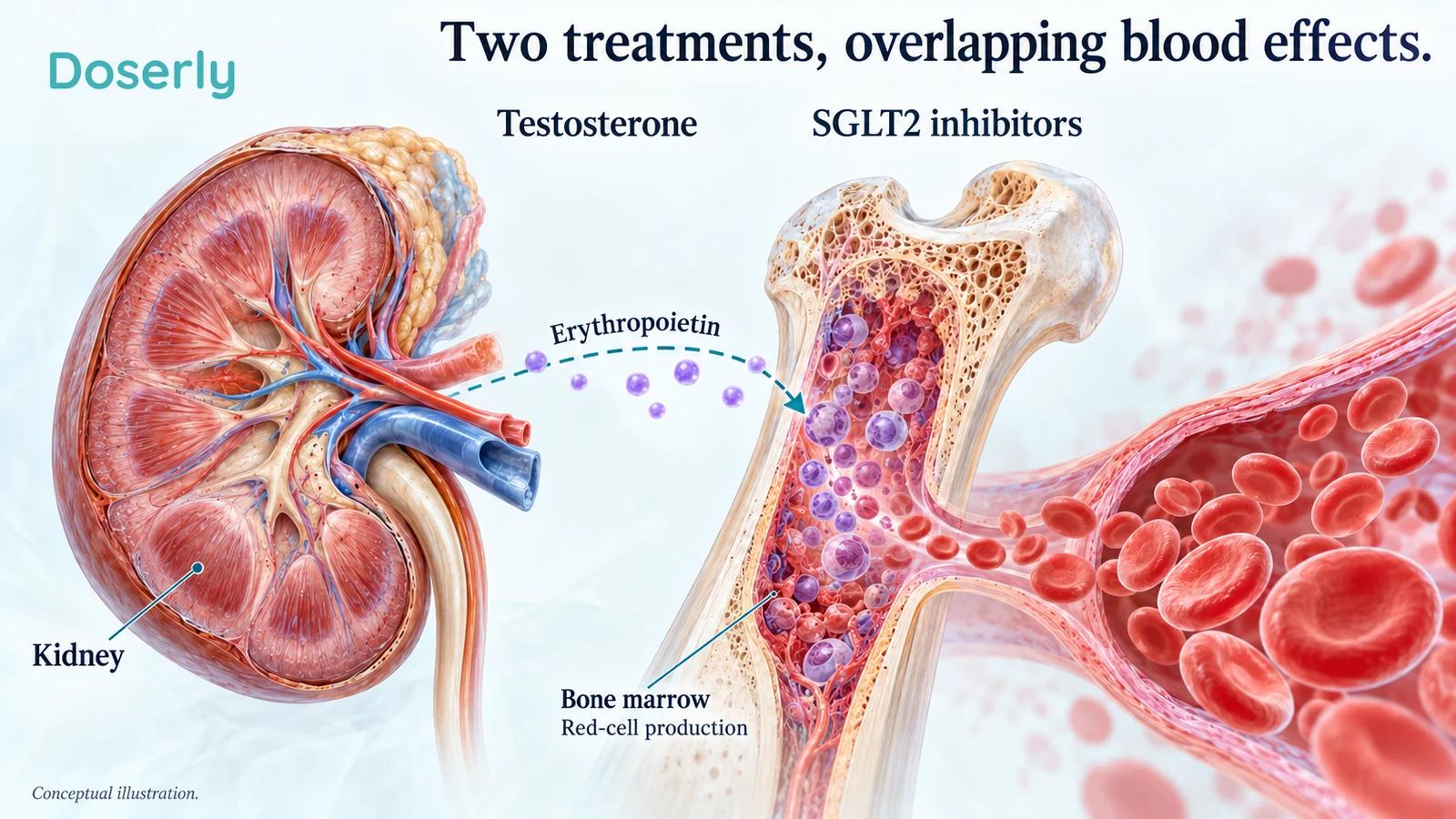
Why a diabetes or kidney medicine belongs in a TRT discussion
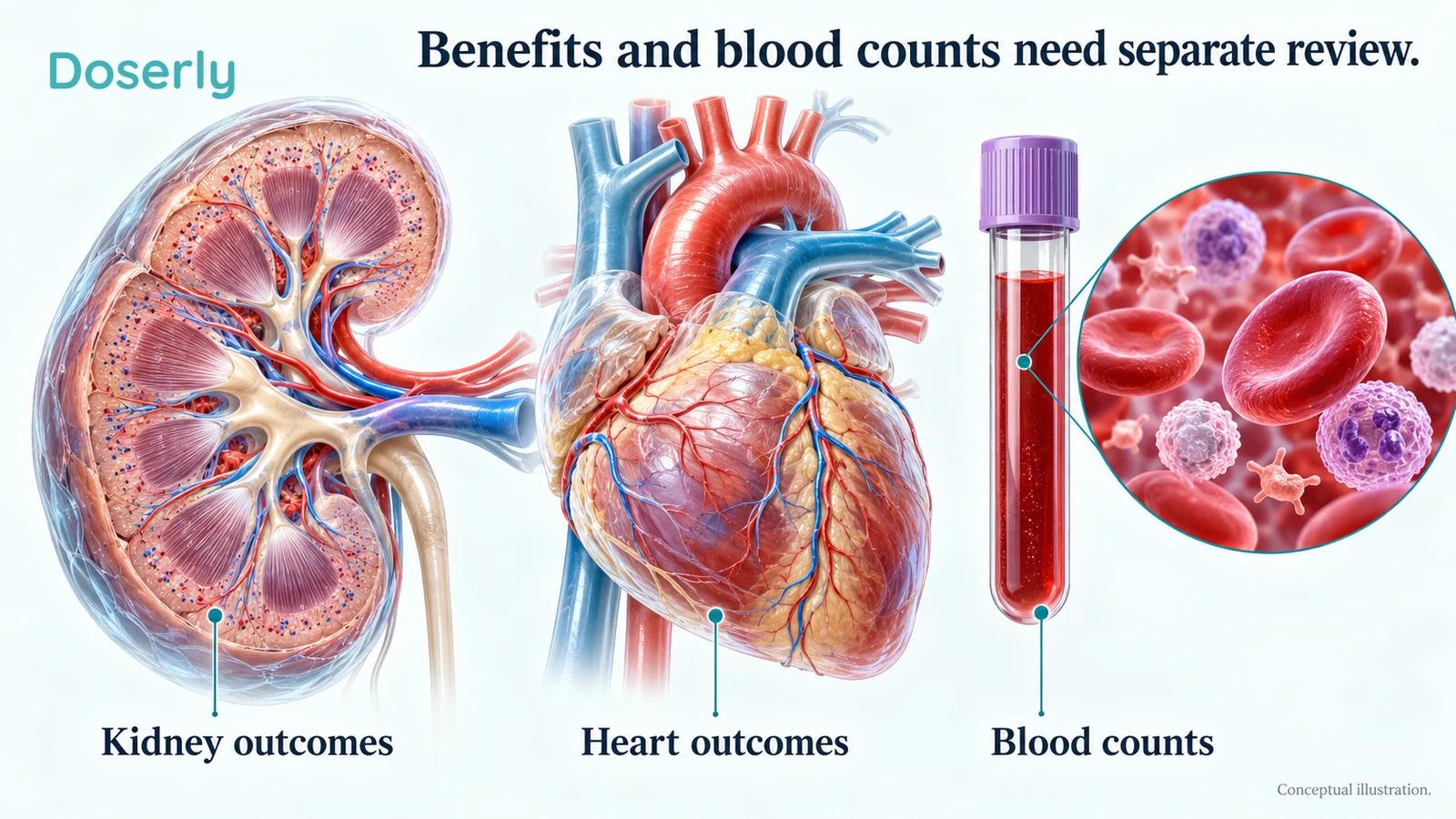
SGLT2 inhibitors act on glucose and sodium handling in the kidney. Their importance is broader than the glucose result on a laboratory report. Depending on the medicine and the patient's condition, they are used for substantial heart and kidney benefits. A rising hematocrit therefore creates a decision that should include the reason each prescription was started.
Consider DAPA-CKD, a randomized trial of 4,304 people with chronic kidney disease and substantial albuminuria, with or without diabetes. Over a median 2.4 years, its primary composite of major kidney-function decline, kidney failure, or kidney/cardiovascular death occurred in 9.2% receiving dapagliflozin versus 14.5% receiving placebo. That is a 5.3-percentage-point absolute difference in that selected population. The trial was funded by AstraZeneca. It did not test the safety of concurrent TRT. DAPA-CKD primary report
Those results explain why simply deleting the newest prescription can be a poor starting assumption. The appropriate question is which treatments remain indicated, what benefit they offer this individual, and how the adverse laboratory trend can be managed. The answer may differ between someone with documented hormone deficiency and kidney disease and someone taking testosterone without a clear diagnostic basis.
Two routes to a higher hematocrit
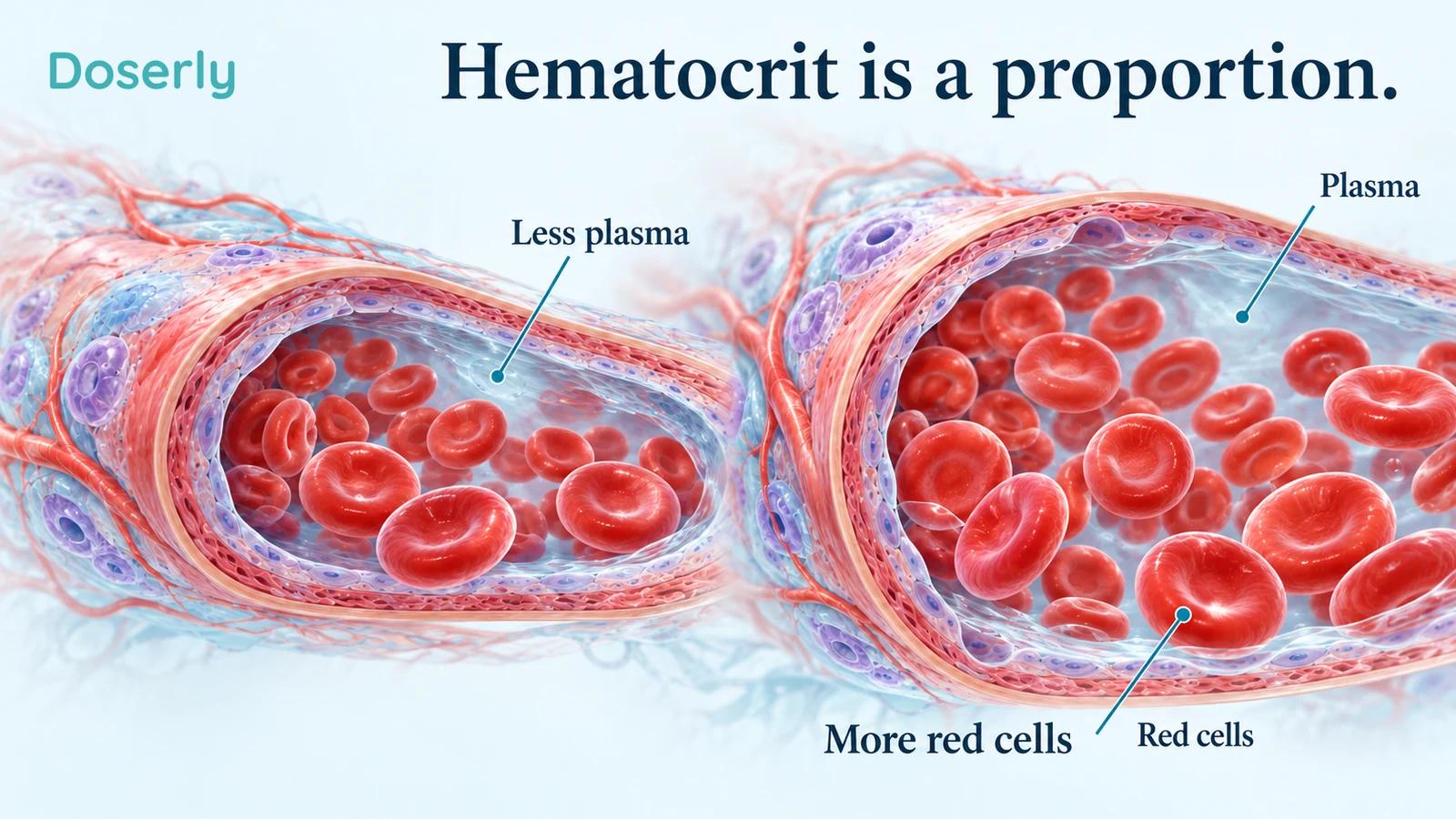
Hematocrit is the proportion of blood occupied by red cells. It can rise because there are more red cells, because there is less plasma around them, or through a mixture of both. An SGLT2 inhibitor's effects on fluid handling can contribute to concentration changes. However, persistent increases cannot automatically be dismissed as dehydration.
In a small randomized exploratory study, 44 people with type 2 diabetes were assigned empagliflozin or placebo for three months. The timing of the blood-count response and changes in iron-related measurements supported a contribution from red-cell production. Some findings were only trends: the reported erythropoietin increase did not reach statistical significance. This was a physiology study, not a test of clot prevention or of the testosterone combination. Empagliflozin erythropoiesis study
A separate post hoc analysis of the randomized Empire HF trial found higher erythropoietin and lower hepcidin with empagliflozin over 12 weeks in patients with reduced-ejection-fraction heart failure. Erythropoietin is a signal that supports marrow production of red cells; hepcidin helps regulate iron availability. The study included 190 patients, most without diabetes, but its exploratory biomarkers do not prove that these changes account for the medicine's clinical benefits. Empire HF analysis
Testosterone also influences this system. A placebo-controlled study in older men with mobility limitations found higher red-cell measurements alongside changes in erythropoietin, hepcidin and ferritin. That supplies a plausible biological reason for overlapping effects, not a formula for predicting an individual's response. Testosterone and iron-regulation study
What the direct combination studies found
The most directly relevant evidence comes from patients who actually received both medicines. A 2024 retrospective study examined 53,971 US veterans with type 2 diabetes, baseline hematocrit of 38–50%, and prescription coverage consistent with substantial adherence. It compared SGLT2 inhibitor use, TRT use and combined use, defining erythrocytosis as hematocrit above 54% within a year.
Across the entire cohort, 756 people, or 1.4%, met that definition. That is the overall cohort proportion, not the combination group's individual risk. After adjustment, combination therapy was associated with higher odds than an SGLT2 inhibitor alone, odds ratio 3.80, and than TRT alone, odds ratio 2.49. The study did not find that topical versus injectable testosterone removed the additional association. Gosmanov and colleagues
An odds ratio of 2.49 does not mean 2.49 extra patients out of every 100, nor does it supply an absolute risk without the underlying group rates. The study was observational: prescription records, clinical selection and differences between patients constrain causal interpretation.
A 2025 Clalit Healthcare Services study adds a different setting. It included 5,235 men with diabetes and hypogonadism, comparing those with and without SGLT2 inhibitor treatment around TRT initiation. The combination group had greater increases in blood-cell measures. Its reported between-group odds ratio for hematocrit above 54% was 4.85. A separate overall before/after TRT estimate did not reach conventional statistical significance. These are different comparisons, so the latter should not be quietly omitted. Kabha and colleagues
Neither study randomly assigned co-treatment or established which prescription should be changed first. Their practical contribution is to make the combination visible as a risk factor worth monitoring, including when one medicine was tolerated for years before the other began.
Regulators have recognized the interaction
In its September 2025 meeting, the European Medicines Agency's pharmacovigilance committee recommended updating topical testosterone product information to include an interaction with SGLT2 inhibitors and increases in hemoglobin and hematocrit. It also stated that the benefit-risk balance in the approved indication remained unchanged. EMA PRAC meeting record
That is a useful middle position. The interaction deserves a place in prescribing and follow-up, but a warning is not equivalent to a universal prohibition. It also means a gel user should not assume the issue only concerns injections. Product-specific advice and the patient's response still matter.
For a patient moving between clinics, it is worth explicitly naming both medicines at each appointment. A shared electronic record is helpful, but the presence of a prescription somewhere in the system does not establish that a clinician has connected it with a new blood-count trend.
A higher count and a clot are different outcomes
A study can convincingly find more erythrocytosis without proving more thrombosis. Thrombosis means a blood clot forming in a vessel; studies also vary in whether they count venous events, heart attacks, strokes, or a composite. Keeping those endpoints separate matters when interpreting reassuring or alarming headlines.
A large 2025 Israeli cohort compared people starting SGLT2 inhibitors with people starting DPP-4 inhibitors or GLP-1 receptor agonists. SGLT2 use was associated with more erythrocytosis. New-onset erythrocytosis was not significantly associated with myocardial infarction, venous thromboembolism or stroke. However, uncertainty was substantial for venous events: its hazard ratio was 1.56 with a 95% confidence interval of 0.68–3.60. That interval does not establish that every clinically important increase is excluded. Lewis and colleagues
A Danish heart-failure cohort similarly found more erythrocytosis after SGLT2 inhibitor initiation without a statistically significant association with one-year thromboembolic events. It included 3,138 treated patients and 3,138 matched controls. This offers another useful population, but it remains observational and is not a dedicated TRT co-use safety trial. Nationwide heart-failure study
These findings should temper the claim that any medication-related hematocrit rise necessarily means a clot is coming. They should not be used to approve an indefinitely rising count in someone whose risk factors and drug combination were not specifically tested.
Why the more concerning findings still matter
A 2025 post hoc analysis pooled randomized canagliflozin trials with baseline hematocrit available for 14,321 participants. Overall, canagliflozin did not change the study's composite risk of myocardial infarction, stroke or thromboembolism. But baseline hematocrit modified the treatment association in men, raising concern about men who already had erythrocytosis.
The myocardial-infarction estimate in that subgroup was imprecise: hazard ratio 1.77, 95% confidence interval 0.76–4.13. This was a secondary analysis of existing trials, not a trial designed to answer the TRT interaction question. Authors reported pharmaceutical research funding and speaking relationships. It is a signal requiring attention and further testing, not proof that all SGLT2 inhibitors cause clots in all men with higher counts. Canagliflozin pooled analysis
A later US electronic-record study reported associations between erythrocytosis during SGLT2 use and thromboembolic outcomes. Its comparisons of stopping treatment, adding antiplatelet therapy or performing phlebotomy were also observational. Sicker patients are more likely to receive interventions, making these comparisons particularly vulnerable to confounding. The paper's abstract and conclusion also describe the direction of the drug-group erythrocytosis comparison inconsistently; its numerical comparisons should be treated cautiously. Chen and colleagues
The studies are not interchangeable votes in a yes-or-no poll. Baseline erythrocytosis differs from newly developing erythrocytosis. Diabetes populations differ from heart-failure populations. A particular drug differs from an entire class, and an observed intervention differs from randomized treatment assignment.
What the 2026 follow-up adds
An August 2026 single-centre Italian study identified erythrocytosis in 132 of 3,848 SGLT2-treated adults with type 2 diabetes, approximately 3.4%. Among affected patients, counts were generally stable over the following year, and no thrombotic or other cardiovascular events were observed during follow-up. The study did not have the size or design to rule out uncommon harms.
Only small groups stopped treatment, underwent phlebotomy or switched within the class. Switching did not clearly resolve the blood-count trajectory. These clinical choices were not randomized, so they cannot establish the best management strategy. The authors also lacked reliable person-time for the full treated population: 3.4% is a proportion, not an annual incidence rate. Baldassarre and colleagues
For someone taking TRT as well, the useful message is that the course can evolve over months and may plateau, but individual follow-up remains necessary. Neither an early normal result nor a population average tells you what will happen after a later prescription change.
Build the medication timeline before choosing a response
Bring the last blood count before the second medicine was started, the first result afterward, and subsequent results. Add actual start dates, formulation changes and any interruptions. A medication list answers what is prescribed today; a timeline answers what changed before the count changed.
For example, imagine someone whose testosterone regimen has been stable, whose hematocrit begins rising after empagliflozin is added, and who then donates blood before the next appointment. The subsequent lower result reflects several events, not simply the long-term effect of the prescriptions. Without the donation date, a clinician could mistakenly conclude that the problem resolved on its own. This is an illustrative scenario, not a patient case or predicted pattern.
It helps to keep hemoglobin and hematocrit in separate columns, with their units. Include ferritin or other iron studies if obtained. Record who ordered each test and who will act on it. Doserly's TRT blood-work guide provides broader context for assembling a usable monitoring record.
The clinical review may need to consider additional explanations, especially if the count was high before either treatment. Sleep-disordered breathing, smoking, fluid status and other illnesses can coexist with a medication effect. A plausible interaction should narrow the investigation intelligently, not end it automatically.
Make the handoff specific enough to act on
A referral that says “hematocrit elevated” leaves the next clinician to reconstruct the sequence. A more useful handoff includes the value before co-treatment, the highest subsequent value, the most recent result and any intervention between them. Attach the reports rather than transcribing only the values flagged in red. A result inside one laboratory's reference range can still be relevant to a rising personal trend.
The treatment question should be equally explicit. The clinician prescribing the SGLT2 inhibitor can explain the heart, kidney or diabetes indication and the consequences of changing it. The TRT prescriber can review the original diagnosis, current exposure and whether the intended benefits are being achieved. Neither assessment is complete if it assumes the other prescription is fixed and only its own medicine can be adjusted.
This coordination is especially useful after a hospital visit or transfer between clinics, when a medication may be added and the monitoring plan may not travel with it. Keep the discharge medication list with the blood-count record and confirm which service will review the next sample. The goal is a shared decision supported by the same timeline, rather than two reasonable recommendations made from different pieces of the history.
What monitoring can and cannot decide
The Endocrine Society recommends hematocrit measurement before TRT, at three to six months, and then annually during routine follow-up. Its guideline advises clinician-directed interruption when hematocrit exceeds 54%, assessment for hypoxia and sleep apnea, and resumption at reduced exposure after the value is safe. Those recommendations are not a combination-specific monitoring schedule. Adding a second count-raising medicine may justify an individualized plan. Endocrine Society guideline
Ask for the next test date and the threshold or trend that should trigger earlier contact. A result near an action threshold deserves a clear response rather than reassurance based solely on feeling well. Conversely, a research definition of erythrocytosis should not be treated as a diagnosis of an impending clot.
Repeated blood removal is not a substitute for reviewing both prescriptions. It removes red cells and iron but leaves unanswered whether ongoing treatment exposure is appropriate. The co-use studies do not establish a preventive donation schedule, a target ferritin, or a reason to start aspirin independently. Those are separate decisions requiring evidence and clinical judgment.

Questions that make the next appointment more useful
The best conversation starts with both treatment goals in view. Ask what the SGLT2 inhibitor is intended to prevent, what established diagnosis supports TRT, and whether the current blood-count pattern changes either plan. If different specialists prescribe the medicines, identify who will coordinate the response.
Useful questions include:
- Did the rise begin before or after the second treatment, and is the trend persistent?
- Does my baseline count or medical history make the combination more concerning?
- Which additional causes need assessment before attributing everything to the prescriptions?
- What result would prompt a treatment change, and who will contact me?
- If blood removal is proposed, what is its purpose and how will iron status be followed?
A sustainable plan should name the next action and its owner. The emerging evidence supports recognizing this interaction, following the actual trend and balancing both medicines' indications. It does not support ignoring the count, abandoning a beneficial medicine reflexively, or managing the combination through an improvised donation routine.