
TRT
October 18, 2026
TRT and fluid retention: why swelling needs more than a hormone explanation
On this page
An ankle that suddenly looks puffy can seem like an obvious testosterone side effect, particularly if TRT started recently. The connection is plausible. Testosterone can promote retention of sodium and water. But swelling is a finding with several possible causes, and a recent prescription does not establish which one is present.
A person can have a medication-related contribution and another condition at the same time. Longstanding vein problems may become more noticeable when fluid balance changes. Heart or kidney disease may first attract attention after a treatment change. A painful swollen leg may need assessment for a clot rather than reassurance about hormones.
The useful question is not simply whether TRT can cause fluid retention. It is whether this pattern of swelling is adequately explained, how urgently it needs assessment, and what information would change the plan. That approach protects against both unnecessary alarm and a missed diagnosis.
New swelling with severe breathlessness, chest pain, coughing blood, fainting or confusion needs emergency assessment. Unexplained swelling in one leg, sudden severe swelling, or a red, hot, painful area also needs prompt medical advice. These are not situations to manage by experimenting with testosterone, estrogen blockers or a borrowed water pill. NHS edema guidance
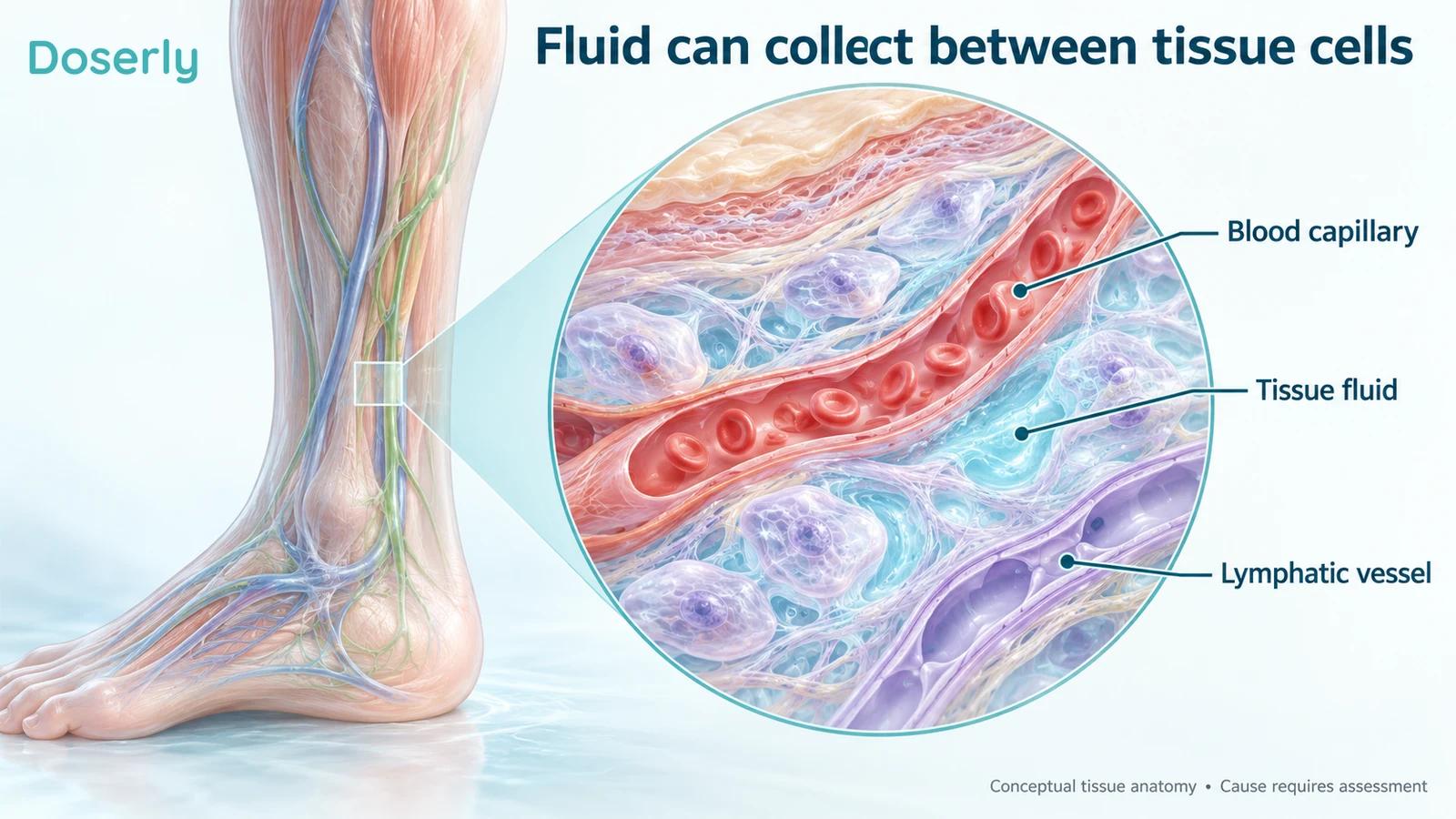
Conceptual edema anatomy. Fluid in tissue spaces can arise through different processes; this image does not diagnose the cause of an individual's swelling.
Our TRT guides cover the broader treatment context. This article focuses on understanding a new symptom and the questions it raises.
What edema means, and what it does not
Edema is swelling caused by fluid accumulating in tissues. It often appears around the feet and ankles, but can involve other areas. “Water retention” is the everyday description, while edema describes the tissue finding. Neither term identifies a specific disease. MedlinePlus edema overview
Think about fluid balance at two levels. The body regulates how much sodium and water it retains overall. Within a limb, blood vessels, surrounding tissue and lymphatic drainage determine where fluid collects. A problem with local drainage is not the same as generalized fluid overload, even if both make an ankle larger.
That distinction explains why treatment should follow the cause. A medicine that changes overall fluid balance will not automatically correct every local circulation problem. Likewise, a normal-looking other ankle does not exclude a problem in the swollen one.
The word “pitting” describes an indentation that remains after pressure on swollen tissue. It is a useful examination finding, not a diagnosis. Some forms of swelling change their texture over time. Photographs or a home pressing test cannot reliably distinguish all the important causes, and repeated pressing is not a substitute for examination.
Testosterone really can influence body water
The FDA AndroGel prescribing information states that androgens can promote sodium and water retention. It warns that edema, with or without congestive heart failure, may be serious in people with existing cardiac, renal or hepatic disease. “Renal” means kidney-related and “hepatic” means liver-related. FDA prescribing information
There is also direct human experimental evidence. In two small open-label randomized crossover studies involving 12 hypopituitary men with growth hormone deficiency and hypogonadism, researchers examined testosterone and growth hormone separately and together. Testosterone alone increased extracellular water, and combined treatment had an additional effect. Johannsson and colleagues
Extracellular water means water outside cells. It is not identical to visibly swollen ankles, and an increase is not automatically heart failure. The study involved a highly specific endocrine population, short interventions and physiological measurements. It cannot tell every modern TRT user how likely noticeable edema is, how much weight is expected, or how long swelling will last.
It nevertheless helps explain why a fluid effect should be taken seriously as a possible medication contribution. The possibility has a biological and human evidence basis; identifying it in one person still requires clinical assessment.
Timing helps, but it cannot settle causation
Record when swelling first appeared relative to starting TRT, changing formulation or changing the prescribed regimen. Also note whether anything else changed around that time: another medicine, a long trip, an injury, reduced mobility or an illness. The more precise the timeline, the less likely the discussion is to become a contest between competing guesses.
Suppose swelling appeared after testosterone and a blood-pressure medicine were both changed. Calling it “TRT water retention” immediately would assign causality before separating the exposures. Suppose it began after a long journey and is mostly on one side. The prescription history remains relevant, but the pattern deserves its own investigation.
Those are hypothetical examples, not a way to diagnose from a timeline. They illustrate why the first appointment should preserve several explanations until the history and examination narrow them.
Improvement after a clinician-directed change may support a medication contribution, but it is still interpreted with the rest of the evidence. Swelling can fluctuate with posture and activity. Deliberately restarting a suspected medicine solely to reproduce a potentially serious reaction is not a useful self-experiment.
One leg or both legs changes the questions
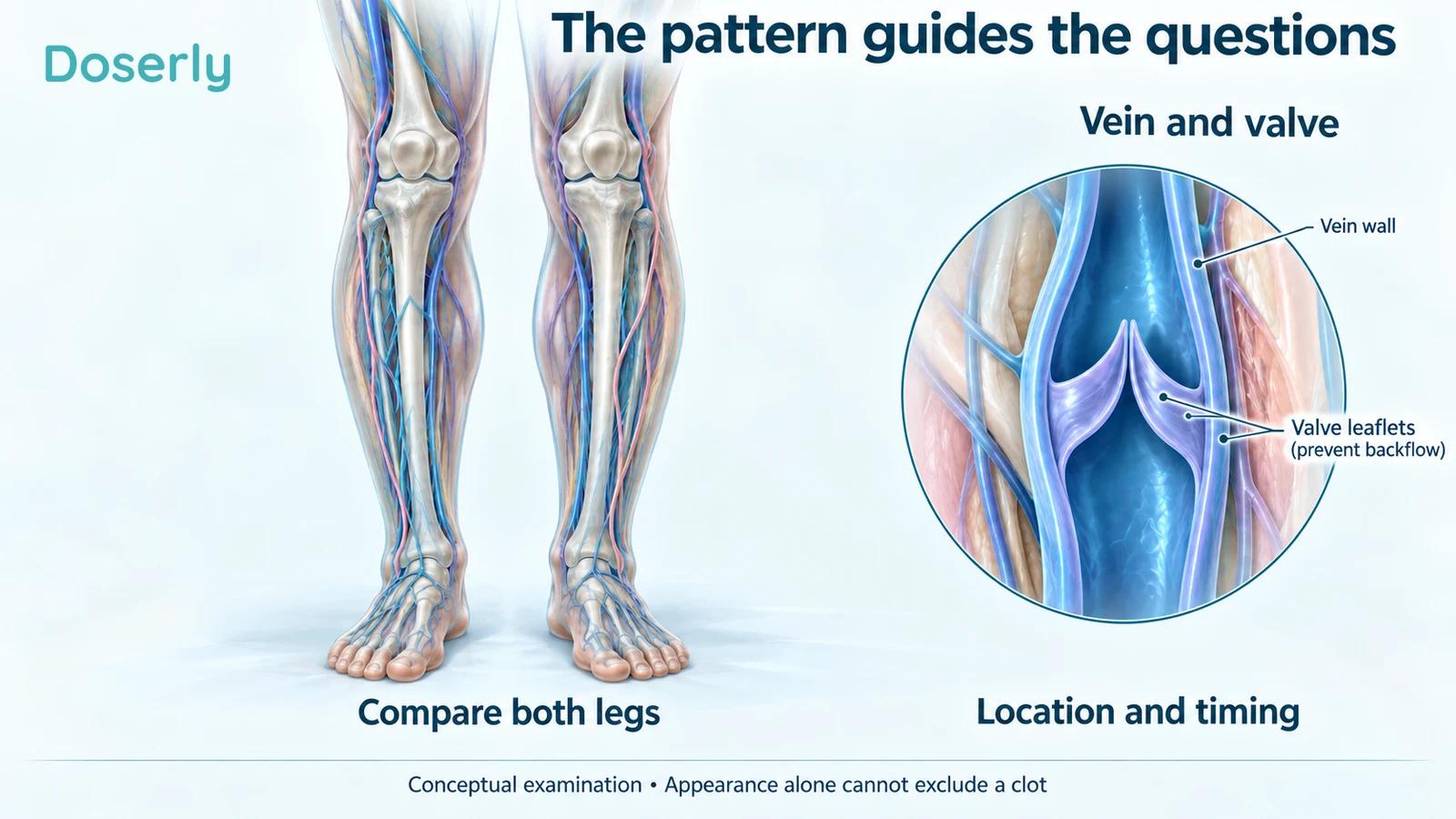
A new difference between legs directs attention toward local causes, including a clot, injury, infection or impaired venous or lymphatic drainage. Bilateral swelling raises different possibilities, including medicines and systemic illness. These patterns guide assessment; they are not absolute rules that allow serious causes to be excluded at home.
The NICE venous-thromboembolism guideline recommends clinical assessment of a swollen or painful leg and a structured probability assessment when deep-vein thrombosis is suspected. Depending on that assessment, clinicians use D-dimer testing and ultrasound. The sequence matters: an isolated test result is not interpreted without the clinical probability. NICE DVT diagnostic recommendations
Do not use the absence of dramatic redness, severe pain or a very large size difference as proof that a clot is impossible. Conversely, a swollen leg does not automatically mean a clot. The purpose of timely evaluation is to distinguish these possibilities rather than assume either one.
Tell the clinician about recent surgery, immobilization, travel, cancer history and previous clots. Those details may change the assessment more than whether the ankle looks slightly better in a morning photograph.
When the heart belongs in the assessment
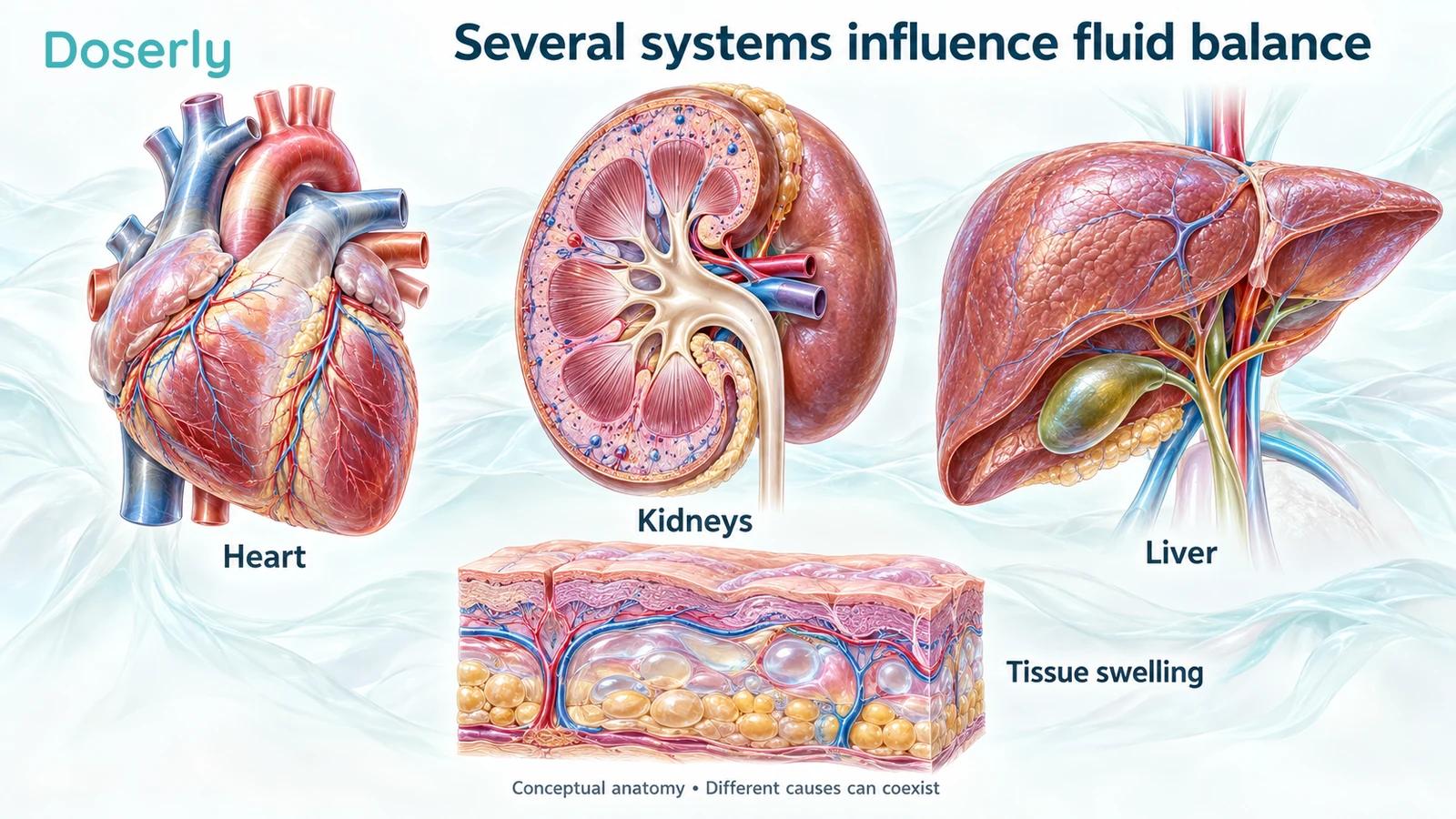
Heart failure can cause fluid accumulation, swelling and weight gain. Breathlessness with ordinary activity, difficulty breathing when lying flat, reduced exercise tolerance or abdominal swelling adds important context. Some people have less obvious breathing symptoms, particularly when their usual activity is limited. NHLBI heart-failure symptoms
This does not mean every pair of swollen ankles represents heart failure. It means the clinician should ask about the whole symptom pattern, rather than consider the ankles in isolation. A change in how many pillows someone needs, or an inability to do a previously comfortable walk, can matter even if the swelling itself looks mild.
The Endocrine Society guideline recognizes that testosterone can worsen edema in heart failure or other edematous states and recommends against starting therapy in uncontrolled heart failure. That is different from declaring that every person with stable heart disease must never receive TRT. Endocrine Society guideline
If heart failure is already diagnosed, use the individualized action plan provided by the treating team. Do not replace it with a generic online threshold for weight gain or an assumption that new symptoms are an expected adjustment to hormones.
Why exercise studies do not make testosterone an edema treatment
Testosterone has been investigated in chronic heart failure because of possible effects on muscle function and exercise capacity. A randomized placebo-controlled study of 76 men reported improved exercise capacity with a testosterone patch over follow-up of up to 12 months. It reported no excess of adverse events, although the patch was poorly tolerated. Malkin and colleagues, original trial
That is a useful positive finding, with a different question from the one posed by newly swollen ankles. The primary endpoint was a walking test. A small trial cannot reliably exclude uncommon harms, establish treatment for acute congestion, or justify ignoring a product's fluid-retention warning.
A person can have an improvement in physical performance and a separate adverse effect. The two outcomes are not mutually exclusive. This is particularly important when a treatment has already helped symptoms and there is an understandable wish to preserve the benefit.
The goal of reassessment is to determine whether the treatment remains appropriate and whether another condition needs care. It is not necessary to deny a real benefit in order to investigate a new problem carefully.
Kidney disease can cause swelling in more than one way
Kidney assessment is not limited to reading one creatinine result. In nephrotic syndrome, substantial protein loss in urine accompanies low blood albumin and edema. The history may include foamy urine, swelling in other areas or weight gain, but testing is needed to identify the pattern. NIDDK nephrotic-syndrome guidance
Albumin is a protein that helps maintain fluid distribution between the circulation and tissues. A urine protein test answers a different question from a filtration estimate. That is why an evaluation may include urine testing and serum albumin rather than only repeating the same blood chemistry panel.
For a reader on TRT, the practical point is not to diagnose kidney disease from ankle swelling or foamy urine. It is to understand why the clinician may order tests that do not appear on a typical hormone panel. A normal testosterone measurement cannot resolve this question.
Bring information about changes in urine output, recent illnesses and use of pain medicines. If kidney disease is known, clarify which clinician should review a new fluid-related symptom. A medication contribution and kidney disease can coexist without either being the only explanation.
Liver disease and abdominal swelling need their own context
Cirrhosis can lead to swelling in the legs and fluid accumulation in the abdomen, called ascites. Other clues can include jaundice, easy bruising, appetite changes or confusion, although early liver disease may cause few symptoms. These features belong in the history rather than being reduced to “bloating.” NIDDK cirrhosis symptoms
A larger waist over time can have several explanations. Visible abdominal distension accompanying leg swelling is a different clinical question from a gradual increase in body fat. Similarly, looking leaner after fluid changes would not establish that body fat changed.
No one should infer cirrhosis simply because testosterone and ankle swelling appear in the same sentence. The point is to avoid narrowing the investigation to hormones before considering the organs that regulate circulation and fluid balance.
The relevant history includes prior liver disease, alcohol use, medicines and supplements, and the pace of the change. If the abdomen is enlarging or other symptoms are developing, describe that explicitly when arranging assessment rather than reporting only the ankles.
Veins and lymphatic drainage can explain a local pattern
Chronic venous insufficiency develops when leg veins do not return blood effectively. Swelling may accompany heaviness, visible varicose veins or skin changes around the ankles. Prolonged standing or sitting and previous leg clots can be relevant. Duplex ultrasound can assess venous blood flow when indicated. Society for Vascular Surgery patient guide
Lymphatic drainage is a separate system that returns fluid from tissues. Surgery, radiation or other disruption can cause lymphedema. In cancer survivors it may develop long after treatment. Early swelling can pit; later tissue changes may make it firmer. A “does it leave a dent?” test therefore cannot reliably sort all lymphatic swelling from other edema. National Cancer Institute lymphedema guidance
These possibilities make past history valuable. A person may not connect an old operation or clot with a new ankle complaint. Bring it up, even if the event predates TRT by years.
The presence of an established vein or lymphatic condition also does not explain every future change automatically. New pain, warmth, redness or rapidly worsening asymmetry still deserves reassessment. Familiar swelling can acquire a new cause.
Review all medicines, not just the newest hormone
Several medication classes can contribute to leg swelling, including calcium-channel blockers, NSAIDs, corticosteroids and hormones. A pain medicine bought without a prescription still belongs on the list. MedlinePlus specifically advises discussing suspected medication-related swelling with the prescriber rather than stopping medicines independently. Medication and swelling overview, reviewed 2025
The testosterone label also identifies concurrent corticosteroid or ACTH use as a situation in which fluid retention may increase. This is a reason for a coordinated medication review, especially when cardiac, kidney or liver disease is present. Current AndroGel interaction information
An estradiol result alone does not establish why an ankle is swollen. Neither does a normal testosterone concentration exclude a medication effect. A hormone measurement describes one part of the situation; it does not inspect veins, measure urine protein or assess cardiac filling.
Before adding an aromatase inhibitor or a diuretic, the more useful question is what diagnosis that treatment would address. An extra medicine can introduce another variable and another adverse effect. A prescriber may adjust treatment after assessment, but visible swelling is not a validated self-dosing signal.
What an evaluation may include
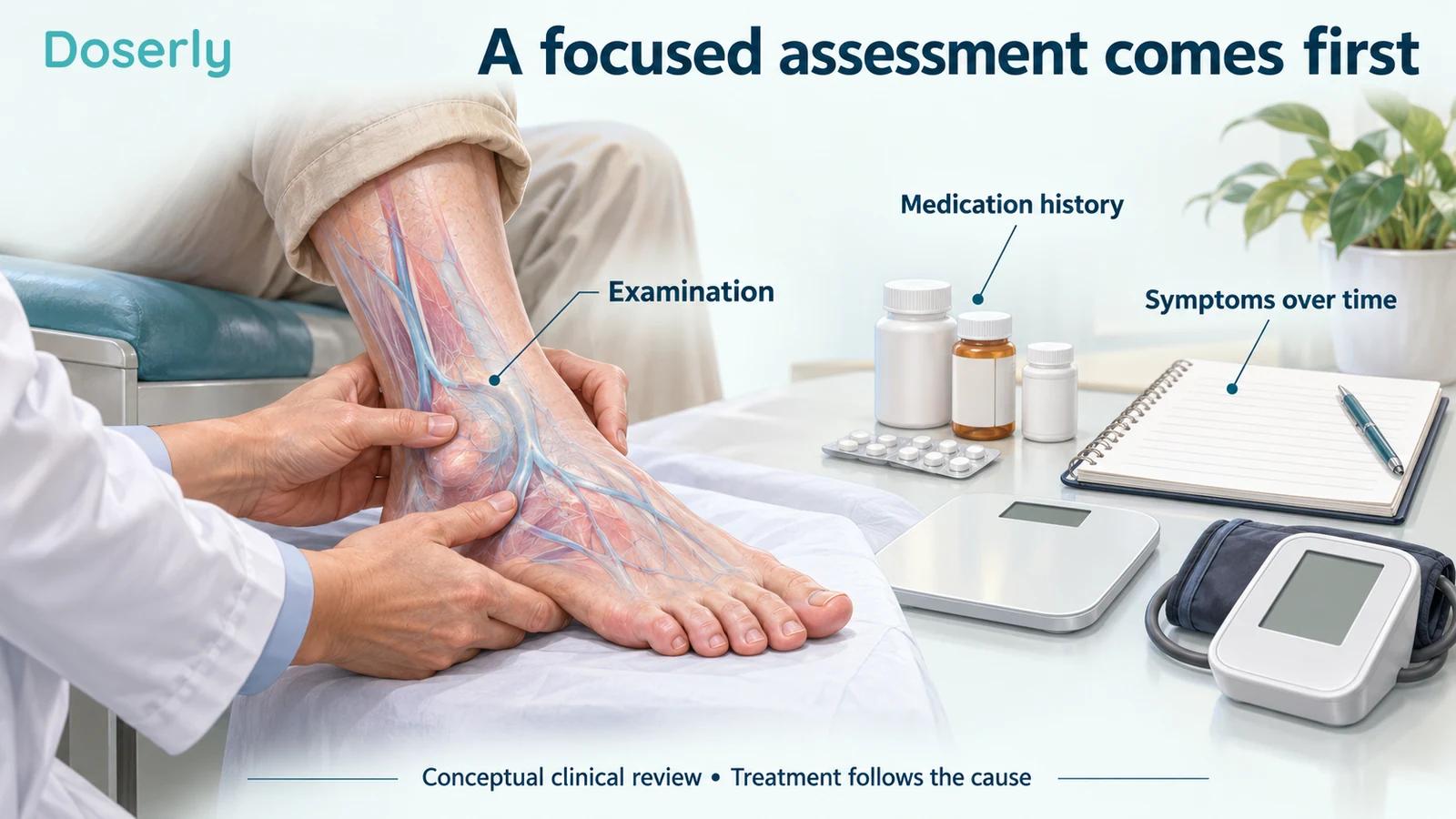
The clinician starts with the distribution, speed and severity of swelling, associated symptoms, medical history and examination. Blood pressure, weight and examination of the heart, lungs, skin and veins may help decide which tests are useful. The aim is to answer specific questions, not to order every available test.
When heart failure is suspected, natriuretic-peptide testing and echocardiography may be part of the pathway. NICE's guideline, updated in 2025, emphasizes that peptide concentrations have other influences: obesity and some treatments can lower them, while kidney or other systemic disease can raise them. A number is interpreted in context. NICE heart-failure recommendations
Other questions may require kidney and liver blood tests, albumin, urine testing or venous imaging. A negative investigation answers the question it was designed to address; it does not necessarily explain the swelling. For example, excluding an acute clot is valuable even if a separate assessment is needed for a chronic venous problem.
Ask what the leading possibilities are, what each test is checking and when results will be reviewed. A follow-up plan matters as much as the initial test order, particularly when symptoms are changing.
What to record while a plan is being made
A brief, consistent record is more useful than repeatedly checking the mirror. Note when swelling appeared, whether it affects one or both legs, whether it is painful, and whether breathing, activity tolerance or urine output changed. Record recent medication changes with actual dates when possible.
If a clinician asks for weight or blood-pressure monitoring, use the agreed method and schedule. Comparing a morning weight with a clothed evening measurement after a meal creates uncertainty that has little to do with the cause of edema. The same principle applies to photographs: similar lighting and position make change easier to judge, but pictures do not replace assessment.
Document the impact on ordinary life. Shoes fitting differently, walking becoming uncomfortable or needing to sleep more upright can convey something a single measurement misses. Report worsening symptoms according to the clinical plan rather than waiting for the next scheduled hormone panel.
These observations should support care, not become a requirement to collect evidence before asking for help. Someone with a concerning new symptom does not need a week of measurements to justify contacting a clinician.
Treatment depends on the explanation
For some causes, a clinician may recommend movement, elevation, appropriate compression or changes in medicines. For others, the priority is treatment of an underlying cardiac, renal, hepatic, venous or lymphatic condition. Compression needs an appropriate assessment and fit; diuretics need an indication and monitoring.
Avoid imposing a severe fluid restriction, forcing large amounts of water, or stacking “water-loss” supplements onto the problem. Different diagnoses require different plans, and an intervention that seems intuitive for one can be unhelpful for another. If a fluid or sodium plan is needed, ask for instructions that account for the actual diagnosis and other medicines.
At the follow-up, clarify whether TRT is thought to be the main cause, a contributing factor or unrelated. Ask what evidence supports that judgment and what would trigger reconsideration. If treatment changes, agree on how symptoms and safety will be reassessed.
TRT-related fluid retention is a real possibility. The safest useful interpretation of swelling, however, comes from its pattern, accompanying symptoms and clinical investigation. Naming the cause is what allows a plan to preserve the benefits of appropriate treatment while addressing the problem that has appeared.