
TRT
October 18, 2026
TRT, creatinine and kidney tests: understanding results when muscle changes
On this page
A routine blood test can become unexpectedly confusing after starting testosterone replacement therapy. You feel stronger, your training has changed, and your clinician sees a higher creatinine result. The estimated kidney filtration number beside it has fallen. Does that mean your kidneys are getting worse, or has the test become harder to interpret because your body has changed?
Both possibilities deserve attention. Creatinine is influenced by muscle, but an increase cannot automatically be dismissed as muscle gain. Cystatin C can provide another perspective, but it is not an infallible referee. The useful goal is to understand what each test measures, compare results under meaningful conditions, and decide whether there is evidence of kidney disease beyond an isolated laboratory flag.
This is particularly relevant when TRT coincides with resistance training, creatine supplements, a different diet or treatment for diabetes and high blood pressure. Several things may change at once. A good assessment separates them instead of asking one laboratory number to explain everything.
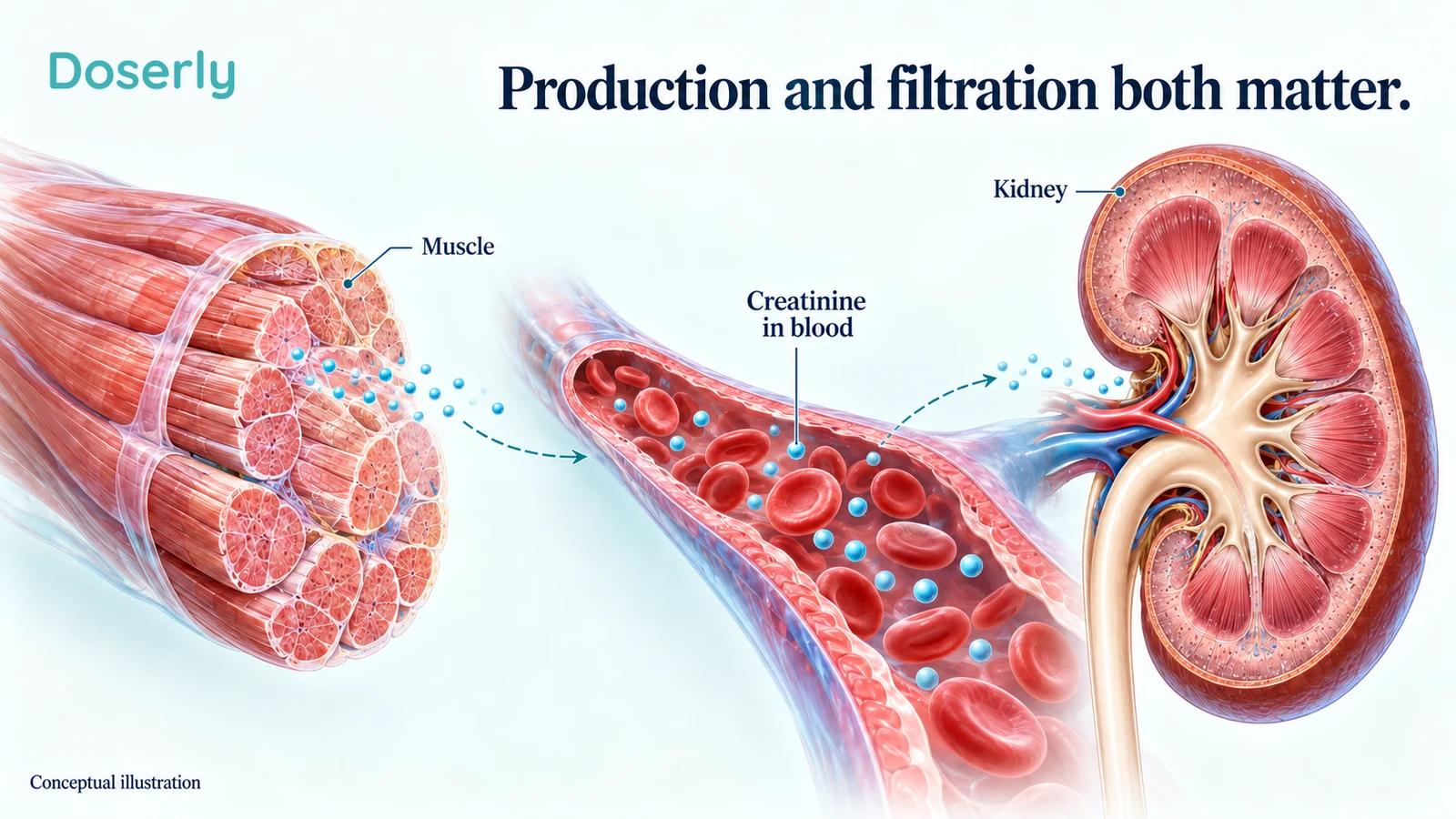
Creatinine has a source as well as an exit
Creatinine is a waste product associated with muscle metabolism. The kidneys remove it from the blood, which is why its blood concentration can help assess filtration. But the concentration reflects the relationship between how much is being produced and how effectively it is cleared. Greater production can complicate interpretation even when kidney filtration has not deteriorated. The NIDDK explanation of kidney testing describes this basic connection between muscle, creatinine and the kidneys.
A foundational study of 170 healthy adults compared body composition, physical activity and kidney markers. Creatinine was associated with lean mass; cystatin C was not significantly associated with lean mass in that sample. More active participants also had higher average creatinine than sedentary participants. The study helps explain why two people with different muscle mass can have different creatinine concentrations without necessarily having different filtration.
It did not test TRT, establish a correction factor for bodybuilders, or prove that a rise in an individual person's creatinine is harmless. Those distinctions matter when applying a group finding to a new result. Knowing that muscle is a plausible explanation should change the questions asked, not end the investigation.
The history also needs more detail than “I gained weight.” Weight can represent muscle, fat or fluid, and a training log is not a direct measurement of lean mass. Report what changed and when, including whether the change preceded the blood test. That gives the clinician something testable to work with rather than an explanation built around the result afterward.
What the testosterone-athlete study actually established
A 2024 report on creatinine and cystatin C examined 227 male athletes attending a single men's health clinic who reported testosterone use. Researchers compared the relationship between the two blood markers across body mass index and body-fat categories. The participants included recreational, competitive and elite athletes, and people with several forms of known kidney disease were excluded.
The paper is directly relevant to the clinical question, but its design limits the answer. It was a retrospective analysis of marker relationships, not a trial comparing TRT with placebo. The investigators did not measure filtration using a reference clearance test. Nor did they follow untreated controls to determine whether testosterone caused a change in kidney function.
A weak correlation between creatinine and cystatin C can show that the markers behave differently. It cannot, by itself, establish which marker is accurate. The study supports taking body composition seriously when interpreting tests; it does not validate a “normal for TRT” creatinine range or establish long-term kidney safety.
This distinction is easy to miss because the article's title refers to testosterone-induced muscle hypertrophy. A clinically appealing title can sound more definitive than the measurements underneath it. For a patient, the productive takeaway is to bring the question of muscle-related distortion to the appointment, while remaining open to additional testing.
Read the name beside the filtration estimate
Estimated glomerular filtration rate, or eGFR, is calculated from blood markers and other variables. It is not a direct observation of how much fluid your kidneys filtered during that blood draw. A creatinine-based estimate will generally fall when creatinine rises, so those two flagged results are not independent confirmations of damage.
There are also different versions. An estimate may use creatinine alone, cystatin C alone, or both. NIDDK guidance on GFR equations generally favors the combined creatinine–cystatin C estimate over creatinine alone, especially near a decision threshold. It also emphasizes that all equations remain estimates. Comparisons over time are more informative when the same equation is used; a laboratory changing its equation can change the reported number without an equivalent physiological change.
Ask which estimate is on your report before comparing it with another person's result or an online calculator. Choosing the calculator that gives the highest number does not solve the uncertainty. It can hide the very disagreement that needs explaining.
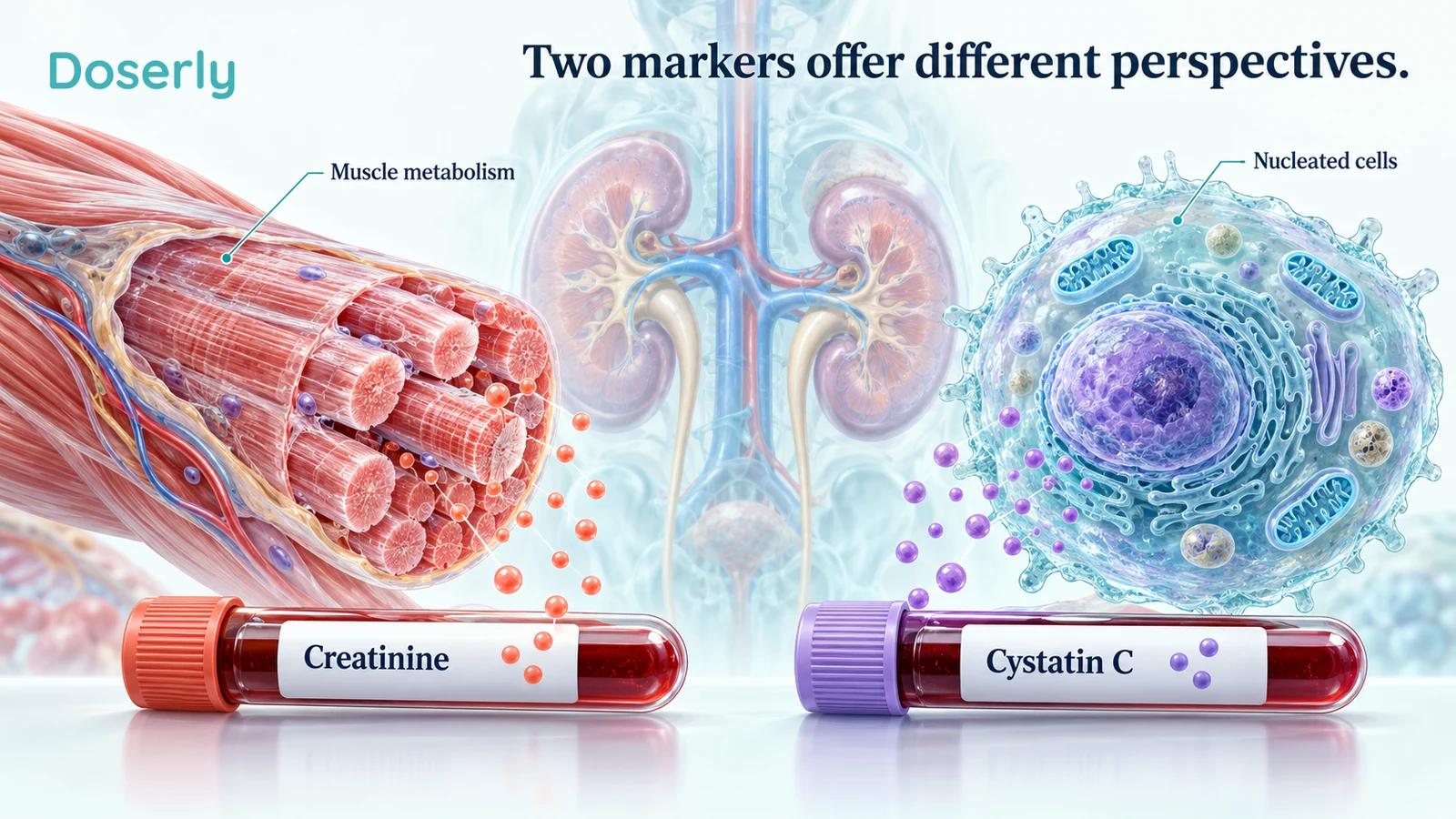
Cystatin C adds information, not certainty
Cystatin C is a protein made by nucleated cells and used as another filtration marker. Its appeal in muscular people is that it has different relationships with body composition from creatinine. The two measurements can therefore help reveal when a creatinine-only interpretation may be misleading.
The KDIGO 2024 kidney guideline distinguishes uncomplicated high muscle mass from medication-related uncertainty. Its table on cystatin C says a cystatin-based estimate may be appropriate when increased muscle is the only abnormality. For anabolic hormone use, however, it notes uncertainty about effects on cystatin C and suggests a combined estimate. That is more nuanced than replacing creatinine with whichever result looks reassuring.
Thyroid disease offers one illustration of cystatin C's limitations. In a small prospective study of 32 people with hypothyroidism, cystatin C rose after thyroid hormone replacement, while creatinine fell in the primary-hypothyroidism subgroup. The study was not about TRT and did not establish a universal adjustment. It demonstrated that hormone-related changes can complicate interpretation of either marker.
A clinician may therefore ask about thyroid treatment or other health changes when the estimates disagree. The disagreement is information. It is not a contest in which one test must always win. Sometimes the combined estimate is adequate for the decision at hand; sometimes the remaining uncertainty matters enough to justify a different assessment.
Hormone studies show why the distinction matters
Evidence from gender-affirming hormone therapy offers useful physiological clues, although those participants and treatment goals are different from those of men receiving replacement for established hypogonadism.
In a 2023 prospective study, researchers followed 260 transgender women and 285 transgender men for a year after starting hormone therapy. Among participants receiving testosterone, both creatinine and cystatin C increased. Cystatin-based eGFR fell by approximately 6 mL/min/1.73 m². Because filtration was estimated rather than directly measured, the study could not fully separate changes in the markers from changes in actual kidney filtration.
That result is a reason to avoid saying cystatin C is unaffected by testosterone. It is not proof that an equivalent fall occurs in every person using TRT, or that a marker change predicts kidney failure. The starting hormonal environment, regimens and population differ.
A 2025 mechanistic study went further by measuring GFR with iohexol clearance and kidney perfusion with another clearance method. It included 21 people starting testosterone and 23 starting feminizing therapy, assessed before treatment and three months later. Measured filtration and perfusion did not significantly change in the testosterone group. However, some exploratory markers, including urinary YKL-40 and plasma TNFR-1, increased.
These findings should stay together. Unchanged measured filtration over three months does not erase exploratory biological changes; changes in those biomarkers do not establish future kidney failure. The study was small, observational and short. It demonstrates why different kinds of kidney measurement can answer different questions without producing a simple “safe” or “damaging” verdict for long-term TRT.
Blood and urine tests answer complementary questions
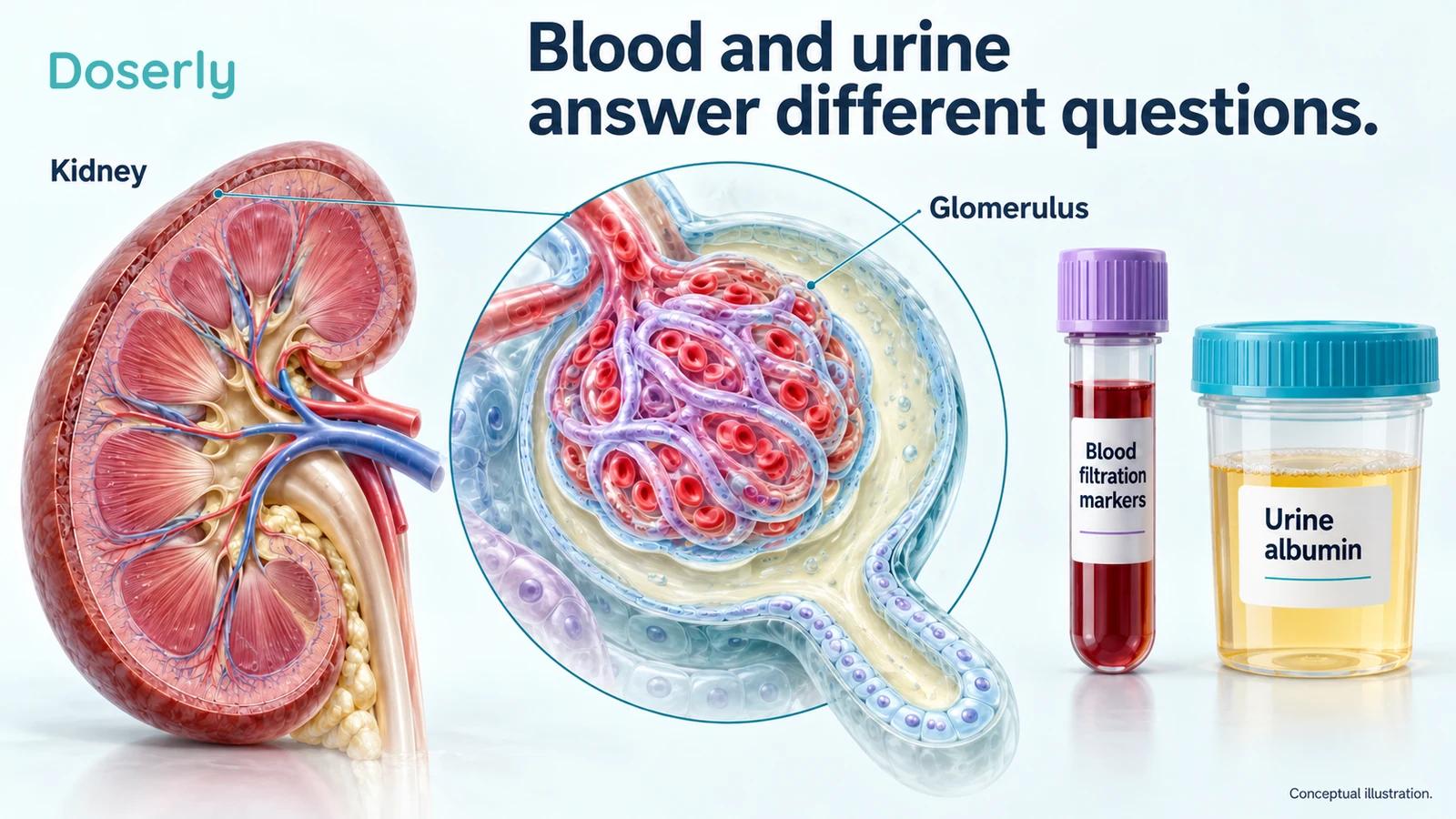
A blood filtration estimate does not tell the whole kidney story. Urine albumin testing looks for a protein that can appear in greater amounts when the kidney's filtering barrier is affected. The urine albumin-to-creatinine ratio, usually abbreviated UACR, relates urine albumin to urine creatinine in the same specimen. It is a different test from the creatinine concentration on your blood chemistry panel. NIDDK recommends considering blood filtration testing and urine albumin together, with repeat testing when needed to confirm an abnormal urine result.
The practical implication is straightforward: a reassuring explanation for blood creatinine does not answer an unexplained urine finding. Similarly, a favorable urine result cannot independently resolve a substantial change in filtration. Ask what each result contributes to the overall assessment rather than treating one as a substitute for the other.
Chronicity matters too. KDIGO defines chronic kidney disease using abnormalities present for at least three months and cautions against assuming chronic disease from a single abnormal result. Previous laboratory records can help establish whether a finding is longstanding. This does not mean waiting three months to address a possible acute problem.
A sudden change during illness deserves a different response from a stable result under comparable conditions. Markedly reduced urine, new swelling or breathlessness, especially alongside an abnormal kidney result, warrants prompt medical assessment; severe breathlessness or confusion warrants emergency care. NICE's acute kidney injury information describes reduced urine, swelling and breathlessness among possible warning symptoms. Feeling well is helpful context, but it cannot replace investigation of an unexpected result.
Meals and supplements belong in the laboratory history
A change in creatinine can sometimes reflect what happened before the sample. In a controlled meal study involving healthy participants and people with diabetes-related kidney disease, cooked meat raised creatinine and temporarily lowered calculated eGFR compared with a nonmeat meal. The effect had disappeared after overnight fasting in that study. This was an acute testing effect, not evidence that a single meal caused chronic kidney damage.
That finding is useful when a result seems out of step with the rest of the record. It supports discussing the timing of a substantial cooked-meat meal and following the laboratory's preparation instructions. It does not justify inventing a restrictive diet to produce a preferred test number. If repeat testing is planned, ask what conditions should be kept consistent and whether fasting is appropriate for your broader medical situation.
Creatine deserves similar attention, but creatine and creatinine are different names for different substances. In a 12-week randomized trial in resistance-trained adults consuming a high-protein diet, creatine supplementation did not significantly impair GFR measured by chromium-51 EDTA clearance compared with placebo. That is more informative about filtration than looking only at serum creatinine.
It remains a short trial in a selected population, not blanket clearance for every supplement, dose, combination or person with kidney disease. Bring the actual product name and ingredient list, along with when you started it. “Gym supplements” is often too vague to distinguish creatine from a mixed pre-workout product or an undeclared ingredient concern.
The purpose of this history is reproducibility. A clinician should be able to tell whether two blood samples represent similar circumstances. Avoid changing several habits immediately before a repeat test unless instructed; otherwise a different result may create another puzzle about which change mattered.
Kidney outcomes cannot be inferred from muscle gain
The larger TRT safety evidence prevents a purely reassuring interpretation. In the TRAVERSE randomized trial, 5,246 men aged 45–80 with hypogonadism and established or increased cardiovascular risk received testosterone gel or placebo. Testosterone met the trial's noninferiority criterion for the primary major cardiovascular outcome. The investigators nevertheless reported more acute kidney injury in the testosterone group.
Acute kidney injury was not the primary outcome, and the abstract does not establish the mechanism behind the difference. Still, the signal cannot be explained away by citing muscle-related creatinine production in an unrelated athlete study. TRAVERSE, funded by AbbVie and others, concerned a defined treatment and risk population. Its cardiovascular conclusion should not be expanded into a statement that every organ outcome was equivalent.
Other evidence points in a more favorable direction. A 2025 electronic-health-record cohort matched 26,027 testosterone-treated men with diabetes and hypogonadism to 26,027 untreated men. Treatment was associated with lower risks of acute kidney injury and kidney failure requiring replacement therapy. Reported hazard ratios were 0.93 and 0.81, respectively, over a mean follow-up of approximately 3.3 years.
Those are relative associations, not absolute percentage-point reductions. Treatment was not randomly assigned, the groups' follow-up began from different clinical events, and residual differences in health or care could influence outcomes. The acute-injury association also lost statistical significance in a sensitivity analysis that excluded the first six months. The study is useful, but it does not establish testosterone as a kidney-protective treatment.
These studies address outcomes in different settings, while marker studies address interpretation. Neither type can do the other's job. Better interpretation can prevent an inaccurate kidney label; outcome research determines whether a treatment changes real clinical risk. A responsible TRT review needs to keep both questions visible.
Make the next test answer a specific question
Before ordering another marker, it helps to identify what decision depends on the answer. Is the clinician confirming an unexpected result, assessing a persistent trend, choosing a medication dose, or considering specialist referral? A test is most useful when its result can change a clearly defined next step.
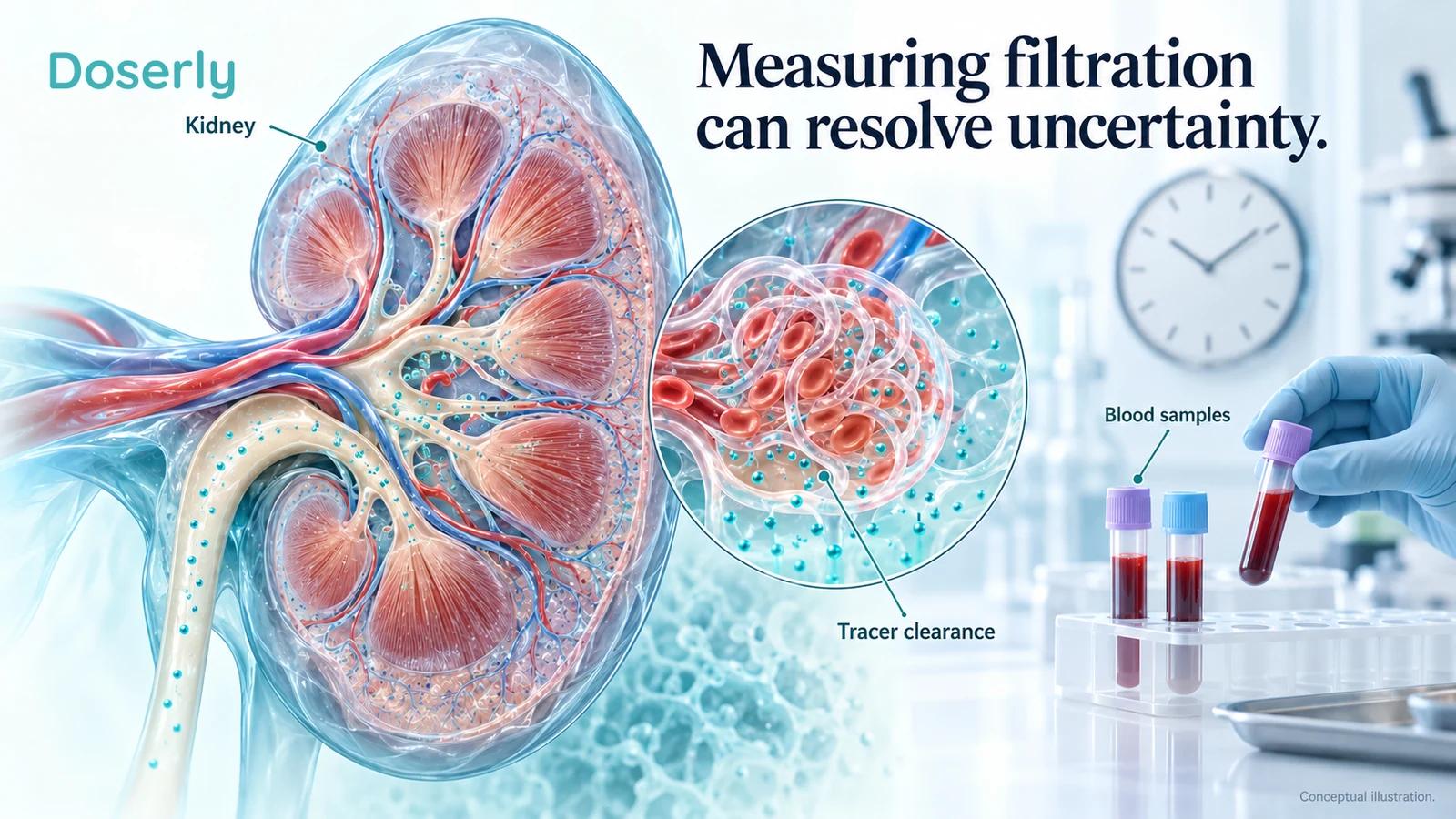
For example, disagreement between two estimates may have little effect on one routine follow-up decision but matter greatly near a treatment threshold. In selected circumstances, a specialist can arrange measured GFR rather than relying only on estimates. KDIGO discusses measured filtration when greater accuracy is needed for clinical decisions. This is a supervised clearance assessment, not a home test or a reason to seek tracer testing for every mildly unusual creatinine result.
A useful appointment record includes the original laboratory reports, dates and units; the TRT formulation and changes; weight and training changes; and the names of prescribed medicines and supplements. Include illnesses around the blood draw and any prior kidney diagnosis. The TRT blood-work guide can help organize that broader monitoring conversation without treating kidney tests as interchangeable with testosterone levels.
Useful questions include:
- Which filtration equation produced this result, and was the same equation used previously?
- Is there a credible muscle, dietary or medication explanation that needs checking?
- Would cystatin C and a combined estimate resolve the uncertainty for this decision?
- What do the urine findings and previous results add?
- When should testing be repeated, and what findings require earlier contact?
You should leave knowing who will review the next result and what it is meant to clarify. The aim is an accurate account of kidney function in your actual body, with its changing muscle, medications and health history. That protects against both an unnecessary alarm and the more consequential mistake of overlooking a real kidney problem.