
TRT
October 18, 2026
TRT and atrial fibrillation: making sense of the heart-rhythm evidence
On this page
A reassuring headline about testosterone and heart attacks can sit beside another headline warning about an irregular heartbeat. Both can accurately describe the same trial. The difficulty is that “cardiovascular safety” includes several different outcomes, and a study's main result does not settle all of them.
For atrial fibrillation, the evidence deserves a specific conversation. TRAVERSE, the largest dedicated cardiovascular safety trial of testosterone replacement, reported more atrial fibrillation in the testosterone group. Other research has produced conflicting findings, including a newer large database study pointing in the same direction and an older Veterans study suggesting lower risk after testosterone normalization.
The defensible conclusion is that there is a rhythm safety signal worth discussing, with uncertainty about its size and applicability to an individual. It is not evidence that every palpitation on TRT is atrial fibrillation, or that someone should change treatment without identifying the rhythm.
If palpitations occur with chest pain, severe breathlessness, fainting or symptoms suggesting stroke, seek urgent medical care. A question about whether testosterone contributed can be addressed alongside evaluation; it should not delay it. NHLBI description and complications of atrial fibrillation
Our TRT guides cover the broader treatment context; this article focuses on the rhythm-specific evidence.
Atrial fibrillation is a rhythm, not a sensation
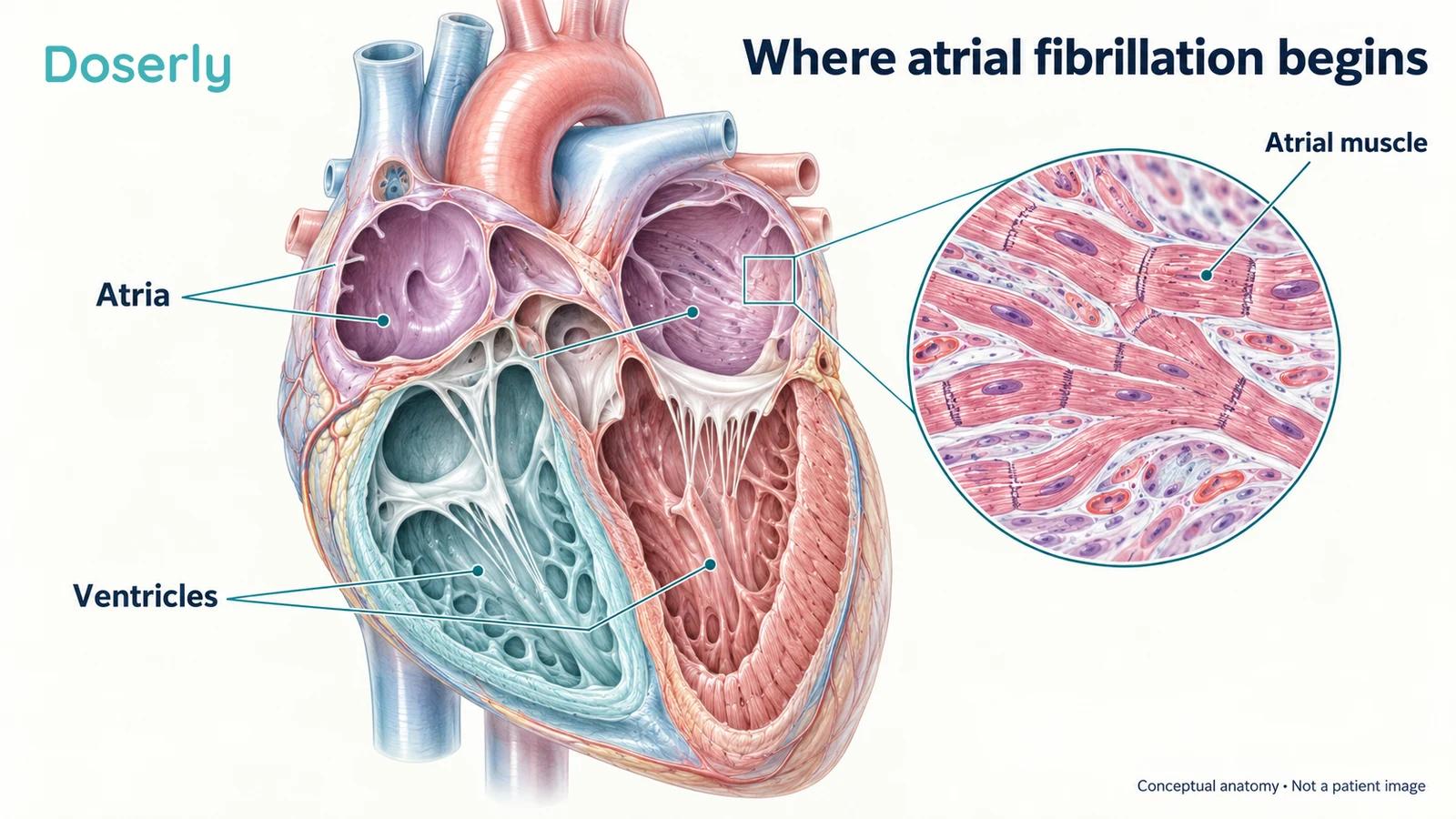
The atria are the heart's upper chambers. In atrial fibrillation, their electrical activation becomes disorganized, and their contraction is less effective. The pulse is often irregular and can be fast. Blood pooling can contribute to clot formation, and the condition can lead to stroke or worsen heart failure. NHLBI overview
Palpitations describe what someone feels: fluttering, pounding, racing or skipped beats. Those sensations do not identify a particular rhythm. AF can also be silent. Conversely, someone can feel substantial palpitations while having a different arrhythmia or another explanation for a faster heartbeat. The intensity of the sensation cannot establish the diagnosis.
Fatigue, reduced exercise tolerance, dizziness and breathlessness may accompany AF, but these symptoms overlap with many reasons people seek hormone care. It is easy to attribute a new symptom to a familiar testosterone narrative, especially soon after starting treatment. That explanation still needs checking. NHLBI symptoms
A useful distinction is between the immediate clinical question, “What rhythm is occurring?”, and the later causal question, “Why did it happen?” Finding the rhythm gives the second discussion a firmer starting point.
What TRAVERSE was designed to establish
TRAVERSE randomized 5,246 men aged 45–80 with hypogonadal symptoms, two fasting testosterone measurements below 300 ng/dL, and existing cardiovascular disease or high cardiovascular risk. Participants received testosterone gel or placebo gel. Mean follow-up was about 33 months, longer than mean treatment exposure of about 22 months.
The primary outcome combined cardiovascular death, nonfatal myocardial infarction and nonfatal stroke. It occurred in 7.0% of the testosterone group and 7.3% of the placebo group, with a hazard ratio of 0.96 and a 95% confidence interval of 0.78–1.17. The trial met its prespecified noninferiority criterion. AbbVie and other manufacturers funded the study. TRAVERSE primary publication
That finding answers the trial's main cardiovascular question. AF was not part of that three-component primary outcome. A study can meet its primary safety criterion while another clinically important adverse event differs between groups.
The trial registration documents the study's planned framework. A registration helps readers understand design; the published results provide the outcome evidence. Neither is a trial of bodybuilding doses, all injectable regimens or decades of exposure in younger men.
The rhythm signal in absolute terms
The updated FDA AndroGel label reports atrial fibrillation in 3.5% of testosterone recipients and 2.4% of placebo recipients in TRAVERSE. Nonfatal arrhythmias requiring intervention occurred in 5.2% and 3.3%, respectively. The latter is a broader category and should not be substituted for AF alone. FDA prescribing information
Using the rounded AF percentages, the difference is about 11 additional reports per 1,000 participants over the trial follow-up. This is a simple subtraction, not an annual risk estimate. It is also not a prediction that 11 of every 1,000 younger injection users will develop AF because of TRT.
A relative comparison makes the difference look larger: 3.5 divided by 2.4 is approximately 1.46. That calculation does not replace the absolute numbers, account for time to events, or become an individualized hazard ratio. Showing both perspectives prevents a modest absolute difference from being either sensationalized or dismissed.
The trial's rhythm findings were additional adverse-event observations, rather than its primary adjudicated cardiovascular endpoint. The publication cautions about interpreting secondary and other comparisons without adjustment for multiple testing. They warrant attention and further study; they do not have the same inferential status as the primary result. TRAVERSE analysis notes
What the 2025 FDA change actually meant
In February 2025, the FDA announced class-wide labeling changes informed by TRAVERSE and separate ambulatory blood-pressure studies. It recommended removing boxed-warning language about increased adverse cardiovascular outcomes, adding TRAVERSE information, and retaining the limitation concerning age-related hypogonadism. It also required blood-pressure warning changes. FDA announcement
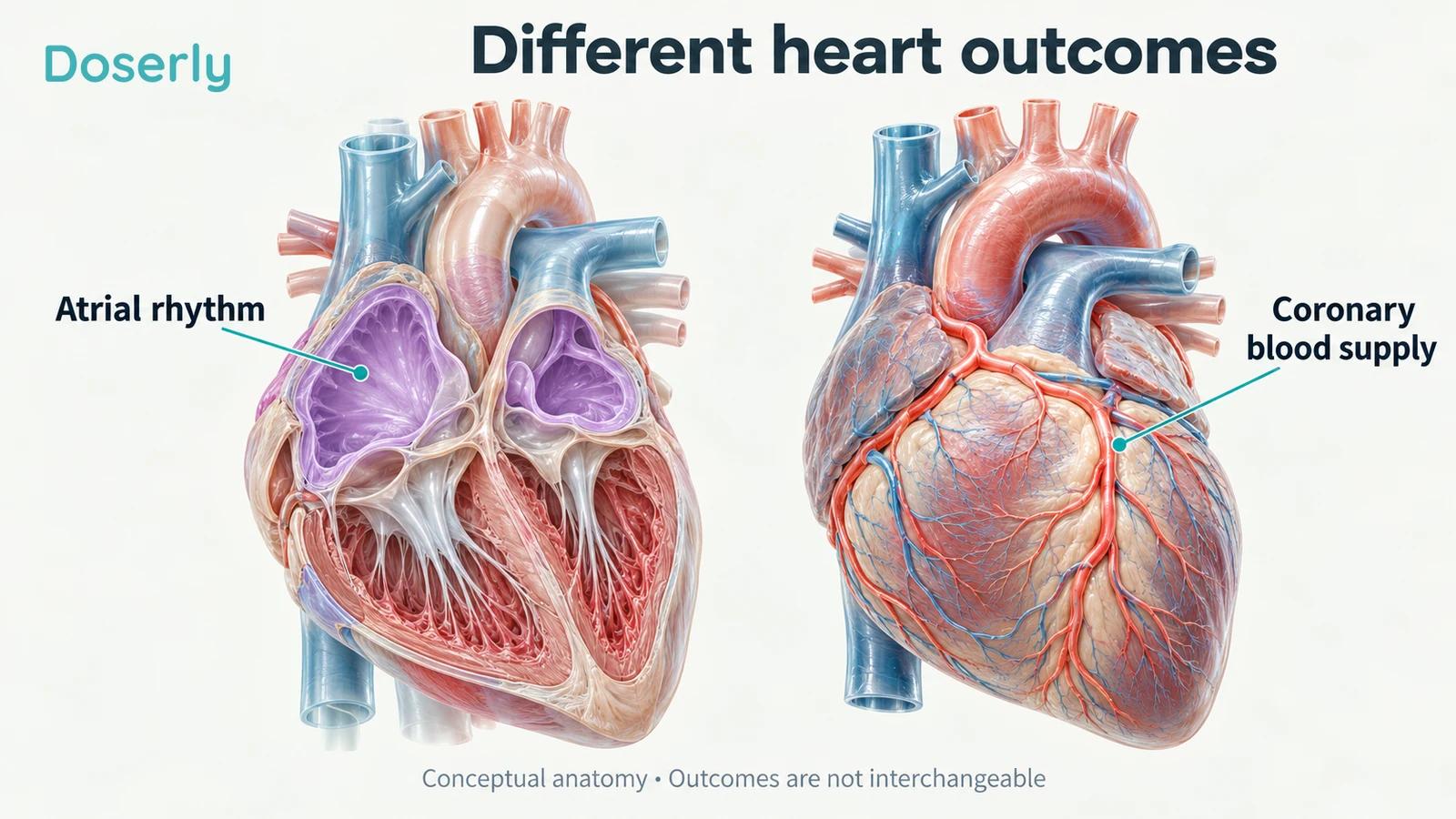
This was a meaningful regulatory update, but “the warning changed” does not translate into “every cardiovascular outcome is settled.” The rhythm findings remain part of the clinical evidence and appear in updated prescribing information.
Blood pressure also deserves its own monitoring plan. An average trial result cannot tell a particular person whether their pressure increased. A prescription can be appropriate while still requiring attention to an adverse effect or a newly recognized condition.
For the appointment, distinguish the question of whether TRT has an appropriate indication from the question of how to monitor it safely. A patient with confirmed deficiency and meaningful symptom benefit has a different decision context from someone pursuing an unsupported high target. Neither context makes a documented arrhythmia unimportant.
The newer database study strengthens concern, but cannot prove cause
A 2025 TriNetX analysis compared 117,908 cisgender men with hypogonadism who received testosterone with the same number of propensity-matched men who did not. Over five years, testosterone treatment was associated with higher AF risk: hazard ratio 1.27, with a 95% confidence interval of 1.22–1.32. Stroke and mortality did not differ in the reported analysis. Original study abstract
The size and contemporary clinical setting are useful. The study also examined transgender men in separate comparisons, which should not be combined with the hypogonadism cohort as though the populations were identical.
However, matching only balances recorded variables used in the analysis. Prescription decisions, health behavior, follow-up intensity, testosterone exposure and unrecorded disease can still differ. More clinical contact can also create more opportunities to diagnose an intermittent rhythm disorder.
A hazard ratio of 1.27 is not a 27-percentage-point increase in risk. Without the relevant absolute event rates and follow-up context, it cannot tell a reader their own chance of AF. The study adds evidence consistent with concern; it does not establish which formulation, concentration or dosing pattern is responsible.
Why an older Veterans study pointed in the other direction
A 2017 retrospective Veterans analysis included 76,639 men with low testosterone. Researchers compared men whose testosterone normalized with treatment, men treated without normalization, and untreated men. The normalized group had lower recorded AF risk than untreated men, with a hazard ratio of 0.79, and a smaller difference compared with treated men who did not normalize. Sharma and colleagues
This is important conflicting evidence, not something to hide because a newer study exists. It is also not a randomized trial of achieving a specific testosterone target. Classification partly depended on what happened after treatment began. Men who normalize may differ in adherence, follow-up, illness or other characteristics related to their future outcomes.
The result therefore does not establish TRT as an AF-prevention treatment. Nor can it justify increasing a dose until a number is “normalized” in order to protect the heart. That would convert an observational association into an intervention the study did not test.
The disagreement between datasets should make the conversation more precise. Ask about who was enrolled, how exposure was defined and how AF was detected before assuming that one headline cancels another.
A more recent conflicting cohort used TriNetX records from 57 health organizations, including 133,584 men after matching. Over three years, recorded AF occurred in 3.6% of TRT recipients and 4.0% of men without TRT, a reported risk ratio of 0.90. The paper appeared in the journal’s 2024 issue. Its authors reported no conflicts of interest. Blackwell and colleagues
This adds a negative counterweight to the 2025 database finding, but not a second randomized answer. Different enrollment periods, eligibility rules and treatment definitions can produce different cohorts within the same database. Electronic records can also miss events occurring outside participating services. The disagreement is a reason to examine each design, rather than treat “large database study” as a single category of proof. Neither result establishes that TRT should be started to prevent AF.
Natural testosterone levels are a different exposure
The ASPREE analysis published in 2024 examined testosterone and subsequent AF in older men. Among 4,570 participants, 286 developed AF over a median follow-up of 4.4 years. Higher testosterone categories were associated with more AF than a middle category after adjustment. Testosterone was measured; participants were not randomized to testosterone replacement. ASPREE hormone analysis
That distinction prevents a common mistake. A naturally higher baseline concentration can reflect a different biological and clinical setting from changing someone's concentration with a prescription. ASPREE's original randomized aspirin assignment does not make every later analysis of its participants a randomized hormone experiment.
The result adds to the question of how androgens relate to atrial biology in older men. It does not identify a universal safe upper testosterone level, and it cannot be used to calculate a dose reduction for someone on TRT.
Similarly, a low testosterone concentration can accompany obesity, illness or other conditions that also influence cardiovascular risk. An association with a hormone value does not automatically show that correcting the value corrects every associated risk. The treatment question requires treatment evidence.
What about studies that found no clear increase?
A 2024 systematic review and meta-analysis considered 106 placebo-controlled trials. Outside the major cardiovascular safety trial, the pooled AF estimate was not statistically significant, with an odds ratio of 1.44 and a wide confidence interval of 0.46–4.46. The review also found no clear difference in major adverse cardiovascular events. Corona and colleagues
The negative finding matters. It argues against presenting a uniform AF increase across all randomized research. But the wide interval also matters: it includes materially different possibilities. Smaller studies with few rhythm events do not necessarily have the precision to exclude an increase of clinical interest.
A meta-analysis can combine information, but it cannot make unmeasured episodes visible or make dissimilar follow-up schedules identical. A trial asking whether strength improves may collect arrhythmias differently from a cardiovascular outcomes trial.
Taken together, the research supports a balanced statement: TRAVERSE raised concern, later observational evidence is mixed, and the remaining randomized evidence has not precisely resolved the rhythm question. No well-established TRT-specific strategy has been shown here to eliminate AF risk by changing injection frequency or pursuing a particular laboratory target.
How a suspected episode is investigated
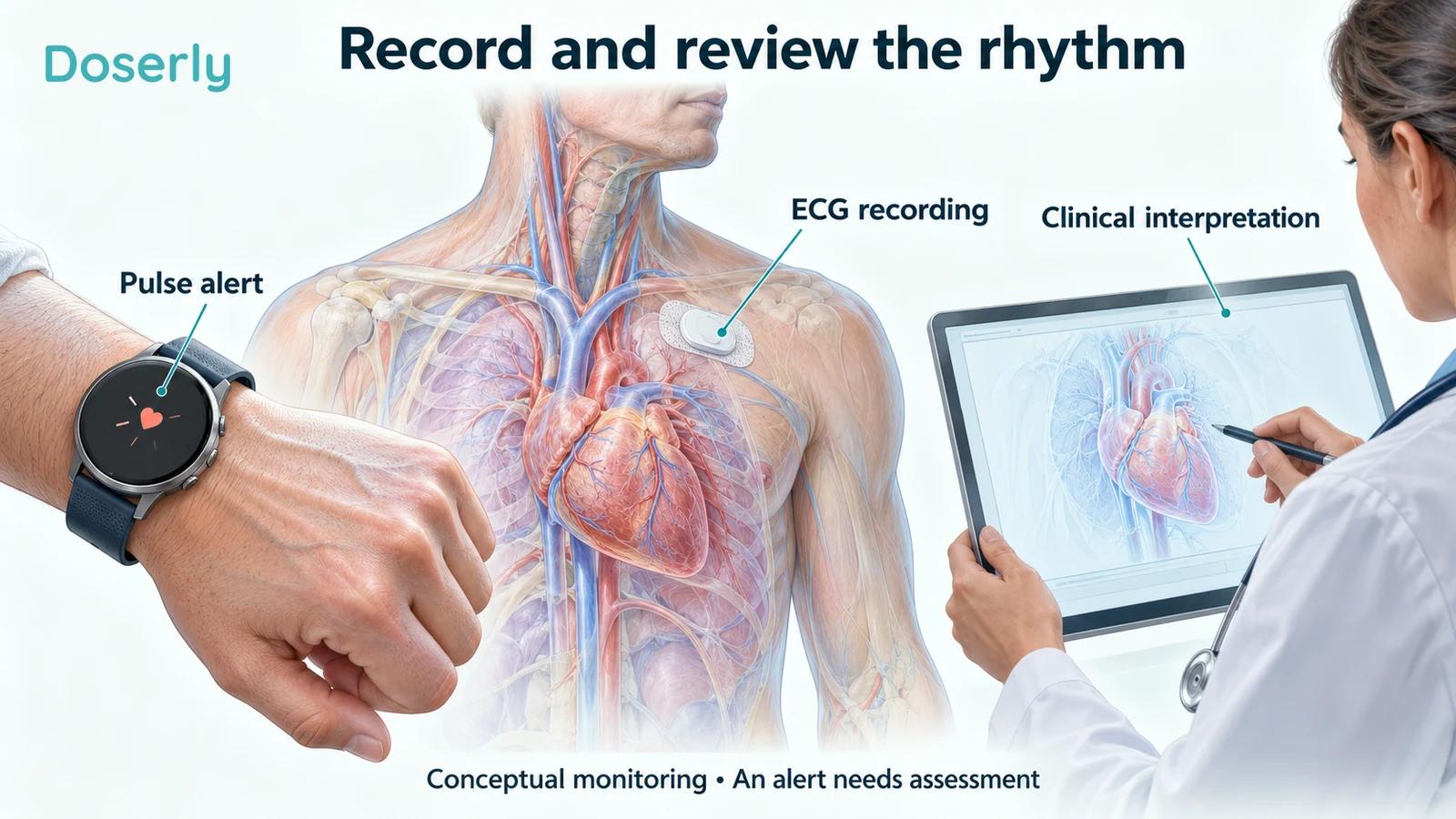
Diagnosis usually starts with history, examination and an electrocardiogram. An ECG records electrical activity at the time it is performed. If symptoms come and go, a clinician may choose a longer-duration monitor to improve the chance of recording an episode. Blood tests and echocardiography can help investigate contributing conditions and cardiac structure. NHLBI diagnostic guidance
The absence of an episode during a brief appointment does not necessarily settle what happened earlier. Record when symptoms began, their duration, what you were doing and whether they accompanied dizziness, breathlessness or chest discomfort. A saved device tracing may be useful if available, but symptoms should not be ignored while trying to obtain a perfect recording.
The testosterone timeline belongs in that history: initiation, formulation changes, prescribed dose changes and collection timing for recent tests. So do alcohol intake, illness, sleep problems and other medications. Recording several plausible contributors avoids turning every symptom after a prescription into proof that the prescription caused it.
The immediate purpose is to identify the rhythm and assess clinical risk. The prescriber and cardiac team can then decide how the hormone treatment fits into the larger picture.
A smartwatch alert is useful information, not the whole diagnosis
The 2023 US AF guideline recommends clinician visual interpretation of electrocardiographic signals for an initial diagnosis. Optical pulse-based alerts can help prompt an ECG, but are not by themselves sufficient to establish AF. ACC/AHA/ACCP/HRS guideline
The Apple Heart Study illustrates the distinction. Among more than 419,000 participants, 0.52% received an irregular-pulse notification. Of 450 notified participants who returned a later ECG patch, 34% had AF recorded. The delay and intermittent nature of AF mean this is not a simple statement that the remaining notifications were false. Apple sponsored the study. Original smartwatch study
That study assessed a detection pathway in volunteers; it did not show that buying a watch prevents strokes or that TRT users need a particular device. A wearable may supply useful documentation, while the clinical question remains what was recorded and how it should be interpreted.
Preserve the tracing or notification details rather than summarizing every alert as “my watch diagnosed AF.” This helps the clinician distinguish a pulse irregularity notification, a single-lead ECG classification and an actual reviewed recording.
What deserves attention beyond the testosterone prescription
Age, hypertension, obesity, sleep apnea, thyroid disease, alcohol exposure and structural heart disease can contribute to AF risk. Their presence does not prove the cause of an episode, but they can affect both the assessment and the plan. NHLBI causes and risk factors
Addressing those conditions is not a way to dismiss a possible medication effect. It is a way to avoid overlooking treatable contributors while the prescription is reviewed. For example, a person may have both a new rhythm diagnosis and previously unrecognized sleep apnea. Treating the situation as a debate about testosterone alone would miss part of their care.
Once AF is confirmed, stroke prevention, symptom control and management of the rhythm are distinct decisions. The guideline bases anticoagulation decisions on thromboembolic risk and clinical context; feeling fewer palpitations does not automatically remove that risk. Do not independently start aspirin or stop an anticoagulant because symptoms settle or TRT changes. US AF guideline
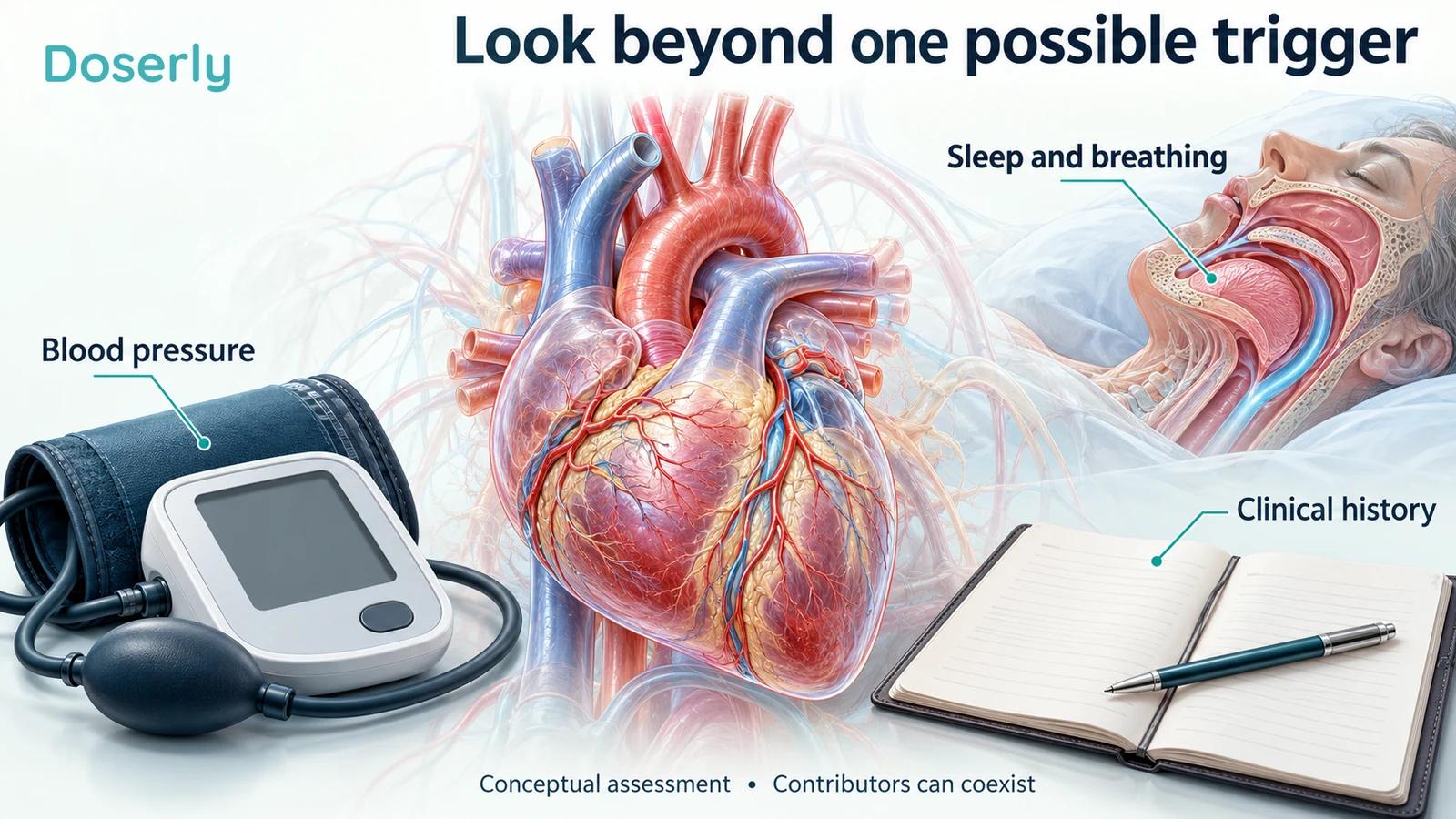
Conceptual review of contributing conditions. The objects identify areas for assessment, not a proven explanation for an individual's AF or a treatment protocol.
Bringing the evidence to a treatment decision
A productive visit can begin with three facts: why testosterone was prescribed, what benefit it has produced, and what rhythm has actually been documented. Then discuss whether the new findings change the balance of benefit and risk and which clinician will coordinate follow-up.
Ask whether the study population resembles your situation, whether your blood pressure and other risk factors are being monitored, and what symptoms should trigger urgent assessment. If a change in TRT is proposed, clarify the reason, the follow-up plan and how benefit or harm will be assessed. A change is more informative when it has a defined clinical purpose.
The available evidence does not support describing testosterone as either an AF-prevention drug or an inevitable cause of arrhythmia. It supports taking a new rhythm symptom seriously, confirming what is happening, and keeping the TRAVERSE signal visible within an individualized treatment discussion.